Monday, February 10, 2014

The Law of Unintended Consequences

I always read John Mauldin's weekly newsletter, and in one was a quoted passage that made me gasp in disbelief:

"In the economic sphere an act, a habit, an institution, a law produces not only one effect, but a series of effects. Of these effects, the first alone is immediate; it appears simultaneously with its cause; it is seen. The other effects emerge only subsequently; they are not seen; we are fortunate if we foresee them.


"There is only one difference between a bad economist and a good one: the bad economist confines himself to the visible effect; the good economist takes into account both the effect that can be seen and those effects that must be foreseen.

"Yet this difference is tremendous; for it almost always happens that when the immediate consequence is favorable, the later consequences are disastrous, and vice versa. Whence it follows that the bad economist pursues a small present good that will be followed by a great evil to come, while the good economist pursues a great good to come, at the risk of a small present evil."

– From an essay by Frédéric Bastiat in 1850, "That Which Is Seen and That Which Is Unseen"

I gasped, because I had two simultaneous thoughts:

1)  What a simple, commonsensical, yet ingenious remark.

2)  How can it be that Bastiat wrote this in 1850, and we still don't get it?

Good grief.


[Thanks to Impactedbygrace for this image.]


Labels: ,


Wednesday, December 17, 2008

Government Intervention Run Amuck No. 19: the SEC vs. Madoff

The Madoff scandal has the damaged investors looking for scapegoats--other than their own cupidity and Mr. Madoff himself, of course. Sooner or later the question had to be asked: Where was the SEC?

goat
[Thanks to Ca.uky.edu for the image.]

Now, goodness knows I am the last person in the world to defend the Securities and Exchange Commission. I don't know what there record is today, but in the 1980s one would have been hard-pressed to find a case where the SEC saved an investor a penny.

This may not be true today, I don't know. But what is certain is that they didn't do their job in the Madoff case, as Christopher Cox seems to be admitting publicly.

But is this really the SEC's fault? Yes of course it is; but it is also the fault of voters who elected the legislators who created the SEC in the first place.

Just like the FDIC, the SIPC, the PBGC, and (hiccup) now even the Federal Reserve, federal guarantee agencies can be grouped under the common heading "Lenders of Last Resort," a kind of national insurance policy for each risk involved (banks, brokerages, pension funds, and ... well, everything else).

The problem with national insurance policies is that, unlike private entities entering into any other venture, the government has no bottom line to manage.

A private insurance company would only insure risks it felt certain it could insure and survive. The government, on the other hand, insures whatever risks it thinks it must to protect the electorate, whether or not the government budget exists to pay for it.

This leads us to what economists call "Moral Hazard," where market players--who are not stupid--take into account the fact that what they are about to do is insured by the government, which allows them to take on more risk than they ordinarily would.

This backfiring of intent is a well-known phenomenon in economic research. For example, wearing seat belts actually causes more accidents because people feel safer and take more risks while driving. It distorts the incentives, as economists say.
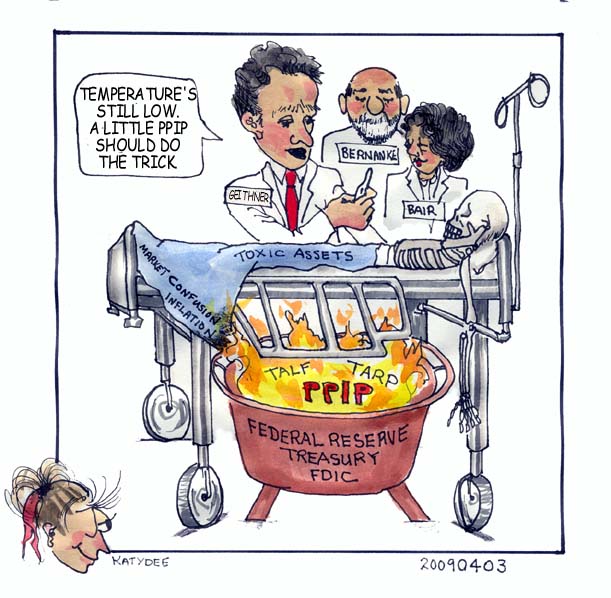
Thus the government that started out to be the protector of the consumer becomes a kind of Risk Devil, encouraging more risk-taking than is healthy, eventually guaranteeing havoc in the marketplace, creating its own program's ultimate failure, and harming the very constituents it intended to protect.

Government oversight may sound like a good thing; but it often ricochets. We might do well to abolish these entities and create in their stead citizen watch-dog groups that will use current legislation to police the bad guys but guarantee nothing and no one.
Read more about the hubris of the financiers who were hit by Mr. Madoff's game in this great piece by John Kay in the Financial Times today. Also, read how Madoff investors are looking for people to sue. It'll just be a matter of time before they decide to sue the SEC--which is us, by the way; and instead of abolishing the SEC, just watch: Legislators, responding to your demands, will strengthen it.

Good grief. We'll never learn.

Labels: , , , , ,


Saturday, September 13, 2008

The Ultimate Bail-Out

According to this piece of news from Qatar's news source The Peninsula, U.S. government officials are finding themselves in a squeeze.

They arranged the bail-out of Bear Stearns; then they nationalized Freddie Mac and Fannie Mae; now, they are surprised to see all eyes on them as Lehman Bros. flails in desperation.

help
[Thanks to Veronicabelmont.com for the image.]

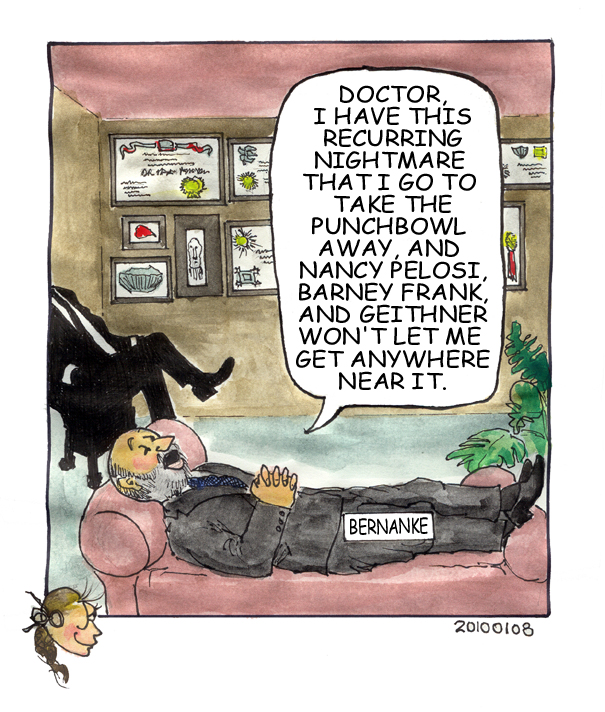
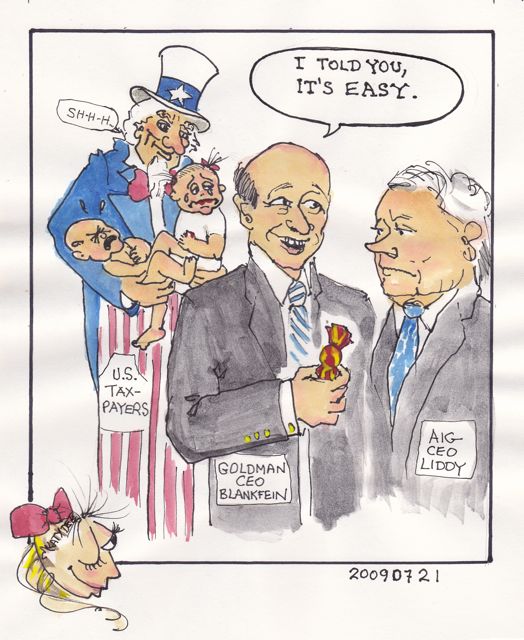
They will have to do something again. They have signaled to the world that they will not let these "too-big-to-fail" companies die, even though they deserve to. Moral Hazard has finally erupted into the monster everyone warned it was going to be.

Officials can argue until the last financial institution croaks that the monetary system could not have withstood the pressure; but all they have done is parcel out the torture. To borrow a friend's expression, it's like cutting off the tail of a dog one joint at a time to save him the pain of losing the whole tail at once.

When will we learn that politicians cannot control economies, that government intervention is guaranteed to run amuk every time?

In the end, the biggest bail-out of all time will be sponsored by us all, the U.S. taxpayers. The working stiffs, the employed, the self-employed, pensioners, the forgotten hords, even the people on unemployment--we'll all be paying for this down the line, when we are called upon to bail out our government for having gotten us into so much debt.

This story isn't over yet, my folks. Real estate hasn't bottomed out yet; companies are not hiring; investment has slowed; credit is still tight (as it should be after so much looseness). We will be paying the bill for this one for years to come.

Labels: , , , ,