Sunday, April 19, 2009

Government Intervention Run Amuck No. 20: Bank Intervention

My list of examples of the unintended consequences of government intervention in the marketplace gets longer and longer. This time, I'm going to point out the latest irony: Investment banking's profitable last quarter.

oops
[Thanks to Thevoiceforschoolchoice.wordpress.com for the photo.]

This would be wonderful news if it were genuine, but looking a little deeper reveals the truth. First, in one of Barron's feature articles by Andrew Bary, we learn about a little-discussed fact: Goldman Sachs has only been able to issue low-cost debt due to the backing of the FDIC through a program called the TLGP, or Temporary Liquidity Guarantee Program.

I suppose this program is no secret, but somehow it had escaped me that Goldman, JP Morgan, Morgan Stanley, and others are relying heavily on it to survive, at the same time as they are declaring profits and claiming that they want to return the TARP money in a show of strength. In fact, it's all show and no strength when you look at the facts.

Here's another thing that raises my cockles. Goldman has stated first quarter earnings as $1.8 billion. As Alan Abelson points out in his weekly Up & Down Wall Street column, Goldman's profit statement all but ignores results for December because of a fluke fiscal-year switch. "Goldman lost some $780 million in December," says Abelson. This brings the four-month profit down to $1.02 billion, which is still respectible; but somewhere else in Barron's (I can't find it now) we learn that Goldman made most of that profit through a risky bet on bond futures.

Isn't risky betting what got us into this mess? And aren't firms like Goldman now gambling with our tax dollars? Aren't we rewarding and encouraging the very behavior that helped get us where we are today? And is there any guarantee that they will make good bets (with our money) in the future? Shouldn't these people be market-dead?

Abelson conjectures, furthermore, along with his source Zero Hedge, that some of Goldman's $1.8 billion profit may have come from payments by AIG, who "'gifted the major bank counterparties with trades which were egregiously profitable to the banks.' This would largely explain, according to Zero Hedge, why a number of major banks actually, as they claimed, were profitable in January and February. But the profits, it is quick to point out, are of the one-shot variety, and ultimately, they entailed a transfer of money from taxpayers to banks, with AIG acting as intermediary."

My free-market instincts have always told me to hold onto my resentment of big bonuses and the new divide between the rich and the "middle class," as illustrated in the supplementary section to this weekend's Wall Street Times, with glossy pictures of dozens of fabulous mansions for sale around the country. And echoing my own sentiment, Gregory J. Millman chides me in his Barron's piece this weekend, "let's not go ape about fairness." He's right--or he would be, in a free-market society.

But Mr. Millman, this market isn't free and hasn't been for decades. How can we talk about free market when the banking barons are divvying up our hard-earned tax money, thanks to the largesse of those who didn't earn it, our legislative representatives? How can we talk about fair competition when the playing field is rigged in favor of the big boys, and the small businessmen and women just have to suck it up when they learn from their subsidized bank that they can't have any of the handouts? How can we talk about a deflationary correction, elimination of the unhealthy business models, and a return to saner plain-vanilla banking, when our legislators continue to reward foolhardy risk-taking?

We're headed in the wrong direction. More limited government is the answer, not bail-outs of bankers who should be dead by any Darwinian-Schumpeter standard; not Treasury-instigated bank "stress tests" that will soon go bang in the night, raining multiple unintended consequences; not back-room cronyism in the name of "saving the system."

Labels: , ,


Sunday, March 01, 2009

Nationalization, By Any Other Name

The word "nationalization" has put fear and trembling into the American marketplace, and understandably so. It rings of socialism, of the European model, of the Third-Way progressive compromise. It's the death knell of the American form of free-market capitalism that is the foundational pillar beneath our symbolic hegemony over the rest of the world.

Apparently our current administration and its Congress don't believe this for a minute, because they haven't yet caught onto the fact that the word needs more than just denial; it needs replacement.

So far, they have been very quick to grasp the emotional impact behind words, to wit their choice of name for their stimulus package, The American Recovery and Reinvestment Act of 2009. We all know that this latest effort is really The Wild Attempt to Save Our Butts From Depression Act of 2009, but to use such blatant language would be ... well, depressing. Our savvy legislators know this, so they found a nicer name for it.

In the same vein, I wonder why no one has yet come up with the suggestion that our government's bailout actions--looking more and more like nationalization--be renamed something more palatable, rather than simply denying that nationalization is what's going on.

Let's take the example of Citigroup. So far, the government:

1. Has pumped billions of taxpayer dollars into their finances to avoid its collapse;

2. Will convert some $25 billion of preferred shares to common stock, effectively diluting existing shareholders' stake by 74%;

3. Has discussed "whether to require the removal of Citigroup Chief Executive Vikram Pandit" but decided that it is "impracticable to oust him" mainly because there's no one to replace him;

4. Is forcing the replacement of every Board member;

5. Is watching every move Citi makes, and management is trying desperately to mind their Ps and Qs.

(Source.)

If that isn't nationalization, I'm not sure what the word means.

Webster's relevant definition is:

"2. to transfer ownership or control of (land, resources, industries, etc.) to the national government"

So let's stop kidding ourselves. A rose, by any other name.... But wait. In fact, as any politician knows, Shakespeare was wrong. You can change the scent of a rose; all you have to do is call it something else.

So instead of watching the public wallow in self-pity as the US government denies nationalizing Citigroup, they need to find another name for it. Something "du jour," something we can empathize with and latch onto.

How about "recycling"? After all, isn't that what we do with smelly trash these days? We pull out what is useful, save it, and bury the rest. The government has no intention of "nationalizing" Citigroup; they simply want to carve out the rot and sell what's left back to its private shareholders, right? So let's not hear this "n" word anymore.

recyle
[Thanks to Ncdc.gov.uk for the photo.]

Labels: , , ,


Sunday, February 22, 2009

We're In For The Long Haul, In Spite of the Stimulus

Barron's has an article by Alan Abelson that expresses my sentiments better than I could today. Here's the crux:
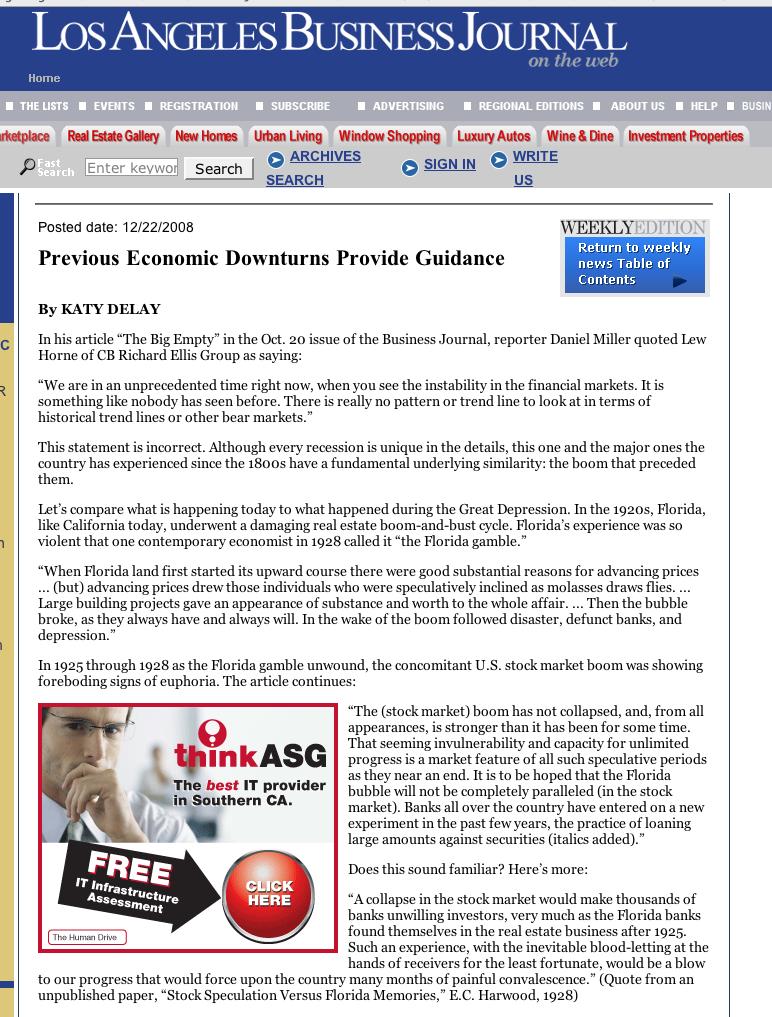
"House prices, in our bloodshot view, have another 20% or so to fall before hitting bottom and, at the earliest, we're talking sometime next year. And, possibly more important, a meaningful brightening of the current, profoundly bleak jobs picture, isn't in the cards for certainly as long, if not longer."

A sad assessment of affairs, with which I agree.

sad
[Thanks to CDIN.org for the touching image.]

He bases this conclusion on a study by ISI Group (not web-accessible) and its two charts that really tell the picture like nothing else I've seen recently. They can be found on the second page of his article. They are (1) the ratio of house prices to rents, and (2) the median house price divided by median family income.

Both of these long-term lines, drawn from 1975 or before to date, demonstrate with stark clarity that house prices are still on the high downside slope of this bubble.

A majority of people believe that government intervention of the kind our legislators have just put in place can stop this "drop" (read "re-normalization") of housing prices. But this legislation has a good chance of missing the mark, at least as far as arresting housing price falls is concerned. As Abelson says:

"While fewer foreclosures are likely to slow the rate of decline, they won't reverse the downtrend or determine 'where homes prices end up.' ... [G]iven the remorseless rise in unemployment, which, if anything, is destined to accelerate in the months ahead, the simple fact that so many people are too strapped to afford to buy a home, is, we believe, the most formidable barrier to even a tepid housing recovery."

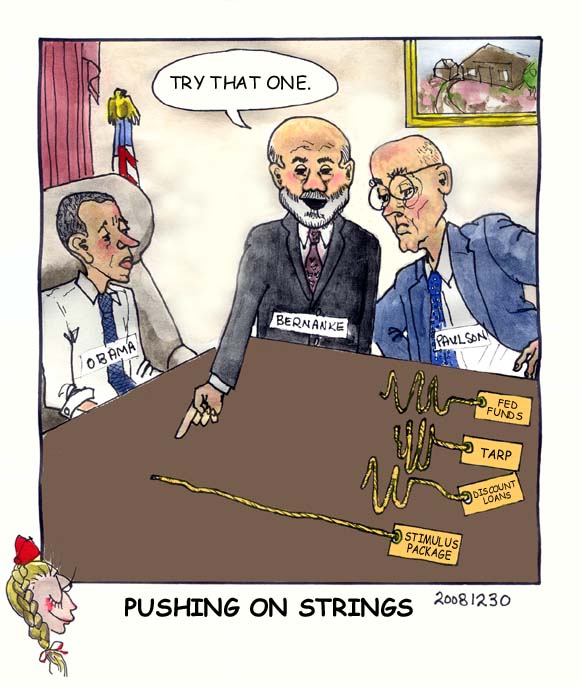
Right on. It's called pushing the string. (See my cartoon on this subject.)

And frankly, I think it would be criminal to deprive us of the benefits of lower prices, whether it be for food, gas, or housing. Lower prices enrich us all.

Personal footnote: I am a commentator, not a researcher. I do not claim to have a Ph.D. in economics. For those readers who would like the academic nuts and bolts under my skepticism, start here, here, here, and here. You will find the deeper research papers accessible on other pages of their website.

Some may object that all of these come from the same think tank, Cato, with its libertarian-oriented research team. This is true. I happen to follow their reasoning on most subjects, having yet to come across a more "progressive" reasoning that can hold a candle to it.

Academics can provide us with some very useful thinking and writing, but they don't have a monopoly on logic. There are many non-academics who have contributed valuable work. There are also academics who have steered us astray. Here are some examples of both:

A few non-academic leaders: Henry George, Mark Twain, Bill Gates (honorary doctorates only), and Benjamin Franklin, to name only four.

Academics who should have had more humility: Robert C. Merton and his economics Nobel Prize partner at LTCM, Myron Scholes; and Margaret Mead, to name only three.

Labels: , ,


Thursday, February 19, 2009

Let Those on the Floor Speak

The country is very divided now about whether or not the "stimulus package" will work. I have already expressed my opinion that it will not, provoking much heated debate among my commentators. I'll be adding more gas to that fire soon.

Meanwhile, I found out today that I'm not the only one who's frustrated with the American people's lack of understanding about the economics underlying the Keynesian spending, government intervention, and wholesale destruction of free-market values (e.g. respect for contracts) that will soon be taking place, the likes of which we have never seen to this degree before, ever.

Listen to these people who have their ear to the ground, the traders in Chicago:

Chicago Traders Video

It's heartwarming to see that there is someone else out there who gets it, even though I can already hear the retort: "But those guys are Wall Street, or the equivalent. They're the bad guys."

It looks like Ben Franklin and the others will continue to spin for a very long time, while Mr. Marx chuckles with glee.

spinningcorpse
[Thanks to Nightviewproductions.com for the image.]

Labels: , ,


Wednesday, December 17, 2008

Government Intervention Run Amuck No. 19: the SEC vs. Madoff

The Madoff scandal has the damaged investors looking for scapegoats--other than their own cupidity and Mr. Madoff himself, of course. Sooner or later the question had to be asked: Where was the SEC?

goat
[Thanks to Ca.uky.edu for the image.]

Now, goodness knows I am the last person in the world to defend the Securities and Exchange Commission. I don't know what there record is today, but in the 1980s one would have been hard-pressed to find a case where the SEC saved an investor a penny.

This may not be true today, I don't know. But what is certain is that they didn't do their job in the Madoff case, as Christopher Cox seems to be admitting publicly.

But is this really the SEC's fault? Yes of course it is; but it is also the fault of voters who elected the legislators who created the SEC in the first place.

Just like the FDIC, the SIPC, the PBGC, and (hiccup) now even the Federal Reserve, federal guarantee agencies can be grouped under the common heading "Lenders of Last Resort," a kind of national insurance policy for each risk involved (banks, brokerages, pension funds, and ... well, everything else).

The problem with national insurance policies is that, unlike private entities entering into any other venture, the government has no bottom line to manage.

A private insurance company would only insure risks it felt certain it could insure and survive. The government, on the other hand, insures whatever risks it thinks it must to protect the electorate, whether or not the government budget exists to pay for it.

This leads us to what economists call "Moral Hazard," where market players--who are not stupid--take into account the fact that what they are about to do is insured by the government, which allows them to take on more risk than they ordinarily would.

This backfiring of intent is a well-known phenomenon in economic research. For example, wearing seat belts actually causes more accidents because people feel safer and take more risks while driving. It distorts the incentives, as economists say.
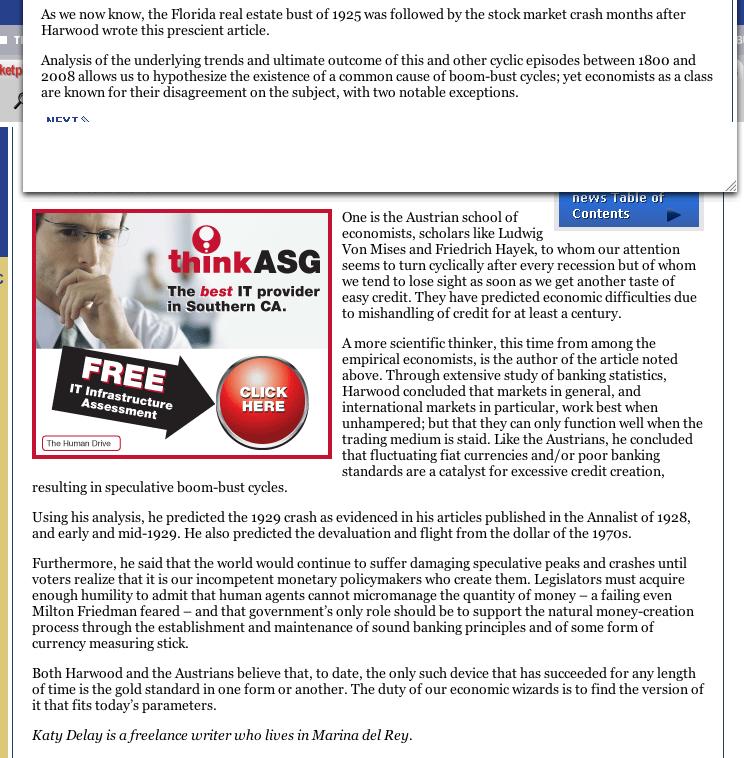
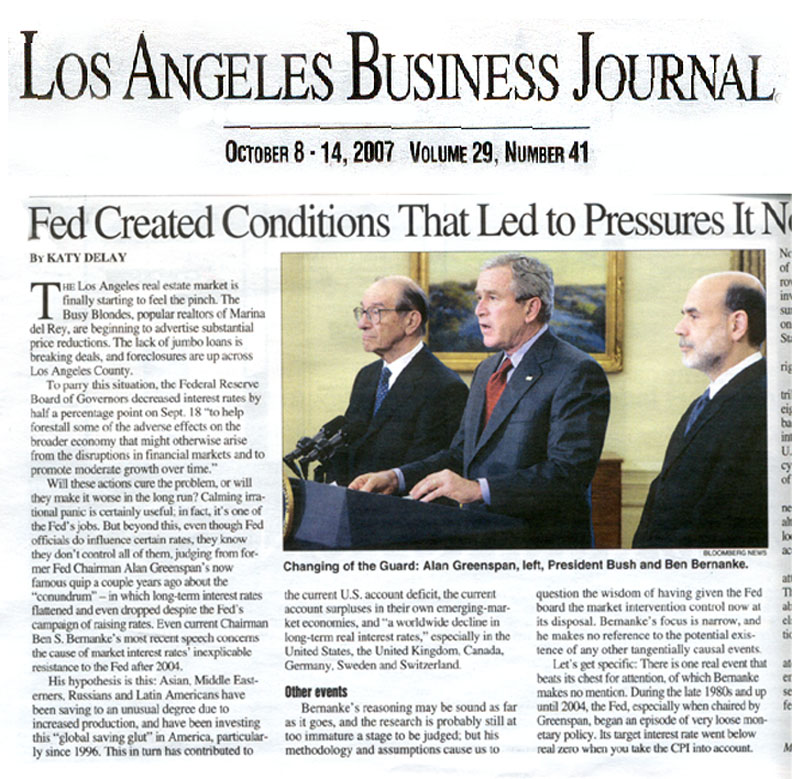
Thus the government that started out to be the protector of the consumer becomes a kind of Risk Devil, encouraging more risk-taking than is healthy, eventually guaranteeing havoc in the marketplace, creating its own program's ultimate failure, and harming the very constituents it intended to protect.

Government oversight may sound like a good thing; but it often ricochets. We might do well to abolish these entities and create in their stead citizen watch-dog groups that will use current legislation to police the bad guys but guarantee nothing and no one.

Read more about the hubris of the financiers who were hit by Mr. Madoff's game in this great piece by John Kay in the Financial Times today. Also, read how Madoff investors are looking for people to sue. It'll just be a matter of time before they decide to sue the SEC--which is us, by the way; and instead of abolishing the SEC, just watch: Legislators, responding to your demands, will strengthen it.

Good grief. We'll never learn.

Labels: , , , , ,


Tuesday, November 11, 2008

The 2008 Bailout: The Pandora's Box of All Pandora's Boxes

If there ever was a Pandora's Box, the Big Bailout of 2008 has to be it.

Pandora's Box
[Thanks to 2highfestival.com for the image.]

How did we get here?

After a difficult time in the early 1900s, we began our drift away from sound monetary and banking policy by turning towards government for the prevention of business cycles.

We thought we were doing the right thing in creating the Federal Reserve. Since then, it has evolved into the monster it is today.

It started as a tool for maintenance of the stability of the banking system, but it has become the all-knowing, all seeing Poobah-Controller of the Issuance of Purchasing Media, in the place of what we had back then, the gold standard. In fact, we've gotten so far away from this standard that we officially abandoned it in 1971.

Today, it is increasing clear that the Fed has no real control of the money-creation process. Meantime, Congress has decided to come to the rescue of one failing institution after another, most recently General Motors. Ford and Chrysler will not be far behind.

Where will it end? How will this turn out?

No one knows; and the more the government messes around with this, the murkier the future becomes.

We are already in a good recession (see the statistics of the American Institute for Economic Research), and it may start out to be deflationary. But our leaders will not let price deflation happen. They will pump as much credit into the system as they think they need to keep prices and the economy stable. After all, that is their mandate. (See what I have to say about their mandate here.)

Yet deflation enriches us through lower prices. (It also means reducing the supply of purchasing media, but that's a separate story. See my discussion of this definition confusion.) If prices were to decrease, we would all be better off. For example, do you prefer the price of tuna fish at $3.99 a can, or $2.99? Duh.

Deflation (i.e. lower CPI) is not bad in and of itself. What is bad is what usually accompanies deflation. In most deflationary episodes we have recession and/or depression: Bankruptcies, decreased consumption, loss of jobs, stock market losses, bank closures.

But the Fed is forgetting that by "curing" the symptom of recession (i.e. by stopping price deflation) they are not necessarily curing the cause of that recession.

To cure this recession, Congress must allow the market to rid itself of a century of inflation. That can only be corrected through a deflationary process, even if it means we must undergo some recession. If the Fed and the Treasury try to keep it from happening, they will maintain the distortion of inflation instead of allowing it to cure itself.

What method will they use to accomplish this? They will try their darnedest to prevent deflation/recession/depression by turning on the printing presses (issuing fiat currency and credit) to whomever needs it the most, or cries the loudest, or threatens to close. They have borrowed billions, and created billions, in this effort. Where will it stop, now that the presses are running full speed?

Businesses are quickly learning that they must start screaming for cash. The cash is available. First come, first served. Yet by continuing the inflationary process and handing out cash, our own elected officials are fleecing us on a daily basis.

They will fund these bailouts with the raises we will not get, with the value we are losing on our houses, with the pension investments we bought at inflated prices and that have vanished.

Our salaries are now in negative growth, banks steal our savings every day through poor interest remuneration (they get cheaper money from the Fed), and our social security incomes and pension allotments are not keeping pace with the CPI. As my Dad used to say, "Stand still, little lambs, to be shorn." (For more about him, see my last post.)

In the longer run (when, I don't know), we the people must reject these shenanigans and turn to gold as a refuge against government destruction of the monetary units of the world.

That's the day Pandora will close her box. I hope I live long enough to see it happen.

Labels: , , , , ,


Sunday, September 21, 2008

America's New-Found Socialism: The Mother of All Government Interventions

I have been having fun over the last few months citing examples of government intervention run amuck. This weekend, I think we've hit the motherload.

Hank Paulson has become the new symbol of American socialism at work. He, with the help of his colleagues Ben Bernanke and some legislators, has become what some are labeling the "bail-out tsar."

tsar
[Tweaked image taken from Wikepedia.org, who got it from Rossia.org]

The French leftist newspaper Liberation is labeling our country, once the symbol of the free market, the USSRA: United Socialist States of the Republic of America.

Yes, the free-market pretense seems to be over, folks. The chips are now on the table. Whatever happened to the so-called "Reagan Revolution"?

As one congressman describes it in a citation pulled from MarketNews International by Prudent Bear:

"U.S. Senator Jim Bunning today issued the following statement regarding the Treasury Department's bailout of Wall Street. ‘Instead of celebrating the Fourth of July next year Americans will be celebrating Bastille Day; the free market for all intensive purposes is dead in America. The action proposed today by the Treasury Department will take away the free market and institute socialism in America.'"

This would be true if it weren't for the fact that we've been creeping toward socialism since the First World War. This latest is only the most recent leftist push.

I suppose there is a slight chance that Paulson--who does know investment banking--might have played the taypayers' hand well. By this I mean that there may be a tiny possibility that the toxic waste he will be buying for us (if Congress gives him the power he seeks) could in the long run be worth more than the taxpayers will pay for it.

But why is it that I just don't believe that? Well, a look back at history tends to substantiate that whenever the government intervenes into the market, it mucks it up. It's just a rule of thumb. Why should this case scenario be any different?

(Don't sell your gold yet.)

Labels: , , , ,


Saturday, September 13, 2008

The Ultimate Bail-Out

According to this piece of news from Qatar's news source The Peninsula, U.S. government officials are finding themselves in a squeeze.

They arranged the bail-out of Bear Stearns; then they nationalized Freddie Mac and Fannie Mae; now, they are surprised to see all eyes on them as Lehman Bros. flails in desperation.

help
[Thanks to Veronicabelmont.com for the image.]

They will have to do something again. They have signaled to the world that they will not let these "too-big-to-fail" companies die, even though they deserve to. Moral Hazard has finally erupted into the monster everyone warned it was going to be.

Officials can argue until the last financial institution croaks that the monetary system could not have withstood the pressure; but all they have done is parcel out the torture. To borrow a friend's expression, it's like cutting off the tail of a dog one joint at a time to save him the pain of losing the whole tail at once.

When will we learn that politicians cannot control economies, that government intervention is guaranteed to run amuk every time?

In the end, the biggest bail-out of all time will be sponsored by us all, the U.S. taxpayers. The working stiffs, the employed, the self-employed, pensioners, the forgotten hords, even the people on unemployment--we'll all be paying for this down the line, when we are called upon to bail out our government for having gotten us into so much debt.

This story isn't over yet, my folks. Real estate hasn't bottomed out yet; companies are not hiring; investment has slowed; credit is still tight (as it should be after so much looseness). We will be paying the bill for this one for years to come.

Labels: , , , ,


Saturday, September 06, 2008

Freddie and Fannie Bail-Outs: The Denouement

You may recall my Example No. 17 of government intervention run amuck. I told you about the mess in which our mortgage industry finds itself, helped by our semi-governmental agencies, Freddie Mac and Fannie Mae.

We now have this piece by Deborah Solomon and Damian Paletta at the Wall Street Journal, giving us an update of their situation.

bail
[Thanks to Tootstubing.com for this image.]

The bail-outs keep coming in this financial saga, and Freddie and Fannie will be no exceptions. A few months ago, Teasury Secretary Henry Paulson obtained our permission (through Congress) to bail them out, and apparently he didn't do it for nothing.

So now we have Government Intervention upon Government Intervention, both now running amuck in tandem. Not only was the very creation of these two organisms unwise, as I explain in my earlier post linked above; but now we have one more in the string of wrongs that government officials are having to commit in their effort to right the original one. To wit:

"Mr. Paulson's push to win authority was meant to reassure investors that the government wouldn't allow Fannie Mae and Freddie Mac to fail. But some believe it ultimately forced Treasury's hand. The federal government's involvement complicated the companies' already-difficult task of raising capital through the sale of common or preferred shares. Investors were leery of buying either while the government's intentions were unknown, because they feared the newly issued shares might become worthless as the result of federal action."

And look for more wrong runnings-amuck from this problem. For example, here's one I can see from a mile away:

"Among the issues with which Treasury has been wrestling is whether to make an investment at such a low price that shareholders are effectively wiped out. Mr. Paulson is cautious about any plan that appears to benefit shareholders because he doesn't want the government to be seen as bailing out investors who for years profited from the companies' success."

Bloomberg also gives their version of this news.

Ah, it would all be so entertaining if it were fiction.

Labels: , , ,


Wednesday, August 06, 2008

Freddie & Fannie: Off With Their Heads

Cato usually gets it right, and William Poole has done it again.

He tells the story of Freddie and Fannie like it is in this latest article appearing recently in the New York Times. His recommendation: Get rid of 'em.

Alice
[Thanks to VictorianWeb.org for the image.]

He's right: Freddie and Fannie have been government entities from the start, even though they were "privatized." The federal guarantee simply went underground for those years.

Just the other day, private investors of Freddie and Fannie "convinced" Congress to admit that the guarantee was valid and made them sign on the dotted line--with your and my "pen" (read "money"), of course.

So this is the denouement of my recent blog post. Therein, I described an example, among many, of government intervention run amuck, where good intentions have dire consequences--a frequent occurrence where government is involved.

In this case, Freddie and Fannie have, in essence, been nationalized.

Who said the US was not a socialist country?

Here's another viewpoint by Gerald P. O'Driscoll, Jr., also of Cato.

Labels: , , , ,


Friday, June 13, 2008

France To Subsidize Gasoline (Government Intervention Run Amuck No. 18)

Just when you thought French President Sarkozy's government was getting things right, you learn something like this:

Francois Fillon, the Prime Minister, announced last night that the government will help all wage earners meet the rising cost of gasoline through a direct paycheck subsidy.

Fillon
[Thanks to EnjoyFrance.com for the photo.]

To quote an article published at the French TF1 TV website:

"Francois Fillon announced a 'direct subsidy' for all wage earners to help them meet the rising cost of their commute to work, and he asked that all the social partners [the powerful French unions] come to agreement on the conditions surrounding this transfer." ... "The Prime Minister chose the method of a direct payment that would appear on the paystub of salaried workers." ... "The conditions to receive the subsidy should include the impossibility of using some form of public transport."

(At the same time, he announced the development of plans for new nuclear facilities, a more practical solution. France is way ahead of the U.S. in this domain.)

Recently, France and other European countries have suffered a number of trucking stoppages and public unrest due to the high cost of gas.

Remember that the social system of many European countries needs to be fed regularly, and a good bite comes out of the French gas budget in the form of taxes; so right now a French worker pays almost $10 a gallon, and large transport companies are suffering even more there than here.

Subsidizing gasoline for commuters is:

(1) Robbing Peter to pay Paul (i.e. taking tax money from the truckers and from all consumers and giving it back to some consumers);

(2) Encouraging consumers to buy more gasoline thereby upholding the demand level even at these unprecented prices;

(3) Placing an additional burden on the already heavily indebted French social economy; and

(4) Using counterproductive measures from an economic standpoint, because when high prices don't result in a lessening of demand, the high prices continue (even if the measure is "productive" in the sense that it calms voters' ire).

On a more positive note, hopefully all those gallon-dollars and euros will end up encouraging production and expansion of the energy industries, provided that they don't think this price spiking is an effect of speculation alone (and there is debate about this on all sides).

So you have here a double-whammy of messy government intervention:

- Bubbles in commodity prices probably are caused at least in part by interventionary and loose central bank monetary policy; and

- These efforts to calm the masses through hand-outs that strain public budgets will only be palliative and most likely will backfire.

Good grief. What a mess.

Labels: , , , , ,


Thursday, June 12, 2008

Odd Ducks Freddie and Fannie: Example No. 17 of Government Intervention Run Amuck

"...[T]he vast majority of mortgage securities sold in the last six months" were offered by Fannie Mae and Freddie Mac, semi-public enterprises that are neither ducks nor geese, human nor animal; i.e. neither totally public nor private corporate entities. (Source.)

hybrid
[Image thanks to Patricia Piccinini, an Australian sculptress, through About.com]

The Legislature created them in the 1930s and 1970s in order to help people of modest means acquire their own home; but--and this is typical of government well-meaning ventures of this type--the latest mortgage crisis has revealed that many of the people who obtained loans over the last four or five years should never have passed through the financial screening process from a banking point of view.

Yet still the impractical goal holds the minds and wills of our legislators today:

"'I want these companies to help with affordable housing, to help low-income families get loans and to help clean up this subprime mess,' said Representative Barney Frank, a Massachusetts Democrat and the chairman of the House Financial Services Committee. 'Otherwise, why should they exist?'" (Source.)

Excellent question, especially when one realizes that Freddie and Fannie were two of the originators of "this subprime mess" (among others).

Both organisms get most of their funding from the public sale of shares, but the line to the government purse is in place, "just in case." This dual line of financing is at once their saving grace and their Achilles Heel, because management has to please two benefactors.

Unfortunately, however, there is a golden rule that says, “No one can serve two masters, because either he will hate one and love the other, or be loyal to one and despise the other." (Luke 16:13).

In trying to please both, Freddie and Fannie have take on a precarious amount of leverage (i.e. they have borrowed way over their credit limit). The market allowed them to do this because of their seeming immunity to the effects of negative market forces, which immunity springs from their position as semi-governmental agencies. The government allowed them to do this because of their above-mentioned goal.

Both companies are about to face a crisis based upon this double role they have been trying to play. They may surmount it; but to do so they may have to dip into our tax money if their regular private sources of capital dry up.

I would hate to be in their CEOs' shoes over the next few months.

Here are two easy-to-read links that will inform you of the situation:

This Wall Street Journal article from today's paper; and

This nice graphic from an earlier New York Times piece.

There's another golden rule that we the voting public may learn in due course: When governments intervene in the marketplace, unintended forces will evolve, and they often run amuck of even the best of intentions.

Labels: , , , , ,


Wednesday, May 14, 2008

The Wealth Gap: Let's Not Rush to Judgment

If it weren't for the fact that the article is well written, I'd have to describe Thomas Frank's editorial in the Wall Street Journal as more than a little irksome.

I don't deny him his (or actually Steven Greenhouse's) statistics about the growing wealth gap in this country.

elephantmouse
[Thanks to Upali.ch for this image.]

What I dislike is his unfounded leap to a conclusion as to its cause.

Both Frank's editorial and Greenhouse's The Big Squeeze are about the impoverishment of the American worker majority and the enrichment of the power class minority; and both works are probably good reads. However, both writers are more journalistic than scientific in their analysis of the causes of this situation. (Too bad we have to use "journalistic" as an antonym of "scientific," but that's just the way it is in many cases including these.)

Frank sees the evil as emanating from classical economic principles as empowered by the Reagan Republicans. Greenhouse points his finger at the same politicians' destruction of the working class's labor movement.

In other words, both writers are probably progressive Democrats and believe in equality of riches, as contrasted to equality of opportunity in the more strict Constitutionist sense.

I don't deny the growing gap and I don't pretend to have the right answer; but before we assume either of these thinkers is correct, here are a few suggestions that might deserve some equal time under the reader's microscope:

1. What about the world central bankers' mismanagement of the monetary units, which mismanagement some believable economists blame for: (a) our current credit and mortgages crises, (b) the huge imbalances in trade and sovereign reserve accounts, and (c) for the erosion of everyone's purchasing power and of the real wages of the majority of working people? These economists believe that our purchasing power should have exploded over the last century, but instead the money mis-managers have siphoned it off to the wealthy speculators and encouraged us all into an unhealthy degree of debt.

2. Going back even further, what about the de-standardization of the currencies? The value of our money used to be established by law to be equal to a specific amount of gold and/or silver but became equal to whatever governments, government agencies, and markets decided they would be worth via fiat. History does not treat this kind of monetary de-standardization kindly. It has always led to dissatisfaction and disruption of social order.

3. Then there's also the increasing centralized government power in this country that has opened up the Pandora's Box of legislative intervention into every sector of our life. (See my "Government Intervention Run Amuck" series of posts over the last few months, which give only a sampling of the damages done.)

Just food for thought, before you jump along with Frank and Greenhouse into a tidal wave of emotionally appealing but premature and illegitimate conclusions.

Labels: , , , , ,


Tuesday, May 13, 2008

Government Intervention Run Amuck No. 15: Social Security Disability Insurance

Today's commentary at the American Institute for Economic Research (the only truly unbiased economic research program I know of) gives us another great example of the unintended consequences of government intervention, even if the legislators' intentions were good--or at least innocent--at the inception.

The number of people receiving disability insurance has increased way above what the statistics should be, leading us to conclude that:

When you put out the bird feeder, the birdies will come.

birdfeeder
[Thanks to Ladybuggiftstore.com for the photo.]

Labels: , , , ,


Monday, May 12, 2008

Government Intervention Run Amuck No. 14: Barney Frank

Barney Frank takes the cake as an example of government's mucky intervention.

whatamess
[Thanks to Funnydog.net for the photo.]

Today's Wall Street Journal editorial on the Legislature's latest effort to intervene in the housing markets reveals just how far the nation has progressed towards interventionnism.

I hope Bush has the sense and courage to veto this one.

Here are a few citations of the terms of Mr. Frank's proposed new laws:

"If both borrower and lender agree to participate, lenders can accept 85% of the current appraised mortgage value and in return get to dump up to $300 billion of those loans on the Federal Housing Administration (FHA)." [And who pays the bill for that? Why, you and I, of course.]

"'If we see a widespread refusal on the part of servicers to cooperate voluntarily in what we see as an important economic problem . . . they can expect much tougher regulation in the future.' And they called Tom DeLay 'the Hammer'?" [I guess blackmail is the new Congressional tool.]

"State governments receive authority to issue $10 billion in tax-exempt bonds to subsidize home purchases and to help subprime borrowers refinance." [Sure. Give 'em some more money so that they can keep that house they can't pay for.]

"Mr. Frank also expands the low-income housing tax credit, and he creates a new refundable credit for certain home buyers. To help defray the cost to the Treasury, Mr. Frank raises taxes on multinational companies by delaying a scheduled reform." [Talk about robbing Peter...]

"Then there is the $230 million for housing counseling to be distributed by the Neighborhood Reinvestment Corporation." [Housing counseling??]

"Also included is this addition to the Home Owners' Loan Act: 'A Federal savings association may make investments, directly or indirectly, each of which is designed primarily to promote the public welfare . . . through the provision of housing, services, and jobs.' Mr. Frank has got to be kidding." [No surprise to me. We're back to trying to confuse the public about what that phrase in the Constitution, "public welfare," really means. Good grief.]

And then this conclusion by the WSJ staff:

"The Frank plan appears to take care of everyone in the housing market, except the renters and homeowners who lived within their means."

Hear, hear.

I can't decide whether we should be thankful or not about the fact that most of these efforts will fail. Unfortunately, we taxpayers will end up holding the stick either way.

Update: Maxine Waters is going to take Second Prize for Mucky Intervention, for her new bill, which would give money to states so they can buy foreclosed homes.

What next.

Labels: , , , ,


Sunday, April 20, 2008

Watch Out for Leftist Bullets Through the Health Savings Account

Government intervention is the bane of the existence of people like me but the silver bullet for people like the socialists, otherwise known as progressives.

silverbullet
[Thanks to street-directory.com.au for the picture.]

They can kill a good idea before you can congratulate yourself.

Widespread adoption of a good version of the Health Savings Account [HSA] would be the best idea that came down the pike since ... well, I'm not sure since when, because there haven't been many good ideas from the government sector in my lifetime.

The HSA is the answer to our exploding medical costs, because it returns the consumer to his position as market player in the health care system, thereby providing the competition that the system now lacks. (See this previous post for a discussion of the healthcare issue.)

But like all good ideas, legislators have been busy trying to kill it, according to this article at the Wall Street Journal.

Don't you fall for the progressives' whining cry for "supervision" or "oversight" of the insureds' use of their own medical savings account funds.

Are we now going to have to submit to the Medical Expense Police every time we write a check for a medical prescription? Can you imagine the cost, even if some company has come up with a computer system to track us all? Will we soon be subject to filing our income taxes through companies like Evolution Benefits?

Do we have to scream "Big Brother" again? Yes, we do, folks. Start howling to your legislators.

If we don't make a fuss, the leftists will put that silver bullet right through the HSA, just like they did the holding of gold (long-term profits from the sale of gold are not taxed at the long-term capital gains rate but at the full rate), the ETA (the treatment of the ETAs is also subject to penalizing tax consequences), the inflation-indexed treasury bond (also subject to taxation penalties), insurance and utility industry activity (subject to state and federal legislation that destroys any semblance of a free market), charity (government has taken over the charitable role and destroyed the ethic that used to exist), property rights (government can now seize your property not just for roads, libraries and parks, but just to make money), and ... well, I could go on and on.

Labels: , , , ,


Friday, April 18, 2008

Food Riots, Some Causes

Some good sense coming out of Vincent Reinhart in this article in the Wall Street Journal today.

foodfight
[Thanks to Lostgirlsworld.blogspot.com for the image.]

He blames four phenomena:

1. Loose monetary policy, with our Federal Reserve setting the interest rates at 2.25%, which is lower than the CPI, thereby encouraging price inflation. [And I'll add, the Fed about to lower it some more, according to market perceptions.]

2. Resulting dollar weakness being coupled with unbalanced exchange rate intervention by certain countries like Saudi Arabia, China, India, Korea, and Taiwan, all holders of huge quantities of US dollars in their reserve accounts and all witnessing the corresponding inflating of their own currency and prices. As an aside, their dollar intervention also forces the other currency market players to play with the currencies that can be played with, like the Canadian dollar, the euro, and the Japanese yen, increasing the value of these currencies and upsetting the respective export markets, adding insult to injury. Fortunately, these latter players can take advantage of their improved currency's buying power vis-a-vis dollar-priced commodities.

3. Government intervention in the marketplace, this time involving ethanol and poorer-nation reactions to increasing food prices with subsidies of foodstuffs and restrictions of their export markets--always counterproductive.

4. Exploding demand for food and oil by China and other parts of Asia, coincidental with the increase in prices and dollar devaluation.

Net result? Food fights.

Labels: , , ,


Tuesday, April 08, 2008

More Greenspan Gobbledegook

This man is a great disappointment to me. Several decades ago, he was one of the few economists who made good economic sense, defending the gold standard and decrying excessive money and credit creation through centralized government monetary intervention.

Then he changed. During his tenure as Chairman of the Federal Reserve prior to Dr. Bernanke, he mastered what became known as "Fed-speak," muddled punctual declarations specifically intended to confuse, presumably to cover up the interventionist Fed's real intentions.

GreenspanCartoon
[Click on the image for a larger version.]

(For a couple more cartoons on the subject, see this one and this one.)

After all those years of blatant disregard of his own prior wisdom, he is now busy trying to defend his record, as we can read and hear in this latest interview in the Wall Street Journal.

Here's an example of his relatively new-found illogic as expressed through Greg Ip's paraphrasing:

"At the time [during his tenure], Mr. Greenspan expected his [low interest rate] policy to boost housing because the rest of the economy was relatively unresponsive to lower interest rates. Based on decades of his own research, he believed a buoyant housing market would spur consumers to borrow against home values and spend more. This would not produce a housing bubble, he predicted, because it was difficult to speculate in homes and the memory of the 2000 tech-stock bust remained fresh. [Italics added]

I would love to see some serious economists "have at" the former Chairman's specific research that gave rise to this second prediction. Since when is it difficult to speculate in homes? Real estate speculation has been part of the economic landscape both in good times and bad, and long before governments learned to inflate their currencies--and believe me, that was many, many centuries ago.

Here's the next paragraph:

"Mr. Greenspan now admits he was wrong about the improbability of a housing bubble. Yet he has long maintained that bubbles are an unavoidable feature of a dynamic economy. He pulls out a 1999 speech and shows, underlined in green marker, passages in which he warned of recurring but unpredictable patterns of overconfidence followed by investor panic. He does not share some foreign central bankers' belief that their job is to defend against excessive asset-price inflation: No sensible policy, he maintains, could have prevented the housing bubble."

I guess that means that if perchance his results don't tally with his expectations, then it must be the fault of some underlying economic axiom we could call the "Bubble Unavoidability Theory." Funny, I never heard of that one, and just because it's Greenspan who formulated it out of the blue does not a valid theory make.

Mr. Greenspan, if I were you, I'd get out a little of that humility syrup that you were taking back in the 1960s. And while you're at it, pull out and reread your old writings, put your thinking cap back on, and hie thee back to the research drawing table.

Labels: , , , , ,


Saturday, April 05, 2008

Government Intervention Amuck No. 13: Efforts to Avoid the Depression

Doug Noland continues to be one of my favorite pundits. He may not be scientific in the sense some use the term, but he looks at all the figures and draws conclusions that concord with mine.

His latest piece at Prudent Bear says it so well, I'd advise you to read it.

As a summary for those who don't have time, our government is scrummaging around in this economic mess we're in, in order to try to save us from ourselves. They will be unsuccessful in the long run, even though in the short run it may seem to work.

In other words, in my view, we are headed within an unknown time frame for either a good recession/depression, or a good run on the dollar.

Take your pick. And yes, it's our government agents' fault. (See my previous posts throughout the last four years to grasp my "analysis" of the reasons for this.)

And as a postscript, I agree with Noland that Bernanke's conclusions about the Great Depression are wrong.

wrong
[Thanks to cards4magic.com.uk for the image.]

One who got it right was Edward C. Harwood. (See this previous post and the first ones of this blog.)

Other economists with a good grasp of monetary science are those academics call "the Austrians," people like Hayek, Von Mises, Schumpeter.

Labels: , , , , ,


Friday, April 04, 2008

Government Intervention Run Amuck No. 12: Bear Stearns Buy-Out

It's amazing how the examples of our government-genie's clumsiness seem to jump off the pages at me on a daily basis.

genie
[Thanks to mwctoys.com for the image.]

I opened today's Wall Street Journal to fall upon this headline.

The Bear Stearns collapse and the subsequent scrambling of the Fed, Congress, J.P. Morgan and the victim Bear Stearns itself, are a great example of how too much government power gets us in trouble as a nation.

I ask you: What business does the government have (whether it be the government-proper or one of its side-kicks like the Federal Reserve) fixing the price of a failing market participant on the brink of bankruptcy? What superior knowledge will permit the government or its agencies to pick the right price?

The answer, of course, is none. They have no business, they have no knowledge, and they are fixing prices--something they profess to be loathe to do.

Not only that; they're doing it with the collusion of the two parties--or least the door is open to that accusation.

And now they're stuck with trying to explain their decision, and they will find this to be a most difficult task. They have chosen some participants over others, putting themselves in the position of the God of Markets. As such, they will recuperate the full force of all the accusatory fall-out that would normally have disinflated itself ricocheting off only non-actionable "market forces."

Here's an example of today's self-defensive jaw-boning:

"'There was a view that the price should not be very high or should be towards the low end...given the government's involvement,'" said Treasury Undersecretary Robert Steel.

The price had been set at $2, but now it five times that, for no apparent reason other than to squash dissent, to find a compromise.

So now, instead of having a bankruptcy (which is what the market would probably have required) and a few days of discomfort, we now have lawsuits, justifications, rationalizations, suppositions and hypotheses about dire consequences that they have no way of foreseeing.

Just another lesson in what is apparently going to be a very long list in my series illustrating government clumsiness.

Labels: , , , ,