Tuesday, July 20, 2010

Blinder's Blindnesses

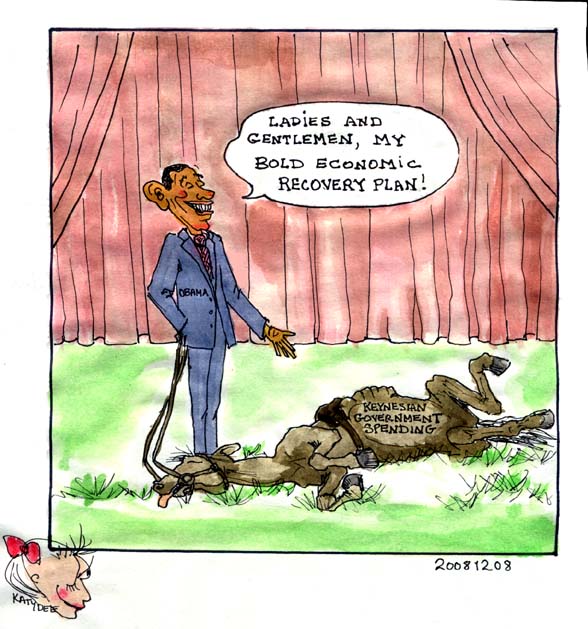
Alan Blinder, the well-known professor of economics at Princeton, wrote an opinion piece in the Wall Street Journal today. He claims that the fiscal hawks who fear that the stimulus hasn't worked are wrong, and that their refusal to give in on the unemployment benefits issue is misguided--what he labeled "pretty anti-Keynesian thinking."

Well yes, Professor, that's on purpose.

blind
[Thanks to for the image of Brueghel's Blind-Leading-The-Blind]

Blinder later specifies that he is referring to Keynes's recommendations to increase federal spending, and to the idea of reducing taxes so as to increase consumers' discretionary income and hence consumption.

But Blinder himself differs from Keynes (taking permission for his inconsistency from Ralph Waldo Emerson) in that he does not endorse tax reduction. Blinder's own Keynes-bis prescription is, on the contrary, to raise taxes by allowing the Bush tax cuts to lapse (because "we can't afford them"), and to "combine more stimulus in the short run with more budgetary restraint for the long run."

This means, I assume, that the government should allow the tax cuts to lapse and use the increased tax revenue to prolong unemployment benefits (basically a redistribution of income). Then Congress should increase federal stimulus deficit spending and worry about the consequences later (believing, I guess, that wishful thinking today will restrain tomorrow's budget in spite of itself).

Thus, he declares, "Obama's Fiscal Priorities Are Right."

I see several problems with his reasoning.

Problem 1. The spender-Congress's plan, to date, is to increase federal spending through more stimulus AND to raise future spending in the long run when the new health care laws kick in and when the coming baby-boom Social Security/Medicare/Medicaid entitlements explode. This is the opposite of Blinder's long-run recommendations.
Problem 2. By increasing both taxes and unemployment benefits Blinder thinks he is simply redistributing wealth, i.e. taking from Peter to pay Paul, justified by the arguments that (i) taking from the rich is not printing money or incurring more debt; (ii) giving $1 in unemployment benefits, or giving $1 in middle-class tax cuts, or giving a $1 cut to a wealthy taxpayer is "identical" in its impact on the budget; and (iii) more consumption will cure the recession.
This is unproven on three fronts.

a. Let's say we grant that an unemployed person is likely to spend the $1, and let's even grant that a middle-class wage earner will most likely spend it. How can Blinder maintain that a wealthy person, with his armada of lawyers, will still declare the same amount of taxable income if the taxes were to increase substantially? The Laffer curve seems to suggest that wealthy taxpayers will find a way to avoid paying taxes as the tax rate climbs to a more punitive level.

b. It may be true that unemployment benefits financed by the confiscated earnings of the wealthy might force GDP income to shift out of capital investment and land in consumption. But is this a proven recession-buster? It might just have the opposite effect, especially if it's on a large scale.

c. I think Zandi's quantitative model may need a little peer review, and preferably not by a Princeton economist. Today's Wall Street Journal mentions two NBER studies that indicate:

- "... a one week increase in potential [unemployment] benefit duration increases the average duration of the unemployment spells of UI recipients by 0.16 to 0.20 weeks" - 1990 study by Lawrence Katz
- "It is well known that unemployment benefits raise unemployment durations" - Raj Chetty of UC Berkeley

- Another study in March of 2010 by Michael Feroli (J. P. Morgan Chase) concludes that "lengthened availability of jobless benefits has raised the unemployment rate by 1.5% points."
3. Blinder says, "[W]e know one thing for sure: As the unemployment rate rises, the disincentives that worry conservatives become less important because there are fewer jobs to find...." Less important? That is nonsensical. He is saying that the chances of finding a job are reduced, but does this mean we have a better excuse to discourage people from accepting work?

I think the contrary. If people are under financial pressure, people will consider working in a different field than they're used to, or at somewhat lower pay, even if only temporarily. This is a GOOD thing, because the bubble economy created imbalances in the workforce that need to be rebalanced. However, if you throw them more benefits, the disincentives will operate to prevent people from hunting for, and accepting, alternative work, and skilled-labor job offers will continue to go unfilled--yes, that's right, skilled workers are hard to find, even today.

Lastly, I would respectfully ask Professor Blinder to drop the moralizing. It's namby-pamby and weak. He says, "In the 1930s, FDR taught us that heedless self-interest is both bad morals and bad economics." P-u-l-lease. He's beginning to sound like a climatologist: "Let's just do the right thing, whether we can prove it's actually beneficial or not."

Not my kind of morals, economics, or science.

Labels: , ,


Thursday, April 15, 2010

Inflation or No Inflation, That Is The Question

Once again, the question of future inflation is boggling the minds of many a financial forecaster. Are we headed for a rise in prices that will carry the Dow up and away, hopefully carrying the rest of us with it, or are we going to suffer the second leg of the W Recession as commercial property and/or the inevitable rise in interest rates hits the skids?

thinker
[Thanks to Commons.wikipedia.org for the photo.]

The questions I would pose are quite different. We are already engulfed in a sea of inflated purchasing media that is constantly roosting, taking off, and re-alighting in its search for new quick profits. Unfortunately, given the current labor market, it won't even be dipping a little toe in the ordinary person's paycheck on its way by, at least not anytime soon.

So where is it now, and what is going on? It is where it has gone for the last two years, to wit ten years or more: into speculative investment, biding its time. In America, at least, it isn't going into production, and it isn't going into salaries. It's going into profits and speculative investments, instruments like Greek bonds and credit default swaps so popular with the hedge fund crowd.

This means that the answer to the introductory question is yes, inflation, but be careful how you define it. As I have harangued before, the word is used flippantly to mean at least two things: on the one hand, price increases represented supposedly by the CPI; and on the other: excess purchasing media, the kind that used to cause price increases before the market got savvy, but that now finds itself blowing bubbles while maintaining general prices that should be falling so that the ordinary consumer gets a break. This definition we could differentiate by naming the process "inflating."

We've got the price stabilization, and we most certainly have got the bubbles blowing again. The excess "money" is now keeping Wall Street afloat--in fact higher than ever, bonuses and all, while stable prices buoy the record private sector profits we've been hearing about (which they're using to increase inventory, speculating on a price-rise opportunity), and while the Fed's funny-money sustains the whole U.S. residential real estate market.

If I were a businessperson these days, I would most certainly not invest in much capital equipment or labor, at least not until I find out:

- What the CPI is going to do over the next months, only because of its effect on what the Fed will do;
- Whether the Fed will really stop buying Freddie and Fannie issues, and/or start to raise interest rates, and/or take some other action to counter their recent balance sheet explosion and any eventual rise in the CPI;
- Whether the commercial real estate market will implode, with the resultant double dip in the economy;
- Whether we'll get a second wave of mortgage foreclosures and a second dip in the residential market, with the obligatory double dip in the economy;
- What the FDIC will look like at the end of 2010;
- What the Pension Benefit Guaranty Corporation will look like at the end of 2011;
- What will happen to the health bill;
- What Congress will look like in November;
- What party will run the country starting in 2011;
- Who will win the election of 2012;
- What the national debt projections will look like over the next two years;
- Whether or not the Chinese, Japanese, and Arabs will continue to buy and/or hold US Treasuries at the rate they are today, and what the U.S. bond market will do in response;
- What else?

Frankly, it's a wonder that the real economy turns at all.

This country is at a crucial point, both politically and economically. Will we affirm the liberty protected by our Constitution by turning away from government intervention in our lives, or will we succumb to the temptation offered by larger and larger handouts from an increasingly intrusive, blood-sucking, and short-sighted public sector?

Just as in the 1930s the electorate and the businesspeople of America are waiting to see what we, collectively, will do. In the 1930s the public sector won, and the private sector lost. After Roosevelt's about-face (his 1932 platform included reducing the debt and reinforcing the gold standard--I'm not kidding!) and after seventy years of inflating the currency, we are seeing the measure of that loss today, and the inflating continues to the detriment of all of us. What is the denouement?

In times like this, I prefer the security of gold and related investments. One thing that history has taught me is that gold tends to retain its purchasing power over time as the paper currencies lose their value. And I'm betting the dollar will lose its value compared to gold, sooner or later.

Labels: , , ,


Wednesday, June 17, 2009

Get Your Gold Right Here!

In Germany, the art of the vending machine is at the forefront of its game. See this one in Wolfsburg, where you can choose your Volkswagen:

vending
[Thanks to Jalobnik.com for the photo.]

Elsewhere, a fellow named Thomas Geissler has started a company that is installing 500 vending machines in various spots, and what do you suppose he sells?

Gold.

That's right, buyers have a choice among a 1 gram wafer for 30 euros, a 10 gram bar for 245 euros, or various gold coins.

There is a slight hitch: He has added a 30 percent mark-up to the cheapest products. Most dealers will ask only around 5 to 7 percent for bullion coins. And of course, prices are monitored and changed every few minutes.

See an article on this by Murray Wardrop at the UK Telegraph. And here's another at Reuters, and a third at Geissler's website.

Economist Edward C. Harwood introduced the notion of selling gold by the gram and potentially using it as an exchange medium back in the 1960s, and he even got his face on a one-ounce gold coin, in honor of his efforts. I don't know if he was the first; but his story is a fascinating one that I may be able to tell at some point relatively soon. I'm now working on his biography.

Meantime, I've often maintained that the gold standard can come back through various doors:

1. Official re-adoption by the politicians (but as my friend the former Columbia economics professor says, don't hold your breath);

2. Partial re-introduction, i.e. official acceptance of gold as legal tender so the public could use it as an alternative to the dollar in contracts and for repayment of debts public and private (I wouldn't hold my breath for this one either, because the politicians know how much this would limit the scope of their financial activities);

3. Demand by the public.

Now, this third avenue may just arrive in spite of a lot of skepticism. US gold coins are in short supply due to the huge demand in the US. Other countries are more aware even than we are of the importance of gold in the historical money markets. This experiment in Germany may tell us just how likely it is. If the public is willing to pay a 30 percent premium to own gold from a vending machine, then the urge to own something of value instead of fiat paper currency must be deeply ingrained indeed.

Mr. Geissler has surely thought this thing through, and has invested in some pretty heavy equipment (500 very solid machines, plus something to make the 1-ounce wafers) and security systems to see that his operation has a chance to succeed. I will be watching this one closely.

Remember my mantra:

You can take gold out of the standard, but you can't take the standard out of gold.

Labels: , , , ,


Friday, June 12, 2009

Skidelsky: The Economic Pendulum Has Swung Again

In his commentary in today's Financial Times about the economic policy of government stimulus of the economy, Robert Skidelsky, the noted British author and authority on John Maynard Keynes, declares:

"What is fascinating is that it is an almost exact rerun of the debate between Keynes and the British Treasury in 1929-1930."

pendulum
[Thanks to Thefoucaultproject.co.uk for the image.]

I have already posted about this earlier. He is right, we are right back where we started. In the 1930s Keynes argued against then-current classical economic theory, holding that government spending would put people back to work. At the time, few economists dared to refute his pronouncements. (One notable exception: Edward C. Harwood.)

But the classical school of economics wasn't dead yet. Spearheaded by Milton Friedman, it girded up its loins and made a comeback, using new geeky esoteric mathematical formulas that were effective in shooing the Keynesians. Today, we see the latter group charging forth again to reclaim their territory.

This swinging back and forth says nothing good about economics as a science, and more particularly macroeconomics. There have been no decisive victories in this field since its inception. This is a scary thought when you think that economists are running the show right now.

This unscientific outcome is typical of a number of the social sciences. As Skidelsky points out:

"It is characteristic of the social sciences that their battles are interminable, temporary defeats being followed by the regrouping of the defeated forces for a renewed assault."

I agree, with a nuance. He seems to be saying that the social sciences are ... well, just different kinds of science. He implies that the natural sciences are like a man: logical, Darwinian, forward-looking; and that the social sciences are more like a woman: emotional, spiteful, revengeful.

I think an endeavor is either a science, or it is not. Skidelsky errs in his designation as science the quixotic behavior of certain persons he calls "economists." They may be generally recognized as economists, but they are not scientists.

The debate then becomes: Is the term "economic science" an oxymoron?

This is a very good question, and perhaps THE fundamental question. There are two possible answers.

1. Either it is an oxymoron and economists should re-designate the field of inquiry as an art form; or

2. Economics can be a science, in which case the methodology has gone awry, given the "interminable, temporary defeats being followed by the regrouping of the defeated forces for a renewed assault", i.e. no progress is being made, the pendulum is merely swinging back and forth. In this case, optimists would hold that the methodology can be fixed.

In the early 1950s, a group of scientists formed a group called the Behavioral Research Council to study this very phenomenon in the social sciences. To make a long story short, they premised their foundation upon the hypothesis that the social sciences did have the potential to be just that, i.e. real sciences in the true meaning of the word; but that much gobbledygook must be lifted off the real science that did exist, in order for the various fields of endeavor to make any real progress.

They published two books:

- Useful Procedures of Inquiry, by E.C. Harwood and Rollo Handy, based upon specific dialogue on methodology between two fellows named Dewey and Bentley; and

- A Current Appraisal of the Behavioral Sciences, edited by the above two gentlemen and authored by various social scientists whose work the group respected.

The first is still pertinent to our discussion, pointing out the very flaws in the methods of research in fields like economics, to which Skidelsky makes oblique reference. Apparently, nothing has improved--a scary thought when you think that our economic future depends upon the work of good-intentioned people like Bernanke and his ilk, who believe in policy research that is unscientific in the judgment of a good portion of their own fellow economists.

The second is out of date but still of interest, because it gives the status of each social science as of the last printing. An update of this text would be useful someday.

I'll conclude this post by stating that my observations of human nature, and specifically of those who would call themselves economic scientists and those who would call themselves political scientists, point toward the conclusion that we have a long, long way to go before they start thinking of us and of their science, and not of themselves. Meantime, look what we have allowed them to do to us all.

PS: Keynes had the potential to be a true economic scientist, but I believe he was too enamored of his own glib persona to limit his mutterings to the truly useful, in the scientific sense of the word. Lawrence H. White, on the other hand, is one of the modern economists who counters this new policy swing back to Keynesianism. Read his latest piece over at Cato to learn a scientific economist's analysis of the Great Depression of 2007 and why the Keynesian stimulus idea can't and won't work in the long run.

Labels: , , , , , ,


Saturday, June 06, 2009

Angela Merkel, Lone Ranger

Among all of the Heads of State, Ms. Angela Merkel is the only one with the courage to denounce the policies of the world's most powerful central bankers, Ben Bernanke, Mervyn King, and Jean-Claude Trichet. Bertrand Benoit's piece in today's Financial Times describes the important ending of her otherwise uninteresting speech Wednesday.

loner
[Thanks to Costumeco.com.au for the photo.]

She gave "a vitriolic attack on the world's three mightiest central banks"--something which she has never done in the past. People who know her well confirm that it was no slip of the tongue, that she is always careful to mean what she says and say what she means. She said that she is "sceptical" about the powers of the US Fed to control the flood of purchasing media and credit they continue to create, alongside their European counterparts.

According to those who surround her, she "does not blame the implosion of the subprime mortgage market for the economic crisis. She does not see securitisation as the culprit. Rather, she thinks the loosening of monetary policy under Alan Greenspan's Fed chairmanship fuelled the creation of asset price bubbles and encouraged excessive leverage within and beyond the financial sector." [You and my spell checker will have to excuse the apparent typos, but I'm quoting a British text.]

She reminds me of Mrs. Thatcher back when the English Prime Minister touted the economics of the Austrian, Professor Hayek, who if he were alive today would surely agree with both ladies about the origin of our problems.

This recession is being described as a quadruple whammy: The first round seemed to come from the imaginative excesses of the residential mortgage market and the Wall Street math geeks who played with them. The second is coming now from the equally imaginative over-expansion of the commercial development financing market and is undermining some major banks' already fragile balance sheets. The third will soon appear within the retail credit sector. And the fourth is the credit derivatives wild card.

The source of all four, however, according to Merkel, Hayek, and me, is the combined actions of the monetary and fiscal authorities, (1) whose decisions are not predictable, (2) who have too much power to distort our money supply, and (3) whose constant interventions can and will, everywhere and always, throw even the best-performing economies into havoc.

What makes this even worse is that omnipotent power attracts those who would profit from it. Just listen to the big market players--the seemingly indestructible huge banks and automobile companies--as they turn their sheepish bahs towards Washington. (Try out this website to hear what this sounds like.)

We are approaching an interesting crux of this recession. Economists and market players alike are split into two camps: those who think the principal danger (or speculative opportunity) is depression and deflation, and those who think it is inflation.

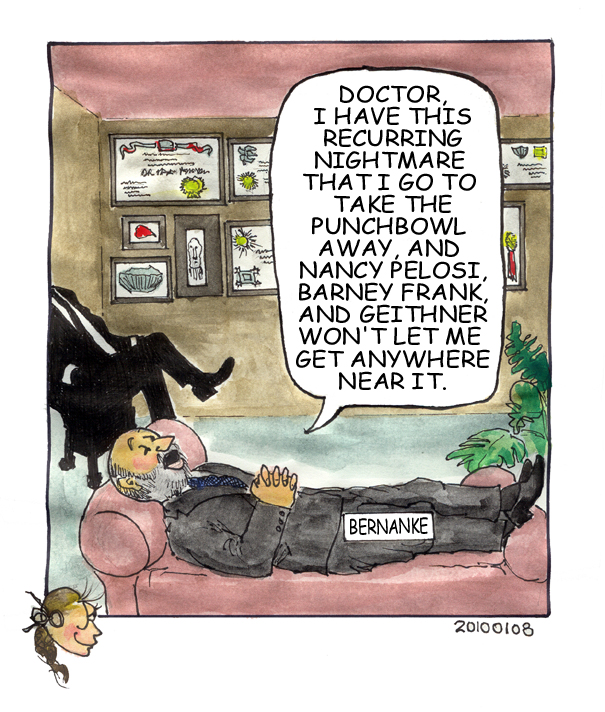
I'm in the inflation camp, alongside Ms. Merkel. I don't know whether the coming series of monetary bubbles will take one year or ten to appear and burst; but I feel very sure they are coming. When it comes time to pull the punch bowl away, this Fed will be no stronger than any other has been in the past (with perhaps the exception of Paul Volcker, but how short-lived his wisdom was). Our Fed governors' task will be complicated by their lack of real control of interest rates: Just when they will want to reign in credit, the rates will go up, putting them in a quandary.

As far as I know, and in the longer run, there has never been a nation in history that has survived the chronic debasement of its monetary unit. Ironically, this time it's Germany (or at least her Head of State) that seems to be the one ready to speak up. As Ms. Merkel puts it: "The most complicated phase will come when the crisis is over."

Labels: , , , ,


Sunday, May 03, 2009

Quick Speculative Thoughts about Possible Future Trends

In reading the daily commentary of the American Institute for Economic Research for April 29, 2009, my speculative little crystal ball began to light up. AIER is the only serious business cycle analyst group that points out reality, and reality is that contraction is everywhere in the stats, in spite of the recent "good news" in the stock market. (Desperate exuberance, anyone?)

So let's think it over.

We all agree that the government and the Federal Reserve think they are doing their best to prevent a deflationary spiral, to un-freeze credit, and to save major industry players from precipitating us all into a deep depression. Money supply creation is high, and we can see that the Fed's balance sheet has never been in a more inflated state.

According to some signs, these policies seem on the surface to be taking effect. Sales of existing homes are turning around, and the stock market is maintaining its rally. Meanwhile, the money supply is expanding by an annual 8.1 percent, while at the same time the CPI is stable or falling.

If past experience is any indication, it would seem logical that we are headed for an arrest--and perhaps even a reversal--of price deflation; and if the money creation continues unabated, as would seem inevitable given current Fed policy and the expansionary will of the administration, inflation should be the outcome. Some are even talking about hyperinflation.

But I have a slightly different crystal-ball image (which could of course change tomorrow). Keeping in mind that this is just a game, and that no one's fortune telling is better than anyone else's, just for fun I thought I'd throw this out on a rainy Sunday afternoon.

ball
[Thanks to Crystal-cure.com for the photo.]

Hyperinflation is not in my crystal image. This is not post-WWI Germany or Zimbabwe, in spite of the way things look. What is the reason? It's certainly not because there is no monetary excess going on; it's because, unlike the world of speculative finance, a good part of American industry is too savvy to get caught up in the exuberance.

In fact, American industry has been savvy for a long time, at least one century or more. In pre-1929, over-issued money supply did not all pour into consumers' hands, where it must be before it can create hyperinflation. In the decade leading up to 1929, prices were relatively stable, yet money supply grew. Where did it all go? It flowed into the stock market, for one, which experienced a huge run-up that subsequently burst and started a cyclical downturn.

Why didn't the country experience general price inflation? Economists speak of nominal inflation versus real inflation. Nominal inflation can remain low or non-existent, even as real inflation grows. Prices are stable, whereas they should be falling. This is what happened in the 1920s. And American industry knew this, while the Fed governors pretended not to (or were too inexperienced to realize it).

Later, during the long inflationary run of the second half of the 20th century, industrial market players and their public adjusted to chronic price increases. It's similar to what we do as we grow older (if not wiser): We get used to living with low-grade arthritis pain. This chronic inflating, however, culminated in another stock run-up and the acute crisis of the 1970s, which some say was deeper than that of the 1930s in real terms.

But we got over it and it didn't take too long to get back to our arthritic monetary ways during the 1990s, helped by urgencies in the savings bank industry and in the commercial banking industry's politically motivated foreign investments. This time, the inflationary run popped in 2000 and 2001, having inspired another stock market bubble. By now, we were so good at putting up with pain that we returned immediately to our bad habits, creating the real estate and credit-speculation bubbles that have dropped us to where we are today.

Instead of taking our medicine once and for all, we're off to the races again. Today's crystal ball tells me that we will get a renewed stock market mini-hyperbubble, along with a government stimulus maxi-bubble targeted to specific groups of rent-seekers (special interest groups like financiers, government workers and programs, construction conglomerates, unions, and the like). While this is going on, general prices will remain fairly stable, and banks and investment houses will go right back to their speculative games. Gold and commodities may go through a mini-hyperbubble as well.

But the business cycle really wants to contract. This time, the arthritic pain is too acute. Look at the stats at AIER. It's possible that real industrial GDP may not progress, even though government stimulus money may creep in, pushing up the digits for a while. But keep in mind that government stimulus must be paid back by future capital, depriving us in the coming years of investment in real industrial GDP. The figures will mislead us all. But American industry knows this.

So to conclude, we could get some short-lived hyperbubbles in the stock market and commodities, but they might deflate and run out of exuberance for a while. The maxi-stimulus fake bubble will run out of public support for sure. GDP will eventually dive again and will become chronic stagflation as the increasingly impotent government and Fed blow stimuli through the system like air bubbles in a fish tank. Most of the new air will dissipate through short-lived financial speculation. (Japan, anyone?)

Keep in mind that, having exposed my insights to you today, I'll probably rethink this whole crystal vision by my next blog. But if the deflationary business cycle fights back and ultimately wins this contest between it and our desperate government and Fed efforts, expect bubbly stagnation for a good while, until industry decides it's time to make a come-back. Then we'll probably get the inflation we've been fearing.

Labels: , , , ,


Sunday, April 26, 2009

The Stress Test: Inspecting the Stable After the Horses Have Gone

horses
[Thanks to Americaswildhorses.com for the photo.]

Even if it's too late, it's good to know that the US Treasury, other Government agencies, and the Federal Reserve are able to do what they were supposed to do all along, i.e. monitor the health of the US banking system. This Federal Reserve white paper amply demonstrates their know-how by detailing the accounting verification procedures they applied in their infamous "stress test" of 19 major US banks, the results of which they now hesitate to divulge to the public for fear of instigating another wave of panic.

This fear harks back to my growing list of examples of government running amuck through inappropriate intervention. Instead of intervening too late, they should have been minding the barn back when it might have turned up some loose beams and posts and kept the horses inside.

What makes this tragic situation worse is that since 2001 the BIS (Bank of International Settlements) has been discussing what to do about what central bank representatives had clearly identified as imbalances in international bank leveraging (e.g. assets vs. capital ratios) and as excessive fiat credit creation.

So where have our central bankers been? Why did it take so long?

Unfortunately, I have no answer to this question.

"[T]he Federal Reserve Board has regulatory and supervisory responsibilities over banks that are members of the System, bank holding companies, international banking facilities in the United States, Edge Act and agreement corporations, foreign activities of member banks, and the U.S. activities of foreign-owned banks. The Board also sets margin requirements, which limit the use of credit for purchasing or carrying securities." [Source. See also this and this.]

Looks like the Fed has spent the last nine years sleeping on the job. Maybe we should start a class action suit for negligence? (Just joking, I think.)

Labels: , , ,


Sunday, April 19, 2009

Government Intervention Run Amuck No. 20: Bank Intervention

My list of examples of the unintended consequences of government intervention in the marketplace gets longer and longer. This time, I'm going to point out the latest irony: Investment banking's profitable last quarter.

oops
[Thanks to Thevoiceforschoolchoice.wordpress.com for the photo.]

This would be wonderful news if it were genuine, but looking a little deeper reveals the truth. First, in one of Barron's feature articles by Andrew Bary, we learn about a little-discussed fact: Goldman Sachs has only been able to issue low-cost debt due to the backing of the FDIC through a program called the TLGP, or Temporary Liquidity Guarantee Program.

I suppose this program is no secret, but somehow it had escaped me that Goldman, JP Morgan, Morgan Stanley, and others are relying heavily on it to survive, at the same time as they are declaring profits and claiming that they want to return the TARP money in a show of strength. In fact, it's all show and no strength when you look at the facts.

Here's another thing that raises my cockles. Goldman has stated first quarter earnings as $1.8 billion. As Alan Abelson points out in his weekly Up & Down Wall Street column, Goldman's profit statement all but ignores results for December because of a fluke fiscal-year switch. "Goldman lost some $780 million in December," says Abelson. This brings the four-month profit down to $1.02 billion, which is still respectible; but somewhere else in Barron's (I can't find it now) we learn that Goldman made most of that profit through a risky bet on bond futures.

Isn't risky betting what got us into this mess? And aren't firms like Goldman now gambling with our tax dollars? Aren't we rewarding and encouraging the very behavior that helped get us where we are today? And is there any guarantee that they will make good bets (with our money) in the future? Shouldn't these people be market-dead?

Abelson conjectures, furthermore, along with his source Zero Hedge, that some of Goldman's $1.8 billion profit may have come from payments by AIG, who "'gifted the major bank counterparties with trades which were egregiously profitable to the banks.' This would largely explain, according to Zero Hedge, why a number of major banks actually, as they claimed, were profitable in January and February. But the profits, it is quick to point out, are of the one-shot variety, and ultimately, they entailed a transfer of money from taxpayers to banks, with AIG acting as intermediary."

My free-market instincts have always told me to hold onto my resentment of big bonuses and the new divide between the rich and the "middle class," as illustrated in the supplementary section to this weekend's Wall Street Times, with glossy pictures of dozens of fabulous mansions for sale around the country. And echoing my own sentiment, Gregory J. Millman chides me in his Barron's piece this weekend, "let's not go ape about fairness." He's right--or he would be, in a free-market society.

But Mr. Millman, this market isn't free and hasn't been for decades. How can we talk about free market when the banking barons are divvying up our hard-earned tax money, thanks to the largesse of those who didn't earn it, our legislative representatives? How can we talk about fair competition when the playing field is rigged in favor of the big boys, and the small businessmen and women just have to suck it up when they learn from their subsidized bank that they can't have any of the handouts? How can we talk about a deflationary correction, elimination of the unhealthy business models, and a return to saner plain-vanilla banking, when our legislators continue to reward foolhardy risk-taking?

We're headed in the wrong direction. More limited government is the answer, not bail-outs of bankers who should be dead by any Darwinian-Schumpeter standard; not Treasury-instigated bank "stress tests" that will soon go bang in the night, raining multiple unintended consequences; not back-room cronyism in the name of "saving the system."

Labels: , ,


Monday, April 13, 2009

Taylor's (and Friedman's) Error

In a book review by Clive Crook in todays Financial Times, we read about the new work Getting Off Track by John Taylor, creator of the "Taylor Rule" for monetary policy. According to Taylor, if the Federal Reserve had followed his famous Rule instead of their own discretion over the last decade, we wouldn't be in the mess we're in today.

Taylor's Rule gives a mathematical formula for the calculation of monetary policy. As Crook describes it:

"The rule says central banks should set the short-term interest rate equal to one-and-a-half times the inflation rate; plus half of the gap between actual and trend gross domestic product; plus one. For example, if the inflation rate is 5 per cent and the output gap 3 per cent, the Taylor rule says make the interest rate 10 per cent: one-and-a-half times 5, plus a half of 3, plus 1."

His idea is similar to the formula of Milton Friedman, which at one point economists called the "k-percent rule." Friedman would have had the Fed increase the money supply annually by a fixed percentage. He is essentially Taylor's precursor.

Both economists advocated a fixed, formulaic determination of the expansion of money supply because they were wary of a discretionary monetary policy open to the whims of central bankers and the politicians who appoint them.

Where both these illustrious gentlemen err is in their naive belief that any political appointee(s) would be capable of limiting themselves to a non-discretionary monetary policy once they have the power not to.

In a July 2006 e-mail exchange with the Wall Street Journal's Tunku Varadarajan, Friedman wrote: "There are certainly occasions in which discretionary changes in policy guided by a wise and talented manager of monetary policy would do better than the fixed rate, but they would be rare." WSJ Archives.

Rare indeed. Didn't he realize that "rare" is in the eyes of the rate-setter?

Friedman's incongruous naivety is at odds with his skeptic personality. In his own book Capitalism and Freedom, he says:

"As matters now stand, while this rule [the k-percent rule] would drastically curtail the discretionary power of the monetary authorities, it would still leave an undesirable amount of discretion in the hands of Federal Reserve and Treasury authorities with respect to how to achieve the specified rate of growth in the money stock, debt management, banking supervision, and the like."

So why does he even bother with the k-percent rule in the first place?

Both Friedman and Taylor seem to be aware of the fallibility of agency intervention into the supply of money; and yet, inexplicably, both seem in the end to take for granted that the agency in question will be willing to renounce discretion when push comes to shove.

This is equivalent to sitting two-year-old Dick and Jane in a room with a big box of chocolates, telling them they can have only one each, then leaving the room. It just won't work.

DickJane
[Thanks to www.lib.udel.edu, the Univ. of Delaware Library, and The New Fun with Dick and Jane, Chicago: Scott, Foresman and Co., 1956.]

And it's not Dick or Jane's fault. Dick and Jane are only two years old. Monetary policymakers are just humans. Humans are control freaks. They are tinkerers. It is a rare economist who, once appointed to the position of Federal Reserve Board Member, can look deep down inside existing economic science and declare the truth of what he finds, i.e. that no one knows how to control monetary policy, with or without a formula.

For one illustration of the mindset of our FRB Members, read this speech by Governor Mishkin. It's an eye-opener, revealing just what the more rational economists like Taylor and Friedman are up against. These Governors see themselves as monetary artists, not scientists.

For a second example of Federal Reserve mindset, take a look at this astonishingly self-serving article by Alan Greenspan in the Wall Street Journal last month. We perceive between the lines that there's a nasty feud going on between Taylor and Greenspan, and rightfully so. Taylor is Jane's older brother (he's six) and Greenspan is little Dicky.

Now children: I guess we'll just have to take that box of chocolates away, now won't we? (Gold standard and sound commercial banking, anyone?)

Labels: , , , , ,


Thursday, March 26, 2009

What Went Wrong with Commercial Banking?

Part III

In Tuesday's post, Part I of this series, I told you about economist Edward C. Harwood's 1928 prediction of the 1929 Great Depression in published and unpublished articles. He saw imbalances in the banking sector that were leading us into a breakdown of the economy through a misuse of the banking system.

In Part II of the series, I gave Harwood's description of sound commercial banking, as read in an unpublished article entitled "A Sharp Distinction Should be Made Between Capital Funds and Commercial Credit." He uses the metaphor of characters in a play. Let me remind you of their names: The Earners, the Investor, the Manufacturer, the Retailer, and the Bank. I recommend that you read Parts I and II first, so that you can make better sense of what follows.

costumes
[Thanks to Dreamstime.com for the photo.]

I had described his understanding of the relationships among the players and how the Bank's main purpose is to facilitate the distribution of production into the hands of all who contributed to it and therefore deserve a share.

In Act I, the Bank's power to create credit is limited to an amount representing actual products or services coming to market. This is one of the essential characteristics of sound commercial banking, the foundation of any economy.

At the end of the last post, Earners had placed a small portion of their claims to production (otherwise known as purchasing power, or money) in savings accounts at the Bank. They did this for safety and convenience, and also to derive a little income from the Bank's judicial placement of these savings into the hands of proven wise investors like Investor, who is asking for some of these claims (money) to buy more stock from Manufacturer.

Manufacturer has seen that his products sell well and that he could profitably expand by issuing more stock. The savings department of the Bank agrees and offers a loan to Investor, holding Investor's stock as collateral. Note that the Bank's savings department does not create any credit here; quite the contrary. They extend claims already in existence (Earners' savings), taking only a conservative calculated risk on their return with interest.

So far, this Act I scenario represents the correct use of commercial credit and of capital funds. All's well that begins well in our sound commercial banking system.

Act II

Here the situation starts to go awry. We are 1913. Congress thinks it wise and useful to create a national entity that would have two functions: to apply modern technology to grease the wheels of check clearance, and to serve as a back-up reserve of funds to avoid the destructive effects of irrational, panicky bank runs.

Simultaneously, a war is brewing abroad and some in government foresee a need for a source of emergency financing for the military industrial sector should the US get involved.

They hit upon the formula of establishing a master bank that would have the two first functions, and a third function as well: to create credit--temporarily of course--by "monetizing debt," or "buying" US bonds with credit created out of thin air--claimless "money," if you will. (See how real money is actually claims on production in Wednesday's post.)

This extra claimless "money" would circulate throughout the economy and become indistinguishable from real money as it flowed first through those industries that would receive government checks to arm the military machine, and then on into the rest of the economy. Our master bank is named the Federal Reserve, Fed for short.

The formula works well. The war is won, thanks in part to this stimulus scheme. The Fed must now withdraw all that excess credit; but this causes a recession and pain, like withdrawal symptoms. Instead of taking his medicine and cleaning the toxic credit from the banking system, our Fed decides to relax his standards and allow the credit to remain in circulation.

In doing so, he loses control of the amount of credit he has created and finds himself in need of a less painstaking measuring stick. He settles on the price level. This, he thinks, will be just as good a measure of the supply of money, because it is well known that excess money creates general price inflation. This is not always true; but the Fed has good intentions and lots of faith in his knowledge of things monetary. (But we know what the road to hell is paved with, don't we?)

This illusion of wealth and the apparent stability of prices deceive all of our players. The Manufacturer converts his arms factory back into peacetime production. The Investor puts all his savings, plus as much as he can borrow from the now credit-stuffed Bank, into buying the Manufacturer's stock for further expansion. Optimism reigns.

Seeing the success of the Investor and plush with cheap "cash" (really only claimless credit) issued by the Fed, the commercial department of the Bank starts to think of new ways to make money. They begin to create credit accounts for Investor's investments, instead of letting the savings department lend real savings. This credit is not collateralized by sales documents as normal commercial credit would be, but is based only on a mutual appetite for risk-taking--not the commercial Bank's proper function. Leveraging creates more claimless "money" and makes the situation even worse.

(Note that there is a place for speculative investment, but it is not within a healthy commercial banking system. True speculators are fully informed of the risks involved and must be forced to withstand the full consequences of their actions, down to the last penny.)

A few Earners, seeing Investor becoming increasingly wealthy through his stock investments, begin to do likewise. They take their money out of the conservative savings account that now offers only a paltry interest, given that the Bank is flush with Fed "credit" and doesn't need Earners' savings anymore. Earners also start requesting loans from the Bank, and the Bank, now having lost itself in this adventure, begins to provide even more claimless credit "money," based on nothing but Earners' stocks, the Bank's optimistic and foolhardy assessment of risk, and also on the Fed's own example. Remember too that the Fed's mere existence has now "guaranteed" the banking system's equilibrium. (Economists call this "moral hazard.")

Times are good. Even Manufacturer and Retailer put a little of their profit aside to speculate in the stock market, sending stock prices sky high, even though general prices are stable. What's the first thing you think of when you get your first extra income? Buying a home, of course. Money (or this claimless credit hybrid it has become) turns towards the real estate market. A housing boom ensues.

More conservative Earners note that their wages seem to be stagnating, and that a good number of individuals around them are becoming extraordinarily rich. Manufacturers and Retailers are not expanding jobs like they used to, engrossed as they are in making it rich through speculation.

Once again, let's stop the carousel. This is starting to look like a game of musical chairs. When the drugged music of easy credit wears off, as it inevitably will (there being nothing but speculative and ephemeral gains to be claimed with all this claimless money), many Earners will be left chairless, and/or some will be sharing useless pieces of a chair when a rise in general price inflation sucks the value out of their real wealth.

Here we are in 1928, at the brink of the Great Depression.

"Act III remains to be played. Just when it will begin is a problem, but it is certain that the actors will not fail to appear. It must be confessed that this drama is a tragedy. The third act may be readily imagined by those who have seen depression before. It is unfortunate that this is what we must expect, but such will always be the price of inflation."

Harwood's phrases. "Inflation" as he uses it here refers to the inherently risky "claimless" credit expansion, to be contrasted with healthy expansion spurred by sound commercial credit creation as described in Part I.

Act III takes place one year later in 1929 with the collapse of a stock market bubble and a bursting real estate boom, much like the ones we find ourselves in today.

What makes today's situation worse than 1928 is that back then, the country observed the gold standard, which guaranteed the value of the dollar and limited the amount of risk-credit expansion that could occur. It was indeed the scarsity of gold that forced the Fed to retract credit in 1929. But both gold and the Fed were only doing their job, something the academic community dismisses today as primitive misguided meddling in free markets, which it was not. On the contrary, it was playing by the rules on a gentleman's playing field. Today, it's a game of Scoundrel Takes All, at least until the public wises up--not through more government intervention, but through a reestablishment of basic rules.

Standardization of the monetary unit referent to something of generally perceived and constant value is the second characteristic of sound commercial banking, whether it be gold or something better. (I know of nothing better.)

Today, we have no such disciplinary tools in place, and "claimless" credit expansion has been allowed to expand to a degree never before seen in history. What remains to be seen is whether the very people who allowed this expansion to take place can now persuade it to retract in an orderly manner.

(The public is not blameless. It is we who elected the 1913 Congress in the first place.)

Labels: , , ,


Wednesday, March 25, 2009

What Is Sound Commercial Banking?

Part II

In yesterday's post I told you about economist Edward C. Harwood's 1928 prediction of the 1929 Great Depression, in published and unpublished articles.

He saw imbalances in the banking sector that were going to lead the country into a quagmire (although he could not have predicted the depth to which it would sink through government and global mismanagement).

In his unpublished article entitled "A Sharp Distinction Should be Made Between Capital Funds and Commercial Credit," written in mid-1928, he gives us a layperson's understanding of sound commercial banking by explaining the relationships among the various participants as though they were characters in a play. Let me introduce you: The Earners, the Investor, the Manufacturer, the Retailer, and the Bank.

- Earners - all who are entitled collectively to a share in a country's GDP, i.e. those who participated in its production. In other words, all of us who work for a living. In reality, all of the characters are Earners, but some have different functions.

- Investor - the risk-taker who lends his capital funds to the Manufacturer in exchange for a piece of the profits.

- Manufacturer - the producer of all products, agriculture, and services.

- Retailer - the selling agent for Manufacturer.

- The Bank - the financial intermediary between Manufacturer and Earners, between Retailer and Manufacturer, and between Earners who save at the Bank and the Retailer or Manufacturer, to name a few of the relationships.

ford
[Thanks to JohnDClare.net for the photo.]

In Act I, all goes well. Manufacturer receives a loan (capital) from Investor with which to buy his building, equipment, and raw materials. Then he plans an amount of production based on expected sales. With the help of Earners, he produces goods (or services) to ship to Retailer for selling to the public. Retailer promises to buy the products and signs the purchase order.

At shipping time, the Manufacturer wants to be able to pay Earners even though he hasn't received payment from Retailer for his products, because Retailer will need to sell the products first, and guess who are his customers? Why, Earners, of course. (What goes around, comes around.)

Here is the first point to remember about a healthy monetary system: Manufacturer always distributes 100% of his gross sales among his expenses, his profit, his Investor, and his Earners; and the only way he can do this at this point is to get a loan at the Bank, and give each Earner a claim for the value of that portion of the products each has helped to produce, so that the claimant can claim it (or its equivalent) when he wants it.

A particular Earner may not want the five cars his annual work entitles him to; he may want down payment on one car, some bread, some meat, rent money--any number of things. Money is, in essence, a claim--no more, no less, and it is generic, accepted everywhere, as long as its value is guaranteed. (More about that later.)

So to give the claims (we could have named them "purchasing power") to each participant, the Manufacturer goes to the Bank with Retailer's order for the goods. On the basis of the order the Bank grants Manufacturer a loan by creating credit out of thin air, so to speak, and puts the credit representing almost the total future sales in a checking account to allow the Manufacturer to pay Earners. (The rest is Bank's income.)

Once the goods are ready for shipment, Manufacturer pays himself and the Earners, including the Investor, in cash or equivalent; and everyone accepts these claims (paper cash bills, a check, or an electronic transfer) representing a piece of the production.

It is important to retain the notion that the income from the wholesale sale of the product is divvied up between the Manufacturer and the Earners, because they each are entitled to a share of the whole production, down to the last penny. There can be no more or less money (claims) handed out than the total wholesale price of the things manufactured. This is an essential point. Also realize that the wholesale sale value is only a part of the final retail sale value. This is normal, because there are others who are going to participate in the distribution process who will also have a right to claim a share representing the work they have done to get the product to market.

Next, the Manufacturer will require Retailer to make good on his signed purchase order and pay the wholesale price before the items are sold. So Retailer too goes to the Bank as soon as he receives the title to the goods in shipment; and the Bank, on the basis of the title, grants a loan (credit) and deposits the sum in a checking account so that the Retailer can pay Manufacturer for the goods, who in turn pays back his own loan from the Bank.

The Bank then destroys Manufacturer's loan document and finds itself with a new loan document signed by Retailer for a higher amount. The Manufacturer's loan account is zeroed out, all sums being paid. Remember, the credit previously issued to Manufacturer and paid out is now claims in the hands of those who produced the products and who deserve their share of its value.

Retailer, who now owes the Bank, sells the products within a few months and pays back his loan. The Bank then destroys the Retailer's loan document. The Retailer, like the Manufacturer, pays the remaining sales proceeds to cover expenses, then himself, his own employees (earners), and investor (another earner), and they all become owners of claims to a piece of the production value.

Soon, someone will have bought all the products that were manufactured, ending the cycle. A few of the paper claims will end up in a savings account at the Bank.

Let's stop the carousel here and take stock of things. What I have described above is the commercial relationship of every company in the world with its bank's commercial department. In the past, banks created credit (in the form of checking accounts) that was self-liquidating, as described here. They did not create any other credit. To do so would have been risky unsound banking, proven in the past to lead to trouble.

In Part III of this series on sound commercial banking, I will delve into how banks dealt with savings.

Labels: , , ,


Tuesday, March 24, 2009

The Origin of This Whole Mess: 1913

Part I

Economists disagree on the identity of the true culprit behind our current crisis. Some blame Wall Street; some blame the progressive politics that pushed Freddie Mac and Fannie Mae beyond their capacity; some blame the profiteering loan brokers, the foxy house flippers, and the naive subprime home buyers in their rush for quick profits. Some blame the Federal Reserve, including me from time to time.

UncleSam
[Thanks to James Montgomery Flagg, the artist, and Wikimedia.org. The image is in the public domain.]

In reality, all of the above had their role, but they are just players in a game, the rules of which are defined by politicians. The origin of the problem lies in the rule changes that caused the demise of sound commercial banking back in 1913.

Before then, good commercial banking had been functioning well, both in England and and the US, for about a century. Business cycle fluctuations, although sometimes painful, managed to keep the profession on the right track. The invention of the Fed in 1913 was supposed to allow banks to weather business cycle downturns without going completely bust because of irrational panic withdrawals that had no justification in the real data.

Morphing onto a national stage out of private banking functions already in development, the Fed's check clearing services and temporary commercial loan facilities were indeed a clever and useful idea. But the politicians discovered that, once the Fed found it could take over the centralized monopoly of legal tender issuance and then credit creation, it could be used for other things than just stabilizing the banking system. And everyone believed the Fed could control this new-found usage and that it would not do any harm.

In preparation for WWI, the government turned to the Fed credit-creation facilities to finance the war. It was a great success. The Fed managed to wrest most of the genie back into the bottle after the war by early 1920; but the temptation was too great and the discipline and privations too onerous, so they allowed over-issuance of credit to continue, ostensibly to help the country out of the recession the war disruption had caused.

The downturn ended in 1921; but the credit issuance continued. The result was 1929. As Doug Noland says in this week's article at Prudent Bear:

"It was understood at the time [during the Great Depression] that our fledgling central bank had played an activist role in fueling and prolonging the twenties boom - that presaged The Great Unwind. Along the way, this critical analysis was killed and buried without a headstone."

How true. Very few economists today remember the Fed's role in inflating credit previous to the Depression. On the contrary, everyone, from Keynes to Friedman to Bernanke, believed and continue to believe to this day that the problem lay in too little credit.

Many base their hypothesis that the Fed did not over-expand credit in the 1920s on the fact that the price level was relatively stable. Economist Edward C. Harwood pointed out in published articles that an economy can present over-expansion of the money supply even in a climate of stable prices; and furthermore, that this held true in the 1920s. Outside factors can cause real prices to fall, while an excess of money supply camouflages these factors by keeping prices at the higher level, with no one the wiser.

Furthermore, what these theorists ignore entirely is that the Fed's newly assumed power to unleash the credit genie destroyed sound commercial banking in pretty short order. ("Power tends to corrupt; absolute power corrupts absolutely." Lord Acton)

In an unpublished article written around May of 1928, Harwood described the process by which the art of commercial banking became tainted and was eventually lost. He compared it to a play in three acts. After describing the players and the events of the first two acts, he wrote:

"To date [May 1928], recent business history has paralleled acts one and two of this drama of commerce. Act III remains to be played. Just when it will begin is a problem, but it is certain that the actors will not fail to appear. It must be confessed that this drama is a tragedy. The third act may be readily imagined by those who have seen depression before. It is unfortunate that this is what we must expect, but such will always be the price of inflation."

He correctly predicted the depression that came one year later. He is one of the few, unfortunately forgotten today.

In the next parts of this blog post, I will go into the details of sound commercial banking, how it was allowed to self-destruct by the creation of the Federal Reserve, and how its destruction led to today's crisis.

Labels: , , , ,


Saturday, March 21, 2009

Fed Credit: The Latest And Perhaps Next-To-Last Bubble

I can't claim to be the origin of the Fed Credit Bubble idea, because it occurred to me as I read a fantastic piece by one of my favorite analysts, Doug Noland of Prudent Bear.

We've just come out of a huge bubble that consisted of inflated real estate investment and speculative finance credit. The bubble burst and the market began to correct itself, menacing to take a lot of nations' economies with it.

The reaction of our economic leaders was and continues to be to try to maintain a minimum of stability by propping up the various players on the world financial stage as they began to totter, one by one: first the real estate sector with aid to Freddie Mac and Fannie Mae, then the banking sector by saving Bear Stearns and loans to other institutions, then the insurance sector by bailing out AIG, then the automobile sector with handouts to GM and Chrysler, more money and loans to the banking and real estate sectors, more to AIG, recently some more to auto supply companies, more to AIG, and now the credit card and other large ticket item credit sector--an endless list, it would seem.

The central banks of the world, to a varying degree, are performing their propping-up role as the ultimate insurance company, the lender of last resort; and the US Fed, given the universal role of the US dollar as reserve currency, is the one that will be the buck-stops-here Last Lender of All Last Resorts.

As Noland points out, however:

"Our federal government has set a course to issue Trillions of Treasury securities and guarantee multi-Trillions more of private-sector debt. The Federal Reserve has set its own course to balloon its liabilities as it acquires Trillions of securities. After witnessing the disastrous financial and economic distortions wrought from Trillions of Wall Street Credit inflation (securities issuance), [it is possible that] the Treasury and Federal Reserve have set a mutual course that will destroy their creditworthiness - just as Wall Street finance destroyed theirs."

He's saying that the Fed is going to create the Bubble of All Bubbles, right there in its own house.

balloonhouse
[Thanks to Bouncehousesnow.com for the picture]

But just how much air can the US Fed balance sheet withstand, without bursting its own skin? The inflationist central banks are acting on the assumption that they can right the "market failure" (see PS below) through this "temporary" remedy, that the market cannot right itself alone, or at least not without disastrous consequences. But aren't they trying to add air to an already burst bubble?

Instead of curing the problem, they are acting contrary to the market's instinctive corrective hiatus and will end up distorting events even further. How can arbitrarily selective bailouts and the forced financing of government projects--projects that otherwise most likely would not have been financed--do anything except further distort the admittedly slow and cumbersome but essential market reevaluation process?

"[T]he seductive part of [the optimistic] view is that unprecedented policy measures may actually be able to somewhat rekindle an artificial boom – perhaps enough even to appear to stabilize the system. But seeming 'stabilization' will be in response to massive Washington stimulus and market intervention – and will be dependent upon ongoing massive government stimulus and intervention. It’s called a debt trap. The Great Hyman Minsky would view it as the ultimate 'Ponzi Finance.'”

Precisely. The ultimate Bubble, created by those who are supposed to help us avoid them altogether.

So how will the world react when this latest bubble bursts? At some point, investors looking to preserve the value of their wealth will realize that there is no investment denominated in an existing national currency that does the trick, and they'll turn to gold, always the last fat lady to sing before the curtain falls and reality sets back in. (By now, you've figured out that I'm somewhat of a gold bug.)

_______

PS: We have no market failure here. On the contrary, the market is functioning perfectly. It is waiting to discover the real price of toxic assets, if only the government and its allies would let it. Rather, it is the market players who have failed us, and more specifically those who would pretend to manage our monetary units. For more on the true source of the real estate and credit bubbles, find yourselves a copy of the March 16, 2009 Research Reports out of the American Institute for Economic Research (annual subscription), and read the piece by Walter M. Cadette entitled "Greenspan the Goat."

Labels: , , , ,


Thursday, March 19, 2009

The Inflation Boat Is Leaving the Dock

Last night we learned that the Federal Reserve is going to put into practice its announced plan to buy US government debt. Today's Financial Times article by Krishna Guha gives the gory details.

Everyone knows that this action by the Fed increases money supply, and most are aware that it increases the probability that at some point in the future the amount of money created will be excessive with regard to the actual needs of the marketplace, which in turn will tend to lead us towards a state of price inflation, or bubble inflation. Another article by Javier Blas on the early signs of this in the commodities markets is a fun read on the subject.

As the Fed sees the problem, then, they must feed us with money supply while the banks are frozen in a state of rigor vivus, and then in future, just at the right moment, they will take steps to prevent the normal outcome of price or bubble inflation by reversing the process.

buysell
[Thanks to 1stchoicecufflinks.com for the nice photo.]

This sounds logical. As an obscure economist named Edward C. Harwood wrote during our last episode of purposefully inflationary Federal Reserve intervention ("the ill-fated Operation Twist in the 1960s"), during a time when we were still trying to adhere to a modified form of the global gold standard:

"Once inflationary purchasing media have been placed in circulation, there are two ways in which sound money-credit relationships may be restored: (1) by means of devaluation, that is, reducing the gold weight of the monetary unit so much that the increase in the number of (smaller) gold dollars equals or exceeds what had been the inflationary portion of total purchasing media; or (2) by means of deflation, that is by removing inflationary purchasing media from circulation." [See this article from the American Institute for Economic Research website [AIER.]

Let's take these in order. In the 1960s during the last years of the gold standard era, the word "devaluation" had by definition a specific political action attached to it. We could say it was an official public confession to a previously committed inflationary crime, the central bank's admission of guilt and acceptance of their incapacity to rectify the situation. To devalue a currency was ripe with ominous significance, and central banks were supposed to take pains to avoid the embarrassment by not inflating the currency in the first place.

Today, however, the devaluation of our currency takes place painlessly for most of us (except for importers), and effectively the Fed gets away with it on a regular basis. In fact, without a gold or any kind of standard, the inflationary purchases of debt instruments that the Fed has already made, plus those it intends now to make, are already devaluing the dollar as I write. We don't have to wait for an official recognition and adjustment of any standard; it just happens on a day-to-day basis.

Under these circumstances, an official announcement of devaluation, therefore, will have no corrective effect. Quite the contrary, inflation will take place simultaneously with the devaluation of the dollar--a double whammy, if you will.

But we don't want prices to skyrocket, so the inflation will still need correction. Let's turn to the other option, deflation. Paradoxically, the Fed is taking its present inflationary action to fight fear of deflation. They are afraid that a banking panic and a lack of credit could cause the system to collapse in what is called a "deflationary spiral." So it will be a while before they feel comfortable with using the deflationary tactic.

Nevertheless, the Fed scientists and governors do believe that it will be possible for them, at some appropriate moment in the future, to begin a controlled deflation of money supply that will not upset the apple cart.

Harwood does write this about the possibility of a controlled deflation:

"That a period of gradually declining prices can be a period also of great economic growth has been amply demonstrated in the past. For example, between 1875 and 1895 while prices decreased substantially, the Nation's productive capacity and output of goods and services increased at a very rapid rate. The often heard assertion that an economy cannot grow unless prices are rising has no basis in fact....

"With gradual deflation, a longer time would be required to eliminate all inflationary purchasing media and reach an equilibrium between the remaining (noninflationary) purchasing media and prices and wages, but the traumatic events that are a feature of rapid deflation would not occur. The Nation would 'outgrow' the inflationary condition as part of the savings of individuals, businesses, and perhaps of the Government were used to pay off inflationary bank loans and thereby cancel both the loans and the checking deposits that the loans had created. Although gradual deflation would be accompanied by decreasing prices, wages almost certainly would decline less or might even be sustained by greater productivity due to technological and other developments."

(For more on why deflation is not always bad thing, read this research by David Beckworth at Cato.)

So it would seem that a gradual well-timed deflation is what Bernanke and his cohorts are counting on. But... there are a few minefields here. One is that we are no longer on a gold standard. We have no point of reference as to where the dollar should end up. I won't go into the reasons why this makes Bernanke's task more difficult, but it does.

Second, how will we know when prices begin to inflate or when bubbles start to form? Alan Greenspan is famous for having remarked that it is impossible to detect when a bubble is appearing. It's true that we all knew the real estate mania was a bubble (or at least I did; didn't you?), but our financial wonks at the Fed either preferred not to recognize it or couldn't prove it to their own satisfaction, at least not to a point where it would have forced them to take action. (I'd add that they may have had incentives not to want to find reasons to take that action, but that would be unfair speculation, so I won't.)

And what if prices remain the same? Does this necessarily mean that we don't have an inflationary maladjustment in the money supply that maintains prices at an artificially stable but too high level? What if the stimulus package spending turns out to be wasteful to some significant degree? Isn't that like blowing bubbles? Example: Bailout-funded Wall Street bonuses.

Third, and here's the real rub, we have not practiced what Harwood calls "sound money-credit principles" since the Fed was created. These principles mandate a specific equilibrium in the commercial banking system between true reserves, deposits, savings, and short-term commercial paper on the one hand; and loans and investments that are speculative and/or based only on some form of collateral, on the other, where these more risky activities would be allowed only outside the strict commercial banking system. (For more on sound commercial banking, find a copy of Harwood's book "Cause and Control of the Business Cycle," 1974 edition, at your local library, or in the AIER catalog. I will delve into the idea of sound money-credit banking in a future blog.)

Fourth, the Fed cannot reverse its current trajectory and start to take deflationary action until the time is right and the worst of the credit crisis is past. Will nothing unexpected disturb their plans? They are relying on deflationary scenario computer models where "all else is equal," meaning when outside factors remain stable. What if the market does something surprising that will make a controlled deflation either inadvisable or even impossible, at the very moment when it must happen? For example, US treasury bonds could become radically less popular among our foreign buyers as a result of the dollar devaluation the inflation will cause; and as nations all over the world scramble to inflate their own currencies, we may find that we have a lot of competition in the bond market.

Personally, I'm betting (and I disclose that I have put a little money where my mouth is by investing in gold-related products) that the Fed will be hard-put to time and measure the controlled deflation.

Why gold? Because, as I've said many times: You can take gold out of the standard, but you can't take the standard out of gold.

Labels: , , , , , , ,


Thursday, March 05, 2009

Future Inflation: Taking Lessons From Those Who Know

When I think of the potential for future inflation from the combined current actions of the Treasury and Federal Reserve, I need a little comic relief.


[Click on the image for a larger version.]

Labels: , , ,


Sunday, March 01, 2009

Nationalization, By Any Other Name

The word "nationalization" has put fear and trembling into the American marketplace, and understandably so. It rings of socialism, of the European model, of the Third-Way progressive compromise. It's the death knell of the American form of free-market capitalism that is the foundational pillar beneath our symbolic hegemony over the rest of the world.

Apparently our current administration and its Congress don't believe this for a minute, because they haven't yet caught onto the fact that the word needs more than just denial; it needs replacement.

So far, they have been very quick to grasp the emotional impact behind words, to wit their choice of name for their stimulus package, The American Recovery and Reinvestment Act of 2009. We all know that this latest effort is really The Wild Attempt to Save Our Butts From Depression Act of 2009, but to use such blatant language would be ... well, depressing. Our savvy legislators know this, so they found a nicer name for it.

In the same vein, I wonder why no one has yet come up with the suggestion that our government's bailout actions--looking more and more like nationalization--be renamed something more palatable, rather than simply denying that nationalization is what's going on.

Let's take the example of Citigroup. So far, the government:

1. Has pumped billions of taxpayer dollars into their finances to avoid its collapse;

2. Will convert some $25 billion of preferred shares to common stock, effectively diluting existing shareholders' stake by 74%;

3. Has discussed "whether to require the removal of Citigroup Chief Executive Vikram Pandit" but decided that it is "impracticable to oust him" mainly because there's no one to replace him;

4. Is forcing the replacement of every Board member;

5. Is watching every move Citi makes, and management is trying desperately to mind their Ps and Qs.

(Source.)

If that isn't nationalization, I'm not sure what the word means.

Webster's relevant definition is:

"2. to transfer ownership or control of (land, resources, industries, etc.) to the national government"

So let's stop kidding ourselves. A rose, by any other name.... But wait. In fact, as any politician knows, Shakespeare was wrong. You can change the scent of a rose; all you have to do is call it something else.

So instead of watching the public wallow in self-pity as the US government denies nationalizing Citigroup, they need to find another name for it. Something "du jour," something we can empathize with and latch onto.

How about "recycling"? After all, isn't that what we do with smelly trash these days? We pull out what is useful, save it, and bury the rest. The government has no intention of "nationalizing" Citigroup; they simply want to carve out the rot and sell what's left back to its private shareholders, right? So let's not hear this "n" word anymore.

recyle
[Thanks to Ncdc.gov.uk for the photo.]

Labels: , , ,


Sunday, February 22, 2009

We're In For The Long Haul, In Spite of the Stimulus

Barron's has an article by Alan Abelson that expresses my sentiments better than I could today. Here's the crux:

"House prices, in our bloodshot view, have another 20% or so to fall before hitting bottom and, at the earliest, we're talking sometime next year. And, possibly more important, a meaningful brightening of the current, profoundly bleak jobs picture, isn't in the cards for certainly as long, if not longer."

A sad assessment of affairs, with which I agree.

sad
[Thanks to CDIN.org for the touching image.]

He bases this conclusion on a study by ISI Group (not web-accessible) and its two charts that really tell the picture like nothing else I've seen recently. They can be found on the second page of his article. They are (1) the ratio of house prices to rents, and (2) the median house price divided by median family income.

Both of these long-term lines, drawn from 1975 or before to date, demonstrate with stark clarity that house prices are still on the high downside slope of this bubble.

A majority of people believe that government intervention of the kind our legislators have just put in place can stop this "drop" (read "re-normalization") of housing prices. But this legislation has a good chance of missing the mark, at least as far as arresting housing price falls is concerned. As Abelson says:

"While fewer foreclosures are likely to slow the rate of decline, they won't reverse the downtrend or determine 'where homes prices end up.' ... [G]iven the remorseless rise in unemployment, which, if anything, is destined to accelerate in the months ahead, the simple fact that so many people are too strapped to afford to buy a home, is, we believe, the most formidable barrier to even a tepid housing recovery."

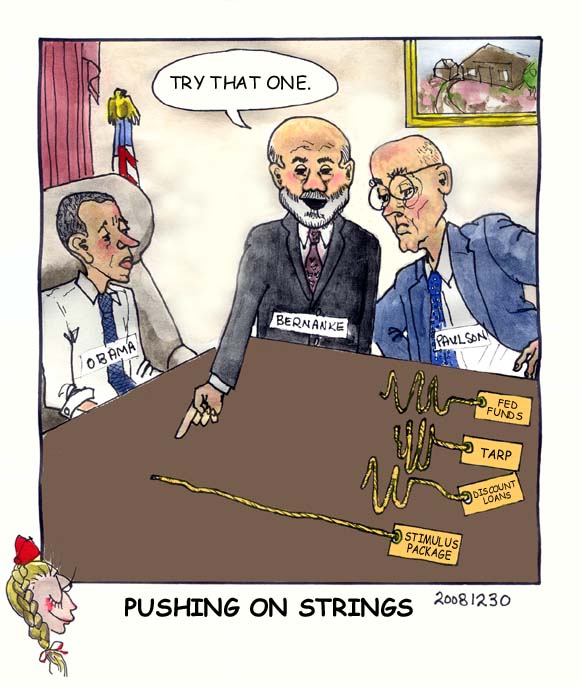
Right on. It's called pushing the string. (See my cartoon on this subject.)

And frankly, I think it would be criminal to deprive us of the benefits of lower prices, whether it be for food, gas, or housing. Lower prices enrich us all.

Personal footnote: I am a commentator, not a researcher. I do not claim to have a Ph.D. in economics. For those readers who would like the academic nuts and bolts under my skepticism, start here, here, here, and here. You will find the deeper research papers accessible on other pages of their website.

Some may object that all of these come from the same think tank, Cato, with its libertarian-oriented research team. This is true. I happen to follow their reasoning on most subjects, having yet to come across a more "progressive" reasoning that can hold a candle to it.

Academics can provide us with some very useful thinking and writing, but they don't have a monopoly on logic. There are many non-academics who have contributed valuable work. There are also academics who have steered us astray. Here are some examples of both:

A few non-academic leaders: Henry George, Mark Twain, Bill Gates (honorary doctorates only), and Benjamin Franklin, to name only four.

Academics who should have had more humility: Robert C. Merton and his economics Nobel Prize partner at LTCM, Myron Scholes; and Margaret Mead, to name only three.

Labels: , ,


Thursday, February 19, 2009

Let Those on the Floor Speak

The country is very divided now about whether or not the "stimulus package" will work. I have already expressed my opinion that it will not, provoking much heated debate among my commentators. I'll be adding more gas to that fire soon.

Meanwhile, I found out today that I'm not the only one who's frustrated with the American people's lack of understanding about the economics underlying the Keynesian spending, government intervention, and wholesale destruction of free-market values (e.g. respect for contracts) that will soon be taking place, the likes of which we have never seen to this degree before, ever.

Listen to these people who have their ear to the ground, the traders in Chicago:

Chicago Traders Video

It's heartwarming to see that there is someone else out there who gets it, even though I can already hear the retort: "But those guys are Wall Street, or the equivalent. They're the bad guys."

It looks like Ben Franklin and the others will continue to spin for a very long time, while Mr. Marx chuckles with glee.

spinningcorpse
[Thanks to Nightviewproductions.com for the image.]

Labels: , ,


Saturday, January 31, 2009

Why Isn't the Market Listening?

You've probably seen the Disney film, Fantasia, in the segment called The Sorcerer's Apprentice. Mickey Mouse is the apprentice, and he decides to use some of the sorcerer's magic while the boss is away. The experience is glorious, until he realizes that he can't control it any more and he finds himself drowning in a self-created flood.

zauberlehrling
[Thanks to Wikipedia.org for the illustration by S. Barth.]

Jean-Claude Trichet, the European Central Bank president, must see the market as a kind of sorcerer who is on his way home to save the day. As the Financial Times tells us (here and here), Mr. Trichet has called on financial markets to "help policymakers rebuild the levels of confidence in the banking system required to kick-start economic growth around the world." He "gave a stark warning to financial markets yesterday to stop putting pressure on banks to hold more capital."

But the market is not the sorcerer. It is the water--neither good nor bad, just flowing, or flooding, or drying up, doing what water does.

Trichet's jawboning reveals that politicians and their appointees, the quasi-government officials, are not part of the solution; they're part of the problem. They are Mickey.

It should be no surprise, then, that Mickey decided in 1913 to take over the powers of the sorcerer by turning a market-suggested financial-market-system convenience--the Federal Reserve clearing house set-up--into a powerful and politically expedient government-like macromanager of our money supply. Nor should it be a surprise when he ends up destroying our economy in the process. (See my article on the Fed, Page 1, Page 2, and Page 3 for more.) He's got the broom now, and things are getting out of hand. Mickey can call on every power he possesses, the water will never heed him.

We shouldn't be disappointed when ordinary humans fail at sorcery. It's not really their fault. Our government agents are themselves part of a bigger "market," in a sense. When we go to the polls and vote for more government intervention in our life, we are expressing our political "market" preference for government sorcery.

In our current crisis, here's an example that shows the pickle their in. This article in the FT says:

"Amid the recrimination and hand-wringing over the causes and consequences of the financial crisis, bankers and policymakers at the World Economic Forum in Davos have identified a new threat to global prosperity: the rise of financial protectionism. The huge state-backed bank bail-outs in Europe and the US, while necessary to prevent a collapse of confidence in the financial system, have forced banks to withdraw from overseas markets in order to concentrate their limited resources at home. ... The sharp reversal of capital flows appears at least partly due to political pressure on banks, especially those that have received large doses of state support, to sacrifice international operations in favour of maintaining lending to domestic consumers and companies. For governments attempting to explain their decision to commit hundreds of billions of taxpayers' money, this is an understandable response."

Likewise, when our factory workers start to hurt, the government becomes protectionist on that front as well. In 1930, Roosevelt's Congress, in response to public pressure to "do something," forced the market to "buy American" by passing the Smoot-Hawley Tariff Act. This Tariff turned out to be one of the main reasons the country didn't recover from the Great Depression until a decade later.

Here's more evidence of the public's growing protectionist spirit in the form of restrictions on purchases of steel with the stimulus package. (At press time, Obama seems to be rethinking this, but he will have to disappoint his base to do anything about it.)

Another example of forthcoming problems for the Sorcerer's Apprentice: The stimulus package won't work the way it's intended. You can't force banks to lend by throwing money at them, because as one banker put it, paraphrased by the Financial Times, "it is difficult to make loans to companies and individuals as most new lending would be loss-making and end up burdening their balance sheets with further writedowns." (FT Article.)

You can't buck the market. Nor can you force home buyers to buy when they know darn well prices will go down even more. Furthermore, when the government borrows money to spend on its own projects, it takes it away from the very people it is trying to help: capital-starved small businesses.

If we step back for a better perspective, clearly we are confronted with a culturo-political phenomenon: People have turned to government to cure a problem of government's own making. That's like asking Apprentice Mickey to solve the water problem.

There is one natural market phenomenon that will get Mickey back onto dry land in the longer run. It is a return to some form of a gold standard. This standard evolved in the marketplaces of the world over the centuries, and it would exist today if government agents had not decided to force their citizens to abandon it by declaring paper money to be our only legitimate legal tender.

Labels: , , , , ,


Saturday, January 17, 2009

Reality Check: The Government Stimulus and Bail-Out Plan

Today is a cartoon about the government stimulus and bail-out packages. I think it's self-explanatory. (Click on the image for a larger version.)

Labels: , , , ,