Taylor's (and Friedman's) Error
In a book review by Clive Crook in todays Financial Times, we read about the new work Getting Off Track by John Taylor, creator of the "Taylor Rule" for monetary policy. According to Taylor, if the Federal Reserve had followed his famous Rule instead of their own discretion over the last decade, we wouldn't be in the mess we're in today.
Taylor's Rule gives a mathematical formula for the calculation of monetary policy. As Crook describes it:
"The rule says central banks should set the short-term interest rate equal to one-and-a-half times the inflation rate; plus half of the gap between actual and trend gross domestic product; plus one. For example, if the inflation rate is 5 per cent and the output gap 3 per cent, the Taylor rule says make the interest rate 10 per cent: one-and-a-half times 5, plus a half of 3, plus 1."
His idea is similar to the formula of Milton Friedman, which at one point economists called the "k-percent rule." Friedman would have had the Fed increase the money supply annually by a fixed percentage. He is essentially Taylor's precursor.
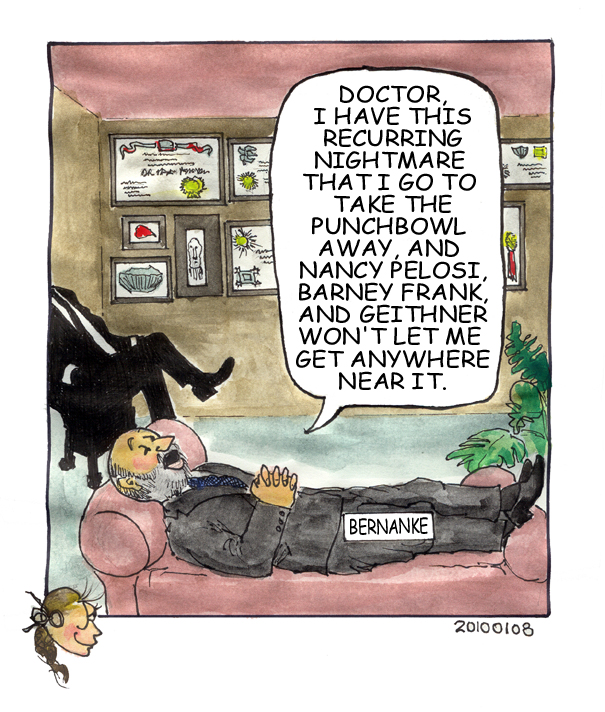
Both economists advocated a fixed, formulaic determination of the expansion of money supply because they were wary of a discretionary monetary policy open to the whims of central bankers and the politicians who appoint them.
Where both these illustrious gentlemen err is in their naive belief that any political appointee(s) would be capable of limiting themselves to a non-discretionary monetary policy once they have the power not to.
In a July 2006 e-mail exchange with the Wall Street Journal's Tunku Varadarajan, Friedman wrote: "There are certainly occasions in which discretionary changes in policy guided by a wise and talented manager of monetary policy would do better than the fixed rate, but they would be rare." WSJ Archives.
Rare indeed. Didn't he realize that "rare" is in the eyes of the rate-setter?
Friedman's incongruous naivety is at odds with his skeptic personality. In his own book Capitalism and Freedom, he says:
"As matters now stand, while this rule [the k-percent rule] would drastically curtail the discretionary power of the monetary authorities, it would still leave an undesirable amount of discretion in the hands of Federal Reserve and Treasury authorities with respect to how to achieve the specified rate of growth in the money stock, debt management, banking supervision, and the like."
So why does he even bother with the k-percent rule in the first place?
Both Friedman and Taylor seem to be aware of the fallibility of agency intervention into the supply of money; and yet, inexplicably, both seem in the end to take for granted that the agency in question will be willing to renounce discretion when push comes to shove.
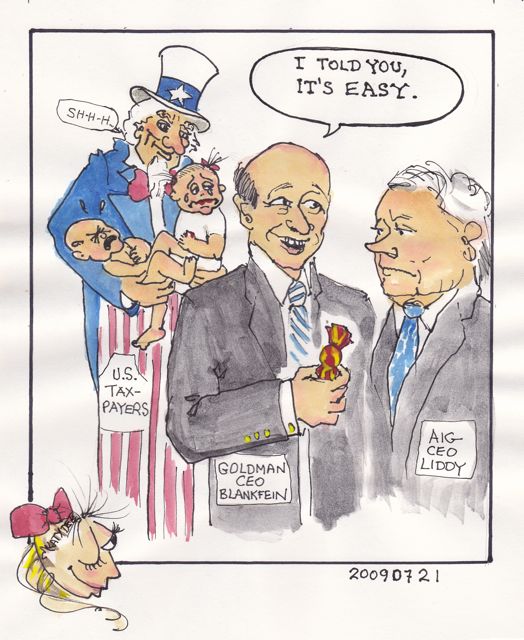
This is equivalent to sitting two-year-old Dick and Jane in a room with a big box of chocolates, telling them they can have only one each, then leaving the room. It just won't work.

[Thanks to www.lib.udel.edu, the Univ. of Delaware Library, and The New Fun with Dick and Jane, Chicago: Scott, Foresman and Co., 1956.]
And it's not Dick or Jane's fault. Dick and Jane are only two years old. Monetary policymakers are just humans. Humans are control freaks. They are tinkerers. It is a rare economist who, once appointed to the position of Federal Reserve Board Member, can look deep down inside existing economic science and declare the truth of what he finds, i.e. that no one knows how to control monetary policy, with or without a formula.
For one illustration of the mindset of our FRB Members, read this speech by Governor Mishkin. It's an eye-opener, revealing just what the more rational economists like Taylor and Friedman are up against. These Governors see themselves as monetary artists, not scientists.
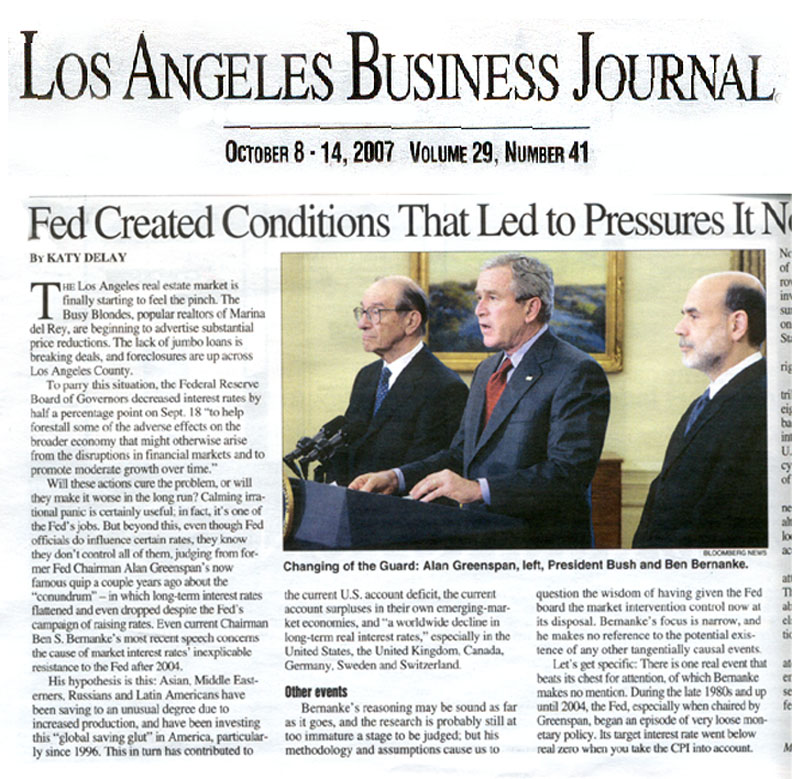
For a second example of Federal Reserve mindset, take a look at this astonishingly self-serving article by Alan Greenspan in the Wall Street Journal last month. We perceive between the lines that there's a nasty feud going on between Taylor and Greenspan, and rightfully so. Taylor is Jane's older brother (he's six) and Greenspan is little Dicky.
Now children: I guess we'll just have to take that box of chocolates away, now won't we? (Gold standard and sound commercial banking, anyone?)
Taylor's Rule gives a mathematical formula for the calculation of monetary policy. As Crook describes it:
"The rule says central banks should set the short-term interest rate equal to one-and-a-half times the inflation rate; plus half of the gap between actual and trend gross domestic product; plus one. For example, if the inflation rate is 5 per cent and the output gap 3 per cent, the Taylor rule says make the interest rate 10 per cent: one-and-a-half times 5, plus a half of 3, plus 1."
His idea is similar to the formula of Milton Friedman, which at one point economists called the "k-percent rule." Friedman would have had the Fed increase the money supply annually by a fixed percentage. He is essentially Taylor's precursor.
Both economists advocated a fixed, formulaic determination of the expansion of money supply because they were wary of a discretionary monetary policy open to the whims of central bankers and the politicians who appoint them.
Where both these illustrious gentlemen err is in their naive belief that any political appointee(s) would be capable of limiting themselves to a non-discretionary monetary policy once they have the power not to.
In a July 2006 e-mail exchange with the Wall Street Journal's Tunku Varadarajan, Friedman wrote: "There are certainly occasions in which discretionary changes in policy guided by a wise and talented manager of monetary policy would do better than the fixed rate, but they would be rare." WSJ Archives.
Rare indeed. Didn't he realize that "rare" is in the eyes of the rate-setter?
Friedman's incongruous naivety is at odds with his skeptic personality. In his own book Capitalism and Freedom, he says:
"As matters now stand, while this rule [the k-percent rule] would drastically curtail the discretionary power of the monetary authorities, it would still leave an undesirable amount of discretion in the hands of Federal Reserve and Treasury authorities with respect to how to achieve the specified rate of growth in the money stock, debt management, banking supervision, and the like."
So why does he even bother with the k-percent rule in the first place?
Both Friedman and Taylor seem to be aware of the fallibility of agency intervention into the supply of money; and yet, inexplicably, both seem in the end to take for granted that the agency in question will be willing to renounce discretion when push comes to shove.
This is equivalent to sitting two-year-old Dick and Jane in a room with a big box of chocolates, telling them they can have only one each, then leaving the room. It just won't work.
[Thanks to www.lib.udel.edu, the Univ. of Delaware Library, and The New Fun with Dick and Jane, Chicago: Scott, Foresman and Co., 1956.]
And it's not Dick or Jane's fault. Dick and Jane are only two years old. Monetary policymakers are just humans. Humans are control freaks. They are tinkerers. It is a rare economist who, once appointed to the position of Federal Reserve Board Member, can look deep down inside existing economic science and declare the truth of what he finds, i.e. that no one knows how to control monetary policy, with or without a formula.
For one illustration of the mindset of our FRB Members, read this speech by Governor Mishkin. It's an eye-opener, revealing just what the more rational economists like Taylor and Friedman are up against. These Governors see themselves as monetary artists, not scientists.
For a second example of Federal Reserve mindset, take a look at this astonishingly self-serving article by Alan Greenspan in the Wall Street Journal last month. We perceive between the lines that there's a nasty feud going on between Taylor and Greenspan, and rightfully so. Taylor is Jane's older brother (he's six) and Greenspan is little Dicky.
Now children: I guess we'll just have to take that box of chocolates away, now won't we? (Gold standard and sound commercial banking, anyone?)
Labels: Alan Greenspan, economic humor, economics, John B. Taylor, Milton Friedman, monetary policy
posted by Katy Delay at 4:18 PM
1 comments