Thursday, April 16, 2020

What Does This Crisis Mean for the Economy's Future?

Recently, someone asked me three questions:
  • Who is going to pay for the government's handouts once this virus episode and economic standstill have passed?
  • What kind of price inflation might we be looking at over the coming months?
  • What should a person be doing today?
It inspired me to write an article that Seeking Alpha decided to publish. It is here.

I hope you will find it of interest.

Labels: , , ,


Saturday, July 14, 2018

The Theft Is Now Official Policy

The Federal Reserve has just published a report stating that it will continue to use new policy tools to control interest rates.

As stated in the Wall Street Journal, "The Federal Reserve defended having the flexibility to set interest rates by using relatively new tools that include paying interest to banks, in its semiannual report to Congress on Friday."

For those of you who are subscribed, see the whole article here.

Creating money and inviting the banks to park it at the Fed, with interest, is theft, in my opinion.


[Thanks to gionalepop.it]


Have you any savings at all?  (Hopefully.). Have you noticed the rate of interest you are earning?  (Probably less than 1 percent unless it's in a CD.)  Have you also noted the official (never mind the unofficial) rate of price inflation currently?  (It's creeping towards 3 percent on an annual basis.)

That's a minimum of 2 percent loss of purchasing power per year, when the banks should be competing for our savings.

So who wins in this new Fed game?  The bankers and speculators.  Who loses?  Those who can least afford it, the forgotten men and women of the Western world.

What an embarrassment.

Labels: ,


Tuesday, May 27, 2014

Time to Put the QE Genie Back In Its Bottle

Price inflation seems to be right around the corner, if it isn't already here, which means that the Federal Reserve may soon have to put their QE genie back in its bottle.  At least that's my hope, for the sake of our children's future.

[Thanks to DinoRentosStudios.com for the image.]

The only problem is:  The economy isn't cooperating.  Employment figures, never mind the full-time work force, are stubbornly refusing to increase.  Jobs are not appearing as hoped.  And GDP is not up to expectations.

Hence, the Fed will be faced with a quandary.  And I can't wait to see what happens.  Please click on this link for some further thoughts on the subject.

Labels: , , , ,


Wednesday, November 27, 2013

Bubbles or No Bubbles?

I have vented my unscientific opinion about the existence of asset bubbles in our economy.  If you are interested in this subject, please be so kind as to click on the following link:

Asset Bubbles, How Do I Love Thee?


Labels: , , ,


Monday, April 01, 2013

Fed Policy and Asset Bubbles

I am convinced that our Federal Reserve Bank's current monetary policy is hurting our economy in a number of ways.  One of these is its effect on the business sector.

I have no proof, being the gadfly that I am; but I have an argument.  I have laid out the tenets of my hypothesis in my latest Seeking Alpha article.  (Please click on the link.)

Labels: , , ,


Sunday, January 09, 2011

Price Shock: M&Ms hit 99 cents a pack!

Doing a bit of shopping the other day, I was horrified to find my staple pack of M&Ms up to $1.29 at Office Depot. Stunned into a reality check, I decided to find out what the current supermarket price is. It's 99 cents.

Most of us look at the items we purchase regularly as an indication of how prices change. The price of M&Ms is my own personal CPI indicator. To take this particular item in a pseudo-scientific study (click on the image for a larger version):

MM

- When I was an adolescent in the 1960s, a one-portion pack was 5 cents.

- I remember a few years later when the pack size began to vary a lot. Mars and the other candy makers started offering Jumbo Packs with twice as much for three times the price and other hoaxes like that, so they could hide the price increase.

- My next statistical indicator comes from the mid- to late-1990s when I owned a small coffee shop and market. I sold my M&Ms portion pack (who knows how many ounces by this time) for 55 cents.

- Today, ten years later, they're at 99 cents, almost double.

Something's happening.

Moving to my reliable source of price inflation information, AIER.org's Cost-of-Living calculator calculates that my 5-cent candy in 1955 should be priced at something like 41 cents today, assuming the portions are approximately the same. Of course, they may not be; but in your estimation, in which direction would the portions vary? Larger, or smaller? Well, let's not denigrate the candy companies. Let's just say that the ounces are the same.

So, I conclude that my M&Ms have increased in price at a rate of double the national average. Which brings me to the subject of the coming world food crisis.

According to Robert Zoellick, the President of the World Bank Group and the fellow I heralded for having dared to bring up the dead subject of the gold standard, the world can take many steps to "put food first." The G20 should "empower the poor" to ensure "the availability of nutritious food." In his piece in the Financial Times of January 6, 2011, world governments can and should take eight steps to achieve this goal in face of rising food prices.

The steps include improvement of weather forecasting (good luck), exempting "humanitarian food aid from export bans" (good luck), establishing "small regional humanitarian reserves in disaster-prone, infrastructure-poor areas (good luck), and helping "smallholder farmers become a bigger part of the solution to food security" (good luck).

I thought Mr. Zoellick had a grain of good common sense when I read his piece about gold's helpful role as a barometer of worldwide inflating. He is letting me down. If I read correctly from this article, he is just another bureaucrat ... but how silly of me. What was I expecting from someone at the World Bank?

Why doesn't he see that the price of sugar is not a supply problem? It is a monetary problem. If it were a supply problem it would be the only commodity with a rising price. However, as the charts reveal, all commodities are rising to record levels, with few exceptions. Take a look at this chart from Indexmundi.com.

There is no question but that the world is headed into a food price crisis. But my analysis of the problem does not point to governments or government agencies as the solution. The real long-term solution lies in finding an anchor for the world's monetary units, whether it be gold or something else.

More close to home, the question, as I have said before, is: Will this wave of commodity price increases translate into a CPI index rise in the U.S.? We have already got higher gasoline prices, and now higher M&M prices. Will it spread to everything else?

That depends on several factors: (1) the turn of U.S. political winds; (2) the health of U.S. and European banks, which in turn depends on the health of the real estate/banking sector in the U.S. and the PIIGS situation in Europe; and (3) the effect of the above on the interest rate markets, which in turn will have an effect on (2).

Some analysts expect the Fed's and other central banks' monetary actions will produce widespread price inflation worldwide. But this can happen only if the deflationary hot air can blow out of depressed economies. What if (1), (2), and (3) turn negative? And/or what if the deflationary pressures underlying our current crisis turn out to be ongoing? The Fed can "print" all it wants, but it cannot (a) force prices up, or (b) force interest rates down against the will of the gods of markets.

This is the infamous rock-and-hard-place I have mentioned in previous posts. My slow-motion movie climax is approaching. Keep your eyes open over the next few months.

Labels: , , , ,


Friday, January 08, 2010

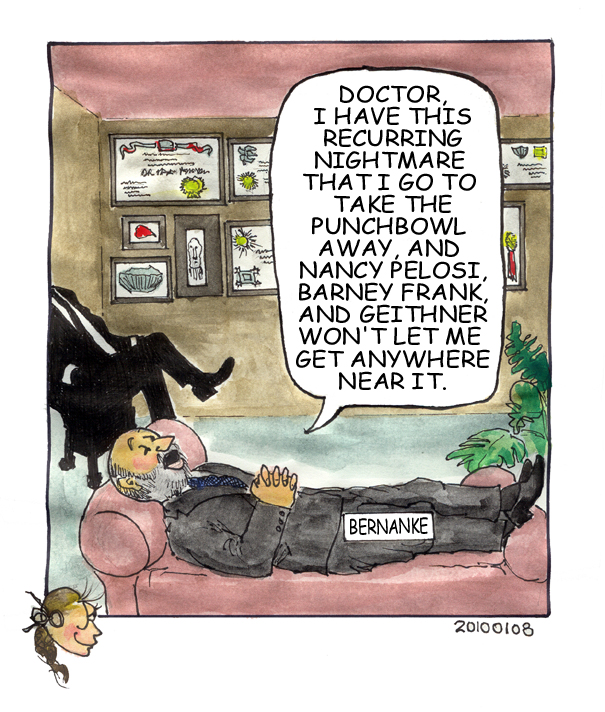
Bernanke's Moment of Truth

Once again, Bernanke is the object of my funny bone. The day is coming soon when his mettle will be tested.

(Click on the image for a larger version.)


Labels: , ,


Monday, January 04, 2010

But Ben, A Bubble Has No National Boundaries

Ben Bernanke is showing himself to be more of a Big-Government politician than a scientist. In his latest speech, he has tried to defend the actions of his predecessors by claiming that their easy-money monetary policy only holds five percent of the responsibility for the high real estate prices that ignited the boom-and-bust bubble that almost broke the back of the global economy.

According to his analysis, 30 percent of the responsibility goes to what he has been calling the "global savings glut." The other 65 percent, he says, belongs to the inferior standards of the US mortgage market. Therefore, his argument seems to be saying that if we cure the standards we cure the problem.

He attempts to prove his point by demonstrating through charts that other countries had even looser monetary policy than the US, and yet they did not show a worse real estate boom; therefore, he concludes, loose monetary policy does not cause bubbles.

This sounds convincing, coming as it does from the highest-placed economic academician in the land. But his logic is flawed.

There are two problems with his argument. First, you cannot isolate these particular variables as he has done. To do so is the equivalent of saying Michael Phelps eats a lot, and he is not obese, therefore a high-calorie diet does not cause obesity. (Michael Phelps is the Olympic medalist swimmer who purportedly eats around 8,000-10,000 calories a day. A scientist could probably prove that he also spends almost 8,000-10,000 calories a day in his sports activities.)

pancake
[Thanks to Allfavoriterecipe.com for the image.]

Second, although Bernanke seems to accept the wisdom that a nation's monetary looseness can create excess purchasing media that can then chase relatively fewer goods, he doesn't seem to admit that there is no economic law that restricts a purchasing media's use to its country of origin, at least not in an immediate temporal sense.

Although US dollars must ultimately come to roost back in the US, they may station themselves in any number of places for many years (to wit, China's Current Account Surplus, for example) before they find their way here; and while so stashed, they can be used as collateral for any number of ventures in the meantime, in any currency--say, for example, to buy Spanish pesetas to be invested in Spain's real estate boom.

By the same token, a loose yen, for example, can go on a bubble-blowing spending binge in the US through the carry trade (borrowing in yen to obtain dollar-denominated instruments, or even cash dollars).

Bernanke's effort is a perfect example of the econometrician's Achilles Heel: narrow-sightedness. Markets are fluid, complicated, convoluted, multifaceted mishmashes of changing signals and events. For his analysis to work it must include a variable for each relevant event, not just an isolated one or two.

I find it strange that high-powered government officials feel justified in using such flawed science to defend themselves, even if they were to claim they do it for some lofty cause like the preservation of market confidence.

Labels: , , ,


Monday, December 28, 2009

Keynes's Blind Spot: Consumption is Production Shared

Bret Stephens has written a nice opinion piece in the Wall Street Journal of December 23. He cites poet Rudyard Kipling and author George Melloan who wrote The Great Money Binge: Spending Our Way to Socialism.

Melloan's work, according to Stephens, shows "in exacting detail, not only how we came to our current crisis--thank you, Barney Frank, Chris Dodd, Alan Greenspan and Tom DeLay--but where [their flawed logic] is destined to take us again."

All four of these politicians--yes, Greenspan is one of them--seem to subscribe to Keynes's theory of what some have called "demand-side economics." This theory says that consumption is the answer to an economic bust cycle, and that it's okay to create the credit to pay for it through central-bank-created funny-money.

Stephens, citing Melloan I presume, and parodying Kipling, counters Keynes's theory using the supply-siders' argument:

"'[C]onsumption must be paid for with production" ... if you don't work (i.e. produce) you die (i.e., can't consume)."

boycook
[Thanks to Allposters.com for this image.]

Stephens and Melloan have understood the evils of Keynesian spending-for-prosperity, to be sure; but they have missed an essential point, which is this:

Consumption is purely a mechanism by which producers share among each other what they have already produced.

(See this post and the subsequent two posts for a more detailed example of this process.)

You see, production and consumption are two sides of the same coin, and production always comes first. One is given life by the other. Consumption cannot exist without production. We divide our production among ourselves on a global basis through the exchange among ourselves of small or large portions of what each of us has produced; and this action is called consumption.

We have gotten a distorted picture of this process, because often we see something we want and we think we have to work to procure the money to buy it. However, in reality the production of that thing came first, and the producers of that thing took their share of the product they produced by accepting a sort of warehouse receipt we have collectively come to label "money" instead of the produced thing itself. When we go to work, we simply become part of the exchanging group, much as a poker player buys chips to participate in the game.

Keynes obviously did not agree with this idea. He wrote as though he believed money has become a tool to be manipulated by politicians and their academic agents, as though it were a vague exchange medium representing nothing more than grease facilitating the performance of our monetary machine.

Like most people, Keynes also confused money (actual warehouse receipts, representing a share of production) with credit (a promise to repay a certain amount of warehouse receipts). Credit is not the warehouse receipt itself, but rather an expectation to receive warehouse receipt(s) within a specific timeframe, based upon the lender's faith that the creditor will hand over warehouse receipts in the short-term, when he or she has actually produced something and receives warehouse receipts as payment (or sells something he or she already owns).

Problems arise when credit promises are not fulfilled. For example, banks sometimes issue credit to market participants over and above producers' capacity to sell. Our current monetary system actually encourages banks to do so to an excessive degree, for reasons that I have treated elsewhere. (See this article, Page 1, Page 2, Page 3, for example.)

It is normal that at some point in every business cycle, banks will become overconfident and begin over-expanding credit by making bad loans. As a result, producers will manufacture (and sellers will purchase, stock, and try to sell) excess production. Under a healthy banking system, slower sales cause sellers' inventories to rise. As a result, they stop ordering, producers stop producing, and things return to their original equilibrium.

However, in an imbalanced banking system, credit starts to circulate, which means that buyers keep buying, profits keep rising, and sellers keep selling at higher and higher prices (too much money chasing too few goods). Producers receive increasing orders and on that basis get even more credit from the bank. They hire more workers, creating a misallocation of labor.

Then, with profits rising inordinately, a speculator instinct wakes up inside some otherwise normal businesspeople. These market players realize that instead of working, they can make lots of easy money borrowing credit, gambling on the stock market, betting on derivatives, playing the foreign-exchange gambit, or flipping real estate, i.e. making fast profits producing nothing.

Bad credit begets bad credit in an ever-climbing spiral. The boom game has begun, misallocating huge sums of what appears to be real money (warehouse receipts), but which in fact is only bad credit.

Then one of the sectors hits a snag. Very often it starts in the financial sphere when someone over-bets his credit. He can't pay; the bank calls his loan. His creditors don't get paid. When this mini-bust occurs, it infects other sectors that depend upon the flow of easy credit collateralized by real or imaginary profits.

Much misappropriated "wealth" just disappears into thin air, which is actually where it came from; but unfortunately ordinary people also suffer as producers of speculative production go bankrupt and misallocated workers lose their jobs.

Fearful people stop consuming until the bad credit is gone and equilibrium returns. This is the normal process, and if left alone it can take several painful months to wind itself down.

But Keynes and today's central bankers think they can outsmart the process. I can hear Keynes say, "Wait a minute. The warehouses are full and people are simply not buying. The wealth seems to be there, because production has already taken place. Somehow, the 'warehouse receipts' have been stashed, or misplaced, or destroyed by the bust mechanism, and all that is needed is for the central bank to prime the pump."

What he doesn't realize is that this Keynesian "solution" just creates more bad credit and throws it at consumers who--quite properly--just don't want to consume. This time, bad credit comes from both the Federal Reserve and the Treasury in the form of zero-interest loans, "stimuli," government purchases of private companies like AIG, and bank bail-outs, which further misallocates money distribution away from the real economy (that can't absorb it) and towards the speculators who know how to play what has now become a funny-money political game. While this is going on, the serious participants in the economy are laying low with uncertainty, wondering what the Fed, the Treasury, plus the IRS, Congress, the EPA, and all the other alphabet agencies, will do next.

Kipling, Stephens, and Melloan seem to understand this game and have tried to call the politicians' bluff. But the politicians will ignore them, because they have found they can fool most of the people most of the time, and a few they can't fool can be bought.

And this game of Pied Piper goes around and around until the people take back control of their money. And they are doing so, through the purchase of gold, gold-related instruments, and other such store-of-value investments. Hopefully, they will not let the government take that right away from them.

Labels: , , , , ,


Friday, December 11, 2009

Bernanke Credibility

Bernanke is always a good target for a cartoon, especially now. So here's my latest.

(Click on the image for a larger version.)


Labels: ,


Saturday, June 06, 2009

Angela Merkel, Lone Ranger

Among all of the Heads of State, Ms. Angela Merkel is the only one with the courage to denounce the policies of the world's most powerful central bankers, Ben Bernanke, Mervyn King, and Jean-Claude Trichet. Bertrand Benoit's piece in today's Financial Times describes the important ending of her otherwise uninteresting speech Wednesday.

loner
[Thanks to Costumeco.com.au for the photo.]

She gave "a vitriolic attack on the world's three mightiest central banks"--something which she has never done in the past. People who know her well confirm that it was no slip of the tongue, that she is always careful to mean what she says and say what she means. She said that she is "sceptical" about the powers of the US Fed to control the flood of purchasing media and credit they continue to create, alongside their European counterparts.

According to those who surround her, she "does not blame the implosion of the subprime mortgage market for the economic crisis. She does not see securitisation as the culprit. Rather, she thinks the loosening of monetary policy under Alan Greenspan's Fed chairmanship fuelled the creation of asset price bubbles and encouraged excessive leverage within and beyond the financial sector." [You and my spell checker will have to excuse the apparent typos, but I'm quoting a British text.]

She reminds me of Mrs. Thatcher back when the English Prime Minister touted the economics of the Austrian, Professor Hayek, who if he were alive today would surely agree with both ladies about the origin of our problems.

This recession is being described as a quadruple whammy: The first round seemed to come from the imaginative excesses of the residential mortgage market and the Wall Street math geeks who played with them. The second is coming now from the equally imaginative over-expansion of the commercial development financing market and is undermining some major banks' already fragile balance sheets. The third will soon appear within the retail credit sector. And the fourth is the credit derivatives wild card.

The source of all four, however, according to Merkel, Hayek, and me, is the combined actions of the monetary and fiscal authorities, (1) whose decisions are not predictable, (2) who have too much power to distort our money supply, and (3) whose constant interventions can and will, everywhere and always, throw even the best-performing economies into havoc.

What makes this even worse is that omnipotent power attracts those who would profit from it. Just listen to the big market players--the seemingly indestructible huge banks and automobile companies--as they turn their sheepish bahs towards Washington. (Try out this website to hear what this sounds like.)

We are approaching an interesting crux of this recession. Economists and market players alike are split into two camps: those who think the principal danger (or speculative opportunity) is depression and deflation, and those who think it is inflation.

I'm in the inflation camp, alongside Ms. Merkel. I don't know whether the coming series of monetary bubbles will take one year or ten to appear and burst; but I feel very sure they are coming. When it comes time to pull the punch bowl away, this Fed will be no stronger than any other has been in the past (with perhaps the exception of Paul Volcker, but how short-lived his wisdom was). Our Fed governors' task will be complicated by their lack of real control of interest rates: Just when they will want to reign in credit, the rates will go up, putting them in a quandary.

As far as I know, and in the longer run, there has never been a nation in history that has survived the chronic debasement of its monetary unit. Ironically, this time it's Germany (or at least her Head of State) that seems to be the one ready to speak up. As Ms. Merkel puts it: "The most complicated phase will come when the crisis is over."

Labels: , , , ,


Monday, April 13, 2009

Taylor's (and Friedman's) Error

In a book review by Clive Crook in todays Financial Times, we read about the new work Getting Off Track by John Taylor, creator of the "Taylor Rule" for monetary policy. According to Taylor, if the Federal Reserve had followed his famous Rule instead of their own discretion over the last decade, we wouldn't be in the mess we're in today.

Taylor's Rule gives a mathematical formula for the calculation of monetary policy. As Crook describes it:

"The rule says central banks should set the short-term interest rate equal to one-and-a-half times the inflation rate; plus half of the gap between actual and trend gross domestic product; plus one. For example, if the inflation rate is 5 per cent and the output gap 3 per cent, the Taylor rule says make the interest rate 10 per cent: one-and-a-half times 5, plus a half of 3, plus 1."

His idea is similar to the formula of Milton Friedman, which at one point economists called the "k-percent rule." Friedman would have had the Fed increase the money supply annually by a fixed percentage. He is essentially Taylor's precursor.

Both economists advocated a fixed, formulaic determination of the expansion of money supply because they were wary of a discretionary monetary policy open to the whims of central bankers and the politicians who appoint them.

Where both these illustrious gentlemen err is in their naive belief that any political appointee(s) would be capable of limiting themselves to a non-discretionary monetary policy once they have the power not to.

In a July 2006 e-mail exchange with the Wall Street Journal's Tunku Varadarajan, Friedman wrote: "There are certainly occasions in which discretionary changes in policy guided by a wise and talented manager of monetary policy would do better than the fixed rate, but they would be rare." WSJ Archives.

Rare indeed. Didn't he realize that "rare" is in the eyes of the rate-setter?

Friedman's incongruous naivety is at odds with his skeptic personality. In his own book Capitalism and Freedom, he says:

"As matters now stand, while this rule [the k-percent rule] would drastically curtail the discretionary power of the monetary authorities, it would still leave an undesirable amount of discretion in the hands of Federal Reserve and Treasury authorities with respect to how to achieve the specified rate of growth in the money stock, debt management, banking supervision, and the like."

So why does he even bother with the k-percent rule in the first place?

Both Friedman and Taylor seem to be aware of the fallibility of agency intervention into the supply of money; and yet, inexplicably, both seem in the end to take for granted that the agency in question will be willing to renounce discretion when push comes to shove.

This is equivalent to sitting two-year-old Dick and Jane in a room with a big box of chocolates, telling them they can have only one each, then leaving the room. It just won't work.

DickJane
[Thanks to www.lib.udel.edu, the Univ. of Delaware Library, and The New Fun with Dick and Jane, Chicago: Scott, Foresman and Co., 1956.]

And it's not Dick or Jane's fault. Dick and Jane are only two years old. Monetary policymakers are just humans. Humans are control freaks. They are tinkerers. It is a rare economist who, once appointed to the position of Federal Reserve Board Member, can look deep down inside existing economic science and declare the truth of what he finds, i.e. that no one knows how to control monetary policy, with or without a formula.

For one illustration of the mindset of our FRB Members, read this speech by Governor Mishkin. It's an eye-opener, revealing just what the more rational economists like Taylor and Friedman are up against. These Governors see themselves as monetary artists, not scientists.

For a second example of Federal Reserve mindset, take a look at this astonishingly self-serving article by Alan Greenspan in the Wall Street Journal last month. We perceive between the lines that there's a nasty feud going on between Taylor and Greenspan, and rightfully so. Taylor is Jane's older brother (he's six) and Greenspan is little Dicky.

Now children: I guess we'll just have to take that box of chocolates away, now won't we? (Gold standard and sound commercial banking, anyone?)

Labels: , , , , ,


Thursday, March 19, 2009

The Inflation Boat Is Leaving the Dock

Last night we learned that the Federal Reserve is going to put into practice its announced plan to buy US government debt. Today's Financial Times article by Krishna Guha gives the gory details.

Everyone knows that this action by the Fed increases money supply, and most are aware that it increases the probability that at some point in the future the amount of money created will be excessive with regard to the actual needs of the marketplace, which in turn will tend to lead us towards a state of price inflation, or bubble inflation. Another article by Javier Blas on the early signs of this in the commodities markets is a fun read on the subject.

As the Fed sees the problem, then, they must feed us with money supply while the banks are frozen in a state of rigor vivus, and then in future, just at the right moment, they will take steps to prevent the normal outcome of price or bubble inflation by reversing the process.

buysell
[Thanks to 1stchoicecufflinks.com for the nice photo.]

This sounds logical. As an obscure economist named Edward C. Harwood wrote during our last episode of purposefully inflationary Federal Reserve intervention ("the ill-fated Operation Twist in the 1960s"), during a time when we were still trying to adhere to a modified form of the global gold standard:

"Once inflationary purchasing media have been placed in circulation, there are two ways in which sound money-credit relationships may be restored: (1) by means of devaluation, that is, reducing the gold weight of the monetary unit so much that the increase in the number of (smaller) gold dollars equals or exceeds what had been the inflationary portion of total purchasing media; or (2) by means of deflation, that is by removing inflationary purchasing media from circulation." [See this article from the American Institute for Economic Research website [AIER.]

Let's take these in order. In the 1960s during the last years of the gold standard era, the word "devaluation" had by definition a specific political action attached to it. We could say it was an official public confession to a previously committed inflationary crime, the central bank's admission of guilt and acceptance of their incapacity to rectify the situation. To devalue a currency was ripe with ominous significance, and central banks were supposed to take pains to avoid the embarrassment by not inflating the currency in the first place.

Today, however, the devaluation of our currency takes place painlessly for most of us (except for importers), and effectively the Fed gets away with it on a regular basis. In fact, without a gold or any kind of standard, the inflationary purchases of debt instruments that the Fed has already made, plus those it intends now to make, are already devaluing the dollar as I write. We don't have to wait for an official recognition and adjustment of any standard; it just happens on a day-to-day basis.

Under these circumstances, an official announcement of devaluation, therefore, will have no corrective effect. Quite the contrary, inflation will take place simultaneously with the devaluation of the dollar--a double whammy, if you will.

But we don't want prices to skyrocket, so the inflation will still need correction. Let's turn to the other option, deflation. Paradoxically, the Fed is taking its present inflationary action to fight fear of deflation. They are afraid that a banking panic and a lack of credit could cause the system to collapse in what is called a "deflationary spiral." So it will be a while before they feel comfortable with using the deflationary tactic.

Nevertheless, the Fed scientists and governors do believe that it will be possible for them, at some appropriate moment in the future, to begin a controlled deflation of money supply that will not upset the apple cart.

Harwood does write this about the possibility of a controlled deflation:

"That a period of gradually declining prices can be a period also of great economic growth has been amply demonstrated in the past. For example, between 1875 and 1895 while prices decreased substantially, the Nation's productive capacity and output of goods and services increased at a very rapid rate. The often heard assertion that an economy cannot grow unless prices are rising has no basis in fact....

"With gradual deflation, a longer time would be required to eliminate all inflationary purchasing media and reach an equilibrium between the remaining (noninflationary) purchasing media and prices and wages, but the traumatic events that are a feature of rapid deflation would not occur. The Nation would 'outgrow' the inflationary condition as part of the savings of individuals, businesses, and perhaps of the Government were used to pay off inflationary bank loans and thereby cancel both the loans and the checking deposits that the loans had created. Although gradual deflation would be accompanied by decreasing prices, wages almost certainly would decline less or might even be sustained by greater productivity due to technological and other developments."

(For more on why deflation is not always bad thing, read this research by David Beckworth at Cato.)

So it would seem that a gradual well-timed deflation is what Bernanke and his cohorts are counting on. But... there are a few minefields here. One is that we are no longer on a gold standard. We have no point of reference as to where the dollar should end up. I won't go into the reasons why this makes Bernanke's task more difficult, but it does.

Second, how will we know when prices begin to inflate or when bubbles start to form? Alan Greenspan is famous for having remarked that it is impossible to detect when a bubble is appearing. It's true that we all knew the real estate mania was a bubble (or at least I did; didn't you?), but our financial wonks at the Fed either preferred not to recognize it or couldn't prove it to their own satisfaction, at least not to a point where it would have forced them to take action. (I'd add that they may have had incentives not to want to find reasons to take that action, but that would be unfair speculation, so I won't.)

And what if prices remain the same? Does this necessarily mean that we don't have an inflationary maladjustment in the money supply that maintains prices at an artificially stable but too high level? What if the stimulus package spending turns out to be wasteful to some significant degree? Isn't that like blowing bubbles? Example: Bailout-funded Wall Street bonuses.

Third, and here's the real rub, we have not practiced what Harwood calls "sound money-credit principles" since the Fed was created. These principles mandate a specific equilibrium in the commercial banking system between true reserves, deposits, savings, and short-term commercial paper on the one hand; and loans and investments that are speculative and/or based only on some form of collateral, on the other, where these more risky activities would be allowed only outside the strict commercial banking system. (For more on sound commercial banking, find a copy of Harwood's book "Cause and Control of the Business Cycle," 1974 edition, at your local library, or in the AIER catalog. I will delve into the idea of sound money-credit banking in a future blog.)

Fourth, the Fed cannot reverse its current trajectory and start to take deflationary action until the time is right and the worst of the credit crisis is past. Will nothing unexpected disturb their plans? They are relying on deflationary scenario computer models where "all else is equal," meaning when outside factors remain stable. What if the market does something surprising that will make a controlled deflation either inadvisable or even impossible, at the very moment when it must happen? For example, US treasury bonds could become radically less popular among our foreign buyers as a result of the dollar devaluation the inflation will cause; and as nations all over the world scramble to inflate their own currencies, we may find that we have a lot of competition in the bond market.

Personally, I'm betting (and I disclose that I have put a little money where my mouth is by investing in gold-related products) that the Fed will be hard-put to time and measure the controlled deflation.

Why gold? Because, as I've said many times: You can take gold out of the standard, but you can't take the standard out of gold.

Labels: , , , , , , ,


Sunday, December 28, 2008

Resuscitating Keynes: Oh No, Not Again

Dr. John Maynard Keynes must get tired of being dug up over and over again by economists looking for a mentor in times of crisis.

livingdead
[Thanks to "Return of the Living Dead" for the image.]

I must say, his mistaken formulas sure do have staying power.

Dr. Martin Wolf, writing today in the Financial Times, goes digging again; but it's useless. Why? Because we are not all Keynesians now, even if a US president and Milton Friedman once said we were, probably in a moment of frustration.

In fact, the opposite is true: Keynes's unfounded notions of pushing on a string will subject us all to its deleterious effects today, just it did our ancestors back in the 1930s.

Bailouts, debt financing, government spending, inflating the money supply to save debtors and attempt the futility of restoring failing demand--all have been tried, and all have done much more harm than good.

No, Dr. Keynes did not teach us the following "three broad lessons" in spite of what Dr. Wolf says:

Non-Lesson No. 1

"... [Keynes believed] we should not take the pretensions of financiers seriously. ... Not for him, then, was the notion of 'efficient markets.'"

This is a non sequitur if I've ever seen one. Keynes may have been cynical about bankers; but I bet he'd love to rise from the dead to confirm that he always believed in efficient markets. Where does Wolf get the connection?

Non-Lesson No. 2

"The economy cannot be analysed in the same way as an individual business. For an individual company, it makes sense to cut costs. If the world tries to do so, it will merely shrink demand. An individual may not spend all his income. But the world must do so."

Wolf talks of "the world" as if we were all parts of one entity acting in concert. In fact, each nation is acting as an individual; and each nation's government should act as an individual, i.e. should cut costs, indeed must cut costs when the money is no longer there to pay for them.

A government can only spend money it doesn't have in three ways: borrow it, confiscate it through taxes, or create it. Because we are already a debtor nation we should not do the first; the second will exacerbate the current shortage of discretionary income; and the third will eventually cause the dollar to collapse, thereby leading up to the confiscation of all dollar-holders' purchasing power--not something to do when foreigners hold a good chunk of your debt.

Of course demand is shrinking. You may not have noticed, but the bubble has burst. The demand we once had was a mirage. And you can't revive a nation's economic demand by stuffing it with borrowed or artificial money like the foie gras of some goose--or rather, you can, but it won't work because this goose is dead. You'll get nothing to show for your efforts except a bag of ruffled feathers.

And Dr. Wolf is forgetting that it is not for lack of will that we or our governments cannot "spend all our income." It is the "income" that simply isn't there, unless we attempt to fabricate it out of more monetary helium, which is how we got the bubble in the first place. (See my article, plus page 2 and 3 linked on my blog, for my view on how this happened.)

Non-Lesson No. 3

Now, this is the one that really gets my blood boiling, so I'm going to have to breathe deeply as I punch my keyboard.

"In the 1930s, two opposing ideological visions were on offer: the Austrian; and the socialist. The Austrians--Ludwig von Mises and Friedrich von Hayek--argued that a purging of the excesses of the 1920s was required. Socialists argued that socialism needed to replace failed capitalism, outright. These views were grounded in alternative secular religions [my italics]: the former in the view that individual self-seeking behaviour guaranteed a stable economic order; the latter in the idea that the identical motivation could lead only to exploitation, instability and crisis."

I don't have enough room here to analyze the error in Wolf's statements about the Austrians, but I'll say that the Austrian view of the 1920s is shared by more than one empiricist. I'll just name one: Edward C. Harwood of the American Institute for Economic Research.

To call the Austrians a "secular religion" may have a scrap of truth to it; but that doesn't mean they are wrong about their analysis of the 1920s. Dr. Wolf's criticism is more a statement about their description of their own methodology, rather than their theories; and in fact, the Austrians are quite empirical in their methodology in spite of themselves.

Even if they weren't, the Doctor mustn't throw out the baby.

More erroneous statements

Both Wolf and Keynes continue to err with the following affirmations:

- "[Keynes recognized] that the minimum state was unacceptable to a democratic society with an organised economy." Nothing could be further from the truth. Such a minimum state is unacceptable only to those who claim humans have the capability of organizing such a society's economy, which we can't, to wit our present mess.

- "Keynes would have insisted that ... [m]arkets are neither infallible nor dispensable. ... [T]hey can also go seriously awry and so must be managed with care." Keynes may indeed have so insisted; but no one has yet proven that humans can manage markets, in fact quite the contrary; the more we try to macromanage them, the more markets rebel.

- "The election of Mr. Obama surely reflects a desire for just such pragmatism." The election reflects no such thing. It reflects a slight majority's secular-religious belief in the spread-the-wealth Obama-Messiah, and/or shows an aversion to Bush and anyone like him.

- "The shorter-term challenge is to sustain aggregate demand, as Keynes would have recommended." You cannot sustain what doesn't exist. You can try to recreate it; but you will fail, just as Roosevelt did back in the 1930s. (See "pushing the string," above.) Roosevelt, with Keynes's encouragement, began the monetary inflating that is the scourge of the fiat-money 20th Century.

- "Also important will be direct central-bank finance of borrowers." This is a good way to transfer solvency problems from the private sector to the taxpayer; nothing more, nothing less.

- "A debt-for-equity swap is surely going to be necessary." Bailouts for special interests; nothing more, nothing less--and one of those special interests is politicians themselves, because it reinforces the electorate's belief in the politicians' capacity to "do something about it."

And on and on the good Doctor goes, making one Keynesian mistake after another.

Wolf finishes with a most sappy and hubristic "We must do better. We can do so, provided we approach the task in a spirit of humility and pragmatism, shorn of ideological blinkers."

Oh, gag me with a spoon. Who is the secular-religious one now?

Keynesian economists lack an understanding of simple market dynamics, and of how far the world has distanced itself from them. To blame the free market for 1929 or for our current turmoil is like blaming a train wreck on the train itself, instead of on the inebriated engineer.

Labels: , , , , , ,


Sunday, November 16, 2008

Gold Standard Talk Again

gold
[Thanks to www.australianminesatlas.gov.au for the image.]

Here's another mention of the gold standard. Doug Noland over at Prudent Bear points out this article by Judy Shelton appearing in the Wall Street Journal Saturday.

The pertinent paragraph:

"... [I]f anyone has demonstrated irresponsibility, it is not those who chased misleading price signals in pursuit of false profits -- but rather global authorities who have failed to provide an appropriate international monetary system to serve the needs of honest entrepreneurs in an open world economy.... [T]he inflationary pressures which caused us to go off the gold standard in the first place have only worsened. Moreover, [Paul Volcker] suggests, floating rates undermine the fundamental tenets of comparative advantage.

"[quoting Volcker:] 'What can an exchange rate really mean,' he wrote in 'Changing Fortunes' (1992), 'in terms of everything a textbook teaches about rational economic decision making, when it changes by 30% or more in the space of 12 months only to reverse itself? What kind of signals does that send about where a businessman should intelligently invest his capital for long-term profitability? In the grand scheme of economic life first described by Adam Smith, in which nations like individuals should concentrate on the things they do best, how can anyone decide which country produces what most efficiently when the prices change so fast? The answer, to me, must be that such large swings are a symptom of a system in disarray.'"

Now, if the G20 read this on Saturday morning, they had some food for thought.

Don't get your hopes up, however. Politicians get too much bang for their fiat-currency buck to give it up. A standard somehow set to gold would tie their hands behind their back.

Even if they want to get back to some kind of standard, the present will not be the time to instigate it. Monetary authorities are now pumping as much liquidity and capital as they can into the system, and a standard would put a gold wrench into the works.

We are now on a path where there can be only one of two outcomes:

- Either we inflate out way out of this crisis and we manage to get back to a semblance of calm, at which time the authorities will have to mop up all that excess liquidity or watch it turn into another global bubble that will last who-knows-how-long until another crisis occurs;

- Or there will be a general flight from all fiat currencies to gold, because either panic or renewed inflation settles in. Gold will explode in exchange value in all currencies, eventually to settle at some amount that will represent the market's evaluation of each currency's real gold-exchange worth.

In other words and in my opinion, if we want to stabilize economies in the future, we will have to get back to gold either by the door or by the window, as the French say.

Mr. Volcker will probably be Obama's adviser. What will he suggest? Wouldn't it be ironic if the resolution of our monetary madness came from the big-government left.

Shelton wrote "Money Meltdown: Restoring Order to the Global Currency System." See more on this book at Amazon.

See also this article at the American Institute for Economic Research, and this AIER book on the prospects for a resumption of the gold standard and what it would take; plus this book on gold's role in history.

Labels: , , , ,


Friday, June 13, 2008

France To Subsidize Gasoline (Government Intervention Run Amuck No. 18)

Just when you thought French President Sarkozy's government was getting things right, you learn something like this:

Francois Fillon, the Prime Minister, announced last night that the government will help all wage earners meet the rising cost of gasoline through a direct paycheck subsidy.

Fillon
[Thanks to EnjoyFrance.com for the photo.]

To quote an article published at the French TF1 TV website:

"Francois Fillon announced a 'direct subsidy' for all wage earners to help them meet the rising cost of their commute to work, and he asked that all the social partners [the powerful French unions] come to agreement on the conditions surrounding this transfer." ... "The Prime Minister chose the method of a direct payment that would appear on the paystub of salaried workers." ... "The conditions to receive the subsidy should include the impossibility of using some form of public transport."

(At the same time, he announced the development of plans for new nuclear facilities, a more practical solution. France is way ahead of the U.S. in this domain.)

Recently, France and other European countries have suffered a number of trucking stoppages and public unrest due to the high cost of gas.

Remember that the social system of many European countries needs to be fed regularly, and a good bite comes out of the French gas budget in the form of taxes; so right now a French worker pays almost $10 a gallon, and large transport companies are suffering even more there than here.

Subsidizing gasoline for commuters is:

(1) Robbing Peter to pay Paul (i.e. taking tax money from the truckers and from all consumers and giving it back to some consumers);

(2) Encouraging consumers to buy more gasoline thereby upholding the demand level even at these unprecented prices;

(3) Placing an additional burden on the already heavily indebted French social economy; and

(4) Using counterproductive measures from an economic standpoint, because when high prices don't result in a lessening of demand, the high prices continue (even if the measure is "productive" in the sense that it calms voters' ire).

On a more positive note, hopefully all those gallon-dollars and euros will end up encouraging production and expansion of the energy industries, provided that they don't think this price spiking is an effect of speculation alone (and there is debate about this on all sides).

So you have here a double-whammy of messy government intervention:

- Bubbles in commodity prices probably are caused at least in part by interventionary and loose central bank monetary policy; and

- These efforts to calm the masses through hand-outs that strain public budgets will only be palliative and most likely will backfire.

Good grief. What a mess.

Labels: , , , , ,


Tuesday, June 10, 2008

Expectations Schmexpectations (Example No. 16 of Government Intervention Run Amuck)

I get so annoyed with our central bank governors when they talk about "market expectations," as though these were something they, the governors, controlled by a mere syllable or two, when in fact they don't even know what they are.

orator
[Thanks to Dr. Leila R. Brammer at homepages.gac.edu/~lbrammer/ for the image.]

To get an idea of how truly flakey economists' understanding of inflation expectations really is, read this speech by Supreme Economist Fed Governor Bernanke himself. I applaud his candid approach to this subject; but the vacuum of scientific knowledge is scary when you think that the Fed Board controls the world economy.

Jean-Claude Trichet, the European Union central bank governor, says in his own most recent speech that "inflation expectations must be controlled."

Although Trichet has earned a reputation for putting his actions where his mouth is, Bernanke is now addressing the inflation issue mainly through jawboning, saying things like, "The Federal Open Market Committee will strongly resist an erosion of longer-term inflation expectations, as an unanchoring of those expectations would be destabilizing for growth as well as for inflation."

Okay, talk on. We'll wait for the action.

What the monetary authorities seem to want to brush under the rug is the following point:

Not only the central bankers' words but their anticipated actions have become a part of the market itself.

Here's how it works: The market participants listen to what the central bank governors say, and then they act accordingly.

Now, this doesn't mean necessarily that the market players heed the words. It may mean that they speculate on the effect of the words first, profiting from the immediate market movement; meantime, they have judged for themselves what the actual actions and outcomes of the words will be. They know well that sometimes the actions and outcomes are diametrically opposed to the words our central bankers utter.

For example, when the U.S. central bank governors instruct the market that they intend to "control inflation," the market knows that the general public might believe them and this may cause certain indices to move in the short term. However, for the long term the market players may know better and suspect that the Fed will continue to inflate at the slightest sign of economic trouble.

The words have now have become a signal to some market players that there is profit to be made in the short-term swings of public reaction to the words; but that in the long run, they can expect the opposite actions and outcome.

Speculators take action accordingly. Company management listens to the Fed governors, even using the words as an excuse to withhold pay raises for their employees. After all, they say to themselves, "[d]espite rising energy and food prices, Trichet said it was vital for workers in Western countries to moderate wage increases, which economists regard as the best way to avoid an inflationary spiral."

Okay, so employees must tighten their belt? But why then doesn't this prevent some of the more savvy market players, e.g. management of larger corporations, from skimming off the profit cream for themselves, or from using corporate funds to indulge in speculative activities a la Sears Roebuck?

In this example, it could almost sound as though management and the central bankers are in cahoots against the wage-earning public.

This may sound far-fetched; but it describes pretty much what is going on. Central bankers are asking wage earners to forego a salary increase even though this is supremely unfair given that the speculators and corporate CEOs are reaping record millions.

This means that the average Joe and Jane get stiffed on the pay raise as the cost of their food and gas is doubling. Meanwhile, higher management with their gawdy salaries--and the central bankers with their political hubris--apparently don't see the irony, or the potential dangers.

I've made a point of listing examples of government intervention gone amuck. This has got to be one of the best.

Labels: , , , ,


Thursday, June 05, 2008

Thanks, Bernanke, but I'll Take What You Do Over What You Say

Bernanke has taken up the Volcker challenge and has decided to change tactics.

He is now going to defend the dollar, if we can believe his latest declarations.

Apparently he thinks talking about it will do the trick, i.e. shape market expectations and prevent inflation from taking hold over the longer term. In other words, he's learning how to jawbone, like any self-respecting Federal Reserve Governor should.

jawbone
[Thanks to 24hourmuseum.org.uk for the picture.]

Jawboning is the Fed representatives' technique of influencing speculators and other market participants so that markets move in the direction the Fed desires.

But this will not be enough this time around.

As this excellent editorial in the Wall Street Journal points out so clearly, words alone will not do the trick at this stage in the game. The world has lived through too much political mirror-speak to believe everything our government or its representatives say.

We have seen nothing but dollar trashing over the last several years. Nothing in the Fed's actions to date confirms that the Board has any intention whatsoever of doing what is necessary to stop the decline of the dollar's exchange value and purchasing power. Quite the contrary.

There has been a loosening of the credit spigot and an assumption of moral hazard to an extent never before seen in history. The road backward is a long, exhausting haul that no political animal would undertake without extreme force.

So what do we learn from all of this jawboning? Markets learn; but Fed officials apparently don't.

Labels: , , , ,


Wednesday, May 28, 2008

The Demise of the Big Bear

Read this three-part series about Bear Stearns's last days. It's fascinating. I can't wait for Part 3 tomorrow. I'll add it to this post.

bear
[Thanks to Indymedia.org.uk for the photo.]

Part 1

Part 2

Part 3

This will make a great movie. Hint hint.

Labels: , , , ,


Saturday, May 24, 2008

Ron Paul: The Last of the True Political Economists?

I like Ron Paul. It's a personal thing.

I think I can say this openly and without fear of being closed down by the Election Police, now that he has no chance of winning the election.

ron_paul
[Thanks to the great illustrator David Dees, at Dees2.com and Deesillustration.com for this image. I am now one of Dees's best fans. Take a look at some of his great political satire at this website.]

Given Paul's meek chances of success in his presidential bid, this could in no way be construed as a political endorsement; but just to avoid any appearance of political bias, I will do my best to find qualities in the other candidates--Hillary-Babe, Obama-Rama, and Johnny Mc-See--just to balance out this blog. (If and when I get around to it.)

But Paul just seems to me like my kind'a guy. He speaks from the hip, he doesn't mince his words, and he knows what he's talking about, in most instances. And he reminds me of my father, economist Edward C. Harwood (see Page 7 in the pdf version, that is to say Page 3 in the print version), in that he comes across, and probably is, a man of great integrity.

He also referred to my Dad's American Institute for Economic Research several times over the years in his Congressional speeches. What's not to like, right?

Well, actually, I can find fault with him, for example: Just the fact that he's not electable for the presidency, probably due to what may be misleading signs of physical age and frailty. Don't kid yourself, the man's going to be a centenarian. He's as tough as an old grape vine--has to be, to withstand the stresses of campaigning and holding government office--and will probably be just as ornary and hard to unseat right up until the day he croaks.

Or perhaps his lack of presidential electability is due to the above-said integrity, i.e. he won't conform to the political establishment's demands, which conformation is a prerequisite for their support. More power to him, at least as a human being if not as our president. At least he'll die with his nose clean.

And just to clear up the record, he is not a believer in the 9/11 conspiracy theory, as confirmed in this interview with Glenn Beck; so we can stop wondering if there's a glitch in the man's thinking somewhere.

His principal appeals are that (1) his economic thinking is right on, unlike any other presidential candidate I can think of; and (2) he has a marvelous way of expressing himself that makes even as boring a subject as economics relevant to all of us. In this, he also resembles my economist Dad. [See above link.]

Here are some excerpts from his recent book, Pillars of Prosperity, reprinted at the Mises.org website.


On the recession:

"When the recession hits full force [because he believes it going to hit us sooner or later], even the extraordinary power and influence of Alan Greenspan and the Federal Reserve, along with all the other central banks of the world, won't be able to stop the powerful natural economic forces that demand equilibrium. Liquidation of unreasonable debt and the elimination of the over-capacity built into the system and a return to trustworthy money and trustworthy government will be necessary."

On Federal Reserve monetary policy:

"Deliberately lowering interest rates isn't even necessary for the dollar to drop, since our policy [of over-creation of currency through credit] has led to a current-account deficit of a magnitude that demands the dollar eventually readjust and weaken."


"A slumping stock market will also cause the dollar to decline and interest rates to rise. Federal Reserve Board central planning through interest-rate control is not a panacea. It is instead the culprit that produces the business cycle. Government and Fed officials have been reassuring the public that no structural problem exists, citing no inflation and a gold price that reassures the world that the dollar is indeed still king.

"The Fed can create excess credit, but it can't control where it goes as it circulates throughout the economy; nor can it dictate value either. Claiming that a subdued government-rigged CPI and PPI proves that no inflation exists is pure nonsense. It is well established that, under certain circumstances, new credit inflation can find its way into the stock or real estate market, as it did in the 1920s, while consumer prices remain relatively stable. This does not negate the distortion inherent in a system charged with artificially low interest rates. Instead it allows the distortion to last longer and become more serious, leading to a bigger correction."


On gold:

"If gold prices reflected the true extent of the inflated dollar, confidence in the dollar specifically and in paper more generally would be undermined. It is a high priority of the Fed and all central banks of the world for this not to happen. Revealing to the public the fraud associated with all paper money would cause loss of credibility of all central banks. This knowledge would jeopardize the central banks' ability to perform the role of lender of last resort and to finance/monetize government debt. It is for this reason that the price of gold in their eyes must be held in check.

"From 1945 to 1971, the United States literally dumped nearly 500 million ounces of gold at $35 an ounce in an effort to do the same thing by continuing the policy of printing money at will, with the hopes that there would be no consequences to the value of the dollar. That all ended in 1971 when the markets overwhelmed the world central banks.

"A similar effort continues today, with central banks selling and loaning gold to keep the price in check. It's working and does convey false confidence, but it can't last. Most Americans are wise to the government's statistics regarding prices and the "no-inflation" rhetoric. Everyone is aware that the prices of oil, gasoline, natural gas, medical care, repairs, houses, and entertainment have all been rapidly rising. The artificially low gold price has aided the government's charade, but it has also allowed a bigger bubble to develop. This policy cannot continue. Economic law dictates a correction that most Americans will find distasteful and painful. Duration and severity of the liquidation phase of the business cycle can be limited by proper responses, but it cannot be avoided and could be made worse if the wrong course is chosen."


On the Fed's effectiveness:

"Micromanaging an economy effectively for a long period of time, even with the power a central bank wields, is an impossible task."


"... the Federal Reserve now buys and holds GSE securities as collateral in their monetary operations. These securities are then literally used as collateral for printing Federal Reserve notes; this is a dangerous precedent."


"But the day will come when we will have no choice but to question the current system. Yes, the Fed does help to finance the welfare state. Yes, the Fed does come to the rescue when funds are needed to fight wars and for us to pay the cost of maintaining our empire. Yes, the Fed is able to stimulate the economy and help create what appear to be good times. But it's all built on an illusion. Wealth cannot come from a printing press. Empires crumble and a price is eventually paid for arrogance toward others. And booms inevitably turn into busts."


"Talk of a new era the past five years has had many, including Greenspan, believing that this time it really would be different. And it may indeed be different this time. The correction could be an especially big one, since the Fed-driven distortion of the past 10 years, plus the lingering distortions of previous decades have been massive. The correction could be big enough to challenge all our institutions, the entire welfare state, Social Security, foreign intervention, and our national defense. This will only happen if the dollar is knocked off its pedestal. No one knows if that is going to happen sooner or later. But when it does, our constitutional system of government will be challenged to the core."


On generational forgetfulness:

"Thomas Jefferson was worried that future generations might squander the liberties the American Revolution secured. Writing about future generations, Jefferson wondered if 'in the enjoyment of plenty, they would lose the memory of freedom.' He believed, 'Material abundance without character is the path to destruction.'"


On Big Government:

"For far too long, we have accepted the idea that government can and should take care of us. But that is not what a free society is all about. When government gives us something, it does two bad things. First it takes it from someone else; second, it causes dependency on government. A wealthy country can do this for long periods of time, but eventually the process collapses. Freedom is always sacrificed and eventually the victims rebel. As needs grow, the producers are unable or unwilling to provide the goods the government demands. Wealth then hides or escapes, going underground or overseas, prompting even more government intrusion to stop the exodus from the system. This only compounds the problem.

"Endless demands and economic corrections that come with the territory will always produce deficits. An accommodating central bank then is forced to steal wealth through the inflation tax by merely printing money and creating credit out of thin air. Even though these policies may work for a while, eventually they will fail. As wealth is diminished, recovery becomes more difficult in an economy operating with a fluctuating fiat currency and a marketplace overly burdened with regulation, taxes, and inflation."


"Our economic, military, and political power, second to none, has perpetuated a system of government no longer dependent on the principles that brought our Republic to greatness. Private-property rights, sound money, and self-reliance have been eroded, and they have been replaced with welfarism, paper money, and collective management of property. The new system condones special-interest cronyism and rejects individualism, profits, and voluntary contracts."

'Nuff said.

Labels: , , , , , ,