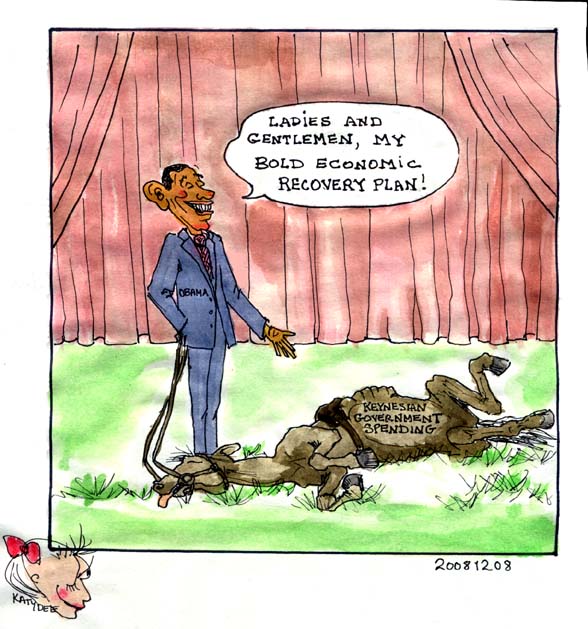
Why a Spending Bill Won't Cut It
Last night, I had to chuckle and cry at the same time as I watched Rachel Maddow's "Bull Puckey" speech.
Rachel's declarations about the job-creating values of spending are about as insightful as Janeane Garofalo's outburst on the radio in 2005, paraphrased thus: "... those free-market wackos with their 'invisible hand' mumbo jumbo."
Both ladies' understanding of the workings of the market typify the overconfidence of those who jump to conclusions without looking at the whole story.
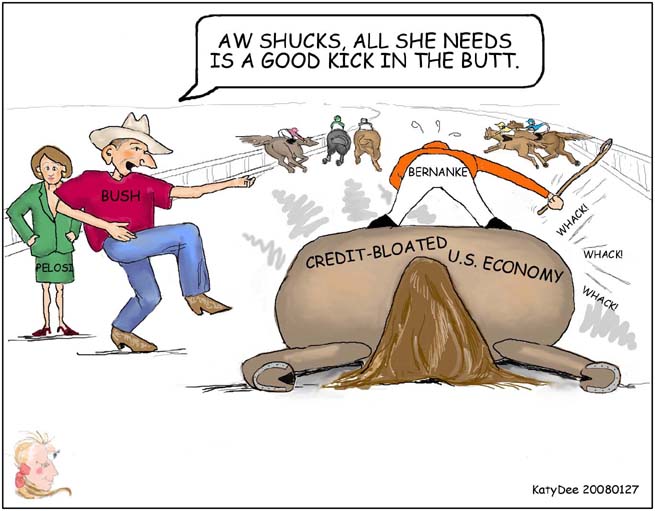
Rachel claims that spending in and of itself is sufficient to create jobs and get the country out of a recession. Obama has embarrassed himself by making the same point. They have both overlooked that the statistical link between government spending and long-term job creation doesn't exist. To illustrate:
Spending:
Let's take an extreme and therefore abstract example. We can hire 15 million workers (10% workforce unemployed) to dig holes and fill them up. Cost: $800,000,000,000. 100% job creation. After the job is done, they go back on unemployment. Job creation for one year: 15 million. Job creation after one year and a half: Zero. Capital available for permanent job creation: X minus $800 billion. And don't give me the argument that the government intends to do more than just dig holes and fill them up. Building bridges and roads that we can't pay for is just as bad.

[Thanks to Swop.net for the photo.]
Permanent Job creation:
At the other extreme, let's say we do nothing, and therefore the government does not sap the marketplace of $800 billion. Cost: Zero. The money is thus available to businesses, small and large, to rev up their engines as this recession starts its uptick. Jobs created during one year: Admittedly, perhaps zero. Jobs created after one year and a half, or sometime thereafter: 7 million, year after year, as unemployment falls back to around 4% or less. These jobs are permanent.
The lenders of the $800 billion know this, as we will soon find out when the US government finds it harder and harder to finance its debt. Why isn't this difference clear to the President and to his supportive progressives? Because these people are short-sighted, and they grasp at whatever supports their political culture instead of looking at all the facts.
Rachel quotes Moody's statistics. Example: "Most Stimulative Spending: Non-refundable tax rebates: $1.00 = $1.02/economic activity. Infrastructure: $1.00 = $1.59/economic activity." These stats make no mention of the duration of job creation in each instance, what kind of jobs are created, and what money was used to do it. Statistics can be the best liars when you don't tell the whole story.
More twisted logic:
- Who will be employed on the construction sites of the Spending Package's bridges, railroads, and roads? Will the government try to pick and choose among the unemployed? Can legislators get the most expensive unemployed (Wall Street workers, lawyers, and others like them) onto the dirt? Does the construction industry worker deserve a job more than an investment banker or lawyer?
- Rachel says that people on unemployment don't spend. Isn't she forgetting that they receive unemployment benefits that are paid out of future income from existing tax structures and not borrowed 100% from the world's capital pool? Then she turns around and almost makes the argument that we should all go on Food Stamps. This is strange thinking.
- We are all (including me) complaining about the big bonuses and the Las Vegas junkets, but isn't this also spending a la Rachel? Aren't we forgetting that jets are made by American workers, that pilots fly those jets, and that lots of people work in Las Vegas? We are also forgetting that the rich spend a portion of those bonuses and invest the rest in things like the stock market, i.e. in the very same instruments that are in all of our 401(k)'s, which could use a little help right now. (Don't get me wrong, those bonuses give me goose bumps; but I believe their size was determined by excessive money and credit supply and by the competitive marketplace, not only by individual greed. See this post, for example.)
- We want to put American manufacturing back on track by recommending we all "buy American." Aren't we forgetting that if we refuse to buy foreign products, foreigners will refuse to buy ours? And that this type of thinking is what ultimately repressed the world economy in the 1930s?
- We want China to allow their currency to rise in value, but aren't we forgetting that for this to happen, China has to stop buying our debt? Do we really want that?
Much illogic should be examined here.
Rachel's declarations about the job-creating values of spending are about as insightful as Janeane Garofalo's outburst on the radio in 2005, paraphrased thus: "... those free-market wackos with their 'invisible hand' mumbo jumbo."
Both ladies' understanding of the workings of the market typify the overconfidence of those who jump to conclusions without looking at the whole story.
Rachel claims that spending in and of itself is sufficient to create jobs and get the country out of a recession. Obama has embarrassed himself by making the same point. They have both overlooked that the statistical link between government spending and long-term job creation doesn't exist. To illustrate:
Spending:
Let's take an extreme and therefore abstract example. We can hire 15 million workers (10% workforce unemployed) to dig holes and fill them up. Cost: $800,000,000,000. 100% job creation. After the job is done, they go back on unemployment. Job creation for one year: 15 million. Job creation after one year and a half: Zero. Capital available for permanent job creation: X minus $800 billion. And don't give me the argument that the government intends to do more than just dig holes and fill them up. Building bridges and roads that we can't pay for is just as bad.
[Thanks to Swop.net for the photo.]
Permanent Job creation:
At the other extreme, let's say we do nothing, and therefore the government does not sap the marketplace of $800 billion. Cost: Zero. The money is thus available to businesses, small and large, to rev up their engines as this recession starts its uptick. Jobs created during one year: Admittedly, perhaps zero. Jobs created after one year and a half, or sometime thereafter: 7 million, year after year, as unemployment falls back to around 4% or less. These jobs are permanent.
The lenders of the $800 billion know this, as we will soon find out when the US government finds it harder and harder to finance its debt. Why isn't this difference clear to the President and to his supportive progressives? Because these people are short-sighted, and they grasp at whatever supports their political culture instead of looking at all the facts.
Rachel quotes Moody's statistics. Example: "Most Stimulative Spending: Non-refundable tax rebates: $1.00 = $1.02/economic activity. Infrastructure: $1.00 = $1.59/economic activity." These stats make no mention of the duration of job creation in each instance, what kind of jobs are created, and what money was used to do it. Statistics can be the best liars when you don't tell the whole story.
More twisted logic:
- Who will be employed on the construction sites of the Spending Package's bridges, railroads, and roads? Will the government try to pick and choose among the unemployed? Can legislators get the most expensive unemployed (Wall Street workers, lawyers, and others like them) onto the dirt? Does the construction industry worker deserve a job more than an investment banker or lawyer?
- Rachel says that people on unemployment don't spend. Isn't she forgetting that they receive unemployment benefits that are paid out of future income from existing tax structures and not borrowed 100% from the world's capital pool? Then she turns around and almost makes the argument that we should all go on Food Stamps. This is strange thinking.
- We are all (including me) complaining about the big bonuses and the Las Vegas junkets, but isn't this also spending a la Rachel? Aren't we forgetting that jets are made by American workers, that pilots fly those jets, and that lots of people work in Las Vegas? We are also forgetting that the rich spend a portion of those bonuses and invest the rest in things like the stock market, i.e. in the very same instruments that are in all of our 401(k)'s, which could use a little help right now. (Don't get me wrong, those bonuses give me goose bumps; but I believe their size was determined by excessive money and credit supply and by the competitive marketplace, not only by individual greed. See this post, for example.)
- We want to put American manufacturing back on track by recommending we all "buy American." Aren't we forgetting that if we refuse to buy foreign products, foreigners will refuse to buy ours? And that this type of thinking is what ultimately repressed the world economy in the 1930s?
- We want China to allow their currency to rise in value, but aren't we forgetting that for this to happen, China has to stop buying our debt? Do we really want that?
Much illogic should be examined here.
Labels: economic humor, economy, recession, spending bill, stimulus package
posted by Katy Delay at 11:12 AM
0 comments