Thursday, March 06, 2008

Government Regulation Gone Amuck No. 11: Mortgage Blaming Games and Bail-Outs

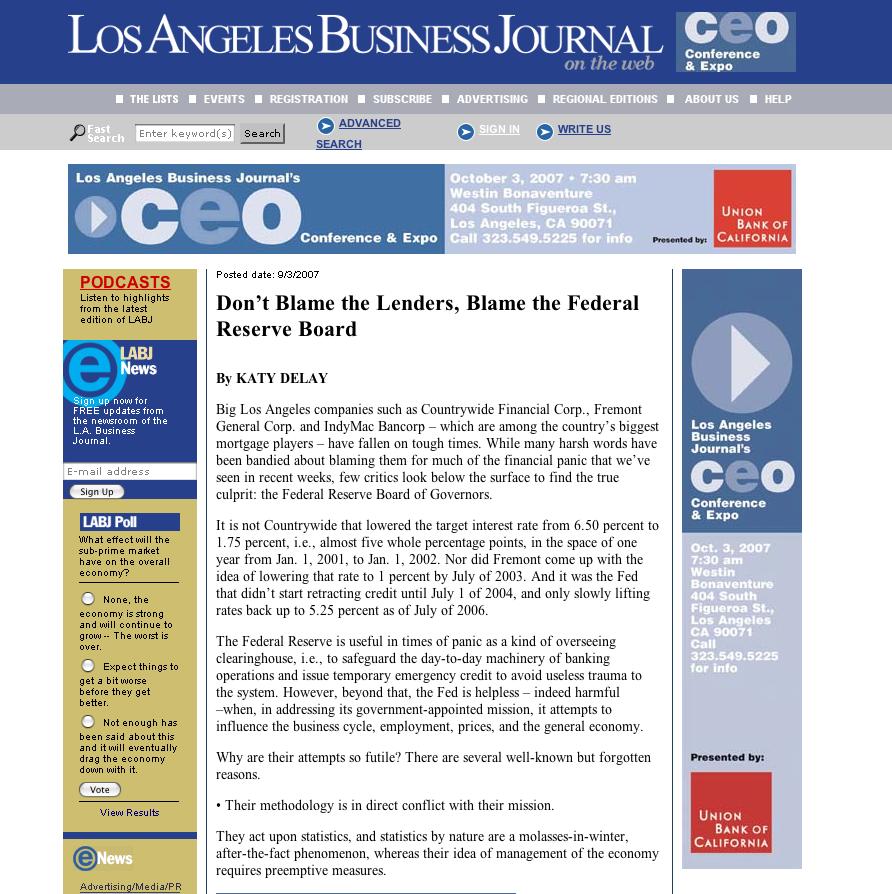
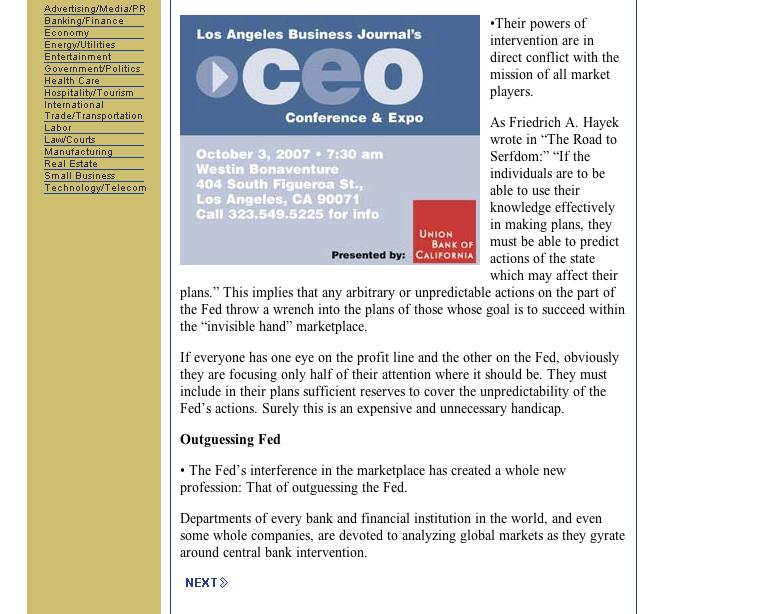
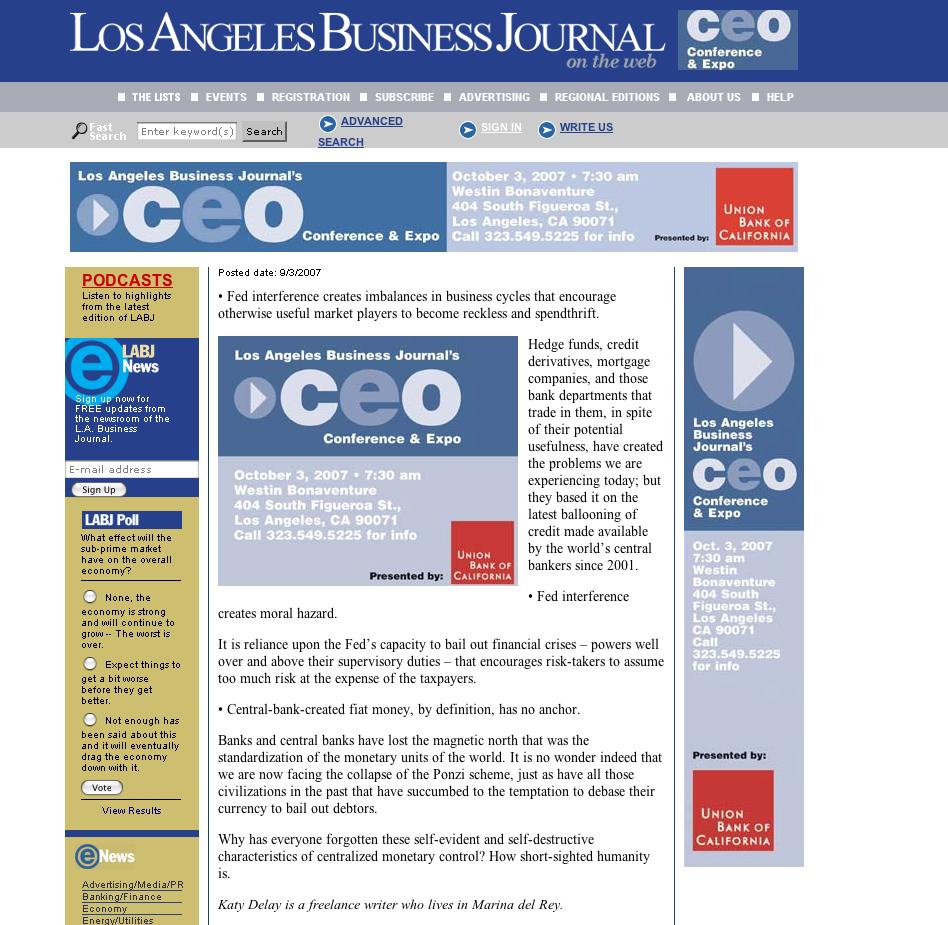
Alan Reynolds at Cato has a nice way with words.

This time, he points out how exquisitely ridiculous politicians can be.

alice
[Thanks to cs.cmu.edu/People/rgs for the Tenniel illustration of Alice in Wonderland.]

On the one hand, government has pursued and fined mortgage brokers for not lending to people with bad credit and for using a process called "red-lining."

On the other hand, and now that it has become expedient, the same politicians want to punish the mortgage brokers for lending to people with bad credit.

Go figure.

Read his piece. It's an eye-opener on how governments always get it wrong. This time, it's both Hillary and Obama who have come up with hair-brained solutions to our mortgage crisis that are so off-base and self-contradictory as to be almost funny.

Almost.

And unfortunately, the Republicans are quite as guilty.

Off with their heads.

Labels: , , ,


Sunday, March 02, 2008

Government Intervention Gone Amuck, Case No. 10: Food Subsidies

Yes, increased inflation is around the corner, judging from the news. Raw-material food commodities are doubling in price.

Some will explain the phenomenon with the following suggested causes:

1. Increased demand from China and India.
2. 2007 was a bad year for wheat and corn.
3. Speculation.
4. Uncharted worldwide monetary looseness (inflation's ultimate cause).

All of the above probably play a greater or lesser role in our current raw material inflation, but our government legislators are not innocent. They have contributed to this crisis by their intervention in our food markets.

monkeyonback
[Thanks to Genie28.blogspot.com for this photo of the monkey on our back.]

Here at Freetrade.Org you can read about food subsidies and the harm they do to our economy and to the poorest among us.

As the article states:

"[F]ailed government policies—supporting domestic farmers through restrictions on cheaper imports and stimulating demand for corn-fed ethanol—are adding to consumers’ woes. The federal government can and should take this opportunity to alleviate the effect of higher prices at the grocery store by reducing taxes on imported rice, dairy products, and sugar and by abandoning its misguided support for biofuels."

Tariffs, price supports, and other government-made distortions to the communication mechanism that is the marketplace almost always (if not always) backfire. See also my previous post about the rice fiasco in the US.

Labels: , , , ,


Sunday, February 24, 2008

Government Regulation Run Amuck, Example No. 9: Political Campaigning

Ann Coulter's 2/20/08 column entitled "How to Keep Reagan Out of Office" does an excellent job of explaining one reason why campaign finance reform isn't really campaign reform but rather campaign rigging, that favors incumbents and discourages the advancement of good but unknown political candidates by limiting vital funding in today's very expensive US political process.

As most readers know, the legislature voted in 2002 to regulate campaign financing, and the result was the McCain-Feingold Act, also called the Bipartisan Campaign Finance Reform Act. (For more, see also this entry.)

The idea was to get big-money donors out of politics and bring the game back down to the fair-and-square level of the people.

But government intentions are full of what the economic scientists call "unintended consequences." McCain-Feingold is no exception.

snake_bite
[Thanks to Harry Short and thesun.co.uk for the photo.]


There are two reasons. First, McCain-Feingold backfired. As laudable as the spirit of this law is, it has become a hindrance to good politics, as we see from Ms. Coulter's piece.

Second, McCain-Feingold didn't work. It failed to contain big-money donors, who simply found other ways to contribute their financial strength to a particular candidate, to wit the Section 527 committees that were so influential in 2004.

Senator McCain himself seems to recognize this, judging from his own activities in a non-profit called the Reform Institute.

According to this 2/12/08 article at Worldnetdaily.com, McCain's non-profit has been funded by the likes of George Soros and Teresa Heinz-Kerry since 2001. (I note in passing that McCain is listed as a Republican, and both these donors are strong liberal Democrats--just for the irony.)

McCain would defend himself by saying that political opponents can work together on issues. He might also say that the Reform Institute is not involved in any way in his campaign. Unfortunately, we learn from the article that Rick Davis, current campaign manager for Senator McCain, had been previously employed at the Reform Institute for years, as have others on McCain's campaign committee.

The Captainsquartersblog.com made this comment back in 2005:

"As the New York Times noted yesterday, RI provides a back-channel method of keeping his campaign staff employed without McCain having to do any fundraising for his political campaigns -- and avoiding the donation caps that come into play for his donors." (I'm not sure whether there is enough evidence to accuse McCain of this, but the liaison surely doesn't look good.)

The linked New York Times article goes into more detail about the appearance of conflict of interest:

"[S]ome campaign finance experts say that Mr. McCain is moving dangerously close to violating his own principles and that as a chief advocate of clean election rules he should make certain he is above criticism. [...] The problem [...] lies in the close and unregulated relationship between the nonprofit groups and politicians. [...] [The Reform Institute could be just a way of] keeping some of the senator's advisers busy in the months before any formal presidential campaign operation would be established. According to the institute's public tax records, Mr. [Rick] Davis, its president, received a $110,000 consulting fee from the group in 2003. Mr. Davis said he was making the same amount this year. [...] 'We don't do campaign work,' said Mr. Davis, who said contributors typically were zealous about political reforms."

And yes, that's the same Rick Davis.

As for big-business donors to the McCain campaign, this is what the New York Times says about the donors to the Reform Institute:

"Some donors [...] are communications industry giants who had business before the Commerce Committee when Mr. McCain was its chairman."

(See some more leftist vitriol against McCain and Davis here.)

Federal regulators please note: I am in no way trying to accuse McCain of any intentional wrongdoing, nor do I condemn one party or another. Rather, I wish to use this illustration to point out how government regulation can run amuck. Whether it be through naivety or cunning is not for me to judge.

Unintended consequences are neither a Republican nor Democratic issue. Ultimately, the issue is big government vs. small government. See my previous blog for more on this new political division running across both parties.

Labels: , , , ,


Friday, February 22, 2008

Government Regulation Gone Amuck, Example No. 8: Real Estate Bailouts

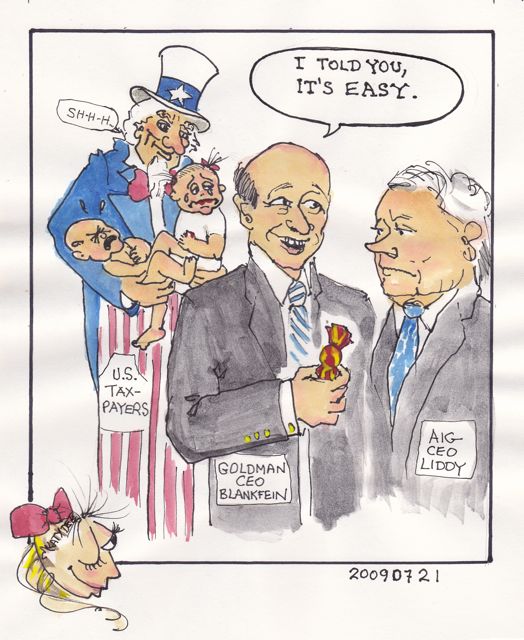
In this New York Times article by Edmund L. Andrews and Louis Uchitelle, we find the latest example of government regulation and/or intervention running amuck. The real estate market has collapsed and the legislators have noted that voters are hurting--once again.

It happens a lot, only in different domains. Politicians love it, because each episode represents an opportunity for them to look like they're "doing something."


[I highly recommend the Schalkenbach Foundation and this magazine article about what they had already labeled in 2006 as the "coming real estate crisis." Click on the image for their website.]

Crises like this one hark us back to the 1930s efforts of Herbert Hoover to "stiffen public confidence" through the National Credit Corporation and subsequently the War Finance Corporation, and to the 1990s bailout of the savings and loans. Today, the government is once again considering similar action.

We should all become suspicious, however, when the ones making the loudest noise are special interests and politicians. Here are five examples:

1. "Bank of America, which is in the process of acquiring Countrywide Financial and has potentially huge exposure, has circulated a proposal to create a new federal agency that would buy vast quantities of delinquent mortgages at a deep discount and replace them with fixed-rate federally guaranteed loans."

2. "The Federal Housing Administration [...] is examining ways to expand its new insurance program, known as FHA Secure, to help people replace their costly subprime mortgages with federally guaranteed fixed-rate mortgages."

3. "Credit Suisse executives said they have held lengthy meetings with F.H.A. officials and have urged the agency to relax rules that currently disqualify many borrowers."

4. "An aide to [House Representative] Mr. [Barney] Frank said his [new] bill would, among other things, allow the government to buy up at least some troubled mortgages."

5. "John M. Reich, director of the Office of Thrift Supervision, the agency that regulates savings and loan companies, [has another plan to] create a voluntary system under which mortgage lenders would reduce debt and monthly payments to reflect the diminished sales value of a home. It would take the remainder of the mortgage as a 'negative amortization certificate,' a lien that the investor could recoup if the house were later sold for its original mortgage value or higher."

(As an aside, does anyone stop to consider what effect these liens will have on the purchase price of houses?)

"In an interview, Mr. Reich said he hoped that most of the old mortgages would be replaced by cheaper mortgages insured through the F.H.A. 'It isn’t a bailout,' Mr. Reich said. 'It is a market-driven solution.'"
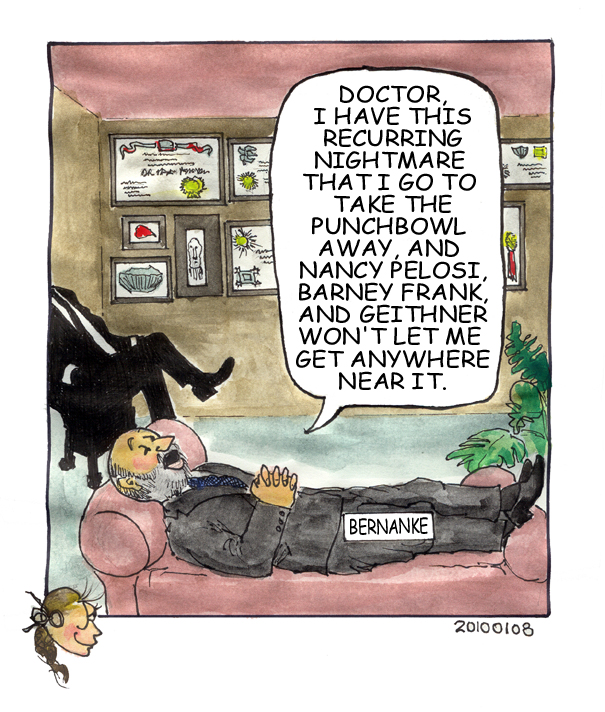
Since when is the Federal Housing Authority not forced to do what the government bids it to do, even against management's better market judgment? Thus, how can FHA loan leniency or intervention be a "market-driven solution"?

No one mentions that the special banking interests, including the above-mentioned Bank of America and Credit Suisse (not even an American bank--why should we bail them out?), made some very bad decisions over the past ten years. But this doesn't keep them from whining for government handouts.

Here's an example of the misleading reasons given for all of this renewed hyperactivity:

"The $168 billion federal stimulus package is likely to be less effective than intended because many homeowners may simply use their government checks to pay down their debts."

(Heaven forbid that they should pay down their debts.)

Does this mean, then, that even the stimulus package won't work? Why am I not surprised? It's what economists call a "Keynesian" effort that will just put the nation further in debt. (Keynes was an early 20th century economist who thought that the Great Depression was caused by abnormal lack of consumer spending, and that it had to be spiked to function, like a lazy nag. Most economists today realize that (1) this was not true at the time and is still not true today, and (2) it's an ineffective and even counterproductive way of trying to improve the economy, borrowing as it does from Peter to pay Paul.)

And finally, here is an example of government misuse of statistics to back up all this frenzy:

"Housing prices in Memphis fell by 2.5 percent last year, only the second decline since records began to be kept in 1968, and by far the largest dip, according to Chandler Reports, which gathers this data for Greater Memphis."

What is missing, of course, is the data that points out the 230% percent rise in home prices that took place in the eight years preceding this housing bust. (Chart.) That's an increase of more than 16 percent a year.

But when home prices go up, nobody complains on behalf of home buyers for some reason, perhaps because everyone thinks he's making money. Well, the party's over, folks.

If you read to the end of the article, you'll see more reasons why government bailouts are a bad idea. The examples chosen incite no pity in me; how about you?

Labels: , , , , ,


Thursday, February 21, 2008

Government Regulation Gone Amuck: An Overview

Economics professor and author Arnold Kling is an adjunct scholar at the Cato Institute, and he writes also for Tech Central Station and for his and a partner's website, EconLog.

He has recently written an article published by the Wall Street Journal on the future of government regulation in America.

He states that public understanding of the limitations of government is poor, as evidenced in the popularity of big-government ideas like nationalized health care and government control of energy production and use.

I like his piece for its clarity and good examples, and also because it sums up the conclusion I was headed toward, i.e. that excessive government regulation will always tend to run amuck, by definition. It destroys competition, pulverizes the pricing mechanism, and pushes a society towards anti-free-market socialism at its own expense, which expense big-government enthusiasts ("progressive" voters and legislators) underestimate (naively or purposely).

He finishes with this:

"Many Americans will welcome the regulatory state. Many others will accommodate it. Only a minority of us will oppose it. Somewhere down the road, as people see the indignity of the many intrusions and the adversity of the consequences, I hope that there will be a backlash. Otherwise, if the era of mandates emerges as I fear it will, then the engine of capitalism in America may run out of the fuel of competition."

I second that. Hear, hear.

Labels: , , , ,


Wednesday, February 20, 2008

Government Regulation Gone Amuck - Case No. 7: Labor

This little program of mine--the finding of cases of well-meaning but poorly-functioning government regulation--is gaining momentum.

Today's example is union control of the construction business in New York, facilitated by state laws that provide the Mafia and mob-controlled corporations with the means to obtain a monopoly of hiring in construction firms.

trumpworldtower
[Thanks to petergof.com for the photo.]

In passing, I'll mention that I'm embarrassed to admit that I thought mob control of labor in New York went out with Giulani. I've seen Marlon Brando's movie, "On The Waterfront," and The Sopranos, which I thought was a period piece; but no. The Mafia's still with us, thanks to government corruption and misfiring legislation.

According to Steve Malanga of the City Journal in this article:

"[E]ven after decades of intensive investigation by law enforcement, organized crime remains a powerful force within the city’s construction industry and in related businesses—like trucking—that are particularly susceptible to mob corruption.
...
"[I]n construction [...], labor law permits contracts between builders and unions in which unions effectively have power over hiring. They enlist workers in their organizations first and then send them out on jobs."

State government officials tried to handle the situation, but unsound reasoning--to give them the benefit of the doubt--got the better of them:

"New York State’s laws and policies add to the industry’s problems by snuffing out competition. The state decrees that on all public construction projects—representing a huge chunk of the industry’s revenue pie—government must pay even nonunionized workers a 'prevailing' wage that in most cases is equal to the highest union worker’s wage. The law sharply reduces the ability of non-union contractors to get government work, since they lose any pricing advantage that lower wages would give them. Thus, many don’t even bother to bid on government contracts, which the construction unions inevitably win. That’s the kind of monopoly that mobsters love.
...
"The state’s Wicks Law further aids the wise guys by requiring government to carve up public construction projects into at least four separate bidding packages, multiplying the number of contractors and subcontractors involved in any project and adding layers of complexity that encourage fraud, bribery, and bid rigging.... [T]he unions love the bureaucracy, inefficiency, and extra work (and workers) that Wicks requires."

France also has plenty of examples of union abuse and monopoly privilege. See this article for an example of their power, and this article at Mises.org giving some background information.

Labels: , , ,


Thursday, February 14, 2008

Government Regulation Gone Amuck, Three Examples in One Day, No. 6: Farming

6. Farming. Due to high prices, food producers are going to ask the government's help to "allow" (?) farmers to increase production of wheat and other grains, according to this article at the Wall Street Journal, written by Lauren Etter and David Kesmodel.

This example is a regulation comedy in reverse.

Everyone knows that a rise in prices causes production to go up, and prices for grains have more than doubled in the past months. Yet farmers are having to beg the government on bended knee for permission to cultivate more food.

How could this be? What is preventing them, you ask?

Did you know that farmers are required by contracts they signed with the government to hold quite a bit of their land idle "to preserve wildlife habitats under an effort called the Conservation Reserve Program"? The Endangered Species Act literally confiscates land from farmers without compensation.

Government officials must have assumed that there would never be a need for more grain, so to protect the habitat of certain animals they forced the farmers not to cultivate on some of their land.

Bird-opoly
[Thanks to dirtworks.net for the image.]

Conservationists and environmentalists will applaud. However, they forget two things. First, as economist Richard L. Stroup has demonstrated, these laws backfire, because when a farmer sees a spotted owl on their land, they quickly destroy the habitat so that the animal goes away before anyone sees it.

Second, our kind-hearted brethren forget that the result of having less land to farm is that poorer people in other nations will have either to fork up more money (and they already have very, very little) or go without grain foods altogether, some of them to the point of malnutrition or worse.

Marie Antoinette's descendant might answer, "No bread? Let them eat meat." But remember, that attitude is what started the heads rolling.

Do we really want our government and organizations like Ducks Unlimited and Pheasants Forever to be accomplices in international hunger? Isn't this the opposite of what philanthropists like Bono and Bill Gates have been trying to do?

* * *

In this and the last five posts, I have described a dangerous tendency in this country to call on Daddy Government at the slightest itch. Hopefully, these and other regulatory efforts will get nowhere; but if they do get anywhere, we voters will be one step closer to central planning.

If you haven't read Von Hayek's The Road to Serfdom, please do it now. You can find a Reader's Digest excerpt here or a cartoon version here. You can also buy the original book at Amazon by clicking on the Amazon "Road to Serfdom" link to your right.

Hayek's book explains why these little baby steps towards bigger government must end eventually with a totalitarian state.

Labels: , , , , , , ,


Government Regulation Gone Amuck, Three More Examples in One Day: No. 5 is Banking

5. Banking. The banking industry is "shopping proposals to Congress" so as to shift risk and eventual losses from bad loans to taxpayers.

In this WSJ article by Damian Paletta, we learn that banks are turning to the federal government, i.e. us as taxpayers, to bail them out of their mistakes. Credit Suisse and J.P. Morgan Chase are both proposing that the government step into this mess and save their butts.

And of course the bonuses their "mistakes" incurred have already been paid, nonrefundable.

They are worried, among other things, that in trying to help homeowners by writing off a portion of subprime loans, "they [the banks] might be sued by investors who hold mortgage-backed securities [i.e. the creditors who actually hold the debt]. However, if the industry came forward with a standard backed by the Treasury Department, the legal concerns would likely fade."

In other words, when you're about to break your contracted word and you're scared of the repercussions, look for a big thug with a gun.

hitman
[Thanks to hitman2.com for the image.]

The second thing they want the government to do is to guarantee the bad loans with taxpayer money. Do you and I really want to pay up when some homeowner who (knowingly or unknowingly) got in over his head decides to walk away from his house?

If you ask me, forcing us innocent bystanders to pay for the bad bets of investors, bankers, mortgage brokers and naive or greedy homeowners, is tantamount to embezzlement, racketeering, and tutti quanti.

Wake up, people. Your representatives in the legislator are about to steal your money, and they don't even have to put a gun to your head.

See my next post for Example No. 6.

Labels: , , , , ,


Government Regulation Gone Amuck, Three More Examples in One Day: Health Insurance is No. 4

I struck a gold mine with this subject, apparently. In today's Wall Street Journal, I stumbled upon three more examples of government's role as Sugar Daddy, i.e. egocentric drug dealer where the drug is special privilege and/or monopoly. (See my last post for a more detailed explanation.)

Today, we get these:

4. Health Insurance. The State of New York is going to conduct an "investigation" into "illegal" (?) pricing of rates by United Health, Aetna, Cigna, and Blue Cross/Blue Shield.

As the article by Vanessa Fuhrmans and Theo Francis states, "Doctors and hospitals have long complained that the methodology [of calculating out-of-network providers' covered fees] is opaque and sets reimbursement artificially low."

Most people have heard of the "preferred provider" system that insurance companies use. Would it really make sense for insurance companies to pay the higher fees of those doctors and hospitals who refused to enter into contracts with them?

drjekyll
[Thanks to gamewad.com for the image.]

And anyway, my experience has been that all of the doctors and hospitals I have consulted have been preferred providers.

Furthermore, without the preferred provider system, patients would have no incentive to use the providers who charged lower negotiated rates because all rates would be reimbursed regardless of the amount and the cost to the patient would be the same.

There is little or no competition in health care under our present system given the extent of coverage from which US insureds can and do benefit; so in order to control costs to the extent they can, insurance companies do not reimburse the higher fees charged. It's the only tool they have to discourage an explosion of medical fees and hence of premiums, which you and I pay for in the long run by renouncing higher salaries.

The truth of the matter is that all players in this game have something to win. New York Attorney General Cuomo, by throwing around unprovable accusations like "insurance companies ... defraud customers" and that there is an "industrywide scheme," gets to look like a hero to voters when he soon runs for governor. (What he doesn't say is that those companies got that big with state help. For more on this and for excellent suggestions for improving our health system, see this Cato material.)

Other players, the doctors and hospitals who refuse to contract with the insurance companies, will try to get the government to bully them into paying their higher rates. And another player, the big-government politicians, see this as a golden opportunity to inch the country towards nationalized health care.

Finally, the insurance companies win because to fight this kind of battle takes lots of money, and only the biggest and baddest can survive. This kills all the small-fry competition.

Insureds, beware. This is going to be a cat-and-dog fight, and once again, we the little guys and gals are going to lose out. Politicians and special interest groups will be the winners.

See my upcoming post for Example No. 5.

Labels: , , , , ,


Wednesday, February 13, 2008

Government Regulation Gone Amuck, No. 3: The American Railroad Industry

How many of you readers think that the government should get more involved with the railroads? How many would like to see a high-speed train between Los Angeles and San Francisco?

How many know the story of the railroads in America?

Alan Greenspan, our former Federal Reserve Chairman who is noted for his foggy Fed-speak, wrote some very clear chapters about 30 years ago describing the American rail fiasco. So did Ayn Rand, although not everyone likes her style or thinks of her as a notable historian.

(For example, see her Capitalism: The Unknown Ideal, Chapters 3 and 4 [the latter written by Greenspan] for an easily understandable critique. I don't support Rand's every word by any means, but I do like some of her better-written passages.)

Because blog posts must remain short and pithy, I won't go into the history of the American railroad but rather will simply note that the federal government was a major factor in the demise of the industry, and it remains involved to this day. Let me just quote Wikepedia's Amtrak entry as a pretty unbiased source of information, at least as of today 2/13/08:

"Literature suggests that the causes of the decline of passenger rail were complex. The industry was hobbled by government regulation and labor inflexibility, which undermined passenger rail just as the industry faced an explosion of competition from flexible and user subsidized automobile and airplane transportation. [Footnotes omitted] These for-profit railroads were structured to sell access to elaborate, efficient, roads at a profit; they lost in the competition for passengers to parallel, publicly-funded, non-profit turnpikes, air strips, and highways in the sky." (Please note the seemingly derogatory use of the phrase "user subsidized." I'm not quite sure what the authors intended to convey thereby, but it doesn't really matter.)

And government involvement continues to this day. Amtrak, the poorly run, mostly government-owned passenger rail system that the legislators have decided to pump up with taxpayer funding to permit it to survive, is only one example. To wit another:

In today's Wall Street Journal article by Daniel Machalaba, we learn that privately owned freight railroads are finally becoming profitable, after almost a century of stagnation. Investors like Warren Buffett have taken serious stakes in one or the other of five major lines: Union Pacific Corp., Burlington Northern Santa Fe Corp., CSX Corp., Norfolk Southern, and Kansas City Southern. Rightfully earned profits, instead of tax dollars, are finally being reinvested, undeterred, in improving rail lines.

But this situation may not last for long:

"The expansion is stirring conflict with some old customers, the shippers who move raw materials such as chemicals, grain and logs, who feel they're being charged unnecessarily high rates to pay for capital improvements. Trade groups representing such shippers are seeking federal legislation to rein in railroad rate increases."

With friendly customers like that, who needs enemies?

What business do you know that doesn't use its own profits, and good credit based thereon, to make capital improvements? The rail companies are charging prices that are competitive with trucking and air freight prices, and if the shippers don't like rail pricing, they should switch to trucking or airplanes instead of running to Daddy Government for intervention.

But old habits die hard. Our nation has become accustomed to Daddy's spoiling ways. Indeed, Daddy feeds our addiction to special favors in order to increase his own stature and power over us. What kind of Daddy is that, a Sugar Daddy?

SugarDaddy
[Thanks to buycostumes.com for the photo of this great "Sugar Daddy" costume.]

We will see what the federal government does. Unfortunately, there is such a long history of federal intervention into this business--indeed, on behalf of special interests in so many businesses--that I wouldn't be surprised if legislators profited from this golden opportunity to "help" (themselves).

Labels: , , , , ,


Tuesday, February 12, 2008

Government Substituting Itself for A Good Reputation: Case No. 2 of Government Regulation Gone Amuck

This is a second example of government regulation gone amuck. The title insurance industry. (See the first one at this previous post.)

Today's Wall Street Journal article by John R. Wilke talks about "new scrutiny" of the "$17 billion title-insurance business."

According to him, there are four insurance companies that dominate the national title insurance industry: Fidelity National Title Group, First American Corp, LandAmerica Financial Group, and Stewart Title Insurance. They control almost 90% of the market.

Because state governments regulate this industry in an effort to eliminate pricing abuse and unsavory practices like kick-backs (although I never really understood how you can compensate an intermediary if you don't pay them), these companies have taken to hiding behind Daddy Government.

HidingBehindDaddy
[Thanks to chris2fer.wordpress.com for this cute picture. I recommend his site for other photos that will melt your heart.]

The irony is that because state regulators approve the rates charged by title companies, the companies benefit from a certain amount of immunity from antitrust claims. What the states have done is, in effect, to create a monopoly, whereby the title companies "collaborate" (collude?) under state government protection to set their rates.

In other words, the goal of government has backfired.

How many of you readers have bought real property and then shopped around for a title company? I'm willing to bet that the shoppers would represent less than 1 percent. All of us accept the title company that our broker and his escrow agent provide.

On the other hand, I am also willing to bet that the escrow companies are faced with a constant barrage of efforts by title companies to compete with each other. This is healthy.

If there were no regulatory action on the part of the state governments, the title companies would be required to compete on the basis of the quality of their service and the rates they charge. Because rates would not be "fixed" by government action, they would become competitive.

What happens, however, is that state government officials (who have no personal skin in the game) approve of title company rates, thereby (1) making all the rates the same, and (2) arbitrarily fixing an amount that has little to do with the actual market.

What has evolved as a result is that the title companies have found another way to compete. With the government's help, they have been able to charge enough money to send kick-backs to escrow agencies. The one who can send the most gets the prize.

Nowadays, therefore, instead of the incentive being to make money by offering a high-quality and low-cost service, it is reduced to making the most money under government protection.

Without this government stamp of approval, market players would have to sink or swim on their reputation. Escrow companies would have to spend a little time finding the best quality title insurance company, if only to preserve their own good name.

When the government tries to regulate industry, it substitutes itself for a hard-won and constantly challenged market reputation; and it creates a playing field where the players who can survive the cost of acquiring government approval can abuse their monopolistic privileges and hide behind their government benefactor as they rip off those paying for the service.

Who is the ultimate loser? You and I, the helpless consumer.

Labels: , , , ,