Wednesday, March 27, 2024

So what is the real reason my electric bill is going up?

My electric bills have been going up for the past few years, so I decided to analyze the data to figure out what was changing. Was it the consumption? Was it the per kWh charge? Was it the taxes? Maybe the service charge(s)? Or something else?

The consumption was pretty predictable and regular. Interestingly enough during these inflationary times, the per kWh charge was exactly the same over an eight year period. Taxes and other state charges didn’t seem to be modified very much, and the monthly service charge was also unchanged.

So where is the culprit?

In California, they have come up with what was supposed to be a credit to our account due to the use of renewable energy. They must have thought that renewable energy sources would provide less expensive electricity. 

Starting in 2016 in our case, this line on the bill was a very tiny credit. But as time has gone by, that column has morphed into a charge climbing steeply. See the result on my chart below.

This supplemental charge is calculated as a percentage of total consumption multiplied by the kWh price, so it moves up and down with changes in consumption. But you can still see the trend. Where it used to be a negative number, it has now reached a level of about 30% of the kWh rate, and hence of the whole bill.

This “Energy Cost Adjustment” has become a way for the company to increase our price while maintaining the per kWh rate. Perhaps they’re just trying to deal with California’s crazy laws, but it’s still VERY SNEAKY, don’t you think?

So is it just an underhanded way of increasing the price? Or did everyone simply misjudge the cost of renewable energy? 

Labels: , , ,


Sunday, March 24, 2024

Updated Proprietary M&Ms Inflation Gauge

I’ve made some revisions to my M&Ms inflation gauge, this time basing it on calculations of the “per ounce” price rather than per packet price, while still expressing the chart values on the historical price of a 1.69 ounce packet. 

Somewhere I read that the M&Ms company claims they always sell the small packets at 250 calories per packet. I have some issues with that, because I have noticed over the years that the size of the packets on sale seem to vary from year to year. However, assuming it is true, that would be the 1.69 ounce packet, according to the linked website. So I have chosen that size to be the anchor for this new graph.

You will note that I’ve left lots of room for future price inflation – and for my own stick-to-it-ive-ness given my advance age....

Enjoy! Hopefully along with a packet of Peanut M&Ms, which are my favorite! (Although the chart is based on the old classic.)


Labels: , ,


Wednesday, February 21, 2024

What is a Flight from the Dollar?

A friend asked what a “flight from the dollar” looks like. I can certainly give my understanding expressed in easy-to-understand language.


A “flight from the dollar” happens when the citizens, or even the global financial system, rejects the dollar as a store of value. Here’s a little history to explain the context.

In the late 1800s, a dollar could be exchanged for 1/20.67 of an ounce of gold. This was the “gold standard,” whereby a dollar was “worth” (i.e. could be exchanged at any bank for) 1/20.67th of an ounce of gold. The banks accepted freely any amount of dollars in exchange for gold at that rate. The standard, as long as it remained in place and was respected, helped banks maintain a safe amount of reserves, a conservative amount of loans (made with real savings), and well-backed credit advances (i.e. credit creation based on commercial paper such as bills of lading and the like); and it kept the economy on a relatively even keel. The fact that every bank had to give out one ounce of gold for $20.67 in paper money kept them – and the dollar – honest, so to speak.

In 1913, the US created its first central bank, which became the arbiter, instead of private banks, of the amount of credit creation that would take place. The original rules applied by the central bank were pretty sound. Credit loans to banks were based only upon commercial paper. However, in the longer term the rules changed. Within a couple of years the central bank began to do what central banks have done for centuries, i.e. they began creating extra additional credit, which the government used to cover wartime and other expenses. 

The first episode of inflationary credit creation (what economist Edward C. Harwood labeled “inflationary purchasing media”) appeared during World War I. As the US central bank began to allow the expansion of credit above what was prudent (according to Harwood), the government spent it on the war effort. When the war was over, the central bank tried to contract that credit, which forced the country into something of a recession in the early 1920s. 

Then during the subsequent years Harwood noted that a lot of “inflationary purchasing media” had still not been cleared from the system, which was maintaining prices too high and encouraging bubbles in real estate (in Miami at the time), and in the stock markets. By 1928-29 he began to warn the public through articles published in financial journals that the previous monetary expansion was still in the system, which would probably end in another contraction. 

Indeed, a peak was reached in 1929. The central bank noticed the problem and tried to correct the imbalance by contracting the money supply. It was the right thing to do, because the excessive credit did indeed need to be withdrawn. Was the contraction too quick? Was the timing wrong? No one really knows, although multiple theories exist. At the same time, the government put in place some very strict trade policies that caused complications in the import-export markets, and we got the 1929 crisis, which extended several years into the 1930s.

In 1933 Roosevelt, in an attempt to save the gold standard, decided one day (literally) to force people to turn in their gold so that he could devalue the dollar down to 1/35th of an ounce. He explained that he didn’t want private “speculators” to profit from the devaluation. He also started the country on a centralizing-regulatory-socialist binge with his New Deal policies. Ownership of gold was outlawed. Much money was wasted in the various efforts, and the economy didn’t recover until the 1940s. By then the second world war was brewing. 

When the soldiers got home in 1945, they went right to work and got the place up and running pretty quickly, thereby probably absorbing the excessive credit created for the war effort. Given the difficulties experienced in the 1920s, the Western World decided that they needed to fiddle with the gold standard again. Global officials met up in Bretton Woods in New Hampshire and decided that the world would go onto a modified dollar-gold standard, i.e. the dollar would stay on the standard at 1/35th an ounce, and the rest of the world would use the dollar in international transactions. Somehow, they thought this would be better than a plain gold standard. 

This plan gave the US both a tremendous advantage and a tremendous disadvantage. The advantage is that nations needed to exchange their exports for dollars in order to do business, and some countries’ banks also bought tremendous quantities of US bonds as capital assets. Therefore the US could print just about whatever it wanted, and the dollars flowed around the world and never came home to roost. It's called “seignorage.” 

The disadvantage is that it is the equivalent of giving a credit card to a 16 year old.* 

It worked pretty well at first back in the early 1950s, but lavish money printing soon started again, creating another bout of creeping price inflation in the US. After all, it is not easy (or perhaps it’s impossible) for central bankers and politicians to determine with precision the amount of dollars that should be created and shared to maintain the Bretton Woods global monetary system. In around 1959, Harwood and others began to notice that in spite of the Bretton Woods fix at 1/35th of an ounce per dollar, the “price” of an ounce gold in dollars was increasing above $35 in certain markets. In other words, people were realizing that the dollar was losing its value. That’s when Harwood started getting people onto gold numismatic coins, gold stocks, gold “annuities,” and Swiss financial instruments, some of the very few ways to invest legally in gold and safe foreign assets.

This state of affairs lasted far longer than anyone thought possible, until 1971. France was getting wise about the loss of value of the dollar, and De Gaulle began asking for his nation’s gold at the official $35 price. Gold at $35 had become a good deal. It all came to a halt when Nixon “closed the gold window,” i.e. refused to pay out gold for dollars. (See this for a detailed explanation.) 

Since then, even though in the mid-1970s Americans could start owning gold again, the world has been on what is called a “fiat standard,” i.e. no standard at all. Over the rest of the decade, gold went from $35 to $800 in 1980, 23 times its previously fixed exchange rate. 

That’s a flight from the dollar.

Even though no longer in an official monetary role, gold still remains a good barometer of the value of currencies around the world. The dollar has continued to decline, and today the ounce of gold costs around $2,026. Yes, the gold exchange rate is “volatile.” But in fact it is not gold that is volatile. It is the paper currencies. After all, smart people watch economic policy and events, and when things start to get frisky, they start looking for ways to preserve the purchasing power of their money. The increased demand creates exaggerated swings in the “price” of gold. But in fact the one thing that remains constant is the underlying, on-average, longer-term stability of gold’s purchasing power. 

And the “price” of gold is one way you can measure the “lost value” of the dollar.
_____________________

* Today the US debt is over $34 trillion and climbing rapidly. This is WAY more than US production can sustain (about 145% of GDP). It is also especially dangerous when price inflation and cheap public borrowing sets in and when the Fed (rightfully albeit somewhat late) decides to take corrective action via higher interests rates. Over the past year or so, the yearly interest rate on the debt is now up to $500 billion, which is about 2/3 of the entire annual US military budget. (And here’s another interesting chart that I hadn’t seen before.)

Labels: , , , ,


Monday, December 14, 2020

Who Says There's No Price Inflation?

I have a proprietary statistical tool called the M&Ms Price Inflation Index. It's not very sophisticated, nor guaranteed to be 100 percent accurate, but I think it's pretty darn near the real deal.

Here it is, and it's pretty convincing to me.


For those of us who prefer pictures, here is the same information in a different format: (you can click on the photos for a larger format)


Labels: , ,


Tuesday, May 26, 2020

Gold Has Retained Purchasing Power over the past 100 Years

As it happens, I am rereading the masters thesis of my economist father, Edward C. Harwood. He went on later to found the American Institute for Economic Research.

In his thesis, he cites the example of a car factory (this is 1931) that produces 100 cars a week. He gives the value at market of the weekly production at 100 pounds of gold.

In those days, the dollar was calibrated at $20.67 per ounce of gold. That puts the dollar value of the 100 cars at 100 pounds of gold x 16 ounces x $20.67 = $33,072, or $330.72 (in 1931) per vehicle.

Using today's dollar exchange rate with gold, we get the following:

100 x 16 x $1,713 = $2,740,800, which is $27,408 per vehicle.

The average price for a car in the US in 2019 is $36,718 according to Kelley Blue Book. I find that incredibly high, but according to a few articles I have read, this is indeed the average price of a light vehicle. One writer chocks the high price up to high demand and easy credit terms. This is possible, especially when you look at the demand for the bigger SUVs and light trucks.

But my fundamental point is that one can still buy a decent car for about 16 ounces of gold. Here's a 1929 Ford versus a 2020 Subaru.

By Richard Smith - Flickr, CC BY 2.0, https://commons.wikimedia.org/w/index.php?curid=329429

2020 Subaru - same price!

I wish that we could still buy a car for 330.72 dollars! But you certainly can still buy a car for 16 ounces of gold.

Labels: , ,


Thursday, April 16, 2020

What Does This Crisis Mean for the Economy's Future?

Recently, someone asked me three questions:
  • Who is going to pay for the government's handouts once this virus episode and economic standstill have passed?
  • What kind of price inflation might we be looking at over the coming months?
  • What should a person be doing today?
It inspired me to write an article that Seeking Alpha decided to publish. It is here.

I hope you will find it of interest.

Labels: , , ,


Thursday, March 14, 2019

Price Shock II: M&Ms Pack hits $2.29!

In January of 2011, I published a blog about price inflation using my personal index, which is the package of M&Ms.  I was shocked that the cost had reached $0.99, especially remembering having to pay $0.05 when I was a kid.

Eight years later in March of 2019, I checked out the purchase at my local grocery store and was shocked again to see that it has now risen to $2.29 for approximately the same size package (although I'm not being overly scientific about this).

So I conclude that it is time to update my chart.  I'll allow the reader to reach the obvious conclusion about the value of the dollar in recent years.


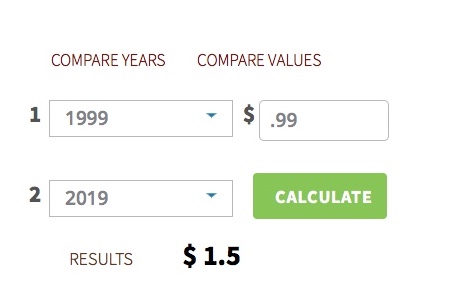
For those of you who enjoy math, that's well over a doubling of the price in ten years.  How can it be that official price inflation numbers would indicate the price should be more like $1.50?

From AIER.org Cost-of-Living Calculator,
found here

Perhaps this uptick is a very recent phenomenon, and the chart doesn't yet have the latest figures in its database.  But whatever the reason is, I find it intriguing.


Labels: , ,


Saturday, March 15, 2014

Update on Price Inflation - What Was That CPI Figure?

The penny has officially become worthless.  I finally had to admit this the other day when I found a pile of them in a parking lot, just as if they had been smelly old cigarette butts dumped out of a car ashtray by someone in a hurry.

A few months ago in an earlier post, I whined about the price of M&Ms, or more accurately about the dollar's decline.  I noted therein that my favorite little candies had gone from 5 cents when I was a girl in the 1950s, through 55 cents when I had my own little store in the 1990s, to 99 cents at my local supermarket in 2011.   So today, I was not particularly surprised to see that my little packet of goodies is now $1.19 in the same supermarket.

But when I did the calculations, I realized that's a 20 percent increase in three years.  That's almost 24 times the 5 cents I paid in the early 1950s....

What??  That may be par for the course, but let's ask the obvious question:  What was that CPI figure again??


Thanks to Wikipedia and Scott Ehardt for this image.


Labels: ,


Monday, January 27, 2014

Why We Are Not Seeing Price Inflation

The Keynesians are saying that price inflation is not a problem and probably won't arrive. The Austrians and others are saying that price inflation must come at some point, given all the monetary stimulus introduced by the Fed. But could they both be wrong?

I hypothesize that price inflation is already here. Please read my argument at this Seeking Alpha article.

Now you see it, now you don't.

Screen shot of the French movie "The Magician"
by George Melies, 1898, from Wikipedia Commons

Labels: , , , ,


Friday, February 04, 2011

Ben Bernanke: "Let Them Eat Cake!"

Marie Antoinette
[Photo of Marie Antoinette from Wikipedia]

According to Robin Harding's article in today's Financial Times, our Federal Reserve Chairman is convinced the Fed's QE2 program has nothing to do with worldwide rising food prices. In response to a question on the subject, Bernanke says:

"I think it's entirely unfair to attribute excess demand pressures in emerging markets to US monetary policy, because emerging markets have all the tools they need to address excess demand in those countries...."

I will not harp on the fact that I don't agree with Bernanke. First of all, no one really cares what I think; and secondly, I don't have the scientific ammunition to prove him wrong, even though evidence to the contrary is clear to me.

What I can point out, however, is his twisted sense of noblesse oblige. To make the above-quoted statement, he must have made one of the following assumptions:

A. An increase in the issuance of U.S. dollars without a corresponding increase in U.S. GDP has no effect on foreign nations; or

B. An increase in the issuance of U.S. dollars without a corresponding increase in U.S. GDP may have an effect on foreign nations, but they can control that effect by tinkering with their own monetary unit, which tinkering is effective and has no deleterious effect; or

C. An increase in the issuance of U.S. dollars without a corresponding increase in U.S. GDP may have an effect on foreign nations, but who cares.

Bernanke may not have the gall to choose C, as did Nixon's Treasury Secretary, John Connally. Faced with a similar question, Connally is reported to have said: "[T]the dollar is our currency but your problem...." No, this would sound too flippant, too frank, and would not correspond to Bernanke's more academic, more convoluted style.

So let's assume Bernanke has chosen B above.

In support of this assumption, Bernanke might cite the example of China. China has simply absorbed any excess dollars by investing them in U.S. treasury bonds. (Don't look now, but China clearly has no other choice. If it stops squirreling away its excess foreign reserves, the dollar will tank even faster and take the value of the reserves with it. And by the way, if you look hard enough you'll notice that China is slowly diversifying away from U.S. dollars.)

Bernanke doesn't seem to care that other countries may not have China's leeway. He explains, "They can, for example, use monetary policy of their own. They can adjust their exchange rates, which is something they've been reluctant to do in some cases."

But ... isn't that illegal currency manipulation? In fact--isn't that what we're doing??

Oh well. I guess two wrongs make a right.

If you ask me, Ben and Marie Antoinette have something in common. It's called Hubris.

Labels: , , , ,


Sunday, January 09, 2011

Price Shock: M&Ms hit 99 cents a pack!

Doing a bit of shopping the other day, I was horrified to find my staple pack of M&Ms up to $1.29 at Office Depot. Stunned into a reality check, I decided to find out what the current supermarket price is. It's 99 cents.

Most of us look at the items we purchase regularly as an indication of how prices change. The price of M&Ms is my own personal CPI indicator. To take this particular item in a pseudo-scientific study (click on the image for a larger version):

MM

- When I was an adolescent in the 1960s, a one-portion pack was 5 cents.

- I remember a few years later when the pack size began to vary a lot. Mars and the other candy makers started offering Jumbo Packs with twice as much for three times the price and other hoaxes like that, so they could hide the price increase.

- My next statistical indicator comes from the mid- to late-1990s when I owned a small coffee shop and market. I sold my M&Ms portion pack (who knows how many ounces by this time) for 55 cents.

- Today, ten years later, they're at 99 cents, almost double.

Something's happening.

Moving to my reliable source of price inflation information, AIER.org's Cost-of-Living calculator calculates that my 5-cent candy in 1955 should be priced at something like 41 cents today, assuming the portions are approximately the same. Of course, they may not be; but in your estimation, in which direction would the portions vary? Larger, or smaller? Well, let's not denigrate the candy companies. Let's just say that the ounces are the same.

So, I conclude that my M&Ms have increased in price at a rate of double the national average. Which brings me to the subject of the coming world food crisis.

According to Robert Zoellick, the President of the World Bank Group and the fellow I heralded for having dared to bring up the dead subject of the gold standard, the world can take many steps to "put food first." The G20 should "empower the poor" to ensure "the availability of nutritious food." In his piece in the Financial Times of January 6, 2011, world governments can and should take eight steps to achieve this goal in face of rising food prices.

The steps include improvement of weather forecasting (good luck), exempting "humanitarian food aid from export bans" (good luck), establishing "small regional humanitarian reserves in disaster-prone, infrastructure-poor areas (good luck), and helping "smallholder farmers become a bigger part of the solution to food security" (good luck).

I thought Mr. Zoellick had a grain of good common sense when I read his piece about gold's helpful role as a barometer of worldwide inflating. He is letting me down. If I read correctly from this article, he is just another bureaucrat ... but how silly of me. What was I expecting from someone at the World Bank?

Why doesn't he see that the price of sugar is not a supply problem? It is a monetary problem. If it were a supply problem it would be the only commodity with a rising price. However, as the charts reveal, all commodities are rising to record levels, with few exceptions. Take a look at this chart from Indexmundi.com.

There is no question but that the world is headed into a food price crisis. But my analysis of the problem does not point to governments or government agencies as the solution. The real long-term solution lies in finding an anchor for the world's monetary units, whether it be gold or something else.

More close to home, the question, as I have said before, is: Will this wave of commodity price increases translate into a CPI index rise in the U.S.? We have already got higher gasoline prices, and now higher M&M prices. Will it spread to everything else?

That depends on several factors: (1) the turn of U.S. political winds; (2) the health of U.S. and European banks, which in turn depends on the health of the real estate/banking sector in the U.S. and the PIIGS situation in Europe; and (3) the effect of the above on the interest rate markets, which in turn will have an effect on (2).

Some analysts expect the Fed's and other central banks' monetary actions will produce widespread price inflation worldwide. But this can happen only if the deflationary hot air can blow out of depressed economies. What if (1), (2), and (3) turn negative? And/or what if the deflationary pressures underlying our current crisis turn out to be ongoing? The Fed can "print" all it wants, but it cannot (a) force prices up, or (b) force interest rates down against the will of the gods of markets.

This is the infamous rock-and-hard-place I have mentioned in previous posts. My slow-motion movie climax is approaching. Keep your eyes open over the next few months.

Labels: , , , ,


Wednesday, October 27, 2010

The Bernanke Putt

Helicopter Ben is now turning to golf, according to an article by Jon Hilsenrath and Jonathan Cheng in today's Wall Street Journal.

golfer

I can't decide whether that feeling in my gut was pain, wrath, or an ironic chuckle, when I read the following:

"The Federal Reserve is close to embarking on another round of monetary stimulus next week ... despite doubts about the wisdom and efficacy of the policy among economists and some of the Fed's own decision makers.... Fed Chairman Ben Bernanke's push to restart the bond-buying program--a form of monetary stumulus known as quantitative easing [QE]--has been greeted with deep skepticism among some of his colleagues.... Mr. Bernanke has used the analogy of a golfer with a new putter: Unsure how it will work, he finds [the] best strategy is to tap lightly at first and keep tapping until the golfer figures out how best to use the putter."

All this is fine and good, Dr. Bernanke, but shouldn't you have gotten your golf practice in well before now, at some prior time when the whole world wasn't watching your every twitch? Do you have any idea of the potential consequences of a misjudgment on your part? According to the WSJ, one of the fellows on your own team, Thomas Hoenig, calls the Fed's up-coming actions a "bargain with the devil."

My previous posts have referred to a slow-motion movie that we are all watching. I have mentioned that at the climax the Fed will find itself between a rock and a hard place: the choice whether to act or not to act.

This is happening right about now, and the Fed has decided to buy bonds. Yet Bernanke has just blown the Fed's reputation as a team of expert economic monetarists capable of curing the second worst economic crisis the world has ever seen, by comparing it to a novice putter trying out a new golf club. Frankly, I'm not sure which is more disquieting.

So now we're pretty sure the Fed will perform QE. Everyone is now asking, will we get inflation or not? First, I'll have to refer you to my previous posts about the definition of "inflation," to remind you that when the media refers to "inflation" they are (incorrectly) referring most often to "price increases," and not the increasing of money supply.

QE is inflating (increasing of the money supply), under the true definition of the word. Whether or not it translates into general price increases is a separate issue that depends on other factors above and beyond the simple act of increasing money supply.

It depends, for example, on the business community's reaction to the results of the November elections, and on the future Congress's subsequent successes or failures. QE might translate into higher general prices, or it might just become higher stock prices, independent of the CPI. It might translate into higher bank bonuses, independent of the CPI. It will certainly translate into a much lower dollar, quite independent of the CPI.

Some recommend TIPS as protection against "inflation" (price increases), but already the TIPS are selling at a premium, so the protection they offer is eroded. And TIPS don't protect us against the effects of a weaker dollar as buyers of our regular bonds reduce their appetite for same. What is the consequence of this? We may soon find out.

What's certain is that Bernanke doesn't seem to care: he's out playing golf.

Labels: , ,


Friday, September 24, 2010

The Macro Forces Behind the Markets

Today's Wall Street Journal brings us this front-page headline:

"'Macro' Forces in Market Confound Stock Pickers" -- Tom Lauricella and Gregory Zuckerman (9/24/2010)

wave
[Thanks to Wikipedia Commons for Hokusai Kashushika's "Kanagawa", Big Wave]

Well, I have news for you: Macro Forces have been confounding American investors for the last century, in fact ever since Congress created the central bank.

The article states that "macro forces began moving stocks in a big way during the 2008 financial crisis...." I disagree. Macro forces have affected markets since the central bank starting making credit expansion a national and international issue, instead of the much more manageable local-bank issue it was at the turn of the 19th century.

The article states that one modern-day stock picker, John Burbank of Passport Capital LLC, "compares investing in the U.S. to investing in emerging markets, where he started his career. 'What is happening with the country, with the government, and what are their policies? These are the questions as an emerging-market investor that you ask before you do any bottom-up work on stocks,' he says."

Guess what, Mr. Burbank? The U.S. economy has been subject to government whim, just like the emerging economies, since 1913. Where have you been? You're probably too young to remember.

Example:

Leading up to the First World War and on into the 1920s, central-bank inspired credit expansion created the first big national boom. A few economists saw the bust coming, e.g., Edward C. Harwood, who wrote in August of 1929:

"[T]he time may not be far distant when the country will realize, in the light of a cold gray 'morning after,' that it has just been on another credit-splurging spree." [The Annalist, A New York Times publication, August 12, 1929.]

That time came two months later. He saw this because he was aware of the macro forces' effect on bank balances.

Another example:

At the end of the Second World War, Harwood saw from his statistics that there was a build-up of real savings capable of spurring on economic growth without help from the central bankers. He also noted that the central bankers were planning to continue their chronic inflating policies anyway. Having become by then an investment advisor as well as an economist, Harwood got his clients into the stock market. They did handsomely for the next ten years.

Then, as Harwood expected, the chronic inflating brought on a balance-of-payments problem, meaning that the gold standard was going to be trashed. He knew that the politicians would never discipline themselves enough to restore the dollar's gold-exchange value. He started getting his clients into gold in 1958. We all know how gold ended up in 1980. His clients did very well, although they got a little SEC harassment along the way.

Another example:

After a few years of sanity in the early 1980s, the central bankers went back to their inflating ways at the first sign of discomfort. The signs were, first, the savings bank crisis; then LTCM and the Latin American crisis; then the dot.com crisis; then the 9/11 worries; and now, S.A.S. (Stagnation Anxiety Syndrome). All these caused and continue to cause the central bankers to inflate, inflate, inflate. Where does that lead in fiat times? Bubbles. And not small bubbles; huge bubbles. Bubbles that are so big they have to be bailed out by the taxpayers or the world will come to an end.

I can't help but think that this final crisis isn't over, because no one can predict with certainly the outcome of the current central bankers' particularly egregious macro force known as QE2. If we get price increases, the stock market will do, because the stock market will simply incorporate the new pricing structure into stock prices. Inflation-adjusted TIPS will do, because they will incorporate the CPI. Gold will probably do, because it is a barometer of inflating. But what if we get no CPI price increases? This can happen; look at Japan.

Of the three, I know which I prefer: gold. I am not a short-term speculator and I need security. Gold is the ultimate monitor of macro forces in times like these.

PS: Congress must also be thinking along these lines. Have you seen the headlines lately about their going after gold dealers? Did you note they are enforcing the 1099 regulations relative to gold sales? I presume that's so no one forgets to pay the sales taxes or capital gains taxes; perhaps also because the gold sellers will have to maintain a record of who's buying the stuff. Don't you wonder what legislators are saying behind closed doors?

Labels: , , ,


Thursday, September 16, 2010

Bloated Government Still a Problem After All These Years

What a pleasure today to open the Wall Street Journal and find a full-page open letter to the President signed by Cato Institute. It scolds him, like Alice shaking the King, that in November of 2008 he promised to eliminate waste in the federal budget "page by page, line by line"; and that so far he had not yet begun.

king
[Thanks to Mr. John Tenniel, illustrator for Alice in Wonderland.]

On the contrary, he and our profligate Congress (both sides of the isle) have been responsible for expanding our budget to a precarious size never seen before.

This letter reminds me of the good old days. Back in the 1950s, 1960s, and 1970s my father, Edward C. Harwood, published such open letters to the standing president, over the byline of his research organization, the American Institute for Economic Research. Very few have the guts to do this anymore.

Rereading from one of my Dad's open letters published in February of 1961 on the subject of inflation, I'm struck by the parallelism with today:

"The great inflation of the past two decades [1940-1960] has shifted about $200,000,000,000 [equivalent to $1.5 trillion in 2010 dollars] worth of assets from the Nation's thrifty citizens and from endowed institutions, in addition to an incalculable but perhaps even larger amount from all whose incomes have been relatively fixed (such as retired individuals ...), to those who have benefited from inflation's progress. One of the chief beneficiaries has been the Government, whose tax revenues have increased greatly; other beneficiaries have been the holders of monopoly privileges including some elements of organized labor as well as numerous others.

"Thus have been fostered dreams of an affluent society able to afford global foreign aid, costly Government intervention in agriculture with accompanying waste of resources, and expansion of business enterprises without sufficient consideration of costs here compared with those abroad.... By cutting in half the buying power of elderly retired persons, they have been stripped of the means to provide for illness and other economic burdens of old age. In these and other ways too numerous to list here economic growth has been retarded and the Nation's economy has been seriously distorted.

"Now, consequences of past money-credit follies confront us. Some Keynesian economists ... recommend more inflation by monetizing more Government debt. Although some Keynesians favor more spending, others favor tax reductions; but the basic notion is the same, i.e., that Government deficits should be monetized to restore prosperity....

"In addition to the dedicated Keynesians, convinced that their nostrum is a useful remedy, various pressure groups will clamor for what they think will promote their interests. Labor leaders who can see only the short-run benefits of more increases in wages instead of decreased wage rates in some industries, speculators in real estate and stocks (especially those speculating on thin margins), bankers whose investment-type assets are excessive and largely 'frozen,' and others who hope to gain from more inflation or fear to lose if deflation occurs will join in the clamor. And adding their not inconsiderable bit will be many intellectuals whose education in verbal facility failed to make them wary of perpetual-motion schemes such as those proposed by the Keynesian inflationists."

[Quoted from "An Open Letter to President Kennedy," 2/19/1961, the final proof document of either the NYT or the WSJ version.]

Ah, that I had the wherewithal to republish much of what he wrote when he was alive. It's all still valid today.

PS: By sheer coincidence, on the page opposite Cato's letter was a huge ad for gold investment in iShares. The ad comes from BlackRock, the gold trust's sponsors and one of the biggest hedge funds, now apparently investing in gold. This also brings back the old days when my Dad brought all his investment clients into gold. He began to do that in 1958, and judging from the results in 1980 when he died, his clients did well.

Central banks have been purchasing gold within the last few months. Would BlackRock be trying to position themselves to get in on a developing business of gold trading, involving bigger and bigger players?

Labels: , , ,


Saturday, August 28, 2010

Why Gold is Up in this Deflationary Environment

I've run across an excellent commentary at The Privateer, entitled "Puzzling - Gold is Going Up Again." He is responding to an August 20, 2010 article on CNN's Money.CNN.com.

As the Privateer points out, some analysts are scratching their head trying to figure out why gold is rising even as inflationary fears are subsiding. This seems counterintuitive.

confusion
[Thanks to Dhirajranka.com for the photo.]

Mr. Privateer puts his figure right on the answer to the quandary: monetary inflating. Some call it quantitative easing (QE). We could also call it Helicopter-Benning, or, as the more old-fashioned among us would say, printing money.

The U.S. central bank is finding itself between the proverbial rock and hard place. The rock: stagnation in the American economy. The hard place: The limitation of its power to do anything about it. But they can't just sit there; they have to act. They're supposed to be controlling this thing.

So the Fed Governors--at least a majority of them anyway--seem to have taken this line of conduct:

When in doubt, pull the checkbook out, and make the bogey-man pout.

Ben Bernanke, the figurehead of this majority, once swore to Milton Friedman that we would never see a deflationary episode like the Great Depression of 1929. Some astute analysts are claiming that we are indeed already seeing the deflationary episode, only it is disguised behind a wall of monetary inflating.

Mr. Privateer is one of them. Here are Mr. Privateer's words:

"Not only is 'quantitative easing' inflationary, it is the absolute last resort of the entire inflationary process. Inflation being defined as an INCREASE IN THE TOTAL STOCK OF MONEY. There are quite a few people out there in the world, and in the US too, who understand what inflation is. These same people understand that rising prices are one amongst very many RESULTS of inflation."

[Ah, a rational human being at last!]

"These same people understand that the destruction of 'wealth' measured in terms of money which has taken place over the GFC [I assume this means Global Financial Crisis] to date has more than offset the creation of new money which governments in general and the US government in particular have been desperately resorting to."

"There is not the slightest chance that there will emerge any GENUINE way out of the GFC until such time as the gargantuan malinvestments propelled by the credit money boom which has now collapsed are liquidated on a market. Every day that this is delayed makes the situation worse. Every new 'Dollar' created by governments and their banking system makes the situation worse. Every new Dollar created in this manner is inflation, pure and simple. The fact that prices are rising or falling has nothing to do with it. Inflation is an increase in the stock of money."

My heart pitter-pattered as I read this. One could hear my sighs of genuine relief at not finding myself alone in this cold world.

The author is correct. I would just add that the nation's "regime confusion" is also contributing to the stagnation. (Robert Higgs calls it "regime uncertainty.")

The question is: what do we do?

Here is the Privateer's response:

"The [CNN] article concludes with the assertion that once the GFC is 'over', there will be no reason to own Gold. The problem is that the GFC will not end - or even properly begin - until money can no longer be 'created' out of thin air. Today, while the Europeans are making some moves towards reducing their deficit spending and while Asia is losing its appetite for US Treasury paper, there is no sign of that happening."

Couldn't have said it better myself.

Labels: , , , ,


Saturday, July 10, 2010

Nature's Golden Standard Is Back (Whether The Macro-Managers Like It Or Not)

The news about gold swaps on the back pages of the Bank of International Settlements report made a few waves last week. Some immediately reacted in shock, claiming this is potential bad news for gold bugs because it augurs a future glut of gold supply on the market if and when the swaps fall through.

But this is not potential bad news for gold bugs, only for gold speculators. Because I am a gold bug, when I heard the news my immediate reaction was, "Hey, this is great. Some financial entity out there got so desperate that they had to use their gold as collateral. It's probably a large European bank or even a central bank, and this may not be the last time it happens. Gold is definitely coming back into style."

MomNature
[Thanks to BuyCostumes.com for the image of Mother Nature.]

A real gold bug like me believes that gold is Nature's monetary base, no matter how politico-academics try to manage their fiat (paper) money without it. The fact that central banks still store the yellow stuff is evidence in support of this, so when I learned that some important entity, perhaps even a central bank, was actually using gold as collateral in a borrowing transaction, I realized it was just more evidence in support.

Thus, in my e-mail update from Mineweb.com, I wasn't surprised to find a link to this article entitled "BIS gold swap--best news to hit gold in 30 years." Author Julian Phillips remarks:

"What is significant about this or these transactions is that gold is being used in international settlements after so many decades of being sidelined in the monetary system!"

This is surely what it looks like to me, too.

The poor speculators, however, unnerved by the slightest tidbit of information, are trying to figure out which way the gold price will move over the next few months. We gold bugs don't really care about the short run, because we know that in the long run there's too much paper money (or its equivalent) floating around, explaining gold's rise relative to a number of currencies. But contrary to us, the speculators don't see the joy here.

They think that gold is just a "hedge against future inflation." Therefore, their next question becomes: Will we get "inflation" (which to them means U.S. price increases) enough to spur the Fed to reign in the fiat dollars? The consumer and other figures suggest not. So should the gold speculators panic and sell it all?

I say that this double-dip will maintain prices, and therefore the Fed is not about to retire any fiat dollars for a while unless general prices start to rise. It would also surprise me if the Europeans manage to retire any euros, what with the PIIGS problem. So without a CPI increase does this mean we will not get "inflation" and the speculators should dump gold?

Well, that depends on how you define the word "inflation." I've been down this road before--it's one of my pet peeves--and I'll do it again by referring you to a modern web dictionary's definition of the word "inflation":

"A persistent increase in the level of consumer prices or a persistent decline in the purchasing power of money, caused by an increase in available currency and credit beyond the proportion of available goods and services."

Interesting that they used the word "or." When can one have a "persistent decline in the purchasing power of money" without an "increase in the level of consumer prices"? Simple: when credit doesn't reach consumers through an increasing paycheck, or through home equity. Where is it, then? In the pockets of speculators, corporations who don't care to invest just now (and rightly so), Wall Street, Freddie and Fannie--in fact anywhere but in the wallets of consumers.

Therefore, general prices will not rise. BUT: the price of gold will rise, because gold is Nature's golden standard, the barometer of "inflation" as defined above in italics. And this italicized inflation situation exists now and has been growing, according to my theory, since consumer prices stabilized in 2008, and perhaps even since earlier than that.

More proof that one can have a decline in the purchasing power of money at the same time as stable prices: Gold compared to the CPI basket of goods has remained stable over time, e.g. about 2.5 ounces/ basket in 2004, the same as in 1942. (Source: www.northerntrust.com/library/econ_research/daily/us/dd052605.pdf.) With the recent increase in its price relative to a number of currencies, however, gold will buy more goods now than is customary. So we have a relative "decline in the purchasing power of money" without an "increase in the level of consumer prices."

Another perspective: Purchasing power in consumer hands is being syphoned off through higher taxes, higher corporate profits (they are not spending, but they are still pricing at the same level), a stagnation of average wages or loss of jobs, and decreasing home equity.

So who is bidding up the price of gold? Anyone with savings they want to protect from further erosion of purchasing power, including many small and large investors, huge hedge funds, enormous pension funds, sovereign funds--anyone who has money to save and who realizes that the dollar and some other currencies have been "over-printed," and that the central bankers are only watching the CPI.

So if the BIS report sent chills up your speculating spine, don't worry. The macro-managers are about to mess things up good, and Mother Nature has yet to sing her last song.

Labels: ,


Thursday, April 15, 2010

Inflation or No Inflation, That Is The Question

Once again, the question of future inflation is boggling the minds of many a financial forecaster. Are we headed for a rise in prices that will carry the Dow up and away, hopefully carrying the rest of us with it, or are we going to suffer the second leg of the W Recession as commercial property and/or the inevitable rise in interest rates hits the skids?

thinker
[Thanks to Commons.wikipedia.org for the photo.]

The questions I would pose are quite different. We are already engulfed in a sea of inflated purchasing media that is constantly roosting, taking off, and re-alighting in its search for new quick profits. Unfortunately, given the current labor market, it won't even be dipping a little toe in the ordinary person's paycheck on its way by, at least not anytime soon.

So where is it now, and what is going on? It is where it has gone for the last two years, to wit ten years or more: into speculative investment, biding its time. In America, at least, it isn't going into production, and it isn't going into salaries. It's going into profits and speculative investments, instruments like Greek bonds and credit default swaps so popular with the hedge fund crowd.

This means that the answer to the introductory question is yes, inflation, but be careful how you define it. As I have harangued before, the word is used flippantly to mean at least two things: on the one hand, price increases represented supposedly by the CPI; and on the other: excess purchasing media, the kind that used to cause price increases before the market got savvy, but that now finds itself blowing bubbles while maintaining general prices that should be falling so that the ordinary consumer gets a break. This definition we could differentiate by naming the process "inflating."

We've got the price stabilization, and we most certainly have got the bubbles blowing again. The excess "money" is now keeping Wall Street afloat--in fact higher than ever, bonuses and all, while stable prices buoy the record private sector profits we've been hearing about (which they're using to increase inventory, speculating on a price-rise opportunity), and while the Fed's funny-money sustains the whole U.S. residential real estate market.

If I were a businessperson these days, I would most certainly not invest in much capital equipment or labor, at least not until I find out:

- What the CPI is going to do over the next months, only because of its effect on what the Fed will do;
- Whether the Fed will really stop buying Freddie and Fannie issues, and/or start to raise interest rates, and/or take some other action to counter their recent balance sheet explosion and any eventual rise in the CPI;
- Whether the commercial real estate market will implode, with the resultant double dip in the economy;
- Whether we'll get a second wave of mortgage foreclosures and a second dip in the residential market, with the obligatory double dip in the economy;
- What the FDIC will look like at the end of 2010;
- What the Pension Benefit Guaranty Corporation will look like at the end of 2011;
- What will happen to the health bill;
- What Congress will look like in November;
- What party will run the country starting in 2011;
- Who will win the election of 2012;
- What the national debt projections will look like over the next two years;
- Whether or not the Chinese, Japanese, and Arabs will continue to buy and/or hold US Treasuries at the rate they are today, and what the U.S. bond market will do in response;
- What else?

Frankly, it's a wonder that the real economy turns at all.

This country is at a crucial point, both politically and economically. Will we affirm the liberty protected by our Constitution by turning away from government intervention in our lives, or will we succumb to the temptation offered by larger and larger handouts from an increasingly intrusive, blood-sucking, and short-sighted public sector?

Just as in the 1930s the electorate and the businesspeople of America are waiting to see what we, collectively, will do. In the 1930s the public sector won, and the private sector lost. After Roosevelt's about-face (his 1932 platform included reducing the debt and reinforcing the gold standard--I'm not kidding!) and after seventy years of inflating the currency, we are seeing the measure of that loss today, and the inflating continues to the detriment of all of us. What is the denouement?

In times like this, I prefer the security of gold and related investments. One thing that history has taught me is that gold tends to retain its purchasing power over time as the paper currencies lose their value. And I'm betting the dollar will lose its value compared to gold, sooner or later.

Labels: , , ,


Wednesday, September 09, 2009

The More Things Change ...

Gold has just hit $1,000 and seems to be staying there. China has revealed that it is divesting its dollar holdings into gold and other assets in order to save their sovereign-fund investments. Even the UN is getting into the act. (Do they see a future role for themselves?)

Stonehenge
[Thanks to Wikipedia/commons for the photo.]

The more things change, the more they stay the same. So this seems as good a time as any to recall what was said by a subsidiary of the American Institute for Economic Research back in July of 1975 when the Institute's founder, E.C. Harwood, was still alive. Much of it is still relevant today.


"Removal of the gold reserve requirement for Federal Reserve notes (your paper money) in March 1968 and closing of the so-called gold window in August 1971 eliminated the last barriers to inflating continually the Nation’s purchasing media. As long as a substantial gold reserve was required by law, the money-credit managers were confronted with a restraining influence.

Now, only the wisdom and determination of the Nation’s money-credit managers can prevent the ultimate decline of the buying power of the dollar until it becomes nearly worthless. To what extent the citizens can rely on the wisdom and courage of those 'responsible men' can be judged by events of the past [seven] decades, including loss of 70 percent [how much today?] of the buying power of savings and life insurance, the increasing rate of depreciation in recent years, loss of much of the Nation’s gold, and the fact that several of these managers have been among the most persistent in advocating the removal of all restraints. Truly wise and responsible men would not want to be without the guidance of such an objective criterion as a gold reserve requirement; and unwise, irresponsible men should not be relied upon to act properly without such guidance.

The dollar appears doomed to continue losing buying power, the only question being, 'How long before it will be practically worthless?'

We, as well as others, have foreseen this possibility for many years. [Six] decades ago advising investors how to protect themselves against substantial depreciation of the dollar was relatively easy. Most domestic common stocks then were available at prices approximating the prewar level, and a long continued upward trend of windfall profits for U.S. corporations was practically assured by the World War II inflating.

Now, however, the situation is different. No longer is there a large reserve of idle purchasing media such as that accumulated during World War II, which was used to augment business expansion during the earlier postwar decades. Rather, there now exists a huge amount of debt incurred during the prolonged period of inflating. Debt liquidation may have a cumulative effect on business failures.

CONCLUSIONS

We have concluded:

1. … Recently Government authorities have been more concerned with attempting to avoid a severe depression than with reducing the rate of inflating.

2. That the various “welfare state” obligations, including the unfunded Social Security obligations, constitute a self-destruct mechanism reducing the standard of living, and consequently the birth rate as well, for a majority of the Nation’s population.

3. That prolonged past inflating has fostered initiation of innumerable businesses lacking adequate capital, widespread speculation “on margin” in real estate and securities, and installment borrowing on an unprecedented scale by individuals.

4. … Even if [there are] chances of a temporary recovery induced by deficit spending … the adverse possible consequences of a severe depression are so great that we do not recommend gambling on a near-future cyclical recovery.

5. Finally, that continuation of the international financial crisis justifies placing much of one’s funds abroad before exchange controls are ordered, which may occur at any time….

RUPTURE OF ECONOMIC RELATIONSHIPS IN WESTERN CIVILIZATION

The consequences of nearly four decades [make that seven in 2009] of almost continuous inflating are becoming more evident with each successive international monetary crisis. All currencies have been and are being degraded steadily. All now have lost about three-fourths, at least [nine-tenths as of 2009 for the U.S. dollar], of their pre-World War II buying power, and all seem destined to depreciate much more in the next several years, perhaps for as long as a few decades before they become practically worthless.

Clearly, what the world needs is a relatively stable money or accounting unit. In the absence of such a unit long-term promises including bonds, life insurance, and pension plans are like a mirage in the desert and business depreciation schedules are misleading distortions of alleged facts. Unfortunately, the world is getting a continuing flood of paper 'money' that has neither a reliable exchange value nor any assurance that it will retain future purchasing power. Without these two essential ingredients, confidence in fiat paper 'money' will continue to diminish, until the flight from currencies overwhelms the efforts of monetary and political authorities to cope with the chaos.

Politicians generally insist on remaining in their Politicians’ Paradise where lavish promises in order to obtain votes are fulfilled with inflationary purchasing media created to finance government deficits. Their accomplices in embezzling the savings and life insurance of the people in Western civilization are the central bankers of the leading nations. Without exception they choose to remain in their Banker’s Heaven, where promises to pay are, as John Exter pointed out, simply 'I owe you nothings.' And the people of Western civilization are beginning to endure the Hell that has been paved with the good intentions of those who would save the world (and incidentally retain power, or is it vice versa) by the money-credit manipulations.

We see little possibility that there will be a return to sound money-credit procedures until after some bitter lessons have been learned during a future depression.

Meanwhile, each succeeding crisis in the foreign-exchange markets for currencies will tend to spread the realization that paper profits are more easily reaped than retained, and that the purchasing power of hard won savings is ephemeral unless those savings are invested in a tangible asset whose exchange value is not subject to manipulation by the monetary and political authorities. Among such tangible assets, gold has proved throughout the centuries of history to be unsurpassed both as a unit of account and as a store of value. Therefore, projecting an increasing demand for gold in its various forms during the period of unstable monetary conditions that almost surely lies ahead appears to be warranted in the light of both recent experience and earlier history.

The more the politicians and central bankers struggle to free themselves from the so-called 'tyranny of gold,' the more that governments endeavor by controls of one kind or another to counteract or conceal the consequences of their money-credit follies, the more they endeavor to seize the wealth of citizens by increased taxes of all kinds in the hope of maintaining a semblance of monetary order, the greater is the incentive of the citizens of every country to get gold. As a safe and sure means of holding wealth, of avoiding the grasp of the tax collector, and of assuring the economic future of families, gold never has had a peer in the history of mankind. Those who would demonetize gold in order to facilitate their embezzlement of private wealth and maintain their positions of power in governments and central banks are following policies that must inevitably teach every intelligent citizen the usefulness of gold. The money-credit managers are defeating their own ends at a price that almost surely will include serious retrogression within Western civilization."


Aren't these remarks still valid today? I'll just leave you with my mantra:

You can take gold out of the standard, but you can't take the standard out of gold.

Labels: , , , ,


Sunday, August 02, 2009

Hyperinflation Not an Option, Say Some

Friday I attended a Symposium on hyperinflation at the American Institute for Economic Research. Participants were Thomas Glaessner of ICG at Citigroup, Peter Heller of the International Monetary Fund, Gerard Caprio, Professor of Economics at Williams College, and Joshua Rosner of Graham Fisher & Co.

zdollars
[Thanks to Virginmedia.com for the image of Zimbabwe's 100-trillion dollar notes.]

Glaessner had much experience with the hyperinflations of Brazil and Argentina; Heller did also but from the angle of the IMF. Rosner gave his own analysis, and Caprio served as moderator.

Glaessner and Heller both felt that hyperinflation was only a remote possibility due to the strength of various factors within the U.S. They both expect inflation at some point, but think that the Fed will somehow pull it off. Glaessner pointed out that the EU was in no better shape, in fact was worse off, and that the euro was not a real competitor to the dollar.

Rosner was more pessimistic in that he felt the Fed had lost some credibility and that the underlying problems that got us where we are today have not yet been addressed. He had predicted our current trouble well before it began, but no one would take him seriously. He now expects another strong deflationary downturn before things get better but also thinks inflation is a distinct possibility once the next downward swing has had a chance to run itself out. After questioning, he did agree that there existed a possibility that there might be a flight from the dollar. They all agreed that China might just find another medium of exchange with some of its trading partners.

Rosner pointed out that the securitization market had become the principal avenue of financing over the last dozen or so years, and he thinks that the recovery will depend upon the revival of this market, because the banks must accumulate capital and are not in a position to take back that function. They all agreed that the reforms of the OTC marketplace will be helpful if they are done correctly (and useless if done incorrectly), and the major OTC market participants are very active currently in trying to see that it is done well.

Gold was only mentioned in passing and time ran out before I could bring it up, which is a pity. I'd have liked to ask whether they thought there might be some more action. In my view, this deflationary cycle is the result of the previous inflationary cycle, and trying to buck the trend to preserve the price level is not going to solve the problem, but in fact make it worse. Judging from past idiotic government attempts to do so, such frontal conflict with deflationary momentum always ends in distortions, and I don't see why this time will be any different.

What does this mean? It means that the deflation will continue until the market finds its sea legs again, but because the underlying problem hasn't been solved, the market will not get those legs until the toxic cancer has been cut out and the financing channels are reestablished. When that will be is anyone's guess.

Meantime, government meddling with interest rates, the dollar, spending, and credit will backfire as usual. The interesting part will be to observe what happens this time. The country and the world might just not accept another inflationary spiral as they did in the 1950s, the 1960s, the 1970s, the 1990s, and the 2000s. Then again, I suppose there is a chance they will.

Rosner argued that there were too many debtors in the country who would all be quite happy with inflating their debt away. But I argue that this only works when wages rise, and I don't think businesses will let wages rise this time, all the more because unemployment doesn't look like it'll moderate any time soon and it'll be an employers' market (except on Wall Street). Non-banking business is getting too savvy about inflation. Rather than pass through any profits to labor, the extra cash will flow back to speculating (as it has already started to do), and we'll get even more disequilibrium between Main Street and Wall Street. (Seen those bonuses?)

We are in a 1929 situation with 2009 tools and a 2009 government mindset, but also with a 2009 public and business mindset. Whatever we get, whether it be deflation, inflation, or a mix of the two with or without hyperinflation, this is going to be interesting.

Labels: , , , , , ,


Saturday, March 21, 2009

Fed Credit: The Latest And Perhaps Next-To-Last Bubble

I can't claim to be the origin of the Fed Credit Bubble idea, because it occurred to me as I read a fantastic piece by one of my favorite analysts, Doug Noland of Prudent Bear.

We've just come out of a huge bubble that consisted of inflated real estate investment and speculative finance credit. The bubble burst and the market began to correct itself, menacing to take a lot of nations' economies with it.

The reaction of our economic leaders was and continues to be to try to maintain a minimum of stability by propping up the various players on the world financial stage as they began to totter, one by one: first the real estate sector with aid to Freddie Mac and Fannie Mae, then the banking sector by saving Bear Stearns and loans to other institutions, then the insurance sector by bailing out AIG, then the automobile sector with handouts to GM and Chrysler, more money and loans to the banking and real estate sectors, more to AIG, recently some more to auto supply companies, more to AIG, and now the credit card and other large ticket item credit sector--an endless list, it would seem.

The central banks of the world, to a varying degree, are performing their propping-up role as the ultimate insurance company, the lender of last resort; and the US Fed, given the universal role of the US dollar as reserve currency, is the one that will be the buck-stops-here Last Lender of All Last Resorts.

As Noland points out, however:

"Our federal government has set a course to issue Trillions of Treasury securities and guarantee multi-Trillions more of private-sector debt. The Federal Reserve has set its own course to balloon its liabilities as it acquires Trillions of securities. After witnessing the disastrous financial and economic distortions wrought from Trillions of Wall Street Credit inflation (securities issuance), [it is possible that] the Treasury and Federal Reserve have set a mutual course that will destroy their creditworthiness - just as Wall Street finance destroyed theirs."

He's saying that the Fed is going to create the Bubble of All Bubbles, right there in its own house.

balloonhouse
[Thanks to Bouncehousesnow.com for the picture]

But just how much air can the US Fed balance sheet withstand, without bursting its own skin? The inflationist central banks are acting on the assumption that they can right the "market failure" (see PS below) through this "temporary" remedy, that the market cannot right itself alone, or at least not without disastrous consequences. But aren't they trying to add air to an already burst bubble?

Instead of curing the problem, they are acting contrary to the market's instinctive corrective hiatus and will end up distorting events even further. How can arbitrarily selective bailouts and the forced financing of government projects--projects that otherwise most likely would not have been financed--do anything except further distort the admittedly slow and cumbersome but essential market reevaluation process?

"[T]he seductive part of [the optimistic] view is that unprecedented policy measures may actually be able to somewhat rekindle an artificial boom – perhaps enough even to appear to stabilize the system. But seeming 'stabilization' will be in response to massive Washington stimulus and market intervention – and will be dependent upon ongoing massive government stimulus and intervention. It’s called a debt trap. The Great Hyman Minsky would view it as the ultimate 'Ponzi Finance.'”
Precisely. The ultimate Bubble, created by those who are supposed to help us avoid them altogether.

So how will the world react when this latest bubble bursts? At some point, investors looking to preserve the value of their wealth will realize that there is no investment denominated in an existing national currency that does the trick, and they'll turn to gold, always the last fat lady to sing before the curtain falls and reality sets back in. (By now, you've figured out that I'm somewhat of a gold bug.)

_______

PS: We have no market failure here. On the contrary, the market is functioning perfectly. It is waiting to discover the real price of toxic assets, if only the government and its allies would let it. Rather, it is the market players who have failed us, and more specifically those who would pretend to manage our monetary units. For more on the true source of the real estate and credit bubbles, find yourselves a copy of the March 16, 2009 Research Reports out of the American Institute for Economic Research (annual subscription), and read the piece by Walter M. Cadette entitled "Greenspan the Goat."

Labels: , , , ,