Sunday, August 19, 2007

LTCM All Over Again?

ducktaped
[Thanks to spamsters.com for the image.]

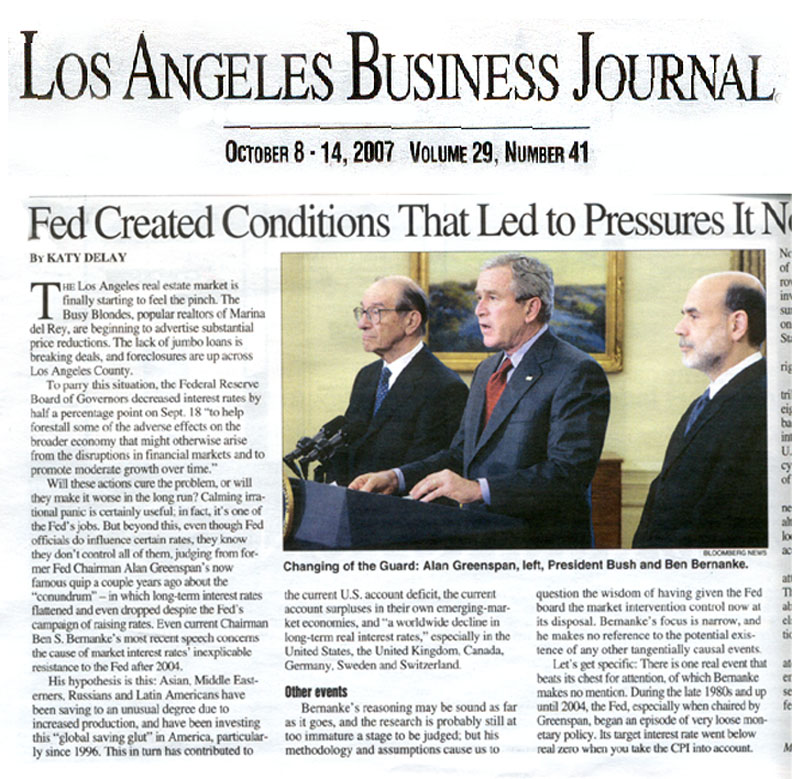
In this article at SeekingAlpha.com, Michael Shedlock paints a stark picture of our present sticky financial crisis and the computer modeling that created it. (I would go even further than he does and blame it on the Fed and the central banks of this world, who believe that they can wave the interest-rate wand over any problem and make it disappear, when all they really do is gunk up the works with excess liquidity. But I digress.)

If I understand correctly, he believes that we are worse off than in 1998 during the Long-Term Capital Management crisis. I concur, mainly because I perceive this one to involve so many more and larger institutions.

Perhaps some of you don't even know we had a crisis back in 1998, but we did, and here's a pretty succinct description of what happened. To make a long story short, some pretty smart people created some pretty wild mathematical/computer models to make lots of money on some pretty risky bets. Unfortunately, their models failed to take into account (1) the time factor, and (2) the panic factor.

By "time factor" I mean the same thing that Keynes (or someone else, maybe) meant when he said something like, "although markets do tend toward rational positions in the long run, the market can stay irrational longer than you can stay solvent." In other words, you can have the best play in the world, but if you can't put your cards down at the right time, you lose anyway. (Or vice versa: When they force you to show your hand before you've acquired all the right cards, you lose even if you'd have gotten them eventually.)

By "panic factor" I'm referring to the irrationality of investors when they are fearful. They can pull their money at any time (within limits), and those who are using that money have somehow to come up with it or die in the process.

In LTCM's case, their positions were sound (reportedly); but they couldn't withstand the violent gyrations that came about in the situation that consumed them. Such situations require liquidity, which requires collateral, which collateral LTCM didn't have, because of some pretty extreme leveraging (i.e. they allowed themselves to get too far out on a financial limb).

The circumstances behind the problems we're having today are much broader and deeper, according to several writers. These fears are confirmed even by such a staid group as the Bank of International Settlements. Here are a couple of quotes from their most recent annual reports:

"The current [2006] environment places a premium on system-wide risk management. It highlights the importance of making available information about risk as well as the interplay, and need for consistency, between financial reporting standards, risk management practices and the overall prudential framework.... [T]here are considerable uncertainties and associated risks, not least concerning inflationary pressures on the one hand, and a possible unwinding of accumulated economic and financial imbalances on the other. These could lead to financial market turbulence or a long period of relatively slower global growth developments, or both. [Emphasis added] " (From the 2006 report.)

"The implications of past risk-taking related to property investments and to the leveraged financing boom will depend critically on the future path of interest rates and overall economic conditions." (From the 2007 report.) How true. It is indeed interest rates that are causing all ruckus, but they are only the catalyst. The real problem is the original excess liquidity created by the central banks.
Here's the scariest part of Shedlock's piece:

After LTCM, what happened? "What became of Long-Terms founders? Were they jailed or banned from the financial world? No. They went on to start another hedge fund!"

Now that's scary. So they went right out and did it again, and others have now copied them. Good grief. How bad is this going to get?

Oh, and by the way, a pox on computer models.

Labels: , , , ,


Wednesday, July 04, 2007

Hedge Fund Investors: Read Your Fine Print

Back in September of 2006, the papers were already discussing the fall of hedge fund Amaranth and what hedge fund investors should do to watch their money. This Article at the Wall Street Journal gives good advice for any readers who happen to be so brave as to put their money at such risk. If you thought you could pull your funds out without much problem, think again.

But frankly, who in his right mind would invest in a hedge fund without knowing that he can lose every penny? It is mind-boggling to think that someone with that much money would not know the risks he or she is incurring.

For those who don't know what a hedge fund is, it's a highly risky investment program that escapes from most of the federal restrictions and regulations. Unfortunately, there are many large pools of funds that are invested in hedge funds, and one of them could be your own IRA, pension fund or insurance policy. If you have access to the manager of your retirement funds or your life insurance company, please call them and find out what's being done with your future income. Even some money market funds are invested into hedge funds.

The times are precarious. Amaranth was only the first and most visible recent fund collapse, and it wasn't even involved in mortgages. We've now had two more balloons pop, over at Bear Stearns and another one in London, all three based on subprime loans.

My insider information tells me that those in the know should watch for monthly CDO mark-to-market figure declarations soon after the end of each month. The financial industry must declare certain numbers at that time, and also at their respective financial-year-ends. Unfortunately, however, they can lie, so try to read between the lines.

Keep your eyes and ears peeled during the first week or so of each month, for more crap to hit the fans. This should be a wild ride, and if it's not, I'll eat my hat. (It's made of straw and should go down nicely with a little vinaigrette and a sip of cabernet.)


[Thanks to /islandiavillage.com and to Travis Werklund for the cute photos. This is before; click on the image to see after.]

Labels: , ,


Monday, June 25, 2007

Another Behind-the-Scenes Wall Street Bailout

Most people don't know it, but the financial world almost stopped turning in 1998 when a huge hedge fund called LTCM (Long-Term Capital Management) "lost $4.6 billion in less than four months and became the most prominent example of the risk potential in the hedge fund industry," according to Wikipedia. ($4.6 billion in 1998 is the equivalent of $5.79 billion in today's dollars. Source)

Fearing devastating repercussions at the time, the Central Bank of New York got involved, and a "bail out" arrangement ensued whereby several large financial houses agreed to back the bad loans.

Where have I heard before that history always repeats itself? We now have a similar situation happening today, only the present-day LTCM is Bear Stearns. This time, we're talking about $3.2 billion at risk, guaranteed by Bear Stearns itself. The quasi-authoritarian intermediary this time is Blackstone, whose two principals are a former classmate of Bush at Yale and a former US secretary of commerce, the same Blackstone in which China just invested mucho dollars. (Aside: Has anyone investigated the potential conflict of interest with this kind of mixed-bedfellow deal? But I digress.)

So far, this is well within Bear Stearn's means, so panic hasn't started yet. But the jitters have begun in earnest, as players watch the other hedge funds that have highly leveraged portfolios as well. There may be a steady flow of money coming into the country even as the big players unwind their unbalanced dollar portfolios, but panic is a funny thing: it doesn't always listen to reason and won't always wait for a level-headed solution to an immediate sticky problem.

sticky situation
[Thanks to number-10.gov.uk for the image.]

The problem irking everyone is that the global financial markets now flow so easily from one country to another, and from one sector to another, and the sums are so huge, that any sign of instability could create a panic environment. The US deficit is supported by billions of investment from foreigners, and these investors have already begun to diversify away from the US dollar as it loses value on the international market. (It has gone from $1 = euro 1.20 to $1.00 = euro 0.74 over the last 6.5 years.)

Whether or not this situation is actually going to threaten America's financial stability is not a sure bet. There are those who deny that the LTCM matter was life-threatening, ironically among them the former chief of Bear Stearns himself. But there is a consensus that there exists an unsavory level of leveraged risk-taking at the present time.

I'm all for risk taking, assuming that it will be the risk-takers who pay the piper, and not the rest of us. Unfortunately, as I have explained in previous posts like this one, I believe the central banks are responsible for this situation and that we are all paying for it through diversion of real wealth to such lottery games, due to the uncertainty of the financial times we live in.

For more on these events, read this article at The Economist, this one by Michael Panzner at SeekingAlpha.com, and this one by Jody Shenn and Bradley Keoun at Bloomberg.

This is definitely something we all should be following closely.

Labels: , , , ,


Thursday, June 21, 2007

Hedge Fund Woes Finally Hitting the Fan?

Peter Viles, blogger at the LA Times, writes today about the saber rattling going on among a few of the big bullies on Wall Street, most recently Bear Stearns, JP Morgan, Deutsche Bank, and Merrill Lynch. It seems that those risky subprime mortgage financing vehicles that were all the rage until 2006 are coming back to haunt the current owners.

This touches on a domain that central bankers have been jawboning about for months now, the credit derivative and securitization market imbalances that are becoming dangerously out of whack. They know--and Wall Street bankers must know (even if they don't act like it)--that there are factors at work in the global economy that have created huge waves of what the financial world calls "liquidity," or large holdings of spending and investing money, if you will.

You have only to follow the recent buzz around the newer Basel II accord to see that the international banking community is aware of the problem; however, just like hyper-gifted children, they sometimes have a hard time disciplining themselves. This lack of self-discipline is creating much central banker angst, because the central bankers are supposed to be supervising banking activity. If they fail to do so, their respective governments will either have to mop up the mess (i.e. bail somebody out) or take blame for the devastating consequences that are potentially very bad for the dollar (not that anyone seems to care anymore) and horrible for the US economy.

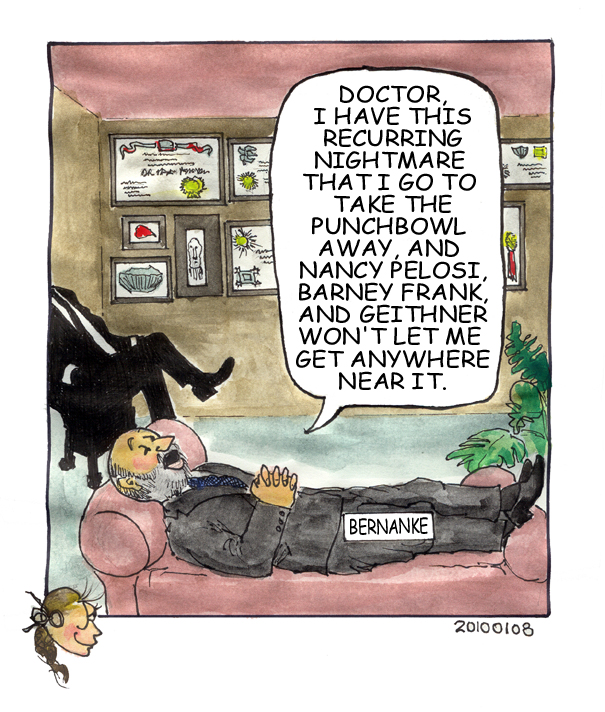
The nature of the factors behind this liquidity has provoked much speculation, but as yet there is no consensus. The US banking-overseer head honcho, Ben Bernanke, blames it on what he has called a "global savings glut" (as though there could exist an excess of savings). Personally, I suspect that the central bankers themselves are at least partially responsible, but I'm not so sure they would agree. (See this previous post in rebuttal to a couple of Fed researchers who tried to pass the buck.)

But whatever the cause, the fact is that trillions of dollars are currently roving the earth looking for a roost, and everywhere they have chosen to alight they have caused bubbles, to wit the 2000 dot.com event and more recently the 2002-2006 housing boom. Other more sustained and recent bubbles can be found in the current securitizations and derivatives markets, where high-rollers bet on the odds of certain financial events happening. (See my article at Prudentbear.com for a discussion of the process.) Until recently, much of this activity centered around the subprime mortgage market, which as we all know is now turning very sour.
bubble gum
[Thanks to ironicconsumer.com for the photo.]

Now, if these particular bubbles burst, they will smack the face of some pretty embarrassed Wall Street fellows who, up until now, have been riding pretty high, making trillions of high-roller subprime risk-taking profits. Who are these gamblers? The same hedge fund managers about whom Peter Viles blogs.

But it goes beyond a mere squabble among bankers. If these bubbles burst, the amount of money involved is so large that the mess could be substantial. This situation must have every central banker on the edge of his seat, wondering whether he will be able to juggle this new event, on top of the rest of the problems of the economy that they are supposed to manage. (See my earlier post for more.)

I wouldn't want to be in their shoes--and I certainly won't be buying hedge fund stock any time soon. (Yes, they're trying to pass the buck, too.)

Labels: , , , , , , ,