Sunday, October 20, 2013

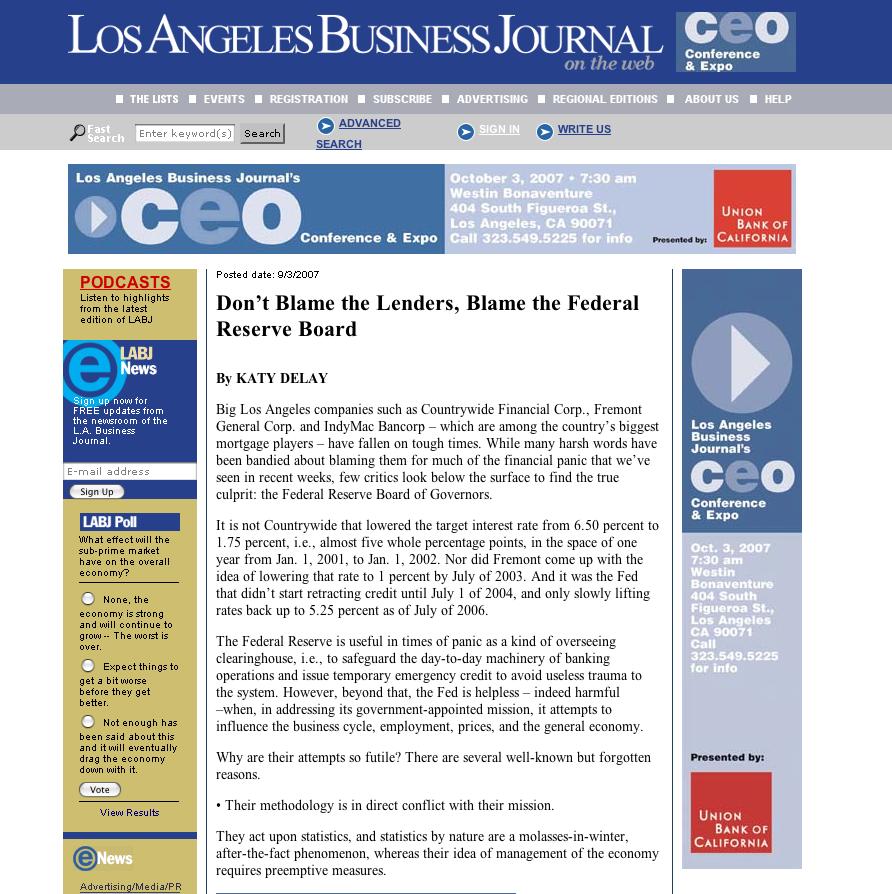
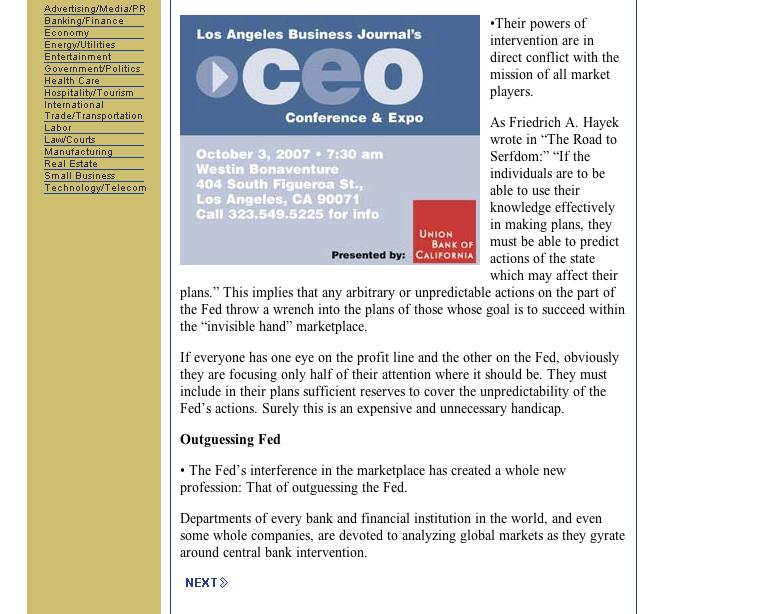
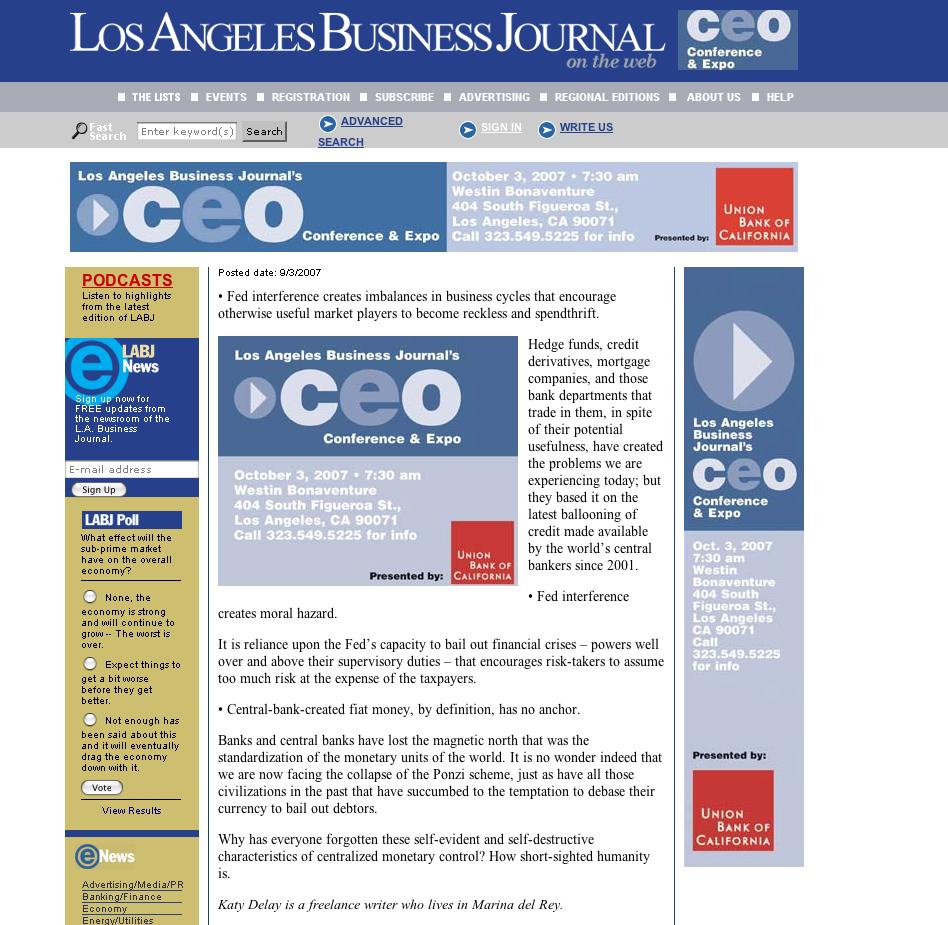
Greenspan is making a fool of himself again


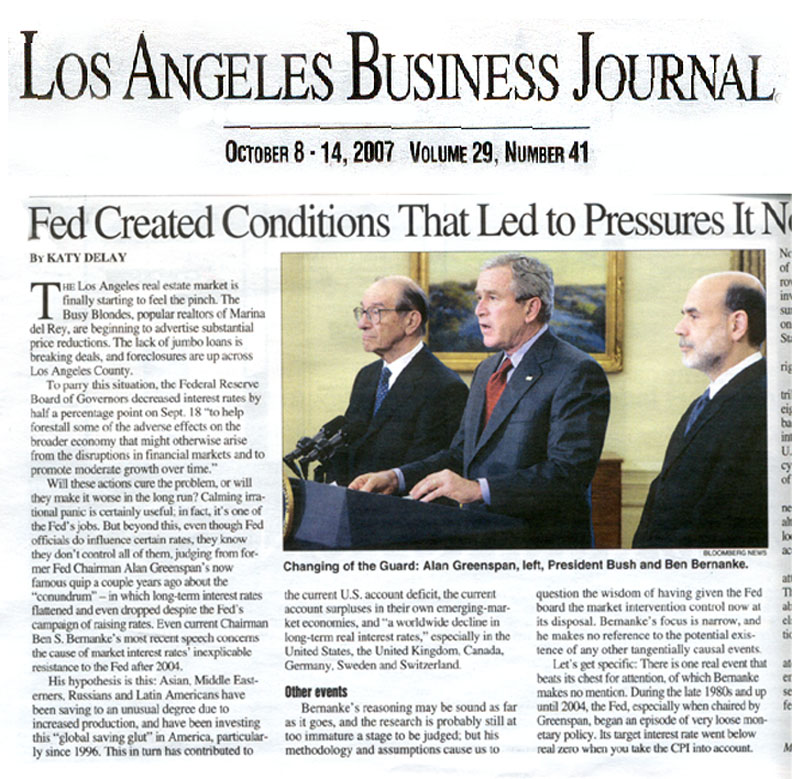
Alan Greenspan is embarrassing himself again (or if not, he should be):

 "[Easy money] had absolutely nothing to do with the housing bubble," he says. "That's ridiculous."

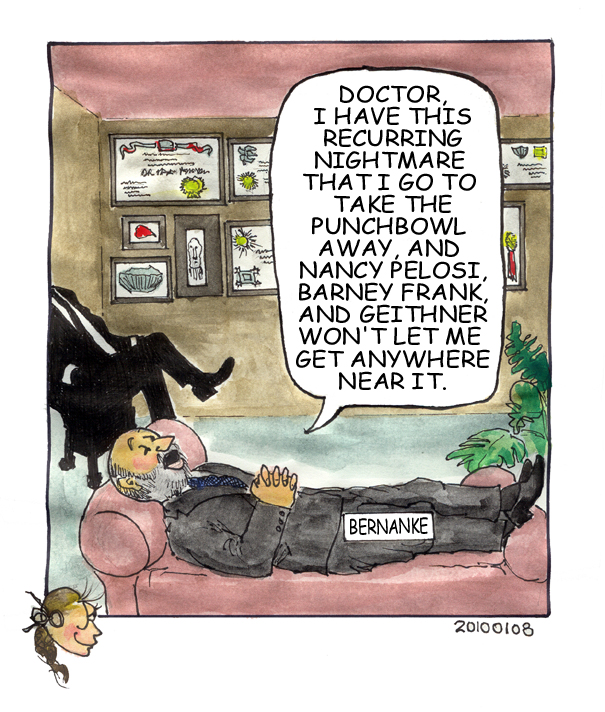
Bubblepin
[One of my cartoons from April of 2006–click on image for larger version.]

Greenspan continues to defend himself, unwilling to believe he could possibly have been responsible in any measure for the troubles we have all undergone over the past decade.

Here's another blooper:

"… [N]ot a single major forecaster of note or institution caught [the financial crisis]," he says. "The Federal Reserve has got the most elaborate econometric model, which incorporates all the newfangled models of how the world works—and it missed it completely."

Well, even stupid little me caught it, Mr. Greenspan, simply by reading people who make common sense.  See my proof above, in April of 2006, and here, even earlier in February 2006.

What planet does this guy live on?

Read more of his latest mutterings here in this weekend's Wall Street Journal.

Labels: , , ,


Monday, April 01, 2013

Fed Policy and Asset Bubbles

I am convinced that our Federal Reserve Bank's current monetary policy is hurting our economy in a number of ways.  One of these is its effect on the business sector.

I have no proof, being the gadfly that I am; but I have an argument.  I have laid out the tenets of my hypothesis in my latest Seeking Alpha article.  (Please click on the link.)

Labels: , , ,


Sunday, January 11, 2009

Government Bonds: The Latest Bubble, but Probably Not the Last

These days US Treasuries can do no wrong. No matter how much interest dips, they're just the hottest thing in town. The bird in the hand theory of finance, I suppose. But is this bird really in hand, and for how long?

One would think that the bond market has already factored in the upcoming big-spending stimuli planned by a number of G20 players; but, even though the printing presses have already begun their magic in earnest, the amounts that have already been distributed have yet to have an impact on the economic outlook. Recession and deflation seem to be what are on everyone's mind.

But for how long? We know that markets are fickle. And supple. They can turn on a dime.

huffy
Thanks to Tfdclowns.com for this picture of Huffy turning on dime.]

Once the presses get churning at billions a minute, and whether or not deflationary pricing stops, what will the markets do? Could they turn this bond boom into another burst bubble?

The world has been awash in credit and in the chimera of purchasing power the sheer mass of it seemed to engender. It flowed into the real estate bubble until 2006, then to the stock market bubble in 2007, then to commodities in 2008. Each one came rushing down like something at Magic Mountain, only to see the remaining cash hop on again for another loop with bonds.

Government bonds are the last safe haven before ... there's only one thing left after government bonds: Gold. But that would mean a flight from paper currencies altogether. Are we that far gone?

We'll soon find out. Foreign bonds will have a tremendous amount of competition soon, once the US and other debtor nations begin to borrow to the max. Cash may still flow into these government bonds for a while, but as stated in this editorial in Friday's Financial Times, "finance ministers must make plain how they intend to keep paying creditors without resorting to debasing their currencies. Those who have not already credibly done so are living on borrowed time."

And just which have done so in a credible fashion? I'm hard-pressed to name one.

So I'm betting that gold will be our next, and perhaps last, bubble, at least for this time around. (Disclosure: Yes, I do own some gold-related assets. I'd be a hypocrite if I didn't.)

In case you haven't seen my mantra, I'll repeat it for you:

"You can take the gold out of the standard, but you can't take the standard out of gold."

Labels: , , ,


Wednesday, May 30, 2007

Conflicting Data From Financial Institutions Regarding Our Future

This article by Kabir Chibber and John Glover at Bloomberg tell a tale of two scenarios.

One the one hand, we learn that major banks around the world are hiring "distressed-debt bankers" to handle an expected credit crunch.

Debt
[Thanks to debt-counsellors.co.uk for the image.]

'"People have been forecasting a meltdown in credit in the next 12 to 18 months,'' said Michael Gibbons, head of the special situations desk at Paris-based BNP Paribas.'

It is true that credit and risk products are at a scary untested record volume.

Others say:

'"When the turn does come, it will be unlike anything we have ever seen before,'' said Iain Burnett, 43, managing director of Morgan Stanley's special situations unit in London. "The scale of it could be considerable because of the size of some of these leveraged deals...."'
'"It's like a hangover, people will wake up and say, 'what have I done?''' said Michael Weinstock, who helps manage $3 billion of distressed debt at private equity firm Quadrangle Group LLC in New York.... "Record-high levels of financing now mean record levels of defaults in the future. There's every reason to believe we're near a market top.'''

'"The risk in all of this is that the higher we fly, the further we could fall as and when the market turns,'' said Paul Watters, S&P's London-based director of debt recovery ratings. "Many borrowers are tacitly acknowledging the growing vulnerability.'''

Then you get this piece of wisdom from the same Mr. Gibbons cited above:

"We tend to crash when we least expect it, rather than when we forecast it.''

So with all of these gloomy forecasts, that puts us back to square one.

But one thing that seems certain: The market is jittery. You have the central bankers and optimists putting up a front of confidence ("soft landing" talk), the bulls trying to wishful-think more loose credit into the system, and the "permabears" like me (as AIER likes to call us) predicting a flight from the dollar, preceded (or not) by a reinflationary or stagflationary episode a la 1970's, or perhaps even by a falsely non-inflationary or -deflationary 1920's.

Item: Small green valley above Salt Lake City, population 5400. At 2.58 people per household (Source), that's about 2093 households. There are almost 200 living units for sale. That's 10%. In one condominium complex of 150 units, 50 are for sale -- plus the ones the developer is refusing to list because he has too many and it makes him look bad. That's over 30%. You draw the conclusion.

If the debt situation our bankers fear comes to pass, this show will be a lively one.

Labels: , , ,