Thursday, April 04, 2024

US Gold Reserves - Short 20th Century history

What trajectory did the US gold reserves follow in the last century?

Below is a World Gold Council chart that might be accurate, although there is some debate today about exactly how much of the US gold reserves are accurately accounted for. Some say a portion of it is no longer there, some say that a percentage has been used in financial transactions that would involve claims to some of it. But the chart is probably not far off.

You can see that gold began leaving the country starting in the mid-1950s. By the end of that decade a few wise financial advisors were recommending investing extra savings – i.e. savings one could afford to risk – in numismatic gold and gold stocks. (It was illegal to hold gold outright.)

The reason was that the gold standard kept the official dollar price at $35, but there was so much dollar inflating going on that foreign countries were smart enough to get gold instead of holding onto dollars (which dollars had been received in payment for imports), and this was causing the unofficial market gold price in dollars to rise.

That’s why in 1971 Nixon probably looked at a similar chart and finally said stop, no more, we’re “closing the gold window.” And that’s when the dollar price took off, as wise advisors had predicted it would. More accurately, that’s when the exchange rate for dollars plummeted and price inflation in the US began to explode. (Yes, price inflation can be late to the party, but it always follows a period of monetary inflating.)

(The yellow line represents the dollar price of gold.)


Note that this chart stops in 2005. Here below is the chart from Kitco for the last three days. The dollar price is up to $2,290 as of this writing, even touching $2,304 for the first time in history. Not a bad investment, right? (But I’m not an investment advisor.)


Gold always seems to reflect the reality of the value of money, even if it no longer is officially an element of any country’s monetary standard. Who said the gold standard is dead?

Labels: , , , ,


Sunday, March 27, 2022

What Should Young People Do With Their Money Today?

We are living in unusual times. The US has never had so much debt, and its central bank has never created so much money out of nothing. Most central banks around the world are following suit. 

As of March 27, 2022 at 4:45 PM Eastern Time
Watch it evolve here:
National Debt Clock

History suggests that at some point the crap will have to hit the fan. What will that moment look like, and how will it affect the younger generation? 

Most youngsters have no idea what’s coming or how to protect themselves. Those that have some savings probably won’t have much choice other than to put them in a bank account. Most will have little money to save, so they will be forced to go with the flow, "play it by ear" as I like to say.  

But still, there are traditional rules to follow. The first rule seems to be to put some money aside as soon as one is able. The purpose is to build a cushion for the proverbial “rainy day.” Young people should do this now before trouble begins. And this advice applies most urgently to young families. Common knowledge says to put away, little by little, about six to twelve months of living expenses. 

Young people should keep credit to a bare minimum, pay off the principal every month, and watch impulse buying. Be smart and humble. Make do with a good second-hand car and merely adequate housing until they have the necessary savings put aside.

And budget, budget, budget. My own rule as a young adult was actually very simple: “Spend nothing above the essential, with only very rare exceptions.” That worked very well.

Buying of gold coins can be entertained at some point once the above is achieved. (But be careful where they are stored.) 

Then one could venture out towards other investments. Examples: Depending on one’s capacity to manage rental property (land or habitat), and also on the state of the real estate market (i.e. not now), that might be an option. Depending on one's plans for moving or not, one could buy a home.

Then, if finances permit, there's the option of branching out from there to rental property of some sort. That’s assuming, of course, that one will not be changing jobs and moving to another state right away, and that one has the time and inclination to devote to this side business (for that's what it is).

Eventually stocks and bonds can be considered, in an effort to build up a retirement account that will grow and provide an adequate income later in life. One can find reasonable advice about that almost anywhere. Caveat: If the investor decides to go with an investment advisor, just be careful about the fees. Compare, compare, compare.

And here again, watch the timing in a “macro” sense. The best time to buy is when the market is in a recession and the investor's own employment situation is secure – a rare combination. Some say don’t try to time anything at all. Just start accumulating little by little over time. That’s possibly the safest way to go about it.

If the whole show comes to a halt because of the monetary nonsense that has been going on since the last century, then it will be survival mode for most of us. The young will do whatever they can just to get through it, but they will have little to lose. Those who have some savings will need to keep a level head, not panic, and stick to the basic rules we have trusted to date.

One really can’t say much more. The current situation is unusual in many ways, and yet in other ways it's classic. As has happened so many times throughout history, currencies all over the world are all being debased, which is easy to do because they are all reliant on a “fiat” monetary system. In other words, no currency in the world has a solid foundation, such as a gold standard or equivalent, as was common in the past. They have all been manipulated, inflated, and deformed to the point of potential rupture. 

In our modern world, cryptocurrencies have been introduced, which is of course new. We don't know yet how they will turn out. Meanwhile, some old standbys are still available. One such is gold, which retains its “barometer” function over the long term, from what one can see so far. 

The Swiss franc is also still a beacon in a sea of monetary folly. In the 1970s it was 4 Sw.fr. to US$1. Now it’s 1 Sw.fr. to US$1.07. Unfortunately, Switzerland no longer accepts US citizens' money in their banks, due to burdensome reporting regulations between the two countries. Other forms of investing there might exist, however.

It would seem to me that a disruption is inevitable. But if, when, and how? Only a fortune teller would pretend to know. 

Labels: , ,


Monday, December 13, 2021

Gold versus Bitcoin


 Two "coins"

Interesting, isn't it, that bitcoin is often portrayed as a gold coin. Well, I think there is a reason for that. If you're curious, you might find this article interesting:

Seeking Alpha - Katy Delay Blog

I wrote it for the financially unsophisticated reader. If you have questions, please don't hesitate to ask and I'll do my best to find the right answer. I'm not an expert myself, but I've acquired a basic understanding of the crypto technology.

Labels: , ,


Friday, February 12, 2016

Fiat Money Versus Gold

Thanks to halloween-masks.com


No one can deny that current markets are scary, so I have opined in an article at Seeking Alpha. 


We all share the malaise as this unfolds in front of our eyes.

Labels: ,


Wednesday, January 21, 2015

Why Gold Is Still Attractive As A Hedge

If you'd like to read a Gadfly's opinion about holding gold-related investments, please read this article at Seeking Alpha.  Thanks.

Gadfly
[Image from Wikipedia]

Labels:


Tuesday, December 30, 2014

The Fed's Game of Monetary Inflating and How to Put an End to It


[Thanks to Dancendancen.com for the image.]

History has shown unequivocally that you don't want to monkey with money and credit.

This is the cogent warning recently issued by Doug Noland at Prudent Bear. He is referring to the monetary shenanigans of the central banks around the world, the most egregious of which is our very own central bank, the Federal Reserve.

After more than 15 years of almost continuous and increasingly profligate money-credit creation, the Fed is now approaching the moment of truth. In the next few months it will have to put its actions where its mouth is regarding the interest rates under its control.

Up to now, Fed Chairman Janet Yellen has been very good at what we could call the Open-Market Charade. While sounding profoundly straightforward and direct, she actually has bested Alan Greenspan at the art of Fedspeak: talking in soothingly erudite phrases, all the while saying nothing in particular.

But no matter what she says now, the Fed's predicament is clear: It must soon choose between allowing the target rate to climb, which will squeeze the necks of already precarious emerging markets, or keeping the rate low and in the process risking re-devaluation of the dollar and/or blowing even more bubbles in stocks, junk bonds, global derivatives, emerging market currencies, and selected real estate.

The inflated bubbles are right in front of our noses. For example, some condos in the West Los Angeles area have now re-attained their all time highs of 2007, and bankrupt ski resort developments have pulled the shovels out of the trash heap and are at it again. And by the way, that price inflation you're looking for? It's already in the high cost of meat, sugar, poultry and eggs, which have climbed 8.3 percent this year, and in dairy that has climbed 5.6 percent. [Source] Butter has doubled since mid-2013. [Source]

The moment the Fed governors choose the former, i.e. increasing the rates, the music will stop and everyone will head for a chair. Usually in this game there is only one empty chair and hence only one loser, but this time there are far fewer chairs and far too many players. If the music stops watch carefully what will happen to countries like Argentina and Russia. Then watch what will happen to the derivatives and other more speculative markets as investors scramble for seats.

For more on the possibilities under this scenario, see this Investopedia.com article about the carry trade, also heavily involved in the derivatives market; see also this David Wessel article about a possible global financial crisis due to a rising dollar.

On the other hand, if the Fed chooses the latter route and delays rate normalization, it may succeed in holding off the moment of truth for a few more months while the music continues and stock market speculators continue their merry dance. At the same time, America's fixed-income recipients will have no choice but to reach for their handkerchiefs again to mourn a further loss of purchasing power. (Already in 2012, the SeniorsLeague.org reported that seniors have lost 34 percent of their purchasing power since 2000.)

The old and the weak are always the first losers during the exaggerated business cycles caused by fiat-money monetary interference, and Oh My, what enormous and distorted cycles they have become. (See this study from the American Institute for Economic Research on the changing nature of business cycles.) Who are the winners? Debtors, and speculators most of whom are debtors. The biggest debtors of all are governments and financial institutions-who just happen to be co-appointers of their accomplice Fed governors.

What artifice makes this game possible? It is the fiat nature of global currencies. (Read Steve Forbes's latest book for more on this.) What is the solution? We must elect politicians who will free gold from its tax shackles. What shackles?

An act of Congress in 1974 and a legal decision in 1977 already permit the holding of and transacting in gold. (See the text of the 1974 law here and a discussion of the court case permitting gold clauses in contracts.) The only thing preventing gold from playing its traditional role as money is the fact that all gold transactions are taxed, whether it be through sales taxes or capital gains taxes.

Why are they taxed? Because back in the 1970's Congress classified gold as a commodity, kind of like copper or wheat. Why did Congress do this? Because the crafty politicians knew that by doing so the commodity-taxation protocol would immediately take the gold-as-money option off the table. This is what forces us all to accept unsafe fiat "money" instead of the real thing.

Without that handicap, we would not accept it unilaterally. Remove the taxation and gold would become money again. It would find its true exchange rate relative to all currencies (which today would probably be higher than its current $1,200 an ounce). Soon enough, someone would set up a system of international exchange based on gold. The metal would find itself at the center of a new worldwide system of exchange and value storage. Such a system would be much more solid and much more widely accepted than Bitcoin or other alternatives. Call it Bitgold, maybe? And by the way, reinstatement of a proper gold standard is probably not even necessary. Let the markets work out the particulars.

This is not just fanciful thinking. States such as Arizona, Texas, and Utah are discussing the use of gold as legal tender. Highly stable gold would eventually replace highly unstable fiat money, and trillions of dollars and yen and euros, currently wasted on chasing a quick profit and fulfilling the dreams of politicians (and causing worldwide recessions), would be turned back to their rightful purposes: fomenting enterprise, creating jobs, and raising standards of living across the globe. And most important, this new gold-based monetary system would deprive our central money manipulators of the world's most corrupting, devastating, unconstitutional, and destructive monopoly power.

Labels: , , , ,


Tuesday, May 27, 2014

Time to Put the QE Genie Back In Its Bottle

Price inflation seems to be right around the corner, if it isn't already here, which means that the Federal Reserve may soon have to put their QE genie back in its bottle.  At least that's my hope, for the sake of our children's future.

[Thanks to DinoRentosStudios.com for the image.]

The only problem is:  The economy isn't cooperating.  Employment figures, never mind the full-time work force, are stubbornly refusing to increase.  Jobs are not appearing as hoped.  And GDP is not up to expectations.

Hence, the Fed will be faced with a quandary.  And I can't wait to see what happens.  Please click on this link for some further thoughts on the subject.

Labels: , , , ,


Tuesday, February 05, 2013

Common Sense and Caution in Today's Investing Climate

In spite of the hesitant Consumer Confidence Index, the New Year is bringing us improved animal spirits. The various stock indices are reaching record levels. Is it time to plunge back into ordinary investments, as the retail sector seems to be doing? Should we dust off the Modern Portfolio Theory and put it back into action? How about taking those old Krugerrands and gold stocks out of the closet and turning them in?

caution
[Thanks to CreativeSafetySupply.com for the image.]

Not so fast. Let's use some common sense and look around us first. I do so regularly, and I wonder: Is it possible that today's high-flying economic and financial geniuses have lost their own common sense and become overly sure of themselves?

The loss of common sense seems to be a phenomenon that occurs frequently among our Ph.D. class, including the mathematics geniuses in our universities' economics departments. The more rational-observer economic science performed by their forefathers such as Adam Smith, John Stuart Mill, Alfred Marshall, Frederich Von Hayek, Ludwig Von Mises, John Neville Keynes, Edward C. Harwood, and even Milton Friedman (incidentally, all probably good or even excellent mathematicians) has been relegated to the back of the auditorium in favor of Dynamic Stochastic General Equilibrium and the like.

Over the past century the economic science has become a clique for high-level mathematicians who enjoy toying with complicated models and computers, probably very much like those used by NASA physicists. It is now a kind of private club where only those with a certain technocrat mindset can pass muster, get published, attain tenure in the best universities, and influence public policy.

Yet the overlooking of a common-sense piece of evidence by some very smart NASA experts actually became a fatal flaw. They failed to note that a piece of lightweight foam could pierce the shell of the Columbia space shuttle, resulting in the death of seven astronauts. (See information about the event here.)

Likewise, could economic folly be causing ruinous holes in our national economy? Although the damage may turn out to be less visually dramatic than the Columbia disaster, it could be more pervasive and therefore equally as devastating, once all is said and done.

Here are some examples of possible loose "foam" in the current application of economics: Does Bernanke really know how to solve the ballooning problem of the Fed balance sheet without making waves in the general marketplace? He says he does; his researchers seem to have the computer models that suggest he does; but does he really have the wherewithal? NASA's elite probably had models that said the Columbia's wing was impenetrable. When they noted the falling foam during the take-off, they were so sure of their models that they didn't hesitate to reassure the crew that the incident was insignificant. Subsequent examination of the evidence proved them wrong.

Is Bernanke correct when he states that the Fed's intervention in the lending markets is helpful, that it does no harm, and that it is, at the very least, the lesser of two evils? Is it possible this policy is doing more damage than its alternative? Intelligent people disagree, including some on the Fed's very own Board of Governors. This policy could very well be contributing to unemployment instead of solving the problem, according to an article today in the Wall Street Journal.

On the international front, do the Japanese prime minister and his cohort at the Japanese central bank (with the encouragement of Princeton's Paul Krugman) really think they can print the yen into oblivion without endangering the Japanese economy? The optimistic prime minister and his own common-sense central banker seem to disagree.

Can the European Union bureaucrats convince themselves and the rest of the world that Greece--and now Spain, Italy, Portugal, Ireland, and even France--can continue being "independent" and still remain a part of the Union in spite of their approaching unofficial bankruptcy status?

These are a few of the questions I am asking myself as a layperson. I hope that 2013 will be the year that reveals the answer to these questions. Will it end with a bang or a whimper? No one really knows, not even the elitist quants.

But what we do know is that in uncertain times people have always turned to gold and gold-related investments, the ultimate store of value, to protect their purchasing power from the folly of their misguided governors. This is certainly one of those times.  I'm not a professional advisor, but I wouldn't let go of your bullion, your ETFs, your gold mining stocks--and your common sense--just yet.

Labels: , ,


Monday, April 09, 2012

The Future for Gold

In an article I wrote recently for Seeking Alpha, I tried to give a casual analysis of the future of the gold "price." This is not easy. Crystal balls have a way of clouding up just when you think you've seen something.

crystal ball
[Thanks to Mysticalball.com for the image. Go ahead, click on the link to the left and ask it something. So far, I've gotten over five conflicting answers to the question, "Will gold go over $2,000?"]

Before we get underway, I really should clarify a detail: The "price" of anything is really just the exchange value of that item in terms of something else. Most often the "something else" is a unit of currency familiar to the concerned parties, buyer and seller. Determining the "price" is a mutually agreed evaluation.

We could say that buyers and sellers intuitively evaluate three variables contained in the transaction:

- The buyer or seller's personal reasons for wanting to exchange the item in the first place;
- The availability, scarcity, or superior utility of the item being bought; and
- The availability, scarcity, or superior utility of the "something else" being exchanged for it.

If a buyer is offering money for something, he or she will tend to forget that money itself can also be a variable. We tend to assume that a dollar is a measuring unit of value, and that it will buy tomorrow what it bought today. We do this even though we've all heard of the CPI. (See the American Institute for Economic Research's EPI Index for an interesting new take on the CPI.) We know prices tend to rise over time. However, even in countries where inflation is rampant, people tend to forget that money isn't always a good measuring stick.

Let me illustrate:

I recently read an anecdote about a person who sat in a café in 1923 Germany. Prices were doubling about every two days. He ordered a cup of expresso priced at, let's say 100,000 German Marks. He lingered a few hours, ordered another, and then asked to pay his bill. The waiter gave him a tab for 300,000 Marks. When he complained that the tab should have been 200,000, the waiter said, "You should have ordered them both at once and paid up front."

Today, with the CPI seemingly under control, we can let ourselves get a little sloppy when it comes to a cup of coffee. But investors, unlike our café-goer, must never lose sight of the variability in the purchasing power of money, even when the inflation rate is apparently tame. The reason is because the rate itself, multiplied by any uncertainty about the future rate, affects every move investors make and complicates their task--especially in times like these.

It turns out that gold itself has a remarkably stable value in terms of other goods over the long term. Ironically, because of its good reputation, it has become the object of much speculation in recent years. When gold speculators think about the "price" of gold, many are concerned principally about the value of the currency they might buy it with, e.g., the U.S. dollar.

Its current "price" represents not just its relatively stable exchange value with other things, but it also includes an amount representing its greater strength relative to the dollar, plus a margin for possible future changes in the dollar and/or in general prices.

All this to get to my point.

Now let's try to analyze informally the future of the dollar in terms of gold. As you can see from the Seeking Alpha article, I can conceive of two fronts in the battle between the dollar and those who could destroy it (central bankers and politicians; see a few of my previous posts). The first front is Europe.

When all will have been said and done after the current crisis plays itself out, the euro with either stand or retreat. The European version of our Federal Reserve, the European Central Bank (ECB), will either put out, i.e. issue euros (probably requiring more help from our Fed), or stand firm. Whether it does either, it will be assisted by international organisms like the IMF, which are heavily funded by the U.S. I gamble that the ECB will put out, thereby exacerbating a dilution of both the euro and the dollar. Politicians hate to admit they were wrong.

The second is the USA. In November 2012 will America give Congress a mandate to deal with our treacherous debt no matter who wins the White House? Or will we split the houses and watch our government dither and spend us dangerously close to oblivion and collapse? My crystal ball says, with strikingly unhelpful certainty, that we have a 50/50 chance of one or the other.

I'm hopeful that in the longer run we will do what is right and deal with the debt. But will we be able to do this without any further crises? No one can say. For the moment we have bailed everyone out. The banks and mortgage companies have learned a lesson, but have the important players (including the Fed) really righted their precarious methodology and their balance sheets? Many banks are still too big to fail. Even certain Fed governors see the systemic dangers of this.

Other geopolitical events could also have an impact: Obstinacy from Iran; a revival of terrorism; the potential collapse of Greece, Portugal, or even Spain; major social unrest in Europe, or right here, never mind Egypt, Syria, Afghanistan, and the rest of the Muslim world. Any one of these might be benign, or any one might be a catalyst for catastrophe.

In conclusion, if I had a pocketful of gold scraps, I think I'd wait a bit before offering it to the local jewelry shop. When you hear confirmed rumors that Europe is going to survive without a revolution and that Congress is finally going to act sensibly, maybe then you could bring some of it out (if you must).

Labels:


Friday, August 12, 2011

French People: Hurry and Get Your Gold Before It's Too Late

In France, the noose is beginning to tighten around the necks of anyone wanting to buy or sell gold anonymously through professional vendors.

lingot
[Thanks to Comptoir Change Opera at www.ccopera.com for the image.]

It used to be possible to make cash purchases or sales of gold up to an amount of 15,000 euros without declaring the purchase (although at least one company limits the sum to 3,000 euros).

As of July, however, there is a new law. It says:

"Law No. 2011-900 of July 29, 2011 of financial rectifications for 2011(1)
"Article 51
"I. - After Article 88 of the General Tax Code is inserted an Article 88A as follows:
" 'Art. 88A - All persons or corporations who regularly purchase ferrous and nonferrous metals on the retail market must submit, before January 31 of each year, to the taxation authorities of their place of residence or legal domicile, a declaration the contents of which is fixed by decree, in which shall figure the identity and address of the sellers and the total amount of the purchases made from each of these.' "

This Law also modifies another Article which now reads as follows:

"Article L.112-6
"Modified by Law No. 2011-900 of July 29, 2011 - Art. 51(V)
"I. - ... Any transaction relative to the retail purchase of ferrous and nonferrous metals is to be made by check, bank or postal transfer, or by credit or debit card, with the total amount of the transaction not to exceed a ceiling fixed by decree. The non-respect of this obligation is punishable as a misdemeanor of the fifth class...."

This punishment consists of a passage before a judge, a fine of between 1,500 and 3,000 euros, possible imprisonment with or without a suspended sentence, mention in one's criminal record, and some kind of restriction of liberty such as the confiscation of the assets involved.

- A vendor's web page on the subject

- Article L.112-6 itself, in the original French

- The new Article 51, in French

The sale of gold bars or coins to a professional vendor is currently taxed in France, unless the seller can prove he acquired the assets more than 12 years ago. If the seller can prove the date of purchase, he can calculate the tax at 31.3% minus a 10% reduction for each year of possession starting with the third year. If he cannot prove the date of purchase, he can opt to pay an 8% tax, no questions asked.

Sovereign-state politicians are too smart to allow the public to buy and sell gold free and clear, because they know that if they did permit it, the public would no longer allow the state to manipulate the currency. But even with the taxes, people are now buying gold more than ever.

Perhaps the reason for France's recent law changes has to do with political fear of the public's reactions to what politicians have done, and are continuing to do, to their national currency.

Labels: , ,


Saturday, November 13, 2010

Is Gold Back?

I couldn't suppress a grin as I read the headline in Saturday's Financial Times: "In gold they rush. World economy: Bullion's sharp rise in price is prompting a rethink for the first time in four decades about whether the metal should have a monetary role, write Robin Harding, Javier Blas and Alan Beattie."

My Dad, economist Edward C. Harwood, predicted that gold would one day reassert itself in world monetary affairs, with or without the permission of the politicians. In February of 1963 he wrote this to his colleague John Exter:

ECH coin
[Photo of one-ounce gold piece
with Edward C. Harwood's profile on it.]

"Perhaps the ultimate return to the gold standard and monetary health will be a slowly progressing evolutionary type of development beginning here and there and finally accepted on a wider scale as it works in practice. It is too early to visualize details of procedures, but almost surely freedom to contract in terms of and ready availability of gold, perhaps in metric weight units for universal convenience, will be aspects of the final solution. Such are my present random thoughts."

Most economists don't know this, but a real return to gold has already happened, at least in the minds of the public. In fact, some of us never left it. My mantra has always been: You can take gold out of the standard, but you can't take the standard out of gold.

However, convincing the power brokers of its value as a barometer of monetary value will be difficult. After all, taking away the world's central bankers' raison d'etre will not be done without a fight.

The editors of the Financial Times scoffed at Zoellick's mention of gold in his recent communique to the press. Although the FT's journalists who wrote this piece today give it a more fair trial, they are still skeptical. Here are their doubts, which I will dispel for you one by one:

1. "The very extent of the rise in its price ... shows the difficulty of using gold as money. Since the turn of the millennium, ... the price of gold in dollars has risen by 498 per cent.... [In terms of the general price level, this equates to] [d]eflation of 75 per cent in a decade.... 'Gold is a very poor reference point because it fluctuates so widely' says Fred Bergsten of Washington's Peterson Institute for International Economics."

The FT and Bergsten have forgotten one important detail: Gold was the U.S. monetary standard from the 1870s until the 1970s, as it was also for other countries. When the world went off this standard, the need for banks to hold gold ceased, causing a glut of supply. Ever since, central banks and international institutions have been selling off tons at a time. Also, this coincided with a return to more conservative monetary policy during the time of Reagan and Volcker. (Note that the world's central banks have not been so stupid as to sell it all off.)

When the Fed got back into the inflating business in the 1990s, it didn't take long for the public to realize that gold had not lost its luster after all. Their increased demand started gold back up to its real value. Therefore, it is the inconsistency of central bank policy that has caused the great fluctuation in the dollar "price" of gold, not anything related to the nature of the metal itself. Gold is simply coming back into its own, and I doubt it will lose that luster anytime soon, at least in the public's eyes (and that's what really counts).

2. The authors also cite stagnant gold mining output, but their figures are misleading. First of all, remember that central banks and international institutions were net sellers of the metal until 2009 and that most of the gold in the world is stored in their vaults. Total new annual production represents only about 1.5% of total world supply. Second, world gold production has not declined as the article implies but rather will probably peak in 2010 at around 2,630 tons, according to the World Gold Council. The article cites production from only a portion of the current world sources. Third, in 2010 central banks were net buyers of gold. Increased demand will increase production.

3. The authors state that the movements of the gold price have "little connection to the price of things that people actually buy...." But no one is claiming that gold tracks the price of things. What gold tracks is the quantity of money circulating relative to the amount that should be circulating. This is what is so very valuable about gold: it actually tells us about money supply, through market sensitivity. To be fair, even the FT journalists do quote Derry Pickford of Sloane Robinson in London:

"Gold along with other asset prices can tell us if there is an erosion in the general purchasing power of money rather than jut the cost of current consumption."

4. The authors quote John Makin of the American Enterprise Institute, who complains that "Fed critics who cite the rise in the price of gold as a signal of incipient higher inflation have to acknowledge that they are in effect calling for the Fed to tighten policy." Not true, Mr. Makin. What we are calling for is that the Fed not loosen monetary policy right now, because by doing so they are going to cause a devaluation of our dollar and will very likely cause a bubble in assets and/or general prices that will come back to bite Dr. Bernanke (and the rest of us) in the backside. And according to Wal-Mart, price inflation is already happening as I write.

So don't let those gold skeptics dismiss its usefulness in future world monetary policy just yet. Harwood might be right, and before too long the world's monetary power brokers might just bring their own evolution forward as quickly as the public has done.

Labels: , ,


Saturday, August 28, 2010

Why Gold is Up in this Deflationary Environment

I've run across an excellent commentary at The Privateer, entitled "Puzzling - Gold is Going Up Again." He is responding to an August 20, 2010 article on CNN's Money.CNN.com.

As the Privateer points out, some analysts are scratching their head trying to figure out why gold is rising even as inflationary fears are subsiding. This seems counterintuitive.

confusion
[Thanks to Dhirajranka.com for the photo.]

Mr. Privateer puts his figure right on the answer to the quandary: monetary inflating. Some call it quantitative easing (QE). We could also call it Helicopter-Benning, or, as the more old-fashioned among us would say, printing money.

The U.S. central bank is finding itself between the proverbial rock and hard place. The rock: stagnation in the American economy. The hard place: The limitation of its power to do anything about it. But they can't just sit there; they have to act. They're supposed to be controlling this thing.

So the Fed Governors--at least a majority of them anyway--seem to have taken this line of conduct:

When in doubt, pull the checkbook out, and make the bogey-man pout.

Ben Bernanke, the figurehead of this majority, once swore to Milton Friedman that we would never see a deflationary episode like the Great Depression of 1929. Some astute analysts are claiming that we are indeed already seeing the deflationary episode, only it is disguised behind a wall of monetary inflating.

Mr. Privateer is one of them. Here are Mr. Privateer's words:

"Not only is 'quantitative easing' inflationary, it is the absolute last resort of the entire inflationary process. Inflation being defined as an INCREASE IN THE TOTAL STOCK OF MONEY. There are quite a few people out there in the world, and in the US too, who understand what inflation is. These same people understand that rising prices are one amongst very many RESULTS of inflation."

[Ah, a rational human being at last!]

"These same people understand that the destruction of 'wealth' measured in terms of money which has taken place over the GFC [I assume this means Global Financial Crisis] to date has more than offset the creation of new money which governments in general and the US government in particular have been desperately resorting to."

"There is not the slightest chance that there will emerge any GENUINE way out of the GFC until such time as the gargantuan malinvestments propelled by the credit money boom which has now collapsed are liquidated on a market. Every day that this is delayed makes the situation worse. Every new 'Dollar' created by governments and their banking system makes the situation worse. Every new Dollar created in this manner is inflation, pure and simple. The fact that prices are rising or falling has nothing to do with it. Inflation is an increase in the stock of money."

My heart pitter-pattered as I read this. One could hear my sighs of genuine relief at not finding myself alone in this cold world.

The author is correct. I would just add that the nation's "regime confusion" is also contributing to the stagnation. (Robert Higgs calls it "regime uncertainty.")

The question is: what do we do?

Here is the Privateer's response:

"The [CNN] article concludes with the assertion that once the GFC is 'over', there will be no reason to own Gold. The problem is that the GFC will not end - or even properly begin - until money can no longer be 'created' out of thin air. Today, while the Europeans are making some moves towards reducing their deficit spending and while Asia is losing its appetite for US Treasury paper, there is no sign of that happening."

Couldn't have said it better myself.

Labels: , , , ,


Sunday, December 20, 2009

The People's Wisdom: A New Gold Standard

In a most insightful commentary published in the Financial Times of last Wednesday, Martin Taylor, himself a former banker, quipped:

"All business people know that you can carry on for a while if you make no profits, but that if you run out of cash you are toast. Bankers, as providers of cash to others, understand this well. They just do not believe it applies to their own business."

The reason bankers have trouble judging their own cash flow, he writes, is that "[i]n general, banks have no measures of cash flow that work for banking." He describes (with a great sense of humor) how bankers got us into this Great Recession by paying out "colossal accounting profits" in cash that were "largely imaginary.... Not only has the industry--and by extension societies that depend on it--been spending money that is no longer there, it has been giving away money that it only imagined it had in the first place. Worse, it seems to want to do it all again." (He's referring to the banking bonuses, which are at a new high.)

He ends the piece perfectly:

"How depressing the shame and folly of it all is, when one considers that the system was brought down not because risk management was deficient (though it was), nor because greed was rampant (though it was), but because bankers could not count. Merry Christmas."

This really states it all in one newspaper column.

adding machine
[Thanks to Britannica.com for the image.]

It also causes one to think: Do we really want the world's money supply punch bowl to depend upon government-employed academicians and government-fed bankers, through a government/bank monetary power hierarchy?

For that is what we have today. With the too-big-to-fail policy, we now have fewer and bigger banks than we did before the crisis, and a government that is too worried about its own survival to care what happens to us, the Forgotten Men and Women. The Fed has been pumping billions of dollars into the banks and into certain markets, like the mortgage market. By doing so, the Fed is trying to juggle the general price level, the mortgage rates, and unemployment--to wit, the whole economy.

Taylor's astute observation about bankers' inability to judge their own cash flow is key here. The observation also seems to apply just as well to Federal Reserve bankers. As long as the Fed offers the opportunity to turn short-term credit into cash, bankers apparently will take advantage of it. This is Taylor's point. No one knows how full the punch bowl really is, nor do they care.

The Fed believes that it can judge the proper amount of created cash through observation of the CPI. But bankers' pay, no matter how outrageous, will never raise the general price level. So the upside potential for this game is limitless.

As long as the Fed's generosity only extends to the small community on Wall Street, they can continue to inflate the bonus bubble at will, along with the speculative and unfair redistributive profits their actions engender. No matter what they do to the dollar, to our savings, or to our purchasing power, they can say they were "just doing their job."

How can we protect ourselves?

In another very good Financial Times article entitled "On the flip side," written by Javier Blas, these lines jumped off the page at me:

"For the first time in decades, investors are allocating a fraction of their portfolios to gold on a long-term basis. That marks a return to normality, some argue. For centuries, gold has been central to savers. 'The aberration had been the last 20-30 years in which gold moved out of most investors' portfolios,' says Mr. [Jonathan] Spall [a director at Barclays Capital in London and author of Investing in Gold: The essential safe haven investment for every portfolio.]."

Once again, we the people are smarter than the politicians or the bankers. We have taken up a kind of individual gold standard, to take the place of the one the politicians and bankers destroyed when it got in their way starting in 1933 and ending in 1971.

Gold may be only a speculative commodity to some, but to many it is still an ideal store of value and the only weapon at our disposal to combat (1) political expediency, (2) the legalized embezzlement that is monetary inflation (with or without price increases--see this post and this post for more on this detail), and (3) bankers' inability to count.

I don't believe gold has hit its high yet. Push must still come to shove if and when the general price level does start to rise. At that point, to prove their goodwill and their capacity to control prices, the Fed would have to make a show of starting to increase rates and stopping "printing money;" but at the same time, they will have their other eye on unemployment.

If unemployment doesn't start to decrease, they will see their choices as between doing nothing, thereby allowing some inflation (general price increases as measured by the CPI), or raising rates thereby stopping the employment "stimulus." My bet is they will choose some inflation, in the wild hope that unemployment figures will improve soon.

Their inaction will signal to the marketplace that they will tolerate a further devaluation of the dollar, and gold will rise up again. How far this game will go is anyone's guess.

If the CPI remains low, they can continue to "stimulate" as long as the bond market will absorb it. This is also good for gold, and for the bankers, if somewhat less so for the Chinese, Japanese, Arabs, and the others who hold US bonds.

Remember:

You can take gold out of the standard, but you can't take the standard out of gold.

Labels: , , ,


Saturday, November 14, 2009

You can take gold out of the standard, but you can't take the standard out of gold

In the latest Buttonwood post at the Economist entitled "Paper promises, golden hordes," the writer notes that gold is coming back into vogue. The price has tripled over the last six years, says another researcher, David Ranson of Wainwright Economics.

It looks like the public has decided that paper money isn't so attractive at this conjuncture, and even some central banks are thinking along those lines, to wit Russia, China, and India.

All this makes perfect sense. Gold is not only a store of value; it's a barometer for currencies.

goldbarometer

This flies in the face of a recent paper by Barry Eichengreen and Douglas Irwin, cited in the Buttonwood post. These two economists have come to the conclusion that "[d]ropping gold did work" i.e. that abandoning the gold standard has somehow shortened recessions and reduced the inclination to raise as many tariffs.

Other economists would disagree. They hold that, in fact, dropping the gold standard and instituting a process of monetary expansion through a central bank is what caused the distortions in the economy in the first place, which in turn led to the recessions and even the Great Depression itself.

I particularly love this statement: "When countries on the gold standard suffered a shock [my italics] they had to let the real economy, rather than their currencies, take the strain." Countries don't just "suffer a shock." Distortions in the economy cause shocks. And according to some economists, central bank responsibility is involved in every recession and depression since the Fed's creation. Like SUVs, economies don't just drive off the road.

We may never find ourselves back on a gold standard as that institution was understood in 1900; however, I believe the world is on a de facto gold standard, by the very nature of this unique metal. Push will come to shove soon, as the Buttonwood post explains:

"[F]oreign creditors have a right to be more suspicious of debtor countries. Even if they do not resort to outright default, they can always achieve partial default through currency depreciation.

"Indeed, the law of volatility can be invoked again. Developed-country governments have attempted to control bond yields through quantitative easing and to support stock markets through ultra-low interest rates. But they cannot support their currencies as well without risking problems in the bond and equity markets. Gold's surge may indicate that investors fear the next stage of the crisis will occur in the foreign-exchange markets."

You can bet your bottom dollar on that one. And with jawboning for China to reevaluate its currency (watch out what you wish for), Australia hiking its interest rates (twice already), and the dollar reaching new lows (how low can it go?), gold will start to look better than ever.

Labels: , , ,


Wednesday, September 09, 2009

The More Things Change ...

Gold has just hit $1,000 and seems to be staying there. China has revealed that it is divesting its dollar holdings into gold and other assets in order to save their sovereign-fund investments. Even the UN is getting into the act. (Do they see a future role for themselves?)

Stonehenge
[Thanks to Wikipedia/commons for the photo.]

The more things change, the more they stay the same. So this seems as good a time as any to recall what was said by a subsidiary of the American Institute for Economic Research back in July of 1975 when the Institute's founder, E.C. Harwood, was still alive. Much of it is still relevant today.


"Removal of the gold reserve requirement for Federal Reserve notes (your paper money) in March 1968 and closing of the so-called gold window in August 1971 eliminated the last barriers to inflating continually the Nation’s purchasing media. As long as a substantial gold reserve was required by law, the money-credit managers were confronted with a restraining influence.

Now, only the wisdom and determination of the Nation’s money-credit managers can prevent the ultimate decline of the buying power of the dollar until it becomes nearly worthless. To what extent the citizens can rely on the wisdom and courage of those 'responsible men' can be judged by events of the past [seven] decades, including loss of 70 percent [how much today?] of the buying power of savings and life insurance, the increasing rate of depreciation in recent years, loss of much of the Nation’s gold, and the fact that several of these managers have been among the most persistent in advocating the removal of all restraints. Truly wise and responsible men would not want to be without the guidance of such an objective criterion as a gold reserve requirement; and unwise, irresponsible men should not be relied upon to act properly without such guidance.

The dollar appears doomed to continue losing buying power, the only question being, 'How long before it will be practically worthless?'

We, as well as others, have foreseen this possibility for many years. [Six] decades ago advising investors how to protect themselves against substantial depreciation of the dollar was relatively easy. Most domestic common stocks then were available at prices approximating the prewar level, and a long continued upward trend of windfall profits for U.S. corporations was practically assured by the World War II inflating.

Now, however, the situation is different. No longer is there a large reserve of idle purchasing media such as that accumulated during World War II, which was used to augment business expansion during the earlier postwar decades. Rather, there now exists a huge amount of debt incurred during the prolonged period of inflating. Debt liquidation may have a cumulative effect on business failures.

CONCLUSIONS

We have concluded:

1. … Recently Government authorities have been more concerned with attempting to avoid a severe depression than with reducing the rate of inflating.

2. That the various “welfare state” obligations, including the unfunded Social Security obligations, constitute a self-destruct mechanism reducing the standard of living, and consequently the birth rate as well, for a majority of the Nation’s population.

3. That prolonged past inflating has fostered initiation of innumerable businesses lacking adequate capital, widespread speculation “on margin” in real estate and securities, and installment borrowing on an unprecedented scale by individuals.

4. … Even if [there are] chances of a temporary recovery induced by deficit spending … the adverse possible consequences of a severe depression are so great that we do not recommend gambling on a near-future cyclical recovery.

5. Finally, that continuation of the international financial crisis justifies placing much of one’s funds abroad before exchange controls are ordered, which may occur at any time….

RUPTURE OF ECONOMIC RELATIONSHIPS IN WESTERN CIVILIZATION

The consequences of nearly four decades [make that seven in 2009] of almost continuous inflating are becoming more evident with each successive international monetary crisis. All currencies have been and are being degraded steadily. All now have lost about three-fourths, at least [nine-tenths as of 2009 for the U.S. dollar], of their pre-World War II buying power, and all seem destined to depreciate much more in the next several years, perhaps for as long as a few decades before they become practically worthless.

Clearly, what the world needs is a relatively stable money or accounting unit. In the absence of such a unit long-term promises including bonds, life insurance, and pension plans are like a mirage in the desert and business depreciation schedules are misleading distortions of alleged facts. Unfortunately, the world is getting a continuing flood of paper 'money' that has neither a reliable exchange value nor any assurance that it will retain future purchasing power. Without these two essential ingredients, confidence in fiat paper 'money' will continue to diminish, until the flight from currencies overwhelms the efforts of monetary and political authorities to cope with the chaos.

Politicians generally insist on remaining in their Politicians’ Paradise where lavish promises in order to obtain votes are fulfilled with inflationary purchasing media created to finance government deficits. Their accomplices in embezzling the savings and life insurance of the people in Western civilization are the central bankers of the leading nations. Without exception they choose to remain in their Banker’s Heaven, where promises to pay are, as John Exter pointed out, simply 'I owe you nothings.' And the people of Western civilization are beginning to endure the Hell that has been paved with the good intentions of those who would save the world (and incidentally retain power, or is it vice versa) by the money-credit manipulations.

We see little possibility that there will be a return to sound money-credit procedures until after some bitter lessons have been learned during a future depression.

Meanwhile, each succeeding crisis in the foreign-exchange markets for currencies will tend to spread the realization that paper profits are more easily reaped than retained, and that the purchasing power of hard won savings is ephemeral unless those savings are invested in a tangible asset whose exchange value is not subject to manipulation by the monetary and political authorities. Among such tangible assets, gold has proved throughout the centuries of history to be unsurpassed both as a unit of account and as a store of value. Therefore, projecting an increasing demand for gold in its various forms during the period of unstable monetary conditions that almost surely lies ahead appears to be warranted in the light of both recent experience and earlier history.

The more the politicians and central bankers struggle to free themselves from the so-called 'tyranny of gold,' the more that governments endeavor by controls of one kind or another to counteract or conceal the consequences of their money-credit follies, the more they endeavor to seize the wealth of citizens by increased taxes of all kinds in the hope of maintaining a semblance of monetary order, the greater is the incentive of the citizens of every country to get gold. As a safe and sure means of holding wealth, of avoiding the grasp of the tax collector, and of assuring the economic future of families, gold never has had a peer in the history of mankind. Those who would demonetize gold in order to facilitate their embezzlement of private wealth and maintain their positions of power in governments and central banks are following policies that must inevitably teach every intelligent citizen the usefulness of gold. The money-credit managers are defeating their own ends at a price that almost surely will include serious retrogression within Western civilization."


Aren't these remarks still valid today? I'll just leave you with my mantra:

You can take gold out of the standard, but you can't take the standard out of gold.

Labels: , , , ,


Sunday, July 12, 2009

Time to Throw Out the Efficient Markets Theory

Over the last few months, I've not been surprised to read that recent events have thrown a bit of doubt on the Efficient Markets [EM] theory. As defined in an article this weekend in the Financial Times, EM is "the theory ... that market participants are governed by rational expectations and markets are self-correcting."

smash
[Thanks to Greenwichroundup.blogspot.com for the image.]

If I understand this theory correctly, the correlation in practicality is that the most prudent long-term investment portfolio for the modest, ordinary investor, i.e. the one with the best risk-security ratio, would be something with a lot of Dow-type common stocks, because the collective markets take all factors into account quicker than any individual can do it.

The evidence behind this theory was provided, in part, by Jeremy Siegel of the Wharton School at the University of Pennsylvania in 1994, in a book entitled Stocks for the Long Run. Siegel analyzed data going back to 1802. According to another article this weekend in the Wall Street Journal, he based his statistics on data provided by two other economists, Walter Buckingham Smith and Arthur Harrison Cole.

However, the WSJ article points out two problems with Siegel's argument: (1) the stock samples chosen were "cherry-picked" and not "comprehensive," and (2) as of June of this year "U.S. stocks have underperformed long-term Treasury bonds for the past five, 10, 15, 20 and 25 years."

Oops.

Ever heard Benjamin Disraeli's phrase, "There are three kinds of lies: lies, damned lies, and statistics"?

I've always had a suspicion about the EM theory. It just seems too pat, too profitable to the Wall Street types, and not really adapted to the little guy: the forgotten men and women who just want to hold onto their hard-earned savings and gain a little real income from them.

I observe that Wall Street market players are not long-term thinkers who spend even a nanosecond worrying about the future of Western Civilization. They're the ultimate Instant-Gratification Kids, worried only about their next buck. "To hell with tomorrow," or such esoteric concepts as the "Forgotten Man."

Even more so today, as we slide into this second phase of our current recession, we realize that the Efficient Markets Theory--and even its supposed alternate, the "Treasury Bond Theory" (I'm inventing the name)--may both have failed us. This will be especially true if inflation hits us, as some predict (and I believe it will, when it comes time to put the Federal Reserve and Treasury credit genies back into the bottle).

The truth of the matter is that there is no stasis. No theory works all the time. As we slide up, over, and down the recessional curve, the corresponding statistical charts will prove first one theory and then the other, depending on where you start and where you stop the x axis.

So where does that leave us?

I would be very interested in some research comparing three model portfolios since approximately 1900 (more precisely, a year in which the market can be considered to have been healthy and balanced): an Efficient Markets portfolio, a Treasury bonds portfolio, and a Gold portfolio (one invested primarily in good gold stocks). To be fair, we would allow modification of common stock, bond, or gold stock picks, but only over the longer range to insure diversification, company soundness, and regular dividend issuance, and only according to some strict rule.

But such research is not easy to come by. Current advisers are not thinking in terms of the erosion of the dollar. Most of them take the dollar as the only game in town.

There was a fellow who tried his best to give us good information: Economist Edward C. Harwood. Up until his death in 1980, he took the position that inflation was the most pernicious waster of wealth we had to face, and that any safe investment must insure against excessive business cycle fluctuations and loss of purchasing power through manipulation of the currency by inflationary monetary policy. For the latter part of his life (1950s to 1980), his investment research pointed to recommendations based on a high percentage of gold holdings. (Or course, we have to keep in mind that the world was on a gold standard until 1971, and he was not alone in seeing the then-coming collapse of the dollar.)

Today, the current strength in the "price" of gold (in fact, it's really not the price of gold, but rather the weakened gold-exchange rate of the dollar) demonstrates once more that the world has not forgotten the role of gold as a monetary metal and does not have blind faith in the dollar, in spite of what the central bankers would like us to believe; and that inflation and possible dollar weakness is still very much on our minds.

You've probably noted over the last few months that China and Russia have made quite a show of recommending the return to gold as a store of value in place of the U.S. dollar. (See this Financial Times article, and my previous post about the Russian fellow Sterligov.)

These outbreaks, although embarrassing to the U.S., don't seem to worry anyone just yet. However, it would be a mistake to write off the sentiment behind them, which is probably shared by more Westerners than our politicians would like to believe. Note also that even our central bankers have slowed their gold sales in recent months. (Do you suppose they themselves are aware of its present and future potential "price"?)

There is a risk in holding gold. Roosevelt gave us the precedent: in the 1930s, he simply made it illegal for American citizens to hold any gold and forced them to accept the dollar. Nothing excludes that from happening again, especially with popular sentiment against "the rich" and "the speculators."

The dollar may have a few more years in it; but in the longer run, it may be just such market sentiments that will force our politicians and academic theoreticians to recognize the simplicity and efficacy of gold as a monetary metal, in some future international role.

I would love to believe that this must happen in my lifetime; and if it does, gold will find its true "price," well above what it is today, Efficient Market theory be damned (and along with it Modern portfolio theory).

I could be pipe dreaming. Meantime, my mantra still holds:

You can take gold out of the standard, but you can't take the standard out of gold.

Labels: , , , ,


Wednesday, June 17, 2009

Get Your Gold Right Here!

In Germany, the art of the vending machine is at the forefront of its game. See this one in Wolfsburg, where you can choose your Volkswagen:

vending
[Thanks to Jalobnik.com for the photo.]

Elsewhere, a fellow named Thomas Geissler has started a company that is installing 500 vending machines in various spots, and what do you suppose he sells?

Gold.

That's right, buyers have a choice among a 1 gram wafer for 30 euros, a 10 gram bar for 245 euros, or various gold coins.

There is a slight hitch: He has added a 30 percent mark-up to the cheapest products. Most dealers will ask only around 5 to 7 percent for bullion coins. And of course, prices are monitored and changed every few minutes.

See an article on this by Murray Wardrop at the UK Telegraph. And here's another at Reuters, and a third at Geissler's website.

Economist Edward C. Harwood introduced the notion of selling gold by the gram and potentially using it as an exchange medium back in the 1960s, and he even got his face on a one-ounce gold coin, in honor of his efforts. I don't know if he was the first; but his story is a fascinating one that I may be able to tell at some point relatively soon. I'm now working on his biography.

Meantime, I've often maintained that the gold standard can come back through various doors:

1. Official re-adoption by the politicians (but as my friend the former Columbia economics professor says, don't hold your breath);

2. Partial re-introduction, i.e. official acceptance of gold as legal tender so the public could use it as an alternative to the dollar in contracts and for repayment of debts public and private (I wouldn't hold my breath for this one either, because the politicians know how much this would limit the scope of their financial activities);

3. Demand by the public.

Now, this third avenue may just arrive in spite of a lot of skepticism. US gold coins are in short supply due to the huge demand in the US. Other countries are more aware even than we are of the importance of gold in the historical money markets. This experiment in Germany may tell us just how likely it is. If the public is willing to pay a 30 percent premium to own gold from a vending machine, then the urge to own something of value instead of fiat paper currency must be deeply ingrained indeed.

Mr. Geissler has surely thought this thing through, and has invested in some pretty heavy equipment (500 very solid machines, plus something to make the 1-ounce wafers) and security systems to see that his operation has a chance to succeed. I will be watching this one closely.

Remember my mantra:

You can take gold out of the standard, but you can't take the standard out of gold.

Labels: , , , ,


Sunday, January 11, 2009

Government Bonds: The Latest Bubble, but Probably Not the Last

These days US Treasuries can do no wrong. No matter how much interest dips, they're just the hottest thing in town. The bird in the hand theory of finance, I suppose. But is this bird really in hand, and for how long?

One would think that the bond market has already factored in the upcoming big-spending stimuli planned by a number of G20 players; but, even though the printing presses have already begun their magic in earnest, the amounts that have already been distributed have yet to have an impact on the economic outlook. Recession and deflation seem to be what are on everyone's mind.

But for how long? We know that markets are fickle. And supple. They can turn on a dime.

huffy
Thanks to Tfdclowns.com for this picture of Huffy turning on dime.]

Once the presses get churning at billions a minute, and whether or not deflationary pricing stops, what will the markets do? Could they turn this bond boom into another burst bubble?
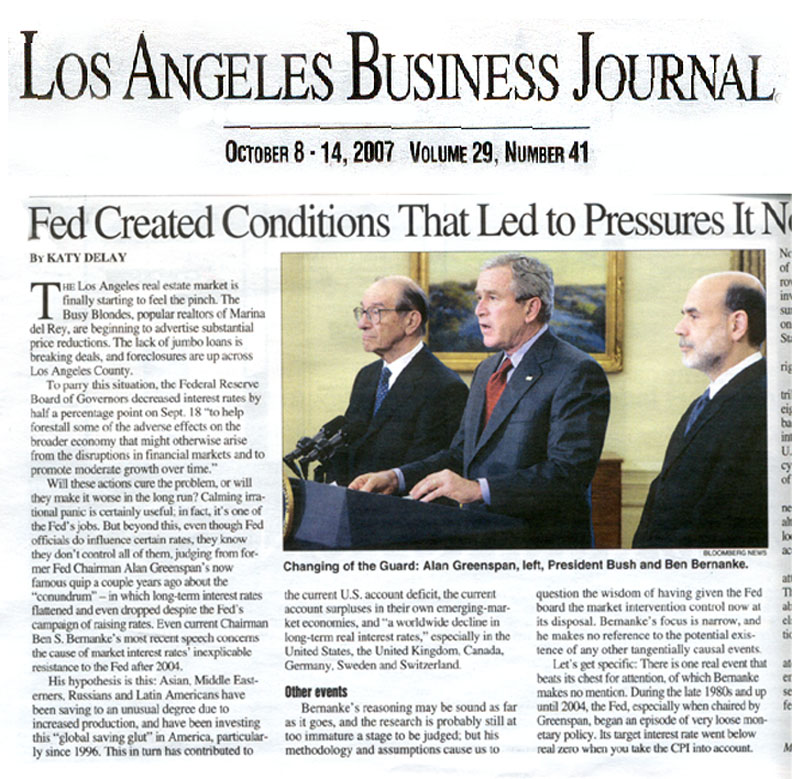
The world has been awash in credit and in the chimera of purchasing power the sheer mass of it seemed to engender. It flowed into the real estate bubble until 2006, then to the stock market bubble in 2007, then to commodities in 2008. Each one came rushing down like something at Magic Mountain, only to see the remaining cash hop on again for another loop with bonds.

Government bonds are the last safe haven before ... there's only one thing left after government bonds: Gold. But that would mean a flight from paper currencies altogether. Are we that far gone?

We'll soon find out. Foreign bonds will have a tremendous amount of competition soon, once the US and other debtor nations begin to borrow to the max. Cash may still flow into these government bonds for a while, but as stated in this editorial in Friday's Financial Times, "finance ministers must make plain how they intend to keep paying creditors without resorting to debasing their currencies. Those who have not already credibly done so are living on borrowed time."

And just which have done so in a credible fashion? I'm hard-pressed to name one.

So I'm betting that gold will be our next, and perhaps last, bubble, at least for this time around. (Disclosure: Yes, I do own some gold-related assets. I'd be a hypocrite if I didn't.)

In case you haven't seen my mantra, I'll repeat it for you:

"You can take the gold out of the standard, but you can't take the standard out of gold."

Labels: , , ,


Saturday, December 13, 2008

Stephanie Pomboy: My Kinda Bear

I'd never heard of Stephanie Pomboy until this morning when I read this interview with her in today's Barron's. Now I have a second bear with whom I see eye to eye. (The first is Doug Noland at PrudentBear.com, although I have no idea what the latter invests in.)

bears
[Thanks to Janusmagnus.be for these cute bears.]

She is founder and president of MacroMavens, a company providing "macroeconomic research and commentary to the institutional investment community." The company strives "to identify major economic trends early while avoiding the typical overemphasis on short-term swings."

Isn't that what any wise investor should be trying to do? No one with a 401(k) should be speculating in any way, shape, or form; and that is what they are doing, albeit unwittingly, by ignoring the macroeconomic ebb-and-flow underneath us all.

She believes we should be "long 'socialism,'" that there will be more government intervention, or as she jokes, "partnering with the government." She thinks the next industry to receive a guarantee will be the municipal bond market.

She sees only two potential outcomes of our present interventionist fling: Higher interest rates or devaluation of the currency. She picks the latter, seeing a weaker dollar as being the choice Bernanke's Fed will make. As soon as interest rates start to climb significantly, they will begin a program of Treasury purchasing to prevent it, which will in turn lower the dollar.

It is this potentiality that makes her a believer in gold, for the medium-term profits and protection of capital. I would add that gold plays a role as a thermometer of monetary inflating. (My mantra, remember: You can take gold out of the standard, but you can't take the standard out of gold.)

Barron quotes her:

"We are going to see a secular rotation from paper assets to hard assets like gold. The whole global competitive currency devaluation, including that of the dollar, plays right into that." [--Yes!--] "I do worry about preservation of capital from the standpoint of how many more unconventional policy actions we are going to have. If I'm correct about the economic deleveraging still ahead and that it will continue for many years, that's a legitimate concern. That's why I'm long gold. I view it as the best way to protect my capital."

Yes yes yes.

As she says on her own website and as quoted in The Weekly Standard in January of 2004, “'Far beneath the surface,’ she writes, ‘the tectonic plates under the U.S. economy have begun to shift, revealing a molten lava river of inflation below….'"

How right she is. I've been railing against inflation since I was born, and more recently since March of 2005 on this blog. The 20th Century's experiment with fiat currencies will very likely fail, as they always have in the past.

In the meantime, hold onto your ingots.

Labels: , , , , ,


Sunday, November 16, 2008

Gold Standard Talk Again

gold
[Thanks to www.australianminesatlas.gov.au for the image.]

Here's another mention of the gold standard. Doug Noland over at Prudent Bear points out this article by Judy Shelton appearing in the Wall Street Journal Saturday.

The pertinent paragraph:

"... [I]f anyone has demonstrated irresponsibility, it is not those who chased misleading price signals in pursuit of false profits -- but rather global authorities who have failed to provide an appropriate international monetary system to serve the needs of honest entrepreneurs in an open world economy.... [T]he inflationary pressures which caused us to go off the gold standard in the first place have only worsened. Moreover, [Paul Volcker] suggests, floating rates undermine the fundamental tenets of comparative advantage.

"[quoting Volcker:] 'What can an exchange rate really mean,' he wrote in 'Changing Fortunes' (1992), 'in terms of everything a textbook teaches about rational economic decision making, when it changes by 30% or more in the space of 12 months only to reverse itself? What kind of signals does that send about where a businessman should intelligently invest his capital for long-term profitability? In the grand scheme of economic life first described by Adam Smith, in which nations like individuals should concentrate on the things they do best, how can anyone decide which country produces what most efficiently when the prices change so fast? The answer, to me, must be that such large swings are a symptom of a system in disarray.'"

Now, if the G20 read this on Saturday morning, they had some food for thought.

Don't get your hopes up, however. Politicians get too much bang for their fiat-currency buck to give it up. A standard somehow set to gold would tie their hands behind their back.

Even if they want to get back to some kind of standard, the present will not be the time to instigate it. Monetary authorities are now pumping as much liquidity and capital as they can into the system, and a standard would put a gold wrench into the works.

We are now on a path where there can be only one of two outcomes:

- Either we inflate out way out of this crisis and we manage to get back to a semblance of calm, at which time the authorities will have to mop up all that excess liquidity or watch it turn into another global bubble that will last who-knows-how-long until another crisis occurs;

- Or there will be a general flight from all fiat currencies to gold, because either panic or renewed inflation settles in. Gold will explode in exchange value in all currencies, eventually to settle at some amount that will represent the market's evaluation of each currency's real gold-exchange worth.

In other words and in my opinion, if we want to stabilize economies in the future, we will have to get back to gold either by the door or by the window, as the French say.

Mr. Volcker will probably be Obama's adviser. What will he suggest? Wouldn't it be ironic if the resolution of our monetary madness came from the big-government left.

Shelton wrote "Money Meltdown: Restoring Order to the Global Currency System." See more on this book at Amazon.

See also this article at the American Institute for Economic Research, and this AIER book on the prospects for a resumption of the gold standard and what it would take; plus this book on gold's role in history.

Labels: , , , ,