Wednesday, December 15, 2010

The Climax is Coming

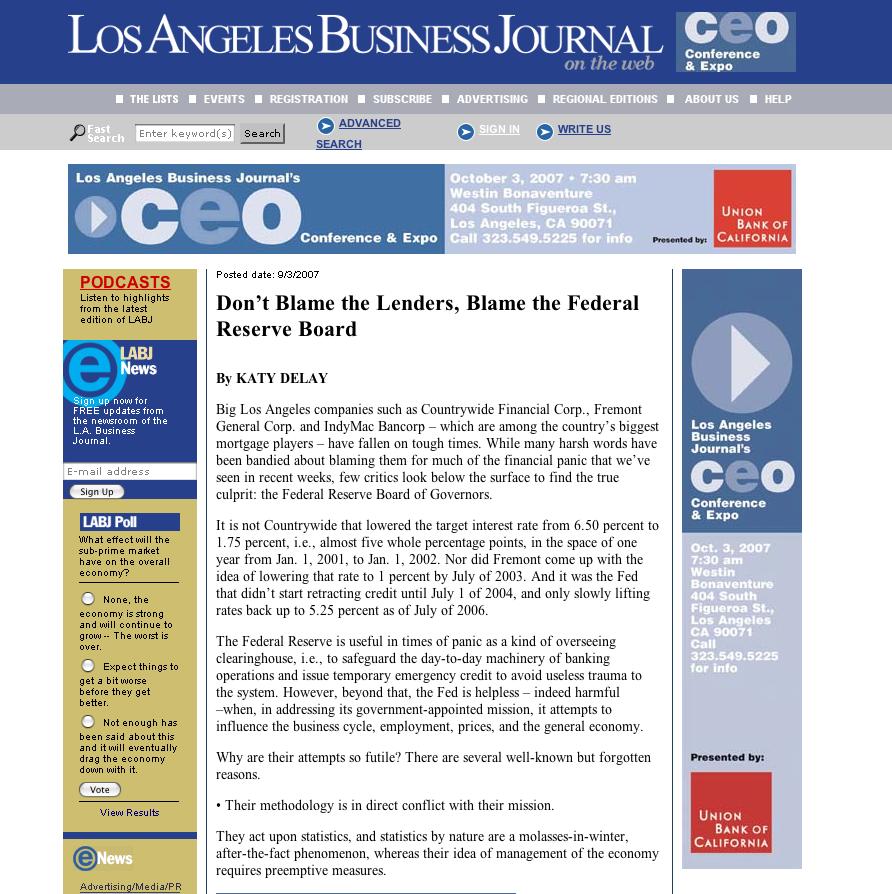
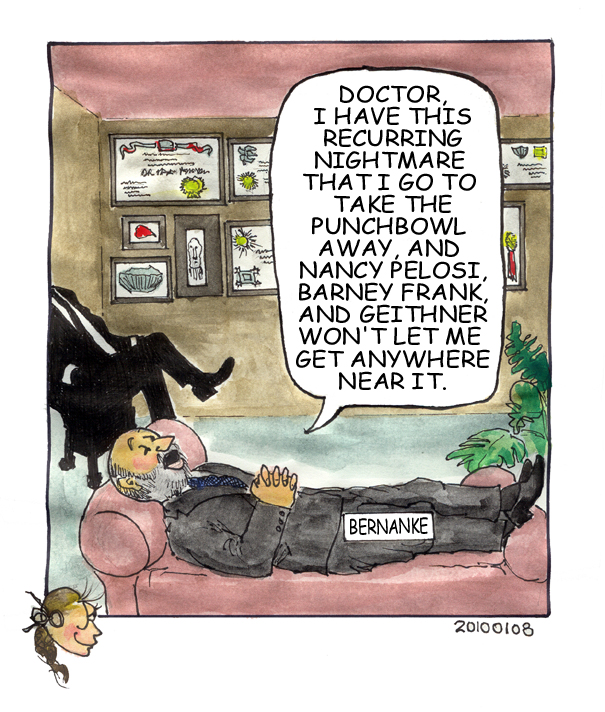
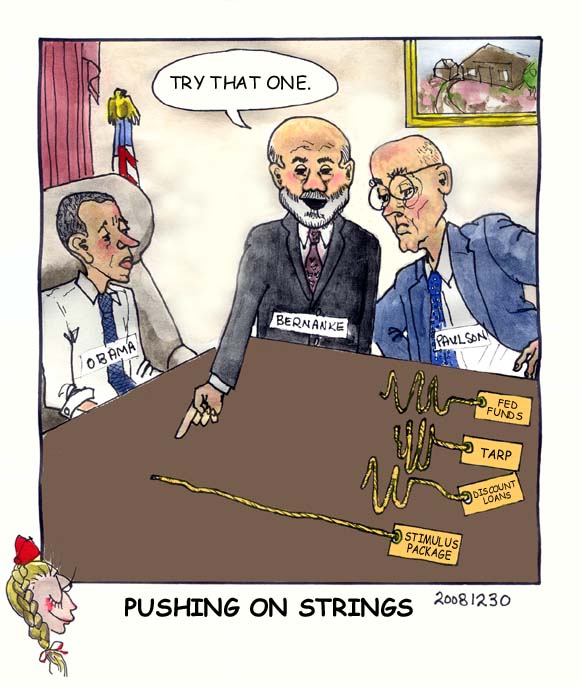
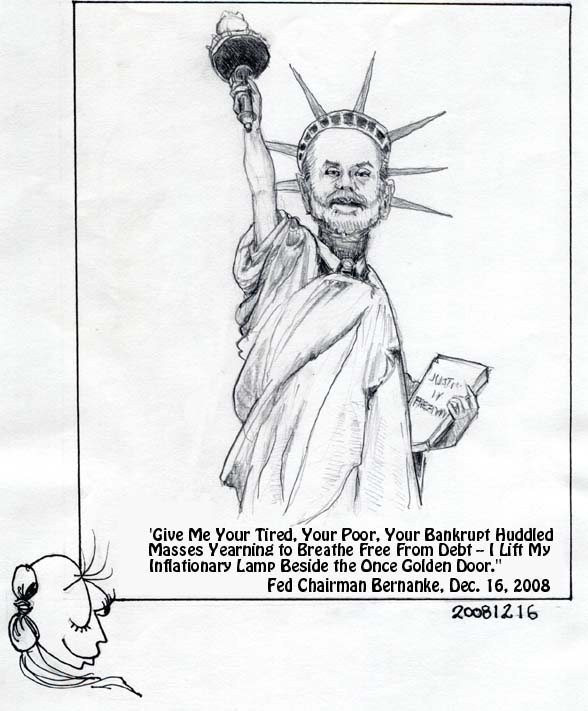
I have said in the past that this Great Recession is playing out like a slow-motion movie. Every scene takes forever--months even--to occur. Ben Bernanke is our hero/anti-hero, and he has implemented his last tactic: QE2 (a second round of Quantitative Easing, another enormous expansion of the Federal Reserve balance sheet), just as he announced he would.

At least he doesn't mess around. He has put his--oops, our--money where his mouth is.

JonStewart

For Jon Stewart's take on all of this, watch this hilarious clip.

So if everything goes as Bernanke expects (or hopes), inflation, i.e. the general price level, will rise a bit, to around two percent. The banks will remain solvent in spite of the fact that they are still carrying billions of bad loans and that real estate will continue to fall in value. Freddie and Fannie will survive. The unemployed will begin to find jobs. U.S. Bonds will continue to sell at low interest rates and the Treasury will be able to finance the biggest budget in history. The U.S. dollar will retain its reserve status because the Chinese and other U.S. financiers will continue to play the game, in spite of the fact that the dollar will continue to lose purchasing power relative to other store-of-value items (e.g., gold and perhaps other currencies). And all will go well in the world.

On the other hand, if things don't go as he expects, commodities will blow off the charts. Retailers will find themselves forced to pass along costs, and general prices will start to rise even though real estate will continue to tank. U.S. bonds will take a big hit and reveal themselves to have been in bubble territory up until two months ago. Banks will find themselves in the interest-rate squeeze. Foreign trading partners will continue the currency race to the bottom and impose more restrictions. The American workforce will profit from the additional year of benefits the government might hand out, and the unemployment figures will not budge or may get worse. General unrest will rise in parts of the world that depend upon commodity prices remaining stable.

Whatever happens to us, all of Europe is, and will continue to be, in a wrestling match with their unions. Usually this is good for the dollar. However, it is not Europe's troubles that will save the U.S. when Moody's downgrades our bonds. Up to now, whenever Europe trembled, the markets fled to the safety of U.S. bonds. But with this new federal spending bill, the current and upcoming battles between the two parties in Congress, and the insecurity of the next two years, we are in for some mind-bending, rule-bending times.

The big question is: Will the world markets accept U.S. profligacy for another round, or will they demand correction? The answer depends upon factors that are unforeseeable at the moment. Even Bernanke couldn't suppress a tremble of the upper lip during his interview on 60 Minutes. I cringed when he declared "100 percent certainty" of his capacity to reverse gears whenever he chose. I imagined I could feel his fear.

I have grave doubts about any such human capacity, and even about Bernanke's sincerity. He has fallen into the Great Hubris Trap. When Japan was on the hot seat, he was full of bravado and advice. Now he is on the hot seat, and he has to make good on his theory. I suppose he might get lucky; but he also might get what he deserves, i.e. a collapse of the U.S. dollar and pandemonium. The problem is, we don't deserve it.

The Chinese are waiting patiently in the wings. They have taken steps to liberate their yuan on the currency markets, and the results have surprised everyone. Hong Kong is scrambling to handle all the business. It seems doubtful that China's currency will become the next world reserve unit, given their efforts to control everything; but what will the markets decide? That is the real question. The Chinese, as the French say, have forgotten to be dumb ("ils ont oublie d'etre cons").

We may have to be patient as this movie plays itself out, but play itself out it will. And the speed can change unexpectedly.

Labels: , , , ,


Sunday, May 03, 2009

Quick Speculative Thoughts about Possible Future Trends

In reading the daily commentary of the American Institute for Economic Research for April 29, 2009, my speculative little crystal ball began to light up. AIER is the only serious business cycle analyst group that points out reality, and reality is that contraction is everywhere in the stats, in spite of the recent "good news" in the stock market. (Desperate exuberance, anyone?)

So let's think it over.

We all agree that the government and the Federal Reserve think they are doing their best to prevent a deflationary spiral, to un-freeze credit, and to save major industry players from precipitating us all into a deep depression. Money supply creation is high, and we can see that the Fed's balance sheet has never been in a more inflated state.

According to some signs, these policies seem on the surface to be taking effect. Sales of existing homes are turning around, and the stock market is maintaining its rally. Meanwhile, the money supply is expanding by an annual 8.1 percent, while at the same time the CPI is stable or falling.

If past experience is any indication, it would seem logical that we are headed for an arrest--and perhaps even a reversal--of price deflation; and if the money creation continues unabated, as would seem inevitable given current Fed policy and the expansionary will of the administration, inflation should be the outcome. Some are even talking about hyperinflation.

But I have a slightly different crystal-ball image (which could of course change tomorrow). Keeping in mind that this is just a game, and that no one's fortune telling is better than anyone else's, just for fun I thought I'd throw this out on a rainy Sunday afternoon.

ball
[Thanks to Crystal-cure.com for the photo.]

Hyperinflation is not in my crystal image. This is not post-WWI Germany or Zimbabwe, in spite of the way things look. What is the reason? It's certainly not because there is no monetary excess going on; it's because, unlike the world of speculative finance, a good part of American industry is too savvy to get caught up in the exuberance.

In fact, American industry has been savvy for a long time, at least one century or more. In pre-1929, over-issued money supply did not all pour into consumers' hands, where it must be before it can create hyperinflation. In the decade leading up to 1929, prices were relatively stable, yet money supply grew. Where did it all go? It flowed into the stock market, for one, which experienced a huge run-up that subsequently burst and started a cyclical downturn.

Why didn't the country experience general price inflation? Economists speak of nominal inflation versus real inflation. Nominal inflation can remain low or non-existent, even as real inflation grows. Prices are stable, whereas they should be falling. This is what happened in the 1920s. And American industry knew this, while the Fed governors pretended not to (or were too inexperienced to realize it).

Later, during the long inflationary run of the second half of the 20th century, industrial market players and their public adjusted to chronic price increases. It's similar to what we do as we grow older (if not wiser): We get used to living with low-grade arthritis pain. This chronic inflating, however, culminated in another stock run-up and the acute crisis of the 1970s, which some say was deeper than that of the 1930s in real terms.

But we got over it and it didn't take too long to get back to our arthritic monetary ways during the 1990s, helped by urgencies in the savings bank industry and in the commercial banking industry's politically motivated foreign investments. This time, the inflationary run popped in 2000 and 2001, having inspired another stock market bubble. By now, we were so good at putting up with pain that we returned immediately to our bad habits, creating the real estate and credit-speculation bubbles that have dropped us to where we are today.

Instead of taking our medicine once and for all, we're off to the races again. Today's crystal ball tells me that we will get a renewed stock market mini-hyperbubble, along with a government stimulus maxi-bubble targeted to specific groups of rent-seekers (special interest groups like financiers, government workers and programs, construction conglomerates, unions, and the like). While this is going on, general prices will remain fairly stable, and banks and investment houses will go right back to their speculative games. Gold and commodities may go through a mini-hyperbubble as well.

But the business cycle really wants to contract. This time, the arthritic pain is too acute. Look at the stats at AIER. It's possible that real industrial GDP may not progress, even though government stimulus money may creep in, pushing up the digits for a while. But keep in mind that government stimulus must be paid back by future capital, depriving us in the coming years of investment in real industrial GDP. The figures will mislead us all. But American industry knows this.

So to conclude, we could get some short-lived hyperbubbles in the stock market and commodities, but they might deflate and run out of exuberance for a while. The maxi-stimulus fake bubble will run out of public support for sure. GDP will eventually dive again and will become chronic stagflation as the increasingly impotent government and Fed blow stimuli through the system like air bubbles in a fish tank. Most of the new air will dissipate through short-lived financial speculation. (Japan, anyone?)

Keep in mind that, having exposed my insights to you today, I'll probably rethink this whole crystal vision by my next blog. But if the deflationary business cycle fights back and ultimately wins this contest between it and our desperate government and Fed efforts, expect bubbly stagnation for a good while, until industry decides it's time to make a come-back. Then we'll probably get the inflation we've been fearing.

Labels: , , , ,


Sunday, August 10, 2008

The Underlying Credit Crisis's Recent Effect on Market Prices

Once again, Doug Noland at Prudent Bear has come up with an answer I was looking for.

In this post from August 8, he offers one explanation for our current strange market conjuncture.

Commodity prices for things like food, petroleum, and oil ran up to record levels up until about mid-July for reasons that are unclear, but that economists have described as resulting from a mixture of:

1. Increased worldwide demand along with supply problems; and/or

2. Speculation that the US dollar would collapse.

In mid-July, along came the Freddie and Fannie problems (see this post for an explanation of the origin of their predicament, and this one for the latest dire news).

Then Treasury Secretary Henry Paulson issued this press release regarding the Treasury's intention to bail out Freddie and Fannie should problems arise.

We also learned of the Treasury's intention to bail out the FDIC (the government entity that guarantees some of your deposits at the bank) in case of need. (See this TickerForum.org entry explaining the FDIC situation, which forum, by the way, proves that ordinary citizens are not as dumb as some would think.)

These two government announcements blow both hot and cold. On the one hand, they reassure Freddie and Fannie bond holders and FDIC insureds that their investments will not disappear. This should be good news for the economy and for the market, and therefore for future demand for commodities.
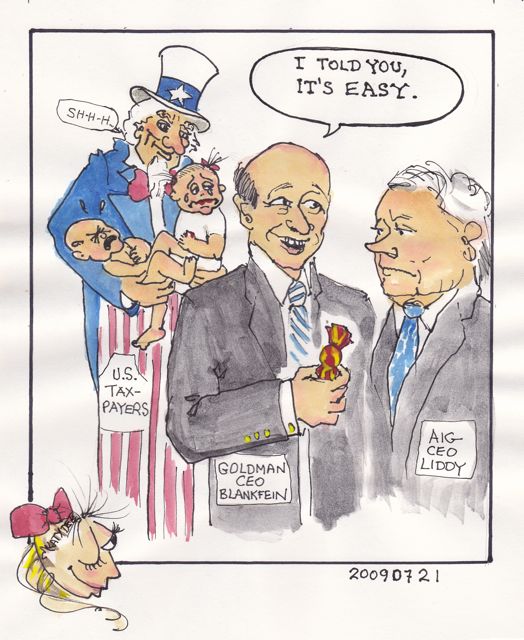
On the other hand, they scream to market players that the US Government officials are really worried about Freddie, Fannie, and the banks. So what should be good news for market players and for future demand for commodities turns into a bad omen for the economy and thus for those same commodity prices.

Meanwhile, the signs of a recession are already evident. (See this American Institute for Economic Research post for the stats.)

So it would make sense that commodity prices would start to reverse big-time, which in fact they did in mid-July.

But--and here's the odd part--the stock market took a simultaneous leap upward, as did the dollar, counterintuitive movements under the circumstances.
Does this mean that the coming recession is somehow calming stock market nerves and inflation hawk fears? Perhaps so, because it might cause "inflation" (read "CPI price increase") to disappear just as the Fed predicted; and it will therefore allow the Fed not to raise rates to curtail such "inflation" (read "CPI price increases"). Low Fed rates mean, in the minds of some market players, that money will be available and things will improve.

BUT: I can't believe that such recessionary momentum will avert real inflation as that term is used in academic economics (read "excess money and credit"--see this post for an explanation of this word's definition problem), even though it may put a brake on CPI price levels.

I believe that real inflation will increase because:

The Fed and Treasury are taking unprecedented measures to avoid catastrophe, i.e. they have once again succumbed to the temptation to use the printing press to pay the monetary system's way out of trouble. They will use Treasury funds to bail out Freddie, Fannie, the FDIC, and--through the Fed's newly seized lending powers--any major failing commercial banks and other financial institutions. And these operations will be carried out on an unprecedented scale.

Remember, real inflation means more dollars running around than is necessary in a balanced monetary system. It means that you will be paying too many dollars for a particular thing, no matter whether the actual price of that thing rises, or whether the price just stays the same when it should in fact be falling in a deflationary market.

This also means that gold prices expressed in dollars (and perhaps other commodity prices as well) will not tend to decrease in the long run, because gold is a hedge against real inflation.

Doug Noland puts my theory into more appropriate financialese in his article. He offers a plausible explanation of how the speculative community has functioned under these unusual circumstances.

I particularly liked these two ideas:

"[I]t is not the nature of dislocated markets to let fundamentals get in the way of price movement. Markets, after all, live on fear and greed."

He is referring here to speculative markets, the ones he credits with causing both the run-up in commodity prices and the recent crashing of same.

And this one:

"The unwind[ing] of bearish speculations and hedges would be a most problematic market development, unleashing a final bout of speculative excess and disorder that would set the stage for a major market crisis."

He is talking about the credit maladjustments that are taking place behind the scenes and that most of us never hear about. See this post for a description of these.

This should all play out by the end of this year. Hold onto your hats.

Labels: , , , , , , ,


Monday, February 11, 2008

The G7: "Who, Me?"

This weekend, the seven world industrial leaders (US, Japan, UK, France, Germany, Italy, and Canada) sent their central bankers to Tokyo to discuss the economy.

WhoMe
[This great deer-in-the-headlights face from Hamiltonspectator.com.]

Typical of central bankers, at no time does any one of them suggest that maybe they had a hand in creating the current credit crisis.

Writers in today's Wall Street Journal (Michael M. Phillips and Yuka Hayashi) give us a report of what our central bankers are discussing.

The causes of the crisis, our bankers say, are:

- Poor underwriting of subprime mortgages and some fraudulent practices in the US industry;

- Rising defaults among subprime borrowers that led to confusion about the value of securities for which the loans were collateral;

- Lack of due diligence on the part of banks regarding the nature of these loans;

- Resulting timidity on the part of the banks holding some of these unquantifiable loans, who found themselves unable to evaluate the value of their portfolios and thus unable to offer or obtain credit from their peers;

- Poor evaluation of risk by the rating agencies;

- Misplaced incentives in the compensation of financial institution employees; and

- High oil prices.

At no time does anyone think to suggest that maybe the world's central bankers might have been inflating money supply to an excessive degree, and that maybe excessive leveraged speculation might have created a ponzi scheme of unworthy credit, both of these phenomena creating the bubbles and bursts that we have experienced.

Oh no, we can't blame the central bankers.... For more details on how these two processes work, see this article, this article, and this article, Page 1 and Page 2.

Labels: , , , ,


Thursday, February 07, 2008

Caution: Here Comes the Wolf Cry: "Market Failure"

With my ear stuck closely to the ground, I can hear the drumbeat mounting against deregulation and the free market. Liberals and even moderate conservatives are seizing the public's fears and running towards increased surveillance of the financial industry and more government intervention rather than less.

lg_wolfcry

[Artwork by Kelly Lollis, her photo from kelligraphics.com]

But blaming these troubled times on "market failure" is nonsense.

Can you blame a river for flowing over a dam when the rains have swollen its volume? Can you blame the ocean for destroying lives when an earthquake causes it to vibrate in uncontrollable tsunamis? Can you blame the wind for destroying people's homes and towns in a tornado?

Can you blame a hurricane for destroying New Orleans when the city managers didn't maintain the levies to modern standards? You can blame the managers for corruption or mismanagement; but you can't fault the hurricane.

Can you blame thieves, high-profile bankers, high-rolling speculators, smalltime quick-buck gamblers, and little guys with nothing to lose, for stealing money just laying there on an unattended roulette table? Of course you can find fault with them for lack of judgment and/or morality; but you can't blame the credit crisis on them, because the money shouldn't have been on the table in the first place.

The market is such a natural phenomenon. It is one of nature's forces. It is a constant flux and reflux, a balancing of tensions among three elements: sellers of goods and services, buyers of these, and the stock of money used in the transactions.

These three elements are interdependent. When one shifts, the other two must and will react. When the shift is violent or voluminous, the reaction is likewise.

We cannot judge the cause of this violent shift until we know all the elements. For all intents and purposes, we might as well be light-years away in the science of economics from being able to measure these elements. The truth is that no one really knows what caused this crisis, even though we all can conjecture about a few contributing factors.

Given this lack of scientific sophistication, our legislators should be very wary of attempting to influence market phenomena. That is why I have been critical of government or quasi-government (central bank) intervention, its efforts to control the flow of credit, and its probable role in our current crisis. Some well-known economists like Anna Schwartz are of the same opinion.

If at some point the government and central bank were to get out of the credit creation and regulation businesses, then and only then could economic scientists begin to observe and interpret the fluctuations of the market and find the true cause of a crisis such as this one.

As long as the government continues to intervene in various aspects of market phenomena, we will find it very difficult to observe action and reaction. "We" are part of the equation.

So it's not "market failure" that critics should address, but rather "intervention failure." Our only hope is to reduce all government distortion of market phenomena to the point where economic scientists can do their work.

Dream on, Sybil, dream on.

Labels: , ,