Friday, November 24, 2006

Fear For The Dollar: A Different Kind of Trade Deficit

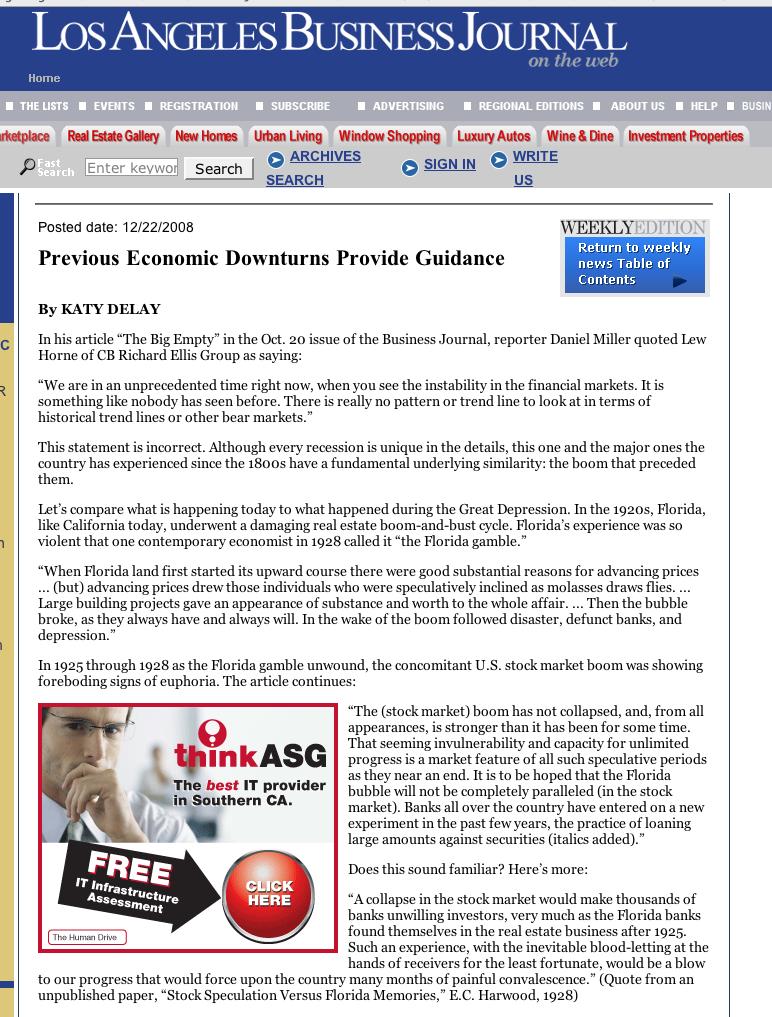
It may be true that the trade deficit and current account deficit are not "deficits" in the accounting sense of the word, as I have tried to explain in an earlier post and more at length in this article over at Prudentbear.com.

However, as I also pointed out in those pieces, there is a factor propping up these deficits that America must guard carefully, and it is the world's faith in our dollar and in our management of its role in global monetary policy.

stilts
[Thanks to sevenseven.com for the photo.]

When it comes to the dollar's worldwide status, we're pretty cocky. You just have to listen to one of our Fed governers crowing about it in Germany the other day. I especially liked the passage where he says something like, "... and I note in passing that we're speaking English at this reunion, aren't we?" As though that were somehow proof of America's fiscal leadership.

But we must be humble and vigilant. Faith can move mountains, but it can also be a delicate thing. Goodness knows that confidence in our judgment is waning on a number of fronts, and that our hubris has gotten us into trouble more than once.

In our defense, the dollar is so dispersed around the world today, that every holder of them has an interest in propping it up. But this interest is a double-edged sword. There could come a time when they can no longer afford to sustain it. Uncertainty is a catchy virus. (See previous posts here and here.)

And it continues:

"People's Bank of China Vice-Governor Wu Xiaoling said East Asia needs to reduce its reliance on dollar inflows because of the risk of a further slump in the currency. China's foreign- exchange reserves exceed $1 trillion, the world's largest." (Source)

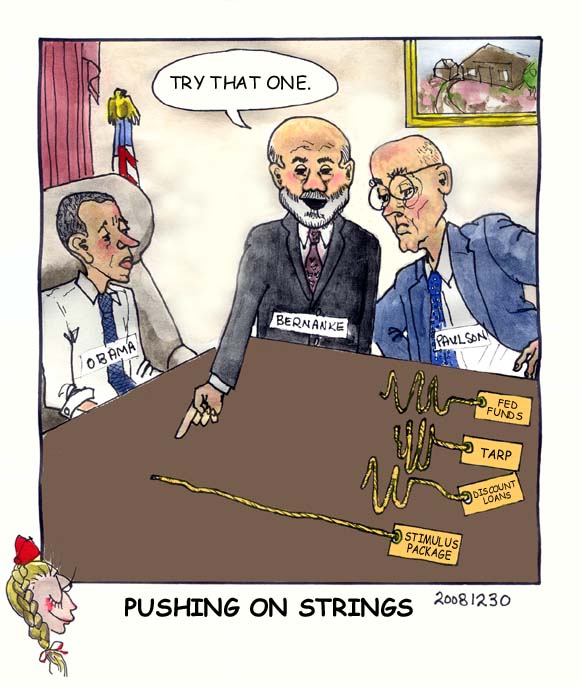
Yup, as I've said many a time, the Fed is between a rock and a hard place. If they lower rates, the dollar holders and speculators may panic and take it and themselves down for a ride, with repercussions for the economy. If the Fed raises rates, the US stockholders and speculators may panic and take workers, their pensions, and the short-term dollar down for the ride. Which will it be? Maybe neither; maybe everyone can hold steady indefinitely. But that doesn't seem to describe today's touchy market dynamics.

On the other hand, maybe a good panic would force central banks out of the monetary policy business. Now that would be good news.

Sunday, January 09, 2011

Price Shock: M&Ms hit 99 cents a pack!

Doing a bit of shopping the other day, I was horrified to find my staple pack of M&Ms up to $1.29 at Office Depot. Stunned into a reality check, I decided to find out what the current supermarket price is. It's 99 cents.

Most of us look at the items we purchase regularly as an indication of how prices change. The price of M&Ms is my own personal CPI indicator. To take this particular item in a pseudo-scientific study (click on the image for a larger version):

MM

- When I was an adolescent in the 1960s, a one-portion pack was 5 cents.

- I remember a few years later when the pack size began to vary a lot. Mars and the other candy makers started offering Jumbo Packs with twice as much for three times the price and other hoaxes like that, so they could hide the price increase.

- My next statistical indicator comes from the mid- to late-1990s when I owned a small coffee shop and market. I sold my M&Ms portion pack (who knows how many ounces by this time) for 55 cents.

- Today, ten years later, they're at 99 cents, almost double.

Something's happening.

Moving to my reliable source of price inflation information, AIER.org's Cost-of-Living calculator calculates that my 5-cent candy in 1955 should be priced at something like 41 cents today, assuming the portions are approximately the same. Of course, they may not be; but in your estimation, in which direction would the portions vary? Larger, or smaller? Well, let's not denigrate the candy companies. Let's just say that the ounces are the same.

So, I conclude that my M&Ms have increased in price at a rate of double the national average. Which brings me to the subject of the coming world food crisis.

According to Robert Zoellick, the President of the World Bank Group and the fellow I heralded for having dared to bring up the dead subject of the gold standard, the world can take many steps to "put food first." The G20 should "empower the poor" to ensure "the availability of nutritious food." In his piece in the Financial Times of January 6, 2011, world governments can and should take eight steps to achieve this goal in face of rising food prices.
The steps include improvement of weather forecasting (good luck), exempting "humanitarian food aid from export bans" (good luck), establishing "small regional humanitarian reserves in disaster-prone, infrastructure-poor areas (good luck), and helping "smallholder farmers become a bigger part of the solution to food security" (good luck).

I thought Mr. Zoellick had a grain of good common sense when I read his piece about gold's helpful role as a barometer of worldwide inflating. He is letting me down. If I read correctly from this article, he is just another bureaucrat ... but how silly of me. What was I expecting from someone at the World Bank?

Why doesn't he see that the price of sugar is not a supply problem? It is a monetary problem. If it were a supply problem it would be the only commodity with a rising price. However, as the charts reveal, all commodities are rising to record levels, with few exceptions. Take a look at this chart from Indexmundi.com.

There is no question but that the world is headed into a food price crisis. But my analysis of the problem does not point to governments or government agencies as the solution. The real long-term solution lies in finding an anchor for the world's monetary units, whether it be gold or something else.

More close to home, the question, as I have said before, is: Will this wave of commodity price increases translate into a CPI index rise in the U.S.? We have already got higher gasoline prices, and now higher M&M prices. Will it spread to everything else?

That depends on several factors: (1) the turn of U.S. political winds; (2) the health of U.S. and European banks, which in turn depends on the health of the real estate/banking sector in the U.S. and the PIIGS situation in Europe; and (3) the effect of the above on the interest rate markets, which in turn will have an effect on (2).

Some analysts expect the Fed's and other central banks' monetary actions will produce widespread price inflation worldwide. But this can happen only if the deflationary hot air can blow out of depressed economies. What if (1), (2), and (3) turn negative? And/or what if the deflationary pressures underlying our current crisis turn out to be ongoing? The Fed can "print" all it wants, but it cannot (a) force prices up, or (b) force interest rates down against the will of the gods of markets.

This is the infamous rock-and-hard-place I have mentioned in previous posts. My slow-motion movie climax is approaching. Keep your eyes open over the next few months.

Labels: , , , ,


Wednesday, October 27, 2010

The Bernanke Putt

Helicopter Ben is now turning to golf, according to an article by Jon Hilsenrath and Jonathan Cheng in today's Wall Street Journal.

golfer

I can't decide whether that feeling in my gut was pain, wrath, or an ironic chuckle, when I read the following:

"The Federal Reserve is close to embarking on another round of monetary stimulus next week ... despite doubts about the wisdom and efficacy of the policy among economists and some of the Fed's own decision makers.... Fed Chairman Ben Bernanke's push to restart the bond-buying program--a form of monetary stumulus known as quantitative easing [QE]--has been greeted with deep skepticism among some of his colleagues.... Mr. Bernanke has used the analogy of a golfer with a new putter: Unsure how it will work, he finds [the] best strategy is to tap lightly at first and keep tapping until the golfer figures out how best to use the putter."

All this is fine and good, Dr. Bernanke, but shouldn't you have gotten your golf practice in well before now, at some prior time when the whole world wasn't watching your every twitch? Do you have any idea of the potential consequences of a misjudgment on your part? According to the WSJ, one of the fellows on your own team, Thomas Hoenig, calls the Fed's up-coming actions a "bargain with the devil."

My previous posts have referred to a slow-motion movie that we are all watching. I have mentioned that at the climax the Fed will find itself between a rock and a hard place: the choice whether to act or not to act.

This is happening right about now, and the Fed has decided to buy bonds. Yet Bernanke has just blown the Fed's reputation as a team of expert economic monetarists capable of curing the second worst economic crisis the world has ever seen, by comparing it to a novice putter trying out a new golf club. Frankly, I'm not sure which is more disquieting.

So now we're pretty sure the Fed will perform QE. Everyone is now asking, will we get inflation or not? First, I'll have to refer you to my previous posts about the definition of "inflation," to remind you that when the media refers to "inflation" they are (incorrectly) referring most often to "price increases," and not the increasing of money supply.

QE is inflating (increasing of the money supply), under the true definition of the word. Whether or not it translates into general price increases is a separate issue that depends on other factors above and beyond the simple act of increasing money supply.

It depends, for example, on the business community's reaction to the results of the November elections, and on the future Congress's subsequent successes or failures. QE might translate into higher general prices, or it might just become higher stock prices, independent of the CPI. It might translate into higher bank bonuses, independent of the CPI. It will certainly translate into a much lower dollar, quite independent of the CPI.

Some recommend TIPS as protection against "inflation" (price increases), but already the TIPS are selling at a premium, so the protection they offer is eroded. And TIPS don't protect us against the effects of a weaker dollar as buyers of our regular bonds reduce their appetite for same. What is the consequence of this? We may soon find out.

What's certain is that Bernanke doesn't seem to care: he's out playing golf.

Labels: , ,


Saturday, August 26, 2006

The Guy Who Would Be King (at the Fed)

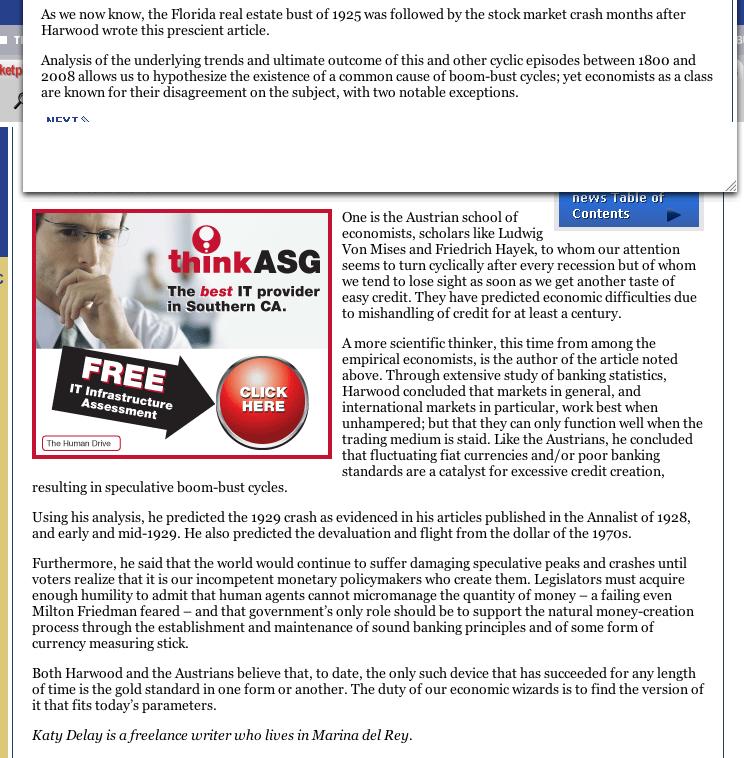
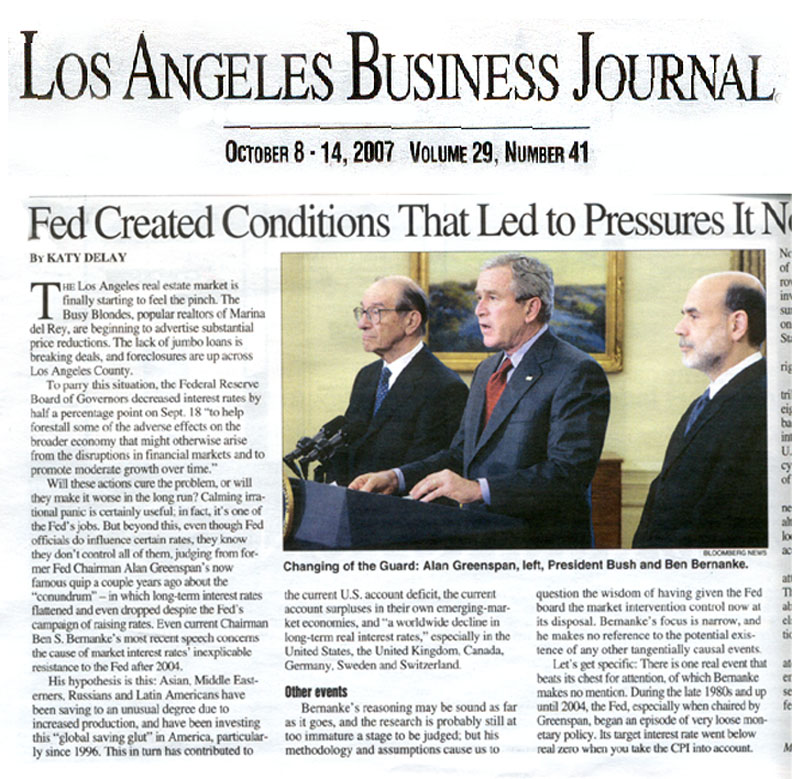
Professor R. Glenn Hubbard, Dean of Columbia Graduate School of Business, was a runner-up in the race to become Federal Reserve Chairman. He was also chairman of President Bush's Council of Economic Advisers from 2001 to 2003.

Glenn Hubbard

He expresses opinions close to my own about the Fed's responsibility for our present situation. In a Reuter's article, he is quoted at the recent Jackson Hole Kansas City Fed's retreat as saying:

"I do believe policy had been too accommodative for too long. And now the question is, How do we deal with the current situation?"

Then Reuter's paraphrases him thus:

"The U.S. central bank, under Bernanke's leadership since February, 'still has enormous credibility with the public,' which is helping to keep inflation expectations contained, Hubbard said."

I would agree that the Fed still has enormous credibility with the public, and even within the business community. After all, they believe (and so does the Fed itself) that the Fed has the power to control the money supply and influence the American economy.

But whether or not it is this credibility that is keeping inflation expectations contained, I am less sure. Business will increase prices when push comes to shove, and it hasn't yet because (in my humble opinion) prices are being kept in check by shrinking consumer purchasing power.

Here's how this wide-reaching vicious circle works. The arresting of prices (and wages, by the way) is caused by limitation of consumer spending capacity, which in America is dependent on two things: (1) their creditworthiness, some of which is evaluated on their real wealth as measured in real estate holdings -- which measurement has stabilized and most likely will soon be reduced; and (2) investors' diminishing willingness to furnish the money behind the credit. (We've reached the end of the CDO, MBS, etc., market expansion potential.)

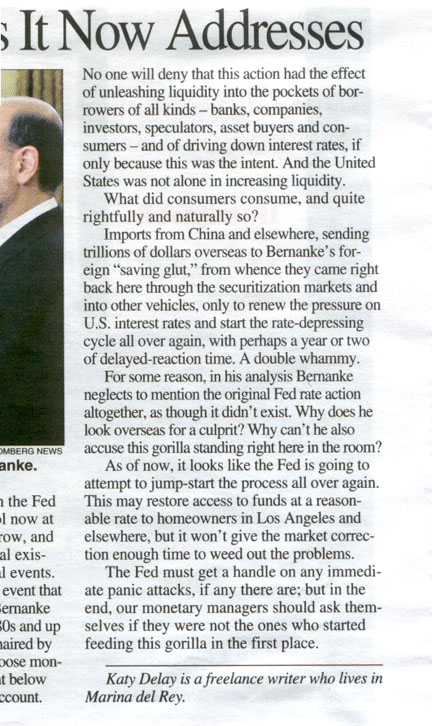
It's called stagflation, folks. It's here. And it's all the Fed's fault. They created this credit bubble in the first place, and now they can't get us out of it. As I've said before, the Fed is between a rock and a hard place. If they increase rates in September, they'll throw turmoil into the housing market and the economy will start to demonstrate recession-like symptoms. If they decrease rates, they'll make a stock market bubble and eventually plunge the long-term dollar into the toilet. If they do nothing, one of two things could happen: (1) we'll let ourselves be strung us along for the stagflation ride, which could go on for some time; and/or (2) at some point the various market players involved may decide they've had enough, and we get some hot action -- if they can afford to, which some of them can't (Japan, China, et al.) Option 2 could therefore mean fireworks, or more stagflation.

Is the Fed making things better or worse by carrying on the charade of control? That is the question. I know they were just trying to avoid a deeper recession in 2001, but if you ask me (which you haven't), I think that someday in the relatively near future, the market will force the Fed out of the money supply/credit business.

I think's it's already happening. Gold is already waiting outside the back door, can't you hear it knocking?

PS: If you haven't seen the parody by some of Columbia Business School's students of Hubbard's "disappointment" at not receiving the Big Chair at the Fed, you've gotta see this:
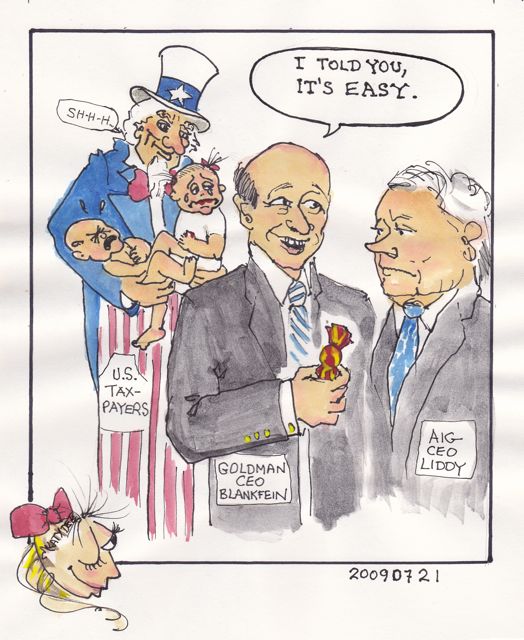
Hubbard Parody

Saturday, August 28, 2010

Why Gold is Up in this Deflationary Environment

I've run across an excellent commentary at The Privateer, entitled "Puzzling - Gold is Going Up Again." He is responding to an August 20, 2010 article on CNN's Money.CNN.com.

As the Privateer points out, some analysts are scratching their head trying to figure out why gold is rising even as inflationary fears are subsiding. This seems counterintuitive.
confusion
[Thanks to Dhirajranka.com for the photo.]

Mr. Privateer puts his figure right on the answer to the quandary: monetary inflating. Some call it quantitative easing (QE). We could also call it Helicopter-Benning, or, as the more old-fashioned among us would say, printing money.

The U.S. central bank is finding itself between the proverbial rock and hard place. The rock: stagnation in the American economy. The hard place: The limitation of its power to do anything about it. But they can't just sit there; they have to act. They're supposed to be controlling this thing.

So the Fed Governors--at least a majority of them anyway--seem to have taken this line of conduct:

When in doubt, pull the checkbook out, and make the bogey-man pout.

Ben Bernanke, the figurehead of this majority, once swore to Milton Friedman that we would never see a deflationary episode like the Great Depression of 1929. Some astute analysts are claiming that we are indeed already seeing the deflationary episode, only it is disguised behind a wall of monetary inflating.

Mr. Privateer is one of them. Here are Mr. Privateer's words:

"Not only is 'quantitative easing' inflationary, it is the absolute last resort of the entire inflationary process. Inflation being defined as an INCREASE IN THE TOTAL STOCK OF MONEY. There are quite a few people out there in the world, and in the US too, who understand what inflation is. These same people understand that rising prices are one amongst very many RESULTS of inflation."

[Ah, a rational human being at last!]

"These same people understand that the destruction of 'wealth' measured in terms of money which has taken place over the GFC [I assume this means Global Financial Crisis] to date has more than offset the creation of new money which governments in general and the US government in particular have been desperately resorting to."

"There is not the slightest chance that there will emerge any GENUINE way out of the GFC until such time as the gargantuan malinvestments propelled by the credit money boom which has now collapsed are liquidated on a market. Every day that this is delayed makes the situation worse. Every new 'Dollar' created by governments and their banking system makes the situation worse. Every new Dollar created in this manner is inflation, pure and simple. The fact that prices are rising or falling has nothing to do with it. Inflation is an increase in the stock of money."

My heart pitter-pattered as I read this. One could hear my sighs of genuine relief at not finding myself alone in this cold world.

The author is correct. I would just add that the nation's "regime confusion" is also contributing to the stagnation. (Robert Higgs calls it "regime uncertainty.")

The question is: what do we do?

Here is the Privateer's response:

"The [CNN] article concludes with the assertion that once the GFC is 'over', there will be no reason to own Gold. The problem is that the GFC will not end - or even properly begin - until money can no longer be 'created' out of thin air. Today, while the Europeans are making some moves towards reducing their deficit spending and while Asia is losing its appetite for US Treasury paper, there is no sign of that happening."

Couldn't have said it better myself.

Labels: , , , ,


Sunday, July 30, 2006

Trouble on the Real Estate Horizon?

Nothing like a tax bill to wake you up. Weber County in Utah seems to have decided to do away with separately taxable land and building evaluations and the correspondingly variable taxation rates, resulting in a tripling of the tax for speculators and non-speculators alike. This is presumably so the County can share in the profits realized as property values have almost doubled in the last few years.

I can think of a situation where rental property owners might find that this puts a crimp on their income, or where an elderly couple finds they can't afford to pay the tax, to the point where neither homeowner can retain his property. This results in their putting it on the already overloaded market. We all know what this does to property values.

On another front, a friend is unable to sell his home in California, and he will soon find himself between the variable-rate rock and the overpriced-home hard place. Hopefully, he will not have to submit to foreclosure.

Wall Street pundits think stagflation seems to be around the bend, judging by the recently released statistics on the GDP and inflation. Anxiety is rising for the next Fed rate announcement. Will they accommodate or tighten? At this point, Las Vegas-type betters are saying the odds are favoring a rise by a small margin. Borrowers must be on pins and needles.

anxiety
[Thanks to opieblue.typepad.com for the image.]

Anecdotal, all of this; but aren't these interesting times we live in. I blame excessive credit creation for these inequities. I believe that property values have ballooned because the Fed has "printed" too much money. The rest all flows from this original sin. Inflation tends to first benefit the real estate contractors, then other speculators; then, as it works its way through the system, its effects begin to inflict pain on unsuspecting homeowners, e.g. lower income elderly living on a fixed or almost fixed income, who find their property tax has tripled and prices are going up, through no fault of their own.

But the Fed people are much too far away from a tiny town in Utah to care.