Saturday, May 19, 2007

Inflation: Let's Get Our Definitions Straight

The G8 is worried that the recent rise in oil prices will exacerbate inflation.

"The level of prices [of energy] contributes to inflation in the world, pushing a number of central banks to raise their interest rates...." (Source: boursorama.com article in French.)

It's true that central banks are concerned about the effect of global oil prices on the CPIs of the world, which is strange. Either they are disingenuous, or they are forgetting the definition of inflation.

Webster's
[Thanks to epinions.com for the image.]

The definition according to Webster's:

"... a) an increase in the amount of money and credit in relation to the supply of goods and services b) an increase in the general price level, resulting from this, specif., an excessive or persistent increase, causing a decline in purchasing power."

(I didn't even have to go to Gwartney & Stroup for that one.)

In other words, inflation is related to money and credit supply, not to a change in price of any particular good. To maintain otherwise is putting the carriage before the horse -- either that, or our G8 central bankers are inadvertently or purposefully using a mistaken definition of the word.

Why they would do that is anyone's guess. I suspect that it's due to their misplaced hubris. For a century now, they have tried to convince us of their usefulness when in fact, the evidence points in the opposite direction. It is due to their intervention that the 1900 dollar is now worth $.06 or less.

Now they have convinced the marketplace that they can, have, and will control "inflation;" and that's why they're nervous. The world misunderstands the meaning of inflation to mean any price increases, even though the central bankers have all taken economics and know that this is not true. For whatever reason (lack of respect for the common man?), they have neglected to explain the difference between a rise in price caused by short supply and one caused by too much money and credit; and this situation has played to their advantage, up to a point.

The tables are now turning, and it's too late to reverse their game plan.

Labels: , , , , ,


Saturday, July 10, 2010

Nature's Golden Standard Is Back (Whether The Macro-Managers Like It Or Not)

The news about gold swaps on the back pages of the Bank of International Settlements report made a few waves last week. Some immediately reacted in shock, claiming this is potential bad news for gold bugs because it augurs a future glut of gold supply on the market if and when the swaps fall through.

But this is not potential bad news for gold bugs, only for gold speculators. Because I am a gold bug, when I heard the news my immediate reaction was, "Hey, this is great. Some financial entity out there got so desperate that they had to use their gold as collateral. It's probably a large European bank or even a central bank, and this may not be the last time it happens. Gold is definitely coming back into style."

MomNature
[Thanks to BuyCostumes.com for the image of Mother Nature.]

A real gold bug like me believes that gold is Nature's monetary base, no matter how politico-academics try to manage their fiat (paper) money without it. The fact that central banks still store the yellow stuff is evidence in support of this, so when I learned that some important entity, perhaps even a central bank, was actually using gold as collateral in a borrowing transaction, I realized it was just more evidence in support.

Thus, in my e-mail update from Mineweb.com, I wasn't surprised to find a link to this article entitled "BIS gold swap--best news to hit gold in 30 years." Author Julian Phillips remarks:

"What is significant about this or these transactions is that gold is being used in international settlements after so many decades of being sidelined in the monetary system!"

This is surely what it looks like to me, too.

The poor speculators, however, unnerved by the slightest tidbit of information, are trying to figure out which way the gold price will move over the next few months. We gold bugs don't really care about the short run, because we know that in the long run there's too much paper money (or its equivalent) floating around, explaining gold's rise relative to a number of currencies. But contrary to us, the speculators don't see the joy here.

They think that gold is just a "hedge against future inflation." Therefore, their next question becomes: Will we get "inflation" (which to them means U.S. price increases) enough to spur the Fed to reign in the fiat dollars? The consumer and other figures suggest not. So should the gold speculators panic and sell it all?

I say that this double-dip will maintain prices, and therefore the Fed is not about to retire any fiat dollars for a while unless general prices start to rise. It would also surprise me if the Europeans manage to retire any euros, what with the PIIGS problem. So without a CPI increase does this mean we will not get "inflation" and the speculators should dump gold?

Well, that depends on how you define the word "inflation." I've been down this road before--it's one of my pet peeves--and I'll do it again by referring you to a modern web dictionary's definition of the word "inflation":

"A persistent increase in the level of consumer prices or a persistent decline in the purchasing power of money, caused by an increase in available currency and credit beyond the proportion of available goods and services."

Interesting that they used the word "or." When can one have a "persistent decline in the purchasing power of money" without an "increase in the level of consumer prices"? Simple: when credit doesn't reach consumers through an increasing paycheck, or through home equity. Where is it, then? In the pockets of speculators, corporations who don't care to invest just now (and rightly so), Wall Street, Freddie and Fannie--in fact anywhere but in the wallets of consumers.

Therefore, general prices will not rise. BUT: the price of gold will rise, because gold is Nature's golden standard, the barometer of "inflation" as defined above in italics. And this italicized inflation situation exists now and has been growing, according to my theory, since consumer prices stabilized in 2008, and perhaps even since earlier than that.

More proof that one can have a decline in the purchasing power of money at the same time as stable prices: Gold compared to the CPI basket of goods has remained stable over time, e.g. about 2.5 ounces/ basket in 2004, the same as in 1942. (Source: www.northerntrust.com/library/econ_research/daily/us/dd052605.pdf.) With the recent increase in its price relative to a number of currencies, however, gold will buy more goods now than is customary. So we have a relative "decline in the purchasing power of money" without an "increase in the level of consumer prices."

Another perspective: Purchasing power in consumer hands is being syphoned off through higher taxes, higher corporate profits (they are not spending, but they are still pricing at the same level), a stagnation of average wages or loss of jobs, and decreasing home equity.

So who is bidding up the price of gold? Anyone with savings they want to protect from further erosion of purchasing power, including many small and large investors, huge hedge funds, enormous pension funds, sovereign funds--anyone who has money to save and who realizes that the dollar and some other currencies have been "over-printed," and that the central bankers are only watching the CPI.

So if the BIS report sent chills up your speculating spine, don't worry. The macro-managers are about to mess things up good, and Mother Nature has yet to sing her last song.

Labels: ,


Sunday, August 10, 2008

The Underlying Credit Crisis's Recent Effect on Market Prices

Once again, Doug Noland at Prudent Bear has come up with an answer I was looking for.

In this post from August 8, he offers one explanation for our current strange market conjuncture.

Commodity prices for things like food, petroleum, and oil ran up to record levels up until about mid-July for reasons that are unclear, but that economists have described as resulting from a mixture of:

1. Increased worldwide demand along with supply problems; and/or

2. Speculation that the US dollar would collapse.

In mid-July, along came the Freddie and Fannie problems (see this post for an explanation of the origin of their predicament, and this one for the latest dire news).

Then Treasury Secretary Henry Paulson issued this press release regarding the Treasury's intention to bail out Freddie and Fannie should problems arise.

We also learned of the Treasury's intention to bail out the FDIC (the government entity that guarantees some of your deposits at the bank) in case of need. (See this TickerForum.org entry explaining the FDIC situation, which forum, by the way, proves that ordinary citizens are not as dumb as some would think.)

These two government announcements blow both hot and cold. On the one hand, they reassure Freddie and Fannie bond holders and FDIC insureds that their investments will not disappear. This should be good news for the economy and for the market, and therefore for future demand for commodities.

On the other hand, they scream to market players that the US Government officials are really worried about Freddie, Fannie, and the banks. So what should be good news for market players and for future demand for commodities turns into a bad omen for the economy and thus for those same commodity prices.

Meanwhile, the signs of a recession are already evident. (See this American Institute for Economic Research post for the stats.)

So it would make sense that commodity prices would start to reverse big-time, which in fact they did in mid-July.

But--and here's the odd part--the stock market took a simultaneous leap upward, as did the dollar, counterintuitive movements under the circumstances.

Does this mean that the coming recession is somehow calming stock market nerves and inflation hawk fears? Perhaps so, because it might cause "inflation" (read "CPI price increase") to disappear just as the Fed predicted; and it will therefore allow the Fed not to raise rates to curtail such "inflation" (read "CPI price increases"). Low Fed rates mean, in the minds of some market players, that money will be available and things will improve.

BUT: I can't believe that such recessionary momentum will avert real inflation as that term is used in academic economics (read "excess money and credit"--see this post for an explanation of this word's definition problem), even though it may put a brake on CPI price levels.

I believe that real inflation will increase because:

The Fed and Treasury are taking unprecedented measures to avoid catastrophe, i.e. they have once again succumbed to the temptation to use the printing press to pay the monetary system's way out of trouble. They will use Treasury funds to bail out Freddie, Fannie, the FDIC, and--through the Fed's newly seized lending powers--any major failing commercial banks and other financial institutions. And these operations will be carried out on an unprecedented scale.

Remember, real inflation means more dollars running around than is necessary in a balanced monetary system. It means that you will be paying too many dollars for a particular thing, no matter whether the actual price of that thing rises, or whether the price just stays the same when it should in fact be falling in a deflationary market.

This also means that gold prices expressed in dollars (and perhaps other commodity prices as well) will not tend to decrease in the long run, because gold is a hedge against real inflation.

Doug Noland puts my theory into more appropriate financialese in his article. He offers a plausible explanation of how the speculative community has functioned under these unusual circumstances.

I particularly liked these two ideas:

"[I]t is not the nature of dislocated markets to let fundamentals get in the way of price movement. Markets, after all, live on fear and greed."

He is referring here to speculative markets, the ones he credits with causing both the run-up in commodity prices and the recent crashing of same.

And this one:

"The unwind[ing] of bearish speculations and hedges would be a most problematic market development, unleashing a final bout of speculative excess and disorder that would set the stage for a major market crisis."

He is talking about the credit maladjustments that are taking place behind the scenes and that most of us never hear about. See this post for a description of these.

This should all play out by the end of this year. Hold onto your hats.

Labels: , , , , , , ,


Wednesday, October 27, 2010

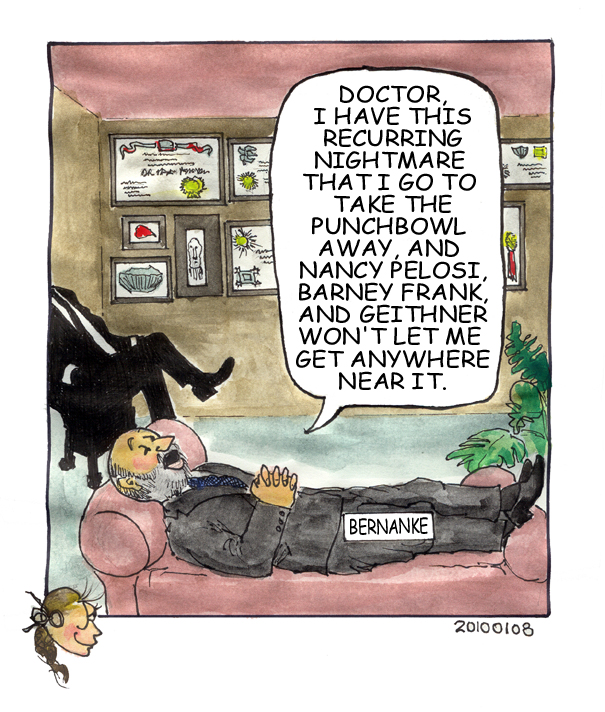
The Bernanke Putt

Helicopter Ben is now turning to golf, according to an article by Jon Hilsenrath and Jonathan Cheng in today's Wall Street Journal.

golfer

I can't decide whether that feeling in my gut was pain, wrath, or an ironic chuckle, when I read the following:

"The Federal Reserve is close to embarking on another round of monetary stimulus next week ... despite doubts about the wisdom and efficacy of the policy among economists and some of the Fed's own decision makers.... Fed Chairman Ben Bernanke's push to restart the bond-buying program--a form of monetary stumulus known as quantitative easing [QE]--has been greeted with deep skepticism among some of his colleagues.... Mr. Bernanke has used the analogy of a golfer with a new putter: Unsure how it will work, he finds [the] best strategy is to tap lightly at first and keep tapping until the golfer figures out how best to use the putter."

All this is fine and good, Dr. Bernanke, but shouldn't you have gotten your golf practice in well before now, at some prior time when the whole world wasn't watching your every twitch? Do you have any idea of the potential consequences of a misjudgment on your part? According to the WSJ, one of the fellows on your own team, Thomas Hoenig, calls the Fed's up-coming actions a "bargain with the devil."

My previous posts have referred to a slow-motion movie that we are all watching. I have mentioned that at the climax the Fed will find itself between a rock and a hard place: the choice whether to act or not to act.

This is happening right about now, and the Fed has decided to buy bonds. Yet Bernanke has just blown the Fed's reputation as a team of expert economic monetarists capable of curing the second worst economic crisis the world has ever seen, by comparing it to a novice putter trying out a new golf club. Frankly, I'm not sure which is more disquieting.

So now we're pretty sure the Fed will perform QE. Everyone is now asking, will we get inflation or not? First, I'll have to refer you to my previous posts about the definition of "inflation," to remind you that when the media refers to "inflation" they are (incorrectly) referring most often to "price increases," and not the increasing of money supply.

QE is inflating (increasing of the money supply), under the true definition of the word. Whether or not it translates into general price increases is a separate issue that depends on other factors above and beyond the simple act of increasing money supply.

It depends, for example, on the business community's reaction to the results of the November elections, and on the future Congress's subsequent successes or failures. QE might translate into higher general prices, or it might just become higher stock prices, independent of the CPI. It might translate into higher bank bonuses, independent of the CPI. It will certainly translate into a much lower dollar, quite independent of the CPI.

Some recommend TIPS as protection against "inflation" (price increases), but already the TIPS are selling at a premium, so the protection they offer is eroded. And TIPS don't protect us against the effects of a weaker dollar as buyers of our regular bonds reduce their appetite for same. What is the consequence of this? We may soon find out.

What's certain is that Bernanke doesn't seem to care: he's out playing golf.

Labels: , ,


Monday, August 22, 2011

What To Do If There's a QE3? --or-- Is This 1933 All Over Again?

Quantitative Easing is nothing but a planned inflating.

rabbitbubble
[Beautiful rabbit bubble image created by Iman Sadeghi]

To be sure that everyone understands this phrase, let's look at the definition of "inflation":

Inflation ... 2a) an increase in the amount of money and credit in relation to the supply of goods and services b) an increase in the general price level, resulting from this, specif., an excessive or persistent increase, causing a decline in purchasing power. (Source: Webster's New World College Dictionary, 4th ed., 1999.)

In other words, Quantitative Easing is the Federal Reserve's attempt to support the economy, general prices, and asset prices (e.g., the stock market) by purchasing government bonds with nothing but its own full-faith-and-credit, backed, of course, by the full faith and credit of the U.S. taxpayers. In effect, the Fed is performing 2a) to achieve 2b). (The decline in purchasing power is just an incidental but not unattractive side-product, at least to the Fed governors' way of thinking.)

Does the Fed really know what it is doing? Let's look at history.

Back in 1933, a little known economist named Edward C. Harwood took a look at the Federal Reserve's intended "planned inflating" of the day. (Harwood later came to dislike using the word "inflation" when referring to 2a) above, and so he substituted the word "inflating," to avoid any confusion.)

Harwood was shocked to learn that anyone was actually considering a planned inflating as a stimulus to cure the Great Depression. He had observed through his statistical work that by 1933 the economy had rid itself of the causative factors behind the crisis, and that business was poised to make a comeback. Interference by government was the last thing the economy needed. Yet here came the politicians and Federal Reserve officials contemplating intervention.

In an article appearing in The Bankers Magazine of New York, Harwood wrote the following (I have substituted "inflating" for "inflation" where necessary):

"[T]here are several possibilities with respect to the scheme itself. It may work as planned and actually cause a return to the general price level of 1926, or at least a movement in that direction of substantial proportions. It may not work at all. It may prove to be unmanageable and carry on to an indefinite expansion of credit and currency which will finally render the dollar valueless. Unfortunately, the historical record suggests that the last named possibility is perhaps the most probable of the three. In any event, it is obvious that every businessman and every investor will be faced with the problem of adjusting his affairs to the new possibilities....

"It is clear that anyone who believes that the attempted inflating will be abortive and without substantial effect will not change his present course of action. However, those who anticipate a recovery and higher prices in general, as well as those who fear an indefinite expansion and ultimate collapse, will surely act with a view to taking advantage of the situation, at least to the extent of protecting themselves. Careful consideration of just what this will mean in the case of each type of individual mentioned will prove illuminating....

"The owner of equities has nothing to fear from inflating, in fact, is apt to gain thereby, [if he or she thinks the planned inflating will be successful;] but the position of the bond owner is vastly different.... [T]he obvious remedy for the situation is to sell fixed income securities and buy equities.

"If, however, the holder of bonds and mortgages fears a runaway inflation [hyperinflation], he may attempt to convert his securities into gold for the purpose of hoarding it....

"The situation of the depositor who has savings accumulated and of the man who owns life insurance policies is similar to that of the bond owner. In the first place, the value of dollars on deposit will decline, in terms of goods, during a period of inflating. It is quite obvious that it would pay depositors to withdraw their funds and buy equities or commodities of some kind. Those who feared that the dollar would go the course of the German paper mark would naturally withdraw their savings, and also their cash surrender values in the case of life insurance, in order to hoard gold.

"It follows that if the inflating is assumed to be effective, the banks will be called upon to pay out vast sums to depositors at the same time that the bond market is flooded with securities for sale. Banks and insurance companies will also be sellers in order to meet demands for cash or cash surrenders and complete demoralization of the bond market would result. It is hardly necessary to add that this would mean the closing of every bank in the country.... [This happened a few weeks later.]

"The truth of the matter is that inflating is the road to ruin. Deliberately planned inflating only makes the road so much the shorter because it points the way for even the most ignorant to see. Inflating can only 'succeed' by fooling most of the people all of the time. That anyone would be fooled concerning a measure which would be fought over in both branches of Congress and in the public press, is beyond belief....

"Those who advocate even the least degree of planned inflating are attempting to set in motion forces which will bring utter ruin, not only to their puny schemes, but to our whole economic fabric. Words are too weak to express adequate condemnation of those who, like children with a complicated toy, are willing to destroy that which they do not understand."

Today's Kitco gold chart gives us an interesting counterpart to his views:

gold
[Kitco gold chart, 8/22/11, 4:30 p.m. EDT]

Today, I would say that the American economy is not in the same place Harwood found it to be in early 1933. We are faced today with another year and a half of "regime uncertainty", a major factor in our current stagnation. However, the market show must go on.

As a result of all the confusion, the market has multiple personalities these days (just like my Sybil). A third of it believes QE3 will be "successful," i.e. it will turn the stock market into a winner. A third believes the European problems will destroy the stock market but reinforce the U.S. Treasury market and dollar hegemony, in spite of QE3. Another third thinks we will see a flight from the dollar and maybe even a worldwide plunge into a Double Dip, just like in 1933.

What do you think?

Labels: , , ,


Thursday, March 19, 2009

The Inflation Boat Is Leaving the Dock

Last night we learned that the Federal Reserve is going to put into practice its announced plan to buy US government debt. Today's Financial Times article by Krishna Guha gives the gory details.

Everyone knows that this action by the Fed increases money supply, and most are aware that it increases the probability that at some point in the future the amount of money created will be excessive with regard to the actual needs of the marketplace, which in turn will tend to lead us towards a state of price inflation, or bubble inflation. Another article by Javier Blas on the early signs of this in the commodities markets is a fun read on the subject.

As the Fed sees the problem, then, they must feed us with money supply while the banks are frozen in a state of rigor vivus, and then in future, just at the right moment, they will take steps to prevent the normal outcome of price or bubble inflation by reversing the process.

buysell
[Thanks to 1stchoicecufflinks.com for the nice photo.]

This sounds logical. As an obscure economist named Edward C. Harwood wrote during our last episode of purposefully inflationary Federal Reserve intervention ("the ill-fated Operation Twist in the 1960s"), during a time when we were still trying to adhere to a modified form of the global gold standard:

"Once inflationary purchasing media have been placed in circulation, there are two ways in which sound money-credit relationships may be restored: (1) by means of devaluation, that is, reducing the gold weight of the monetary unit so much that the increase in the number of (smaller) gold dollars equals or exceeds what had been the inflationary portion of total purchasing media; or (2) by means of deflation, that is by removing inflationary purchasing media from circulation." [See this article from the American Institute for Economic Research website [AIER.]

Let's take these in order. In the 1960s during the last years of the gold standard era, the word "devaluation" had by definition a specific political action attached to it. We could say it was an official public confession to a previously committed inflationary crime, the central bank's admission of guilt and acceptance of their incapacity to rectify the situation. To devalue a currency was ripe with ominous significance, and central banks were supposed to take pains to avoid the embarrassment by not inflating the currency in the first place.

Today, however, the devaluation of our currency takes place painlessly for most of us (except for importers), and effectively the Fed gets away with it on a regular basis. In fact, without a gold or any kind of standard, the inflationary purchases of debt instruments that the Fed has already made, plus those it intends now to make, are already devaluing the dollar as I write. We don't have to wait for an official recognition and adjustment of any standard; it just happens on a day-to-day basis.

Under these circumstances, an official announcement of devaluation, therefore, will have no corrective effect. Quite the contrary, inflation will take place simultaneously with the devaluation of the dollar--a double whammy, if you will.

But we don't want prices to skyrocket, so the inflation will still need correction. Let's turn to the other option, deflation. Paradoxically, the Fed is taking its present inflationary action to fight fear of deflation. They are afraid that a banking panic and a lack of credit could cause the system to collapse in what is called a "deflationary spiral." So it will be a while before they feel comfortable with using the deflationary tactic.

Nevertheless, the Fed scientists and governors do believe that it will be possible for them, at some appropriate moment in the future, to begin a controlled deflation of money supply that will not upset the apple cart.

Harwood does write this about the possibility of a controlled deflation:

"That a period of gradually declining prices can be a period also of great economic growth has been amply demonstrated in the past. For example, between 1875 and 1895 while prices decreased substantially, the Nation's productive capacity and output of goods and services increased at a very rapid rate. The often heard assertion that an economy cannot grow unless prices are rising has no basis in fact....

"With gradual deflation, a longer time would be required to eliminate all inflationary purchasing media and reach an equilibrium between the remaining (noninflationary) purchasing media and prices and wages, but the traumatic events that are a feature of rapid deflation would not occur. The Nation would 'outgrow' the inflationary condition as part of the savings of individuals, businesses, and perhaps of the Government were used to pay off inflationary bank loans and thereby cancel both the loans and the checking deposits that the loans had created. Although gradual deflation would be accompanied by decreasing prices, wages almost certainly would decline less or might even be sustained by greater productivity due to technological and other developments."

(For more on why deflation is not always bad thing, read this research by David Beckworth at Cato.)

So it would seem that a gradual well-timed deflation is what Bernanke and his cohorts are counting on. But... there are a few minefields here. One is that we are no longer on a gold standard. We have no point of reference as to where the dollar should end up. I won't go into the reasons why this makes Bernanke's task more difficult, but it does.

Second, how will we know when prices begin to inflate or when bubbles start to form? Alan Greenspan is famous for having remarked that it is impossible to detect when a bubble is appearing. It's true that we all knew the real estate mania was a bubble (or at least I did; didn't you?), but our financial wonks at the Fed either preferred not to recognize it or couldn't prove it to their own satisfaction, at least not to a point where it would have forced them to take action. (I'd add that they may have had incentives not to want to find reasons to take that action, but that would be unfair speculation, so I won't.)

And what if prices remain the same? Does this necessarily mean that we don't have an inflationary maladjustment in the money supply that maintains prices at an artificially stable but too high level? What if the stimulus package spending turns out to be wasteful to some significant degree? Isn't that like blowing bubbles? Example: Bailout-funded Wall Street bonuses.

Third, and here's the real rub, we have not practiced what Harwood calls "sound money-credit principles" since the Fed was created. These principles mandate a specific equilibrium in the commercial banking system between true reserves, deposits, savings, and short-term commercial paper on the one hand; and loans and investments that are speculative and/or based only on some form of collateral, on the other, where these more risky activities would be allowed only outside the strict commercial banking system. (For more on sound commercial banking, find a copy of Harwood's book "Cause and Control of the Business Cycle," 1974 edition, at your local library, or in the AIER catalog. I will delve into the idea of sound money-credit banking in a future blog.)

Fourth, the Fed cannot reverse its current trajectory and start to take deflationary action until the time is right and the worst of the credit crisis is past. Will nothing unexpected disturb their plans? They are relying on deflationary scenario computer models where "all else is equal," meaning when outside factors remain stable. What if the market does something surprising that will make a controlled deflation either inadvisable or even impossible, at the very moment when it must happen? For example, US treasury bonds could become radically less popular among our foreign buyers as a result of the dollar devaluation the inflation will cause; and as nations all over the world scramble to inflate their own currencies, we may find that we have a lot of competition in the bond market.

Personally, I'm betting (and I disclose that I have put a little money where my mouth is by investing in gold-related products) that the Fed will be hard-put to time and measure the controlled deflation.

Why gold? Because, as I've said many times: You can take gold out of the standard, but you can't take the standard out of gold.

Labels: , , , , , , ,


Thursday, April 15, 2010

Inflation or No Inflation, That Is The Question

Once again, the question of future inflation is boggling the minds of many a financial forecaster. Are we headed for a rise in prices that will carry the Dow up and away, hopefully carrying the rest of us with it, or are we going to suffer the second leg of the W Recession as commercial property and/or the inevitable rise in interest rates hits the skids?

thinker
[Thanks to Commons.wikipedia.org for the photo.]

The questions I would pose are quite different. We are already engulfed in a sea of inflated purchasing media that is constantly roosting, taking off, and re-alighting in its search for new quick profits. Unfortunately, given the current labor market, it won't even be dipping a little toe in the ordinary person's paycheck on its way by, at least not anytime soon.

So where is it now, and what is going on? It is where it has gone for the last two years, to wit ten years or more: into speculative investment, biding its time. In America, at least, it isn't going into production, and it isn't going into salaries. It's going into profits and speculative investments, instruments like Greek bonds and credit default swaps so popular with the hedge fund crowd.

This means that the answer to the introductory question is yes, inflation, but be careful how you define it. As I have harangued before, the word is used flippantly to mean at least two things: on the one hand, price increases represented supposedly by the CPI; and on the other: excess purchasing media, the kind that used to cause price increases before the market got savvy, but that now finds itself blowing bubbles while maintaining general prices that should be falling so that the ordinary consumer gets a break. This definition we could differentiate by naming the process "inflating."

We've got the price stabilization, and we most certainly have got the bubbles blowing again. The excess "money" is now keeping Wall Street afloat--in fact higher than ever, bonuses and all, while stable prices buoy the record private sector profits we've been hearing about (which they're using to increase inventory, speculating on a price-rise opportunity), and while the Fed's funny-money sustains the whole U.S. residential real estate market.

If I were a businessperson these days, I would most certainly not invest in much capital equipment or labor, at least not until I find out:

- What the CPI is going to do over the next months, only because of its effect on what the Fed will do;
- Whether the Fed will really stop buying Freddie and Fannie issues, and/or start to raise interest rates, and/or take some other action to counter their recent balance sheet explosion and any eventual rise in the CPI;
- Whether the commercial real estate market will implode, with the resultant double dip in the economy;
- Whether we'll get a second wave of mortgage foreclosures and a second dip in the residential market, with the obligatory double dip in the economy;
- What the FDIC will look like at the end of 2010;
- What the Pension Benefit Guaranty Corporation will look like at the end of 2011;
- What will happen to the health bill;
- What Congress will look like in November;
- What party will run the country starting in 2011;
- Who will win the election of 2012;
- What the national debt projections will look like over the next two years;
- Whether or not the Chinese, Japanese, and Arabs will continue to buy and/or hold US Treasuries at the rate they are today, and what the U.S. bond market will do in response;
- What else?

Frankly, it's a wonder that the real economy turns at all.

This country is at a crucial point, both politically and economically. Will we affirm the liberty protected by our Constitution by turning away from government intervention in our lives, or will we succumb to the temptation offered by larger and larger handouts from an increasingly intrusive, blood-sucking, and short-sighted public sector?

Just as in the 1930s the electorate and the businesspeople of America are waiting to see what we, collectively, will do. In the 1930s the public sector won, and the private sector lost. After Roosevelt's about-face (his 1932 platform included reducing the debt and reinforcing the gold standard--I'm not kidding!) and after seventy years of inflating the currency, we are seeing the measure of that loss today, and the inflating continues to the detriment of all of us. What is the denouement?

In times like this, I prefer the security of gold and related investments. One thing that history has taught me is that gold tends to retain its purchasing power over time as the paper currencies lose their value. And I'm betting the dollar will lose its value compared to gold, sooner or later.

Labels: , , ,


Tuesday, November 11, 2008

The 2008 Bailout: The Pandora's Box of All Pandora's Boxes

If there ever was a Pandora's Box, the Big Bailout of 2008 has to be it.

Pandora's Box
[Thanks to 2highfestival.com for the image.]

How did we get here?

After a difficult time in the early 1900s, we began our drift away from sound monetary and banking policy by turning towards government for the prevention of business cycles.

We thought we were doing the right thing in creating the Federal Reserve. Since then, it has evolved into the monster it is today.

It started as a tool for maintenance of the stability of the banking system, but it has become the all-knowing, all seeing Poobah-Controller of the Issuance of Purchasing Media, in the place of what we had back then, the gold standard. In fact, we've gotten so far away from this standard that we officially abandoned it in 1971.

Today, it is increasing clear that the Fed has no real control of the money-creation process. Meantime, Congress has decided to come to the rescue of one failing institution after another, most recently General Motors. Ford and Chrysler will not be far behind.

Where will it end? How will this turn out?

No one knows; and the more the government messes around with this, the murkier the future becomes.

We are already in a good recession (see the statistics of the American Institute for Economic Research), and it may start out to be deflationary. But our leaders will not let price deflation happen. They will pump as much credit into the system as they think they need to keep prices and the economy stable. After all, that is their mandate. (See what I have to say about their mandate here.)

Yet deflation enriches us through lower prices. (It also means reducing the supply of purchasing media, but that's a separate story. See my discussion of this definition confusion.) If prices were to decrease, we would all be better off. For example, do you prefer the price of tuna fish at $3.99 a can, or $2.99? Duh.

Deflation (i.e. lower CPI) is not bad in and of itself. What is bad is what usually accompanies deflation. In most deflationary episodes we have recession and/or depression: Bankruptcies, decreased consumption, loss of jobs, stock market losses, bank closures.

But the Fed is forgetting that by "curing" the symptom of recession (i.e. by stopping price deflation) they are not necessarily curing the cause of that recession.

To cure this recession, Congress must allow the market to rid itself of a century of inflation. That can only be corrected through a deflationary process, even if it means we must undergo some recession. If the Fed and the Treasury try to keep it from happening, they will maintain the distortion of inflation instead of allowing it to cure itself.

What method will they use to accomplish this? They will try their darnedest to prevent deflation/recession/depression by turning on the printing presses (issuing fiat currency and credit) to whomever needs it the most, or cries the loudest, or threatens to close. They have borrowed billions, and created billions, in this effort. Where will it stop, now that the presses are running full speed?

Businesses are quickly learning that they must start screaming for cash. The cash is available. First come, first served. Yet by continuing the inflationary process and handing out cash, our own elected officials are fleecing us on a daily basis.

They will fund these bailouts with the raises we will not get, with the value we are losing on our houses, with the pension investments we bought at inflated prices and that have vanished.

Our salaries are now in negative growth, banks steal our savings every day through poor interest remuneration (they get cheaper money from the Fed), and our social security incomes and pension allotments are not keeping pace with the CPI. As my Dad used to say, "Stand still, little lambs, to be shorn." (For more about him, see my last post.)

In the longer run (when, I don't know), we the people must reject these shenanigans and turn to gold as a refuge against government destruction of the monetary units of the world.

That's the day Pandora will close her box. I hope I live long enough to see it happen.

Labels: , , , , ,


Wednesday, January 04, 2012

California's Redevelopment Agencies: Another Example of Government Run Amok

California is a funny state. It is overwhelmingly Democratic, but there are old-school Republicans hidden about here and there, and the usual few Libertarians. Over the last twenty-five years, it has had both Republican and Democrat Governors, but since Reagan left the State, it has become the standard-bearer for progressive legislation.

Some years ago the legislature happily gave city bureaucrats the budgetary wherewithal to take over control of inner downtown areas through an institution called the Redevelopment Agency. The Agencies began a campaign to renovate downtown areas that had become run down due to landowner neglect.

Instead of looking for the twisted economic incentive that spurs otherwise intelligent people to allow their buildings and neighborhoods to fall apart, the politicians decided simply to override property rights by making deals with favored land developers. These professionals, backed by City Hall, proceeded to rid the city streets of the eyesores and reap huge profits in the process. The Supreme Court decision in Kelo v. the City of New London buttressed their actions.

By a strange quirk of nature, Governor Jerry Brown, who is about as progressive as they come, decided to cut the budget for the redevelopment agencies. Of course, the slighted bureaucrats howled and even took him to court. They lost.

What they don't realize is that there are other ways to combat downtown blight, as I point out in a short Letter to the Editor at the Los Angeles Daily News.


[Thanks to the Daily News.]

Quoting loosely but also filling out the shorter letter, I told them that people like Nancy Sweeney, the President of Revitalize Reseda, who defend the redevelopment agencies against Brown's budget cuts must not realize that California has come very close to bankruptcy. The agencies' pet projects may be nice on their face, but (1) they are likely to be projects that would not be completed without taxpayer subsidy, and (2) at the moment taxpayers have more important things to do with their money.

Instead, let's take away the incentive to abandon property. To avoid allowing city blocks to fall into the same blighted state again, I suggest that Californian cities and towns implement Henry George's Land-Value Taxation (LVT) scheme. According to this policy, agglomerations are, by definition, the creators of a good measure of the value of a particular central street address. Therefore they (i.e. the local taxpayers) should reap the rewards. George's taxation scheme places all the tax burden on the land and none on the improvements, while lightening or even eliminating the taxes for other things (sales tax, license fees, income tax, and oh-so-many others).

The proven results--already obtained by some communities around the country and the world--are a downtown where blight is "taxed away." Owners of valuable property cannot just sit on centrally located but deteriorating land and buildings, just to speculate in future gains. Why? Because the taxes are too high to make it worth their while. It's "either crap or get off the pot": build something useful, or sell the spot and let someone else do it.

California is special because Proposition 13 protects commercial property owners as well as residential owners from reassessments as long as they hold onto their land. They can even exchange a plot with another like landowner and retain the lower taxation rate. A change in the law for these businesspeople would force them back into a more fair taxation schedule. (After all, they are not little retired grandmas who risk losing their home in an episode of runaway inflation, like the individuals who inspired Proposition 13 in the first place.)

Then, once the LVT is in place, developers will flock downtown to buy properties from former speculators and turn valuable spaces into income sources for those who created that value, i.e. the taxpayers. To each his just desserts. And the professional developers will not install just any income source, as the redevelopment agencies tend to do (behold the restaurant over-development in Old Pasadena). These new owners have every incentive to find the ones that will be the most successful.

Although Governor Brown may not know why, he has done the right thing. Now the people of the State should take it one step further.

Labels: , , ,


Sunday, July 16, 2006

Reading the Crystal Ball

Market players have a tough time of it. Not only must they attempt to predict consumer taste and spending power, but they must also try to read the numbers and interpret the Fed's every word for the direction of interest rates.

The Fed's purported role is to control inflation, while at the same time insuring that the economy has wiggle room enough to avoid recession. But the Fed, as it portrays itself, is the equivalent of the tail wagging the dog.

tail wagging dog
[Thanks to loreenleedy.com for the image.]

The Fed can only act upon its own interpretation of statistics. The statistics in question are all after the fact -- the definition of statistics being "numerical data." You can't have data unless you've had the acts that create them and the time to collect, record and publish them.

The Fed's purported role as stated is nonsensical. You cannot "control" anything (implying foreknowledge of the economy's reaction to manipulated events) (1) using tools that are several weeks if not months old, and (2) manipulating events that are only a few of the many that affect an economy.

Read about Bernanke's quandary next Wednesday. The CPI statistics come out that morning, and he is speaking to Congress that afternoon. Marketwatch story.

Thursday, June 27, 2019

Fractional Reserve Banking: Con-Fus-Ing!

I recently ran into a discussion about fractional reserve banking. [FRB]  There seems to be much confusion about it.


Basically, the definition is:

"Fractional reserve banking is a banking system in which only a fraction of bank deposits are backed by actual cash on hand and are available for withdrawal. This is done to expand the economy by freeing up capital that can be loaned out to other parties."  [Investopedia]


Certain economists are vehemently against FRB, especially some in the Austrian school.  But I don't always agree.  Sometimes fault appears in one place when it is actually in another.

I see it this way:  When you hold what you consider to be money, whatever that is (e.g., euros, dollars) you own them, period.  When you decide that you don't want to take the risk of seeing them stolen from your home and you look around for a safe warehouse, you find that the service is offered by banks.  The bank will hold that money for you, available upon demand, and if you want a little income it will even pay you interest, which it earns by lending your money out or using it as collateral.  If you put your money in the bank, therefore, you will have, in effect, lent your money to the bank.  

The risks will vary according to the type of bank you choose.  I consider normal and safe banking to be the lending of my money to someone for, say, a home, as long as the bank is a good one and judges well its debtors.  And it is my responsibility to see that I choose a good bank by studying its history.  I would expect a reasonable amount of interest for my loan to this type of bank.  And, depending on the interest I demand, I might expect to have free access to my money whenever I want it.  

This is not FRB.  It works as long as there are no economic panics, and even if there were, the banks can avoid money shortages simply by branching out into various states in other parts of the country.  (See Canada's experience during the Great Depression.)

Or, to take another example, I could lend the money to a bank that wishes to lend credit (not my money this time, but credit created by the bank) to a company that produces, say, trucks.  My money could be used as a small, say 10%, part of the reserve of the bank for that purpose.  The bank would know the truck company well and would expect to be reimbursed for the credit loan within a relatively short period of time, say around 30-90 days.  The bank would also hold, as collateral for the other 90%, documents called commercial paper for the trucks produced (basically a claim on the trucks).  The credit, upon reimbursement by the truck company, would liquidate, and my money would be quite safe.  I would receive good interest for this loan as well.  This is what I consider to be Healthy FRB.

Today in our looser banking world, I could also consider lending my money to a bank that issues credit, again beyond the amount of my cash deposit, but without commercial paper or other type of collateral.  This is much more risky, and normally I would expect to be paid a lot more interest in this case.  This is also FRB, but I would categorize it as Risky FRB.

The problem is that today ,with Risky FRB loans that are not collateralized and that are loosely distributed by unexperienced bankers, we are not offered proportionate compensation for the high risk involved.  If banks had to compensate us for the actual risks they are making us take, they would not make as many risky loans.

Furthermore, as it happens, we now have a number of government-instigated measures putting fuel on the Risky-FRB fire.  The Fed, without a gold or other standard, is dishing out dollars to banks with one hand, and with the other giving the banks interest just to park their reserves at the Fed.  This means that the banks have even less motivation to pay us any interest at all.  Quite the contrary:  Today savers receive at most 2% interest on their savings accounts, which is barely enough to cover the official price-inflation numbers.  In other words people are lending money to banks in return for no interest at all.

Just to keep it safe from theft?  Frankly, that IS theft.

In other words, it's not the FRB per se that is at fault.  It is: 

1.  The unstandardized, loose fiat monetary system in which we live, where risky-type FRB without collateral has allowed banks to make many more loans and take many times more risk than they would otherwise; plus

2.  The lack of proportionate compensation for the risk the banks are taking with OUR money; plus

3.  The new practice of bailing out large banks, which takes away even more incentive to lend conservatively; plus

4.  This new Fed policy of giving banks interest on reserves; plus

5.  The lack of viable alternatives for safeguarding our money.

Labels: