Tuesday, April 08, 2008

More Greenspan Gobbledegook

This man is a great disappointment to me. Several decades ago, he was one of the few economists who made good economic sense, defending the gold standard and decrying excessive money and credit creation through centralized government monetary intervention.

Then he changed. During his tenure as Chairman of the Federal Reserve prior to Dr. Bernanke, he mastered what became known as "Fed-speak," muddled punctual declarations specifically intended to confuse, presumably to cover up the interventionist Fed's real intentions.

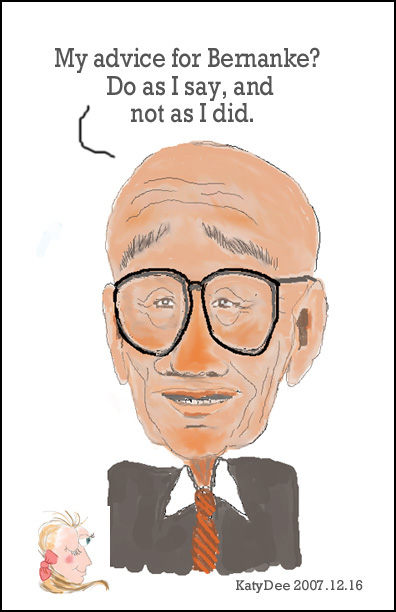
GreenspanCartoon
[Click on the image for a larger version.]

(For a couple more cartoons on the subject, see this one and this one.)

After all those years of blatant disregard of his own prior wisdom, he is now busy trying to defend his record, as we can read and hear in this latest interview in the Wall Street Journal.

Here's an example of his relatively new-found illogic as expressed through Greg Ip's paraphrasing:

"At the time [during his tenure], Mr. Greenspan expected his [low interest rate] policy to boost housing because the rest of the economy was relatively unresponsive to lower interest rates. Based on decades of his own research, he believed a buoyant housing market would spur consumers to borrow against home values and spend more. This would not produce a housing bubble, he predicted, because it was difficult to speculate in homes and the memory of the 2000 tech-stock bust remained fresh. [Italics added]

I would love to see some serious economists "have at" the former Chairman's specific research that gave rise to this second prediction. Since when is it difficult to speculate in homes? Real estate speculation has been part of the economic landscape both in good times and bad, and long before governments learned to inflate their currencies--and believe me, that was many, many centuries ago.

Here's the next paragraph:

"Mr. Greenspan now admits he was wrong about the improbability of a housing bubble. Yet he has long maintained that bubbles are an unavoidable feature of a dynamic economy. He pulls out a 1999 speech and shows, underlined in green marker, passages in which he warned of recurring but unpredictable patterns of overconfidence followed by investor panic. He does not share some foreign central bankers' belief that their job is to defend against excessive asset-price inflation: No sensible policy, he maintains, could have prevented the housing bubble."

I guess that means that if perchance his results don't tally with his expectations, then it must be the fault of some underlying economic axiom we could call the "Bubble Unavoidability Theory." Funny, I never heard of that one, and just because it's Greenspan who formulated it out of the blue does not a valid theory make.

Mr. Greenspan, if I were you, I'd get out a little of that humility syrup that you were taking back in the 1960s. And while you're at it, pull out and reread your old writings, put your thinking cap back on, and hie thee back to the research drawing table.

Labels: , , , , ,


Sunday, December 16, 2007

Greenspan from the Sidelines - Cartoon Time

Today I felt like getting back to my cartooning. I've been reading the various interviews with Greenspan, our former Federal Reserve Chairman, and he advises his successor Ben Bernanke to avoid exacerbating inflation by lowering Fed rates too much--strange advice considering from whom it comes.


[Click on it for a larger version.]

Labels: , , , , ,


Wednesday, December 12, 2007

Greenspan's Mea Culpa: Too Little Too Late

Today's Wall Street Journal opinion section carries a piece by former Federal Reserve Chairman Alan Greenspan, creator of the "Greenspan Put."

For the uninitiated, this is what financial markets had come to call the Greenspan Fed's reacting to specific market sector stress, i.e. an addition of liquidity to the credit markets, or what the old-timers would call "revving up the money printing press."

Actually, this liquidity put is not peculiar to Greenspan, as Bernanke (our current Chairman) has proven over the last few months. In fact, it has become a part of the monetary landscape. Every time the markets perceive signs of stress in the financial sector, the Fed starts printing.

Strangely, enough, it only seems to work one way. The Fed has rarely moved rates up in reaction to the preliminary signs of such stress (a growing speculative bubble), for reasons that are obscured by the rhetoric of players like Greenspan.

But I digress.

It looks like Greenspan is beginning to feel pangs of guilt about his activities as Fed Chairman. Here is the pertinent paragraph from the article:

"I do not doubt that a low U.S. federal-funds rate in response to the dot-com crash, and especially the 1% rate set in mid-2003 to counter potential deflation, lowered interest rates on adjustable-rate mortgages (ARMs) and may have contributed to the rise in U.S. home prices."

Oops
[Thanks to allposters.com for this image.]

Congratulations, Sir, on your armchair 20/20 hindsight. We wish you had had such clear vision in 2003.

Then he quickly dries his crocodile tears with this:

"In my judgment, however, the impact on demand for homes financed with ARMs was not major."

Unfortunately, you have no way of proving this, Sir. The state of the economic science in general, and the monetary oversight science in particular, is primitive to say the least. A cursory glance at history, however, would suggest that central banks should be much more contrite.

All fiat currencies (money that is not backed by a standard like a measure of gold, silver, or something of generally accepted value) have gone the way the dollar is going, thanks to the intervention of the governments and/or entities that controlled them.
It's funny, but you yourself, Sir, used to proclaim such wisdom in the past. I'm reading your chapters of Ayn Rand's "Capitalism: The Unknown Ideal." In one, published in 1966, you state:

"Credit, interest rates, and prices tend to follow similar patterns in all countries. For example, if banks in one country extend credit too liberally, interest rates in that country will tend to fall, inducing depositors to shift their gold [or whatever they are using in its place] to higher-interest paying banks in other countries."

How true, at least back then. Today, we have no gold standard; and because we don't, we didn't get the remedial "... shortage of bank reserves in the 'easy money' country" to induce "tighter credit standards and a return to competitively higher interest rates again." Yes, these are your words, Sir.

(Well, actually you still get the shortage of bank reserves, but only after the huge wave of financial liquidity has done great damage, just as it has drowned our housing sector. The gold standard would have cut the wave short before it became a tsunami.)

What else did you say back then? "It was limited gold reserves [as contrasted to unlimited fiat central bank reserves] that stopped the unbalanced expansions of business activity, before they could develop into the post-World War I type of disaster."

You go on to describe the Federal Reserve created fiasco of the 1920s with perfect analysis. You say:

"The Fed ... nearly destroyed the economies of the world.... The excess credit which the Fed pumped into the economy spilled over into the stock market [read housing market today]--triggering a fantastic speculative boom."

I read these pages with my mouth dropped wide open, thinking, "Can this be the same Greenspan?"

Sir, you would do well to read your own scripture. When you have, come back and rewrite this Mea Culpa. Your "can't beat 'em, so I guess I'll just join 'em" days are behind you now. Please, get yourself back on the straight and narrow before you put the final touches on your own legacy.

Labels: , , , ,


Monday, August 27, 2007

Who Is At Fault? The Central Banks

Will Hutton, in this article from the Observer of London, appearing at the Gold Anti-Trust Action Committee website, is on a rampage. And I sympathize with his emotions, if not entirely with his recommendations.

Excerpts:

"While obeisant governments bail out dodgy plutocrats, it's ordinary people who foot the bill."

"One of the most inequitable and amoral acts in modern times is happening in front of our eyes...."
"The multi-billion dollar bailout of global finance after one of the most reckless periods of lending and deal-making since the late 1920s is extraordinarily one-sided. Little people's taxes are underwriting the mistakes of big people, who in the process have made riches beyond the dreams of avarice. Globalisation, it is now clear, is run in the interests of a global financial class which has Western governments in its thrall. This class does not give a fig for the interests of savers, clients or wider workforces. The rules of the game are set up solely to benefit the financiers whether in London, New York, or Hong Kong."

"Interpol should make arrests in New York, London, Tokyo, Beijing, Frankfurt, and Paris, starting with all the executives in the credit-rating agencies who blithely ranked the debt as creditworthy in exchange for fat fees and freebies from the very banks who were making the absurd loans. Governments should bring suits against the executives involved, the repositories of vast personal wealth, to help repair the hole in private and public balance sheets."

" It is as though Europe and America had announced an amnesty to the world's criminal gangs after they had gone on a killing spree because they feared the killing would get worse."

* * * * *

These are harsh words, and one can't help but identify with his ire. But I believe his call for hanging the culprits is a little over the top, because like Robespierre, he's got the wrong defendants.

Greenspan tatoo
[Thanks to Robolove3000 for this great tatoo.]

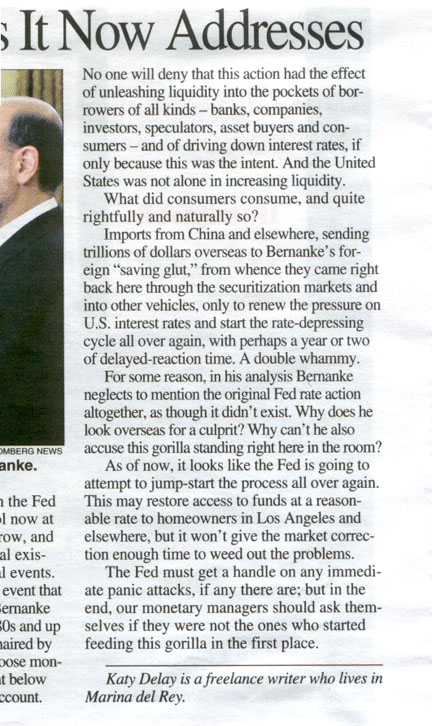
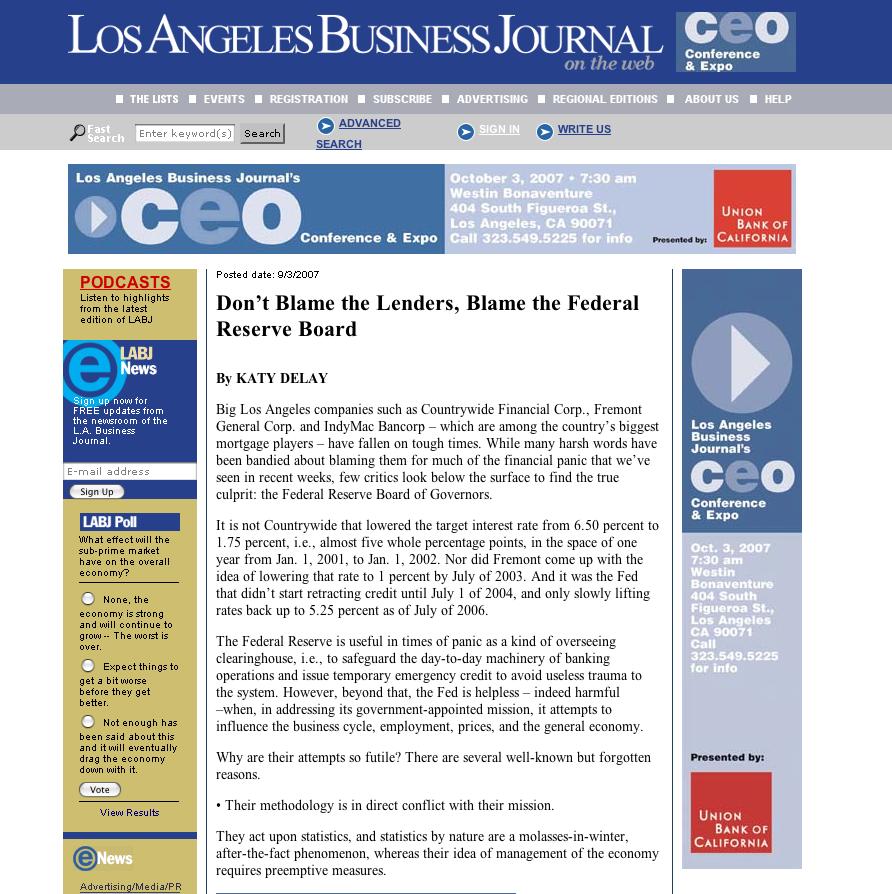
Everyone is forgetting the most important element in all of this: The identity of those who allowed all of this to happen. Why does everyone forget that it is Greenspan's Federal Reserve Board that decided to lower the target interest rate from 6.50% to 1.75%, i.e. almost five whole percent, in the space of one year from January 1, 2001 to January 1, 2002? And who continued to lower that rate to 1.00% up to July of 2003? Who is it who didn't start to retract until July 1 of 2004, slowly lifting rates back up to 5.25% in July of 2006?

Housing was already taking off worldwide, but the US Fed chose to ignore it, even publishing papers to the effect that the housing boom was not a monetary phenomenon. (See my previous post and my cartoon on the subject. I wrote an economic analysis of one ridiculous paper, but no one cared to publish it.)

I thoroughly admire the Fed's latest efforts at transparency and their desire to act in a predictable fashion from 2004 to 2006, raising the rates only by .25% at each announcement; but what I deplore is the Fed's conviction that they can produce anything positive by their manipulations, fast or slow.

The Fed is useful in times of panic as a kind of overseeing clearinghouse, i.e. when it can influence the day-to-day machinery of banking operations and issue temporary emergency credit to avoid useless trauma to the system. However beyond that, the Fed is helpless--indeed harmful--when, in addressing its government-appointed mission, it attempts to influence the business cycle, employment, prices, and the general economy.

Why are their attempts so futile? There are several well-known but forgotten reasons.

1. Their methodology is in direct conflict with their mission. They act upon statistics, and statistics by nature are a molasses-in-winter, after-the-fact phenomenon, whereas their idea of management of the economy requires preemptive measures.

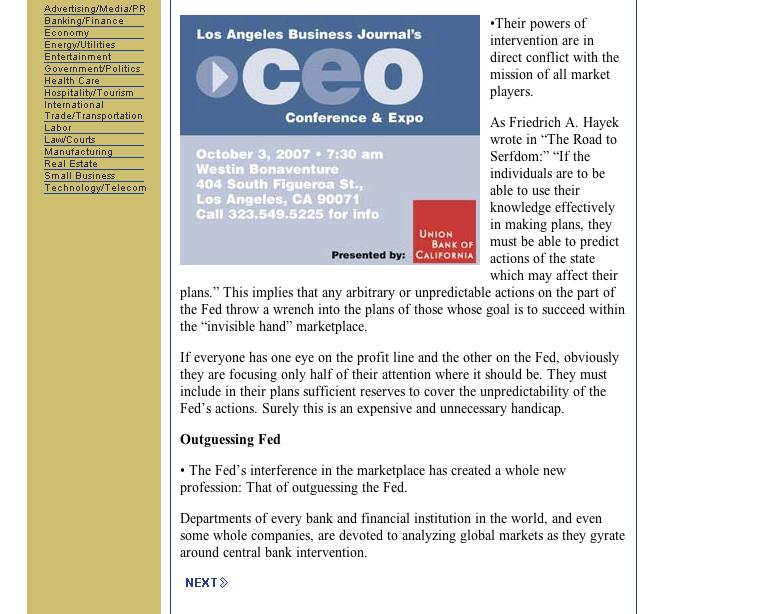
2. Their powers of intervention are in direct conflict with the mission of all market players. As Hayek said in The Road to Serfdom, "If the individuals are to be able to use their knowledge effectively in making plans, they must be able to predict actions of the state which may affect their plans." This implies that any arbitrary or unpredictable actions on the part of the Fed throw a wrench into the plans of those whose goal is to succeed within the "invisible hand" marketplace. If everyone has one eye on the profit line and the other on the Fed, obviously they are focusing only half of their attention where it should be; and they must include in their plans sufficient reserves to cover the unpredictability of the Fed's actions. Surely this is an expensive and unnecessary handicap.

3. The Fed's interference in the marketplace creates a whole new profession: That of outguessing the Fed. Every bank and financial institution in the world, and even some whole companies, are devoted to analyzing global markets as they gyrate around central bank intervention.

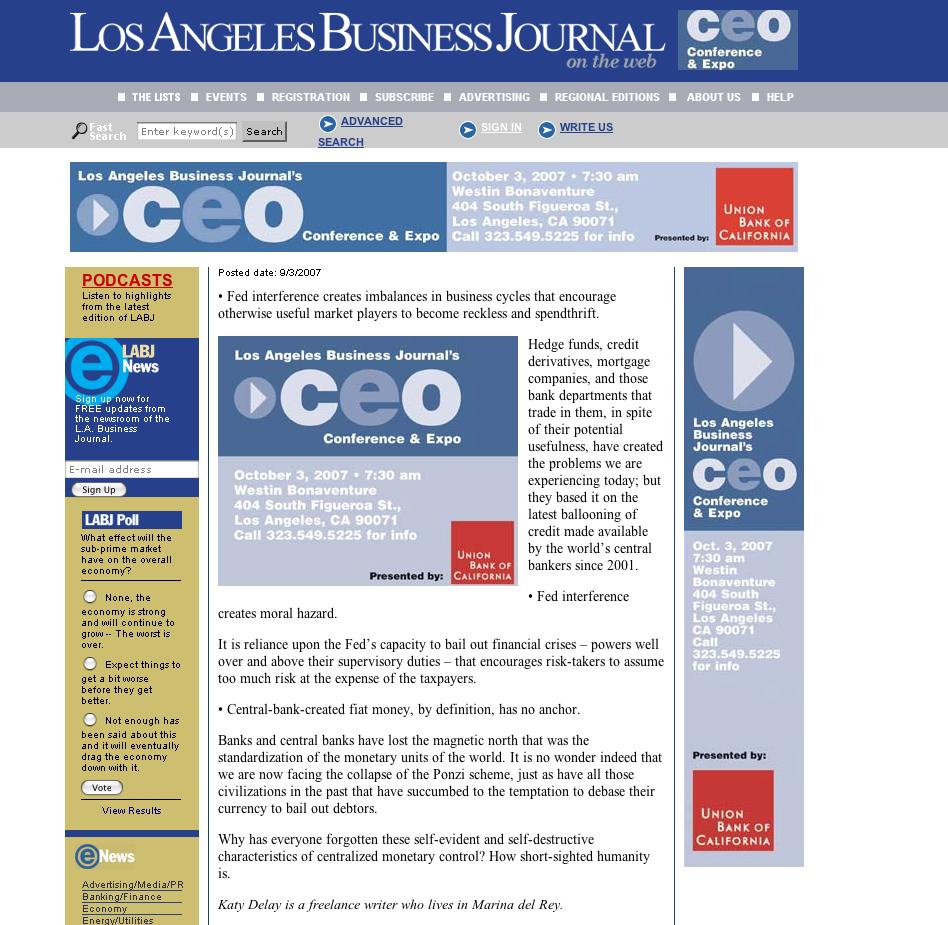
4. Fed interference creates imbalances in business cycles that encourage otherwise useful market players to become reckless and spendthrift. Hedge funds, credit derivatives, and those bank departments that trade in them have created the problems we are experiencing today, based on the latest ballooning of credit made available by the world's central bankers in 2001. Thus the Fed, with the collaboration of these risk-players, is directly responsible for the euphoria of today's boom/bust situation.

5. Fed interference creates moral hazard. It is reliance upon the Fed's capacity to bail out financial crises--powers well over and above their clearinghouse duties--that encourages risk-takers to assume too much risk at the expense of the taxpayers.

* * * * *

Why has everyone forgotten these self-evident characteristics of centralized monetary control? [Sigh]

So if we're looking for someone to hang, let's look at ourselves. We are the ones responsible for centralizing our government and allowing legislators to create and empower a Federal Reserve in the first place. Let the taxpayers pay for this one; but let them also rise up in anger against the central banks to prevent another such credit cycle.

Labels: , , , , , ,


Wednesday, February 28, 2007

Wha' Happened?

Okay, so China's stock market, being the first to wake up in the morning, started off a flame of panic across the world that ended in the West. Two things are weird about this one: (1) The cause -- or rather the match strike -- of this surprise is not readily evident, and (2) gold didn't react by moving in the opposite direction.

I guess people are so scared they think they'd better have cash for a few "seconds" until they figure out what to do next.

All of us gold bugs have been warning the world of the imbalances we perceive in the world markets but none of us can say how and when they will all unravel. Is this the beginning of the denouement? And why China?

What I see so far is this:

Greenspan
[Thanks to fiscalstudy.com for this photo of an ironically relaxed Doomsday Greenspan.]

Greenspan was giving a speech in Hong Kong. When Greenspan speaks, the East listens. Greenspan predicted an American recession by the end of the year.

No matter that his predictions have usually been wrong in the past; as usual, panics don't listen to statistics. And anyway, the underlying causes of the imbalances are what we goldies have been howling about for months and years now. (Start with my March 2005 archives and read forward.)

To run that by you again, there are two fundamental principles at work here:

1. The lack of an international hard monetary yardstick such as the gold standard; combined with
2. Human nature.

The two are a highly flammable mixture, even if they can waft together for years without a hitch as long as they don't come into contact with a match.

Out of this lethal combination come:

1. Inflating of and speculation in currencies that float (and those that don't, i.e. those that are pegged and/or otherwise manipulated);
2. Protectionism through currency manipulation;
3. Use of the money supply to ease market tensions (the Federal Reserve and other central banks do this all the time -- big mistake);
4. Lack of the discipline and will power to return strength to the monetary system once they have used it for No. 3 (the Fed governors are only human after all and hate to be the bearers of bad news);
5. Naivete of the voting public as to what is going on, which allows the power players to gamble all day long at our (the public's) expense.

Who is it that said: "The only thing we learn from history is that we don't learn from history." How many times do economies (and governments) have to tank for lack of monetary discipline?

Here is Bill Cara's article over at Seeking Alpha along these lines. I agree with him that:

"[T]he Gnomes are bulldogs, and they have put their terriers into the U.S. Fed and Treasury. I believe there will be one final attempt to print the way out of a market crash. Ergo; I see one final push in precious metal prices. But the end of the long-term global stock cycle is near. It has been driven by a credit balloon that cannot be pumped higher. The peak of the cycle would have occurred in May 2006 except for the programs of the U.S. Administration (including the Fed) to ramp up the money printing. [Katy's Caveat: I would have added the other central bankers who are playing the same game, i.e. Japan, China, et al. The Fed is not alone in this.] The sad thing is that at the end of the day, when inflated stock prices blow up, those holding debt will still be holding the same level of debt. The banks will be demanding payment. That's what bankers do -- real bankers, not trader-bankers."

Labels: , , , , ,