Thursday, April 04, 2024

US Gold Reserves - Short 20th Century history

What trajectory did the US gold reserves follow in the last century?

Below is a World Gold Council chart that might be accurate, although there is some debate today about exactly how much of the US gold reserves are accurately accounted for. Some say a portion of it is no longer there, some say that a percentage has been used in financial transactions that would involve claims to some of it. But the chart is probably not far off.

You can see that gold began leaving the country starting in the mid-1950s. By the end of that decade a few wise financial advisors were recommending investing extra savings – i.e. savings one could afford to risk – in numismatic gold and gold stocks. (It was illegal to hold gold outright.)

The reason was that the gold standard kept the official dollar price at $35, but there was so much dollar inflating going on that foreign countries were smart enough to get gold instead of holding onto dollars (which dollars had been received in payment for imports), and this was causing the unofficial market gold price in dollars to rise.

That’s why in 1971 Nixon probably looked at a similar chart and finally said stop, no more, we’re “closing the gold window.” And that’s when the dollar price took off, as wise advisors had predicted it would. More accurately, that’s when the exchange rate for dollars plummeted and price inflation in the US began to explode. (Yes, price inflation can be late to the party, but it always follows a period of monetary inflating.)

(The yellow line represents the dollar price of gold.)


Note that this chart stops in 2005. Here below is the chart from Kitco for the last three days. The dollar price is up to $2,290 as of this writing, even touching $2,304 for the first time in history. Not a bad investment, right? (But I’m not an investment advisor.)


Gold always seems to reflect the reality of the value of money, even if it no longer is officially an element of any country’s monetary standard. Who said the gold standard is dead?

Labels: , , , ,


Wednesday, February 21, 2024

What is a Flight from the Dollar?

A friend asked what a “flight from the dollar” looks like. I can certainly give my understanding expressed in easy-to-understand language.


A “flight from the dollar” happens when the citizens, or even the global financial system, rejects the dollar as a store of value. Here’s a little history to explain the context.

In the late 1800s, a dollar could be exchanged for 1/20.67 of an ounce of gold. This was the “gold standard,” whereby a dollar was “worth” (i.e. could be exchanged at any bank for) 1/20.67th of an ounce of gold. The banks accepted freely any amount of dollars in exchange for gold at that rate. The standard, as long as it remained in place and was respected, helped banks maintain a safe amount of reserves, a conservative amount of loans (made with real savings), and well-backed credit advances (i.e. credit creation based on commercial paper such as bills of lading and the like); and it kept the economy on a relatively even keel. The fact that every bank had to give out one ounce of gold for $20.67 in paper money kept them – and the dollar – honest, so to speak.

In 1913, the US created its first central bank, which became the arbiter, instead of private banks, of the amount of credit creation that would take place. The original rules applied by the central bank were pretty sound. Credit loans to banks were based only upon commercial paper. However, in the longer term the rules changed. Within a couple of years the central bank began to do what central banks have done for centuries, i.e. they began creating extra additional credit, which the government used to cover wartime and other expenses. 

The first episode of inflationary credit creation (what economist Edward C. Harwood labeled “inflationary purchasing media”) appeared during World War I. As the US central bank began to allow the expansion of credit above what was prudent (according to Harwood), the government spent it on the war effort. When the war was over, the central bank tried to contract that credit, which forced the country into something of a recession in the early 1920s. 

Then during the subsequent years Harwood noted that a lot of “inflationary purchasing media” had still not been cleared from the system, which was maintaining prices too high and encouraging bubbles in real estate (in Miami at the time), and in the stock markets. By 1928-29 he began to warn the public through articles published in financial journals that the previous monetary expansion was still in the system, which would probably end in another contraction. 

Indeed, a peak was reached in 1929. The central bank noticed the problem and tried to correct the imbalance by contracting the money supply. It was the right thing to do, because the excessive credit did indeed need to be withdrawn. Was the contraction too quick? Was the timing wrong? No one really knows, although multiple theories exist. At the same time, the government put in place some very strict trade policies that caused complications in the import-export markets, and we got the 1929 crisis, which extended several years into the 1930s.

In 1933 Roosevelt, in an attempt to save the gold standard, decided one day (literally) to force people to turn in their gold so that he could devalue the dollar down to 1/35th of an ounce. He explained that he didn’t want private “speculators” to profit from the devaluation. He also started the country on a centralizing-regulatory-socialist binge with his New Deal policies. Ownership of gold was outlawed. Much money was wasted in the various efforts, and the economy didn’t recover until the 1940s. By then the second world war was brewing. 

When the soldiers got home in 1945, they went right to work and got the place up and running pretty quickly, thereby probably absorbing the excessive credit created for the war effort. Given the difficulties experienced in the 1920s, the Western World decided that they needed to fiddle with the gold standard again. Global officials met up in Bretton Woods in New Hampshire and decided that the world would go onto a modified dollar-gold standard, i.e. the dollar would stay on the standard at 1/35th an ounce, and the rest of the world would use the dollar in international transactions. Somehow, they thought this would be better than a plain gold standard. 

This plan gave the US both a tremendous advantage and a tremendous disadvantage. The advantage is that nations needed to exchange their exports for dollars in order to do business, and some countries’ banks also bought tremendous quantities of US bonds as capital assets. Therefore the US could print just about whatever it wanted, and the dollars flowed around the world and never came home to roost. It's called “seignorage.” 

The disadvantage is that it is the equivalent of giving a credit card to a 16 year old.* 

It worked pretty well at first back in the early 1950s, but lavish money printing soon started again, creating another bout of creeping price inflation in the US. After all, it is not easy (or perhaps it’s impossible) for central bankers and politicians to determine with precision the amount of dollars that should be created and shared to maintain the Bretton Woods global monetary system. In around 1959, Harwood and others began to notice that in spite of the Bretton Woods fix at 1/35th of an ounce per dollar, the “price” of an ounce gold in dollars was increasing above $35 in certain markets. In other words, people were realizing that the dollar was losing its value. That’s when Harwood started getting people onto gold numismatic coins, gold stocks, gold “annuities,” and Swiss financial instruments, some of the very few ways to invest legally in gold and safe foreign assets.

This state of affairs lasted far longer than anyone thought possible, until 1971. France was getting wise about the loss of value of the dollar, and De Gaulle began asking for his nation’s gold at the official $35 price. Gold at $35 had become a good deal. It all came to a halt when Nixon “closed the gold window,” i.e. refused to pay out gold for dollars. (See this for a detailed explanation.) 

Since then, even though in the mid-1970s Americans could start owning gold again, the world has been on what is called a “fiat standard,” i.e. no standard at all. Over the rest of the decade, gold went from $35 to $800 in 1980, 23 times its previously fixed exchange rate. 

That’s a flight from the dollar.

Even though no longer in an official monetary role, gold still remains a good barometer of the value of currencies around the world. The dollar has continued to decline, and today the ounce of gold costs around $2,026. Yes, the gold exchange rate is “volatile.” But in fact it is not gold that is volatile. It is the paper currencies. After all, smart people watch economic policy and events, and when things start to get frisky, they start looking for ways to preserve the purchasing power of their money. The increased demand creates exaggerated swings in the “price” of gold. But in fact the one thing that remains constant is the underlying, on-average, longer-term stability of gold’s purchasing power. 

And the “price” of gold is one way you can measure the “lost value” of the dollar.
_____________________

* Today the US debt is over $34 trillion and climbing rapidly. This is WAY more than US production can sustain (about 145% of GDP). It is also especially dangerous when price inflation and cheap public borrowing sets in and when the Fed (rightfully albeit somewhat late) decides to take corrective action via higher interests rates. Over the past year or so, the yearly interest rate on the debt is now up to $500 billion, which is about 2/3 of the entire annual US military budget. (And here’s another interesting chart that I hadn’t seen before.)

Labels: , , , ,


Tuesday, December 30, 2014

The Fed's Game of Monetary Inflating and How to Put an End to It


[Thanks to Dancendancen.com for the image.]

History has shown unequivocally that you don't want to monkey with money and credit.

This is the cogent warning recently issued by Doug Noland at Prudent Bear. He is referring to the monetary shenanigans of the central banks around the world, the most egregious of which is our very own central bank, the Federal Reserve.

After more than 15 years of almost continuous and increasingly profligate money-credit creation, the Fed is now approaching the moment of truth. In the next few months it will have to put its actions where its mouth is regarding the interest rates under its control.

Up to now, Fed Chairman Janet Yellen has been very good at what we could call the Open-Market Charade. While sounding profoundly straightforward and direct, she actually has bested Alan Greenspan at the art of Fedspeak: talking in soothingly erudite phrases, all the while saying nothing in particular.

But no matter what she says now, the Fed's predicament is clear: It must soon choose between allowing the target rate to climb, which will squeeze the necks of already precarious emerging markets, or keeping the rate low and in the process risking re-devaluation of the dollar and/or blowing even more bubbles in stocks, junk bonds, global derivatives, emerging market currencies, and selected real estate.

The inflated bubbles are right in front of our noses. For example, some condos in the West Los Angeles area have now re-attained their all time highs of 2007, and bankrupt ski resort developments have pulled the shovels out of the trash heap and are at it again. And by the way, that price inflation you're looking for? It's already in the high cost of meat, sugar, poultry and eggs, which have climbed 8.3 percent this year, and in dairy that has climbed 5.6 percent. [Source] Butter has doubled since mid-2013. [Source]

The moment the Fed governors choose the former, i.e. increasing the rates, the music will stop and everyone will head for a chair. Usually in this game there is only one empty chair and hence only one loser, but this time there are far fewer chairs and far too many players. If the music stops watch carefully what will happen to countries like Argentina and Russia. Then watch what will happen to the derivatives and other more speculative markets as investors scramble for seats.

For more on the possibilities under this scenario, see this Investopedia.com article about the carry trade, also heavily involved in the derivatives market; see also this David Wessel article about a possible global financial crisis due to a rising dollar.

On the other hand, if the Fed chooses the latter route and delays rate normalization, it may succeed in holding off the moment of truth for a few more months while the music continues and stock market speculators continue their merry dance. At the same time, America's fixed-income recipients will have no choice but to reach for their handkerchiefs again to mourn a further loss of purchasing power. (Already in 2012, the SeniorsLeague.org reported that seniors have lost 34 percent of their purchasing power since 2000.)

The old and the weak are always the first losers during the exaggerated business cycles caused by fiat-money monetary interference, and Oh My, what enormous and distorted cycles they have become. (See this study from the American Institute for Economic Research on the changing nature of business cycles.) Who are the winners? Debtors, and speculators most of whom are debtors. The biggest debtors of all are governments and financial institutions-who just happen to be co-appointers of their accomplice Fed governors.

What artifice makes this game possible? It is the fiat nature of global currencies. (Read Steve Forbes's latest book for more on this.) What is the solution? We must elect politicians who will free gold from its tax shackles. What shackles?

An act of Congress in 1974 and a legal decision in 1977 already permit the holding of and transacting in gold. (See the text of the 1974 law here and a discussion of the court case permitting gold clauses in contracts.) The only thing preventing gold from playing its traditional role as money is the fact that all gold transactions are taxed, whether it be through sales taxes or capital gains taxes.

Why are they taxed? Because back in the 1970's Congress classified gold as a commodity, kind of like copper or wheat. Why did Congress do this? Because the crafty politicians knew that by doing so the commodity-taxation protocol would immediately take the gold-as-money option off the table. This is what forces us all to accept unsafe fiat "money" instead of the real thing.

Without that handicap, we would not accept it unilaterally. Remove the taxation and gold would become money again. It would find its true exchange rate relative to all currencies (which today would probably be higher than its current $1,200 an ounce). Soon enough, someone would set up a system of international exchange based on gold. The metal would find itself at the center of a new worldwide system of exchange and value storage. Such a system would be much more solid and much more widely accepted than Bitcoin or other alternatives. Call it Bitgold, maybe? And by the way, reinstatement of a proper gold standard is probably not even necessary. Let the markets work out the particulars.

This is not just fanciful thinking. States such as Arizona, Texas, and Utah are discussing the use of gold as legal tender. Highly stable gold would eventually replace highly unstable fiat money, and trillions of dollars and yen and euros, currently wasted on chasing a quick profit and fulfilling the dreams of politicians (and causing worldwide recessions), would be turned back to their rightful purposes: fomenting enterprise, creating jobs, and raising standards of living across the globe. And most important, this new gold-based monetary system would deprive our central money manipulators of the world's most corrupting, devastating, unconstitutional, and destructive monopoly power.

Labels: , , , ,


Thursday, November 07, 2013

If the Fed Won't Give Us Sound Money, Who Will?

Recently, a good friend asked me to describe the recent research on the subject of "sound money." He is referring to money that is not fiat, money that is anchored in something with real value as contrasted to market-determined value.

Historically, the last time the world had any sound money was during the reign of the gold standard. One of the gold standard's most ardent defenders was 20th century economist Edward C. Harwood, who was nicknamed the Father of the Sound Money Movement.

More recently, one of the places one needn't look for research on sound money is the Federal Reserve. My article at Seeking Alpha continues the discussion.  (Read the full article.)

Interesting images:

A gold dollar from 1888:
A gold-backed paper certificate from 1934:
Current distribution of fiat money around the world:

Labels: ,


Friday, February 18, 2011

International Money: Big-Government Solution or Trust and Honesty?

Robert Zoellick is back in the news with advice about international monetary policy. His Financial Times commentary starts out with the admission that "[n]ew agreements may be in short supply when finance ministers of the Group of 20 heading economies meet this weekend in Paris."

Paradoxically, he ends up his commentary recommending that the G7 should "issue a statement to reflect" ... the "agreement" "establishing an important norm: to maintain flexible exchange rates, without intervention, unless the group agrees special circumstances warrant action." I guess he thinks agreement is more easily reached among seven than among twenty.

As to be expected from someone who is the acting President of the World Bank Group, he recommends that an international agency, specifically the IMF, should act as a "referee, able to blow the whistle on the appropriateness of external policies" of nations, with the IMF having no power to "impose penalties." Right. That should work, just like it has in the past ... Oh, that's right, it hasn't.

But that doesn't prevent Zoellick from advising us to expand the IMF's responsibilities even more. They should also "sharpen the multilateral review" of certain policies, which review should "compare national policies with international information indicators, including commodity prices such as gold." At least he got that right.

He goes on to list a few more ideas of how a world agency such as the IMF and the WTO could, by working together, offer incentives or disincentives to world governments. I suppose two international agencies is better than one. I say, Good luck.

Much more reasonable, and much more in line with human nature, would be something more resembling what historically had worked pretty well for many decades in the free markets of 19th and 20th century Western civilization. Take, for example, the ideas offered up by Rep. Ron Paul and Lewis Lehrman in their book The Case for Gold. This book was written after the 1982 Gold Commission, which, according to some who were present, was something akin to a sham. (I'm referring to comments made by Anna J. Schwartz in 2004, set forth in the AIER book entitled Prospects for a Resumption of the Gold Standard referenced at the end of this post.)

caseforgold
[Thanks to Google, Creative Commons, for the image.]

The Case for Gold is now being re-released by Mark Calabria, Director of Financial Regulation Studies at Cato Institute. Download it for free here.

Here are a few poignant quotes from Calabria's description of the book:

"Its authors argued that while persistent and high inflation, a weak economy, and high unemployment were the direct result of misguided Keynesian policies, the answer was not monetarism. For the basis of monetarism is still allowing a government monopoly on the issue of money. We have again found ourselves in an environment where both Keynesian and monetarist policies have failed us. The necessity for alternate options is pressing."

"Paul and Lehrman remind us that when government has the ability to abuse our trust, as in the case of purchasing its own debt or debasing its currency, it will inevitably betray that trust.... The Case for Gold is the case for limited government, a case for applying the rule of law to our monetary arrangements, as opposed to the highly discretionary rule of man which now governs our monetary system. With the public's renewed interest in constitutional government, it is only fitting that such an interest extends to money."

"Paul and Lehrman remind us that the ultimate purpose of a monetary standard is not price stability, but 'trust and honesty.'"

The American Institute for Economic Research held a symposium in May of 2004 on the very subject of resumption of something resembling the gold standard. The results are set forth in one of their booklets, available here. Contributing to the conference were Lawrence H. White, Anna J. Schwartz, Gerald P. O'Driscoll, Jr., H. David Willey, Hugo Salinas Price, John C. Hathaway, Michael T. Darda, Richard Sylla, Michael W. Crook, Robert E. Wright, and John H. Wood.

Both works are an excellent read.

Labels: , , , , , , ,


Saturday, November 13, 2010

Is Gold Back?

I couldn't suppress a grin as I read the headline in Saturday's Financial Times: "In gold they rush. World economy: Bullion's sharp rise in price is prompting a rethink for the first time in four decades about whether the metal should have a monetary role, write Robin Harding, Javier Blas and Alan Beattie."

My Dad, economist Edward C. Harwood, predicted that gold would one day reassert itself in world monetary affairs, with or without the permission of the politicians. In February of 1963 he wrote this to his colleague John Exter:

ECH coin
[Photo of one-ounce gold piece
with Edward C. Harwood's profile on it.]

"Perhaps the ultimate return to the gold standard and monetary health will be a slowly progressing evolutionary type of development beginning here and there and finally accepted on a wider scale as it works in practice. It is too early to visualize details of procedures, but almost surely freedom to contract in terms of and ready availability of gold, perhaps in metric weight units for universal convenience, will be aspects of the final solution. Such are my present random thoughts."

Most economists don't know this, but a real return to gold has already happened, at least in the minds of the public. In fact, some of us never left it. My mantra has always been: You can take gold out of the standard, but you can't take the standard out of gold.

However, convincing the power brokers of its value as a barometer of monetary value will be difficult. After all, taking away the world's central bankers' raison d'etre will not be done without a fight.

The editors of the Financial Times scoffed at Zoellick's mention of gold in his recent communique to the press. Although the FT's journalists who wrote this piece today give it a more fair trial, they are still skeptical. Here are their doubts, which I will dispel for you one by one:

1. "The very extent of the rise in its price ... shows the difficulty of using gold as money. Since the turn of the millennium, ... the price of gold in dollars has risen by 498 per cent.... [In terms of the general price level, this equates to] [d]eflation of 75 per cent in a decade.... 'Gold is a very poor reference point because it fluctuates so widely' says Fred Bergsten of Washington's Peterson Institute for International Economics."

The FT and Bergsten have forgotten one important detail: Gold was the U.S. monetary standard from the 1870s until the 1970s, as it was also for other countries. When the world went off this standard, the need for banks to hold gold ceased, causing a glut of supply. Ever since, central banks and international institutions have been selling off tons at a time. Also, this coincided with a return to more conservative monetary policy during the time of Reagan and Volcker. (Note that the world's central banks have not been so stupid as to sell it all off.)

When the Fed got back into the inflating business in the 1990s, it didn't take long for the public to realize that gold had not lost its luster after all. Their increased demand started gold back up to its real value. Therefore, it is the inconsistency of central bank policy that has caused the great fluctuation in the dollar "price" of gold, not anything related to the nature of the metal itself. Gold is simply coming back into its own, and I doubt it will lose that luster anytime soon, at least in the public's eyes (and that's what really counts).

2. The authors also cite stagnant gold mining output, but their figures are misleading. First of all, remember that central banks and international institutions were net sellers of the metal until 2009 and that most of the gold in the world is stored in their vaults. Total new annual production represents only about 1.5% of total world supply. Second, world gold production has not declined as the article implies but rather will probably peak in 2010 at around 2,630 tons, according to the World Gold Council. The article cites production from only a portion of the current world sources. Third, in 2010 central banks were net buyers of gold. Increased demand will increase production.

3. The authors state that the movements of the gold price have "little connection to the price of things that people actually buy...." But no one is claiming that gold tracks the price of things. What gold tracks is the quantity of money circulating relative to the amount that should be circulating. This is what is so very valuable about gold: it actually tells us about money supply, through market sensitivity. To be fair, even the FT journalists do quote Derry Pickford of Sloane Robinson in London:

"Gold along with other asset prices can tell us if there is an erosion in the general purchasing power of money rather than jut the cost of current consumption."

4. The authors quote John Makin of the American Enterprise Institute, who complains that "Fed critics who cite the rise in the price of gold as a signal of incipient higher inflation have to acknowledge that they are in effect calling for the Fed to tighten policy." Not true, Mr. Makin. What we are calling for is that the Fed not loosen monetary policy right now, because by doing so they are going to cause a devaluation of our dollar and will very likely cause a bubble in assets and/or general prices that will come back to bite Dr. Bernanke (and the rest of us) in the backside. And according to Wal-Mart, price inflation is already happening as I write.

So don't let those gold skeptics dismiss its usefulness in future world monetary policy just yet. Harwood might be right, and before too long the world's monetary power brokers might just bring their own evolution forward as quickly as the public has done.

Labels: , ,


Saturday, July 10, 2010

Nature's Golden Standard Is Back (Whether The Macro-Managers Like It Or Not)

The news about gold swaps on the back pages of the Bank of International Settlements report made a few waves last week. Some immediately reacted in shock, claiming this is potential bad news for gold bugs because it augurs a future glut of gold supply on the market if and when the swaps fall through.

But this is not potential bad news for gold bugs, only for gold speculators. Because I am a gold bug, when I heard the news my immediate reaction was, "Hey, this is great. Some financial entity out there got so desperate that they had to use their gold as collateral. It's probably a large European bank or even a central bank, and this may not be the last time it happens. Gold is definitely coming back into style."

MomNature
[Thanks to BuyCostumes.com for the image of Mother Nature.]

A real gold bug like me believes that gold is Nature's monetary base, no matter how politico-academics try to manage their fiat (paper) money without it. The fact that central banks still store the yellow stuff is evidence in support of this, so when I learned that some important entity, perhaps even a central bank, was actually using gold as collateral in a borrowing transaction, I realized it was just more evidence in support.

Thus, in my e-mail update from Mineweb.com, I wasn't surprised to find a link to this article entitled "BIS gold swap--best news to hit gold in 30 years." Author Julian Phillips remarks:

"What is significant about this or these transactions is that gold is being used in international settlements after so many decades of being sidelined in the monetary system!"

This is surely what it looks like to me, too.

The poor speculators, however, unnerved by the slightest tidbit of information, are trying to figure out which way the gold price will move over the next few months. We gold bugs don't really care about the short run, because we know that in the long run there's too much paper money (or its equivalent) floating around, explaining gold's rise relative to a number of currencies. But contrary to us, the speculators don't see the joy here.

They think that gold is just a "hedge against future inflation." Therefore, their next question becomes: Will we get "inflation" (which to them means U.S. price increases) enough to spur the Fed to reign in the fiat dollars? The consumer and other figures suggest not. So should the gold speculators panic and sell it all?

I say that this double-dip will maintain prices, and therefore the Fed is not about to retire any fiat dollars for a while unless general prices start to rise. It would also surprise me if the Europeans manage to retire any euros, what with the PIIGS problem. So without a CPI increase does this mean we will not get "inflation" and the speculators should dump gold?

Well, that depends on how you define the word "inflation." I've been down this road before--it's one of my pet peeves--and I'll do it again by referring you to a modern web dictionary's definition of the word "inflation":

"A persistent increase in the level of consumer prices or a persistent decline in the purchasing power of money, caused by an increase in available currency and credit beyond the proportion of available goods and services."

Interesting that they used the word "or." When can one have a "persistent decline in the purchasing power of money" without an "increase in the level of consumer prices"? Simple: when credit doesn't reach consumers through an increasing paycheck, or through home equity. Where is it, then? In the pockets of speculators, corporations who don't care to invest just now (and rightly so), Wall Street, Freddie and Fannie--in fact anywhere but in the wallets of consumers.

Therefore, general prices will not rise. BUT: the price of gold will rise, because gold is Nature's golden standard, the barometer of "inflation" as defined above in italics. And this italicized inflation situation exists now and has been growing, according to my theory, since consumer prices stabilized in 2008, and perhaps even since earlier than that.

More proof that one can have a decline in the purchasing power of money at the same time as stable prices: Gold compared to the CPI basket of goods has remained stable over time, e.g. about 2.5 ounces/ basket in 2004, the same as in 1942. (Source: www.northerntrust.com/library/econ_research/daily/us/dd052605.pdf.) With the recent increase in its price relative to a number of currencies, however, gold will buy more goods now than is customary. So we have a relative "decline in the purchasing power of money" without an "increase in the level of consumer prices."

Another perspective: Purchasing power in consumer hands is being syphoned off through higher taxes, higher corporate profits (they are not spending, but they are still pricing at the same level), a stagnation of average wages or loss of jobs, and decreasing home equity.

So who is bidding up the price of gold? Anyone with savings they want to protect from further erosion of purchasing power, including many small and large investors, huge hedge funds, enormous pension funds, sovereign funds--anyone who has money to save and who realizes that the dollar and some other currencies have been "over-printed," and that the central bankers are only watching the CPI.

So if the BIS report sent chills up your speculating spine, don't worry. The macro-managers are about to mess things up good, and Mother Nature has yet to sing her last song.

Labels: ,


Friday, July 02, 2010

The Evils of Fiat Money: Voice from the Past

gold
[Thanks to the-gold-market.blogspot.com for the image.]

In doing some research I came upon the following quote:

"Whenever commodity prices are far removed from a stable relationship with the alleged gold content of the monetary unit concerned, there is something, probably more than one thing, seriously wrong. Included in the maladjustments may be extensive abuse (misuse, unwise use) of the banking system with resulting inflation, serious overexpansion of capital facilities in various lines, unwise speculation in tulip bulbs, commodities generally, Florida lots, common stocks, Canadian mining stocks, or what have you, and possibly serious distortions among wages with steel workers getting more than college professors, etc.

"How anyone can imagine that all such distortions, maladjustments, abuses, etc. can be miraculously cured by devaluation is beyond me. Devaluation simply satisfies the most ardent pressure groups for the time being and greases the skids for the next slide by gradually destroying the stable middle-class element of society; it confirms all the unwise in their unwisdom; makes unsound banking look like sound banking; and, after two or three doses, virtually assures the ultimate destruction of the monetary unit as the strengthened pressure groups demand more and more. Such, in my opinion, is the obvious lesson of history, ancient, medieval, modern, and recent. Perhaps things will some day be different, but I doubt that."

As I read this I couldn't help but think how right he was. Everything he described has come to fruition today.

The date? 1953. The writer? Edward C. Harwood, founder of the American Institute for Economic Research. Would that such wise men were still around today.

Labels: , ,


Sunday, December 20, 2009

The People's Wisdom: A New Gold Standard

In a most insightful commentary published in the Financial Times of last Wednesday, Martin Taylor, himself a former banker, quipped:

"All business people know that you can carry on for a while if you make no profits, but that if you run out of cash you are toast. Bankers, as providers of cash to others, understand this well. They just do not believe it applies to their own business."

The reason bankers have trouble judging their own cash flow, he writes, is that "[i]n general, banks have no measures of cash flow that work for banking." He describes (with a great sense of humor) how bankers got us into this Great Recession by paying out "colossal accounting profits" in cash that were "largely imaginary.... Not only has the industry--and by extension societies that depend on it--been spending money that is no longer there, it has been giving away money that it only imagined it had in the first place. Worse, it seems to want to do it all again." (He's referring to the banking bonuses, which are at a new high.)

He ends the piece perfectly:

"How depressing the shame and folly of it all is, when one considers that the system was brought down not because risk management was deficient (though it was), nor because greed was rampant (though it was), but because bankers could not count. Merry Christmas."

This really states it all in one newspaper column.

adding machine
[Thanks to Britannica.com for the image.]
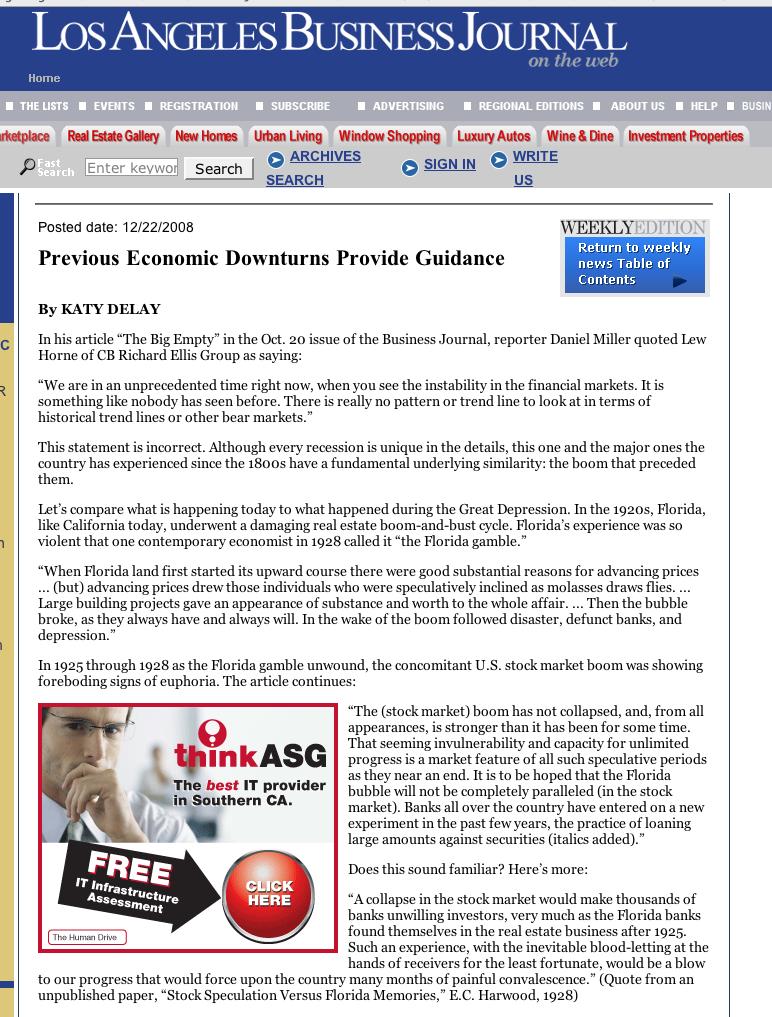
It also causes one to think: Do we really want the world's money supply punch bowl to depend upon government-employed academicians and government-fed bankers, through a government/bank monetary power hierarchy?
For that is what we have today. With the too-big-to-fail policy, we now have fewer and bigger banks than we did before the crisis, and a government that is too worried about its own survival to care what happens to us, the Forgotten Men and Women. The Fed has been pumping billions of dollars into the banks and into certain markets, like the mortgage market. By doing so, the Fed is trying to juggle the general price level, the mortgage rates, and unemployment--to wit, the whole economy.

Taylor's astute observation about bankers' inability to judge their own cash flow is key here. The observation also seems to apply just as well to Federal Reserve bankers. As long as the Fed offers the opportunity to turn short-term credit into cash, bankers apparently will take advantage of it. This is Taylor's point. No one knows how full the punch bowl really is, nor do they care.

The Fed believes that it can judge the proper amount of created cash through observation of the CPI. But bankers' pay, no matter how outrageous, will never raise the general price level. So the upside potential for this game is limitless.

As long as the Fed's generosity only extends to the small community on Wall Street, they can continue to inflate the bonus bubble at will, along with the speculative and unfair redistributive profits their actions engender. No matter what they do to the dollar, to our savings, or to our purchasing power, they can say they were "just doing their job."

How can we protect ourselves?

In another very good Financial Times article entitled "On the flip side," written by Javier Blas, these lines jumped off the page at me:

"For the first time in decades, investors are allocating a fraction of their portfolios to gold on a long-term basis. That marks a return to normality, some argue. For centuries, gold has been central to savers. 'The aberration had been the last 20-30 years in which gold moved out of most investors' portfolios,' says Mr. [Jonathan] Spall [a director at Barclays Capital in London and author of Investing in Gold: The essential safe haven investment for every portfolio.]."

Once again, we the people are smarter than the politicians or the bankers. We have taken up a kind of individual gold standard, to take the place of the one the politicians and bankers destroyed when it got in their way starting in 1933 and ending in 1971.

Gold may be only a speculative commodity to some, but to many it is still an ideal store of value and the only weapon at our disposal to combat (1) political expediency, (2) the legalized embezzlement that is monetary inflation (with or without price increases--see this post and this post for more on this detail), and (3) bankers' inability to count.

I don't believe gold has hit its high yet. Push must still come to shove if and when the general price level does start to rise. At that point, to prove their goodwill and their capacity to control prices, the Fed would have to make a show of starting to increase rates and stopping "printing money;" but at the same time, they will have their other eye on unemployment.

If unemployment doesn't start to decrease, they will see their choices as between doing nothing, thereby allowing some inflation (general price increases as measured by the CPI), or raising rates thereby stopping the employment "stimulus." My bet is they will choose some inflation, in the wild hope that unemployment figures will improve soon.

Their inaction will signal to the marketplace that they will tolerate a further devaluation of the dollar, and gold will rise up again. How far this game will go is anyone's guess.

If the CPI remains low, they can continue to "stimulate" as long as the bond market will absorb it. This is also good for gold, and for the bankers, if somewhat less so for the Chinese, Japanese, Arabs, and the others who hold US bonds.

Remember:

You can take gold out of the standard, but you can't take the standard out of gold.

Labels: , , ,


Saturday, November 14, 2009

You can take gold out of the standard, but you can't take the standard out of gold

In the latest Buttonwood post at the Economist entitled "Paper promises, golden hordes," the writer notes that gold is coming back into vogue. The price has tripled over the last six years, says another researcher, David Ranson of Wainwright Economics.

It looks like the public has decided that paper money isn't so attractive at this conjuncture, and even some central banks are thinking along those lines, to wit Russia, China, and India.

All this makes perfect sense. Gold is not only a store of value; it's a barometer for currencies.

goldbarometer

This flies in the face of a recent paper by Barry Eichengreen and Douglas Irwin, cited in the Buttonwood post. These two economists have come to the conclusion that "[d]ropping gold did work" i.e. that abandoning the gold standard has somehow shortened recessions and reduced the inclination to raise as many tariffs.

Other economists would disagree. They hold that, in fact, dropping the gold standard and instituting a process of monetary expansion through a central bank is what caused the distortions in the economy in the first place, which in turn led to the recessions and even the Great Depression itself.

I particularly love this statement: "When countries on the gold standard suffered a shock [my italics] they had to let the real economy, rather than their currencies, take the strain." Countries don't just "suffer a shock." Distortions in the economy cause shocks. And according to some economists, central bank responsibility is involved in every recession and depression since the Fed's creation. Like SUVs, economies don't just drive off the road.

We may never find ourselves back on a gold standard as that institution was understood in 1900; however, I believe the world is on a de facto gold standard, by the very nature of this unique metal. Push will come to shove soon, as the Buttonwood post explains:

"[F]oreign creditors have a right to be more suspicious of debtor countries. Even if they do not resort to outright default, they can always achieve partial default through currency depreciation.

"Indeed, the law of volatility can be invoked again. Developed-country governments have attempted to control bond yields through quantitative easing and to support stock markets through ultra-low interest rates. But they cannot support their currencies as well without risking problems in the bond and equity markets. Gold's surge may indicate that investors fear the next stage of the crisis will occur in the foreign-exchange markets."

You can bet your bottom dollar on that one. And with jawboning for China to reevaluate its currency (watch out what you wish for), Australia hiking its interest rates (twice already), and the dollar reaching new lows (how low can it go?), gold will start to look better than ever.

Labels: , , ,


Friday, June 26, 2009

Golden Hero From ... Russia?

I had to put aside my very pressing work on the biography of Edward C. Harwood to honor my subject's great respect for the gold standard and sound commercial banking, when I saw an ad on the front page of Section 2 of the Financial Times today. Unfortunately, I can't locate a link to the ad itself, but it says:

"THE FAST TRACK OUT OF THE CRISIS
The New Global Payment Unit
Troy Ounce Fine Gold 999.9
Paper money or real gold?
It's your call."

I immediately realized this was the handiwork of either a madman or a genius, or some combination of both, and so I set about finding out more about the fellow. Indeed, he is both.

He is a Russian billionaire named German Sterligov, and he has come up with a new, yet age-old idea: Using gold in international exchange transactions. He has ordered to be stamped under the label "ASCENT" (Anticrisis Settlement & Commodity Centre) 1.1 million Troy ounces of gold, acceptable at any ASCENT office worldwide in international trade deals done through his offices.

This fits in with the rest of his business, which is international barter exchange, a transaction style dear to the Russian heart according to some of the information I found on his US website.

On the European version, I found these two short videos featuring the madman-genius himself--a most intriguing character.

Interview with CNBC on June 23, 2009

Interview on Aljazzeera on May 4, 2009

I think I could grow to like the guy. He became rich in his twenties; he lost the Russian Presidential election to Putin in 2004; and now he raises goats.

goat
[Thanks to Farmtoconsumer.org for the photo.]

I assume he has squirreled his riches away somewhere (and I bet I know where that is).

I agree with everything he says about gold, its historical use, and its potential to help rectify much that ails the world today. On the other hand, I fear for his life, because for this system to become a reality, many central bankers and the politicians who use them will find the competition unbearable.

I will watch this with great interest. Mr. Sterligov, please watch your back. You are playing a game with potentially some very powerful and nasty opponents. If you have any success at all, you will soon be challenged by all the armaments the current monetary authorities and legislators of the world can summon from their reading of the law, and from their judges and alphabet hit men. After all, centralized government's very survival depends upon the powers derived from fiat paper currency.

You could use some help from some small-government politician with the foresight to see the potential of your idea to get the forgotten men and women back to center stage, someone who has the guts and the personality to seize the moment and make a run for it. More power to you and this rare politician, Mr. Sterligov.

Labels: , ,


Wednesday, June 17, 2009

Get Your Gold Right Here!

In Germany, the art of the vending machine is at the forefront of its game. See this one in Wolfsburg, where you can choose your Volkswagen:

vending
[Thanks to Jalobnik.com for the photo.]

Elsewhere, a fellow named Thomas Geissler has started a company that is installing 500 vending machines in various spots, and what do you suppose he sells?

Gold.

That's right, buyers have a choice among a 1 gram wafer for 30 euros, a 10 gram bar for 245 euros, or various gold coins.

There is a slight hitch: He has added a 30 percent mark-up to the cheapest products. Most dealers will ask only around 5 to 7 percent for bullion coins. And of course, prices are monitored and changed every few minutes.

See an article on this by Murray Wardrop at the UK Telegraph. And here's another at Reuters, and a third at Geissler's website.

Economist Edward C. Harwood introduced the notion of selling gold by the gram and potentially using it as an exchange medium back in the 1960s, and he even got his face on a one-ounce gold coin, in honor of his efforts. I don't know if he was the first; but his story is a fascinating one that I may be able to tell at some point relatively soon. I'm now working on his biography.

Meantime, I've often maintained that the gold standard can come back through various doors:

1. Official re-adoption by the politicians (but as my friend the former Columbia economics professor says, don't hold your breath);

2. Partial re-introduction, i.e. official acceptance of gold as legal tender so the public could use it as an alternative to the dollar in contracts and for repayment of debts public and private (I wouldn't hold my breath for this one either, because the politicians know how much this would limit the scope of their financial activities);

3. Demand by the public.

Now, this third avenue may just arrive in spite of a lot of skepticism. US gold coins are in short supply due to the huge demand in the US. Other countries are more aware even than we are of the importance of gold in the historical money markets. This experiment in Germany may tell us just how likely it is. If the public is willing to pay a 30 percent premium to own gold from a vending machine, then the urge to own something of value instead of fiat paper currency must be deeply ingrained indeed.

Mr. Geissler has surely thought this thing through, and has invested in some pretty heavy equipment (500 very solid machines, plus something to make the 1-ounce wafers) and security systems to see that his operation has a chance to succeed. I will be watching this one closely.

Remember my mantra:

You can take gold out of the standard, but you can't take the standard out of gold.

Labels: , , , ,


Friday, January 16, 2009

Italy Suggests Global "Legal Standard": A Viable Financial Measuring Stick?

In today's Financial Times, we find an article by Guy Dinmore entitled "Italy calls for 'legal standard' on world finance."

Italy's finance minister Giulio Tremonte thinks he can persuade the G7 to adopt a new global financial standard--"just as once there was a gold standard"--to discipline world financial markets. He thinks he has the support of France's Sarkozy and Germany's Merkel.

The idea is to bring "tighter financial regulation" through a "legal standard" that would be "the minimum basic set of rules on propriety of international activities and transparency which the whole international community is expected to respect."

Hm. Nice idea. But...

My first reminiscence was about the UN, an optimistic creation that came about in another time of abject pessimism. The second was the Bank of International Settlements, intended to regulate foreign exchange after it became apparent that the world was abandoning the gold standard. My third was the Doha round of talks, meant to free trade relations as the international community struggles with the seeming impossibility of applying free-market theory to the real world.

I stopped there. No point in prolonging the agony: These three international cooperative efforts--but not only these three--have been failures. I wonder where Italy's finance minister gets the courage to attempt another such unrealistic idea.

According to the article, he thinks that the trading nations of this world would abide by "a mix of voluntary and binding codes" that "would be closely monitored with a wide range of tools, including peer review, naming and shaming, indicators and 'black listing ... for "rogue" economies.'"

OOooooooo. These sound ree-e-e-e-eally scary (not).

The Organization for Economic Cooperation and Development is helping work out the details. They will suggest "an anti-bribery convention, principles on corporate governance including state-owned enterprises, guidelines on multinational enterprises, standards of transparency and cooperation on tax, principles on disclosure of financial information, existing G7 task force recommendations on money laundering, and standards on international property rights."

Remember, every nation would have to participate to make it work. I wonder how many legislators of participating G20 countries would tremble at the thought of being named and shamed--places like China, Russia, Argentina, ... why, even Europe and the US.

As recently as yesterday, the USA--the supposed bastion of the free market--raised the (already existent) import tariffs on French Roquefort goat cheese. (See this article in the French newspaper Le Monde.)

chevres
"What?!? Qu'est-ce que tu dis?!?"

[Thanks to Lepetitcochin.fr for this picture of their cute little French goats, admittedly from Poitou and not Roquefort.]

Did you know Americans already pay a 100% import duty on Roquefort cheese, and that it will now go up to 300%? And that you will now have to pay 100% duty on French "meat, fruits and vegetables, mushrooms, cereals, chewing gum, chocolate, chestnuts, fruit juices, mineral waters, and fat products"?

Of course, this will spark a lawsuit by the European authorities at the World Trade Organization (WTO) against the US. Their statement (my translation): "It is clear that this decision of the American administration signifies that we will have no other choice but to begin preparations to bring this matter to the WTO. Important efforts have been made to find a set of rules that could be accepted by the various parties in the current conflict. This task has now been rendered more difficult."

Oh, I forgot to tell you that the EU had previously banned US beef on the (unsubstantiated) grounds that the hormones in it are dangerous.

Just like a couple of five-year-olds.

Does Mr. Tremonti really think a "legal standard" will do the trick? I doubt it. His ideas are in a huge bag labeled "Wishful Thinking," especially when you consider that the supposedly most capitalist countries of them all can't even stop bickering about beef and cheese (never mind get rid of subsidies of American sugar, rice, et al., or agree to abide by some vague and relative international financial "legal standard").

The irony is that the international community is passing by the very thing that has any chance in hell of carrying some weight: The gold standard itself, or some modern form of it designed to avoid the pitfalls that caused its demise in 1971.

The gold standard, as contrasted to a "legal standard," is tangible, physical, and precise. It is literally measurable, not just approximate. It is based upon something with a specific density, weight, and chemical composition, whereas a legal standard is based upon morality; and everyone knows that morality is relative when it comes to politics.

That the world might obey such a solid, modernized gold standard is perhaps also a pipe dream. I'm not saying that it would not need legal backing; quite the contrary. It will indeed need sharp judicial teeth. But those teeth would at least have a solid-gold jawbone as a foundation, and not just international good will, which would be a standard with about as many rotten holes as Roquefort cheese.

Labels: , , , , ,


Sunday, November 16, 2008

Gold Standard Talk Again

gold
[Thanks to www.australianminesatlas.gov.au for the image.]

Here's another mention of the gold standard. Doug Noland over at Prudent Bear points out this article by Judy Shelton appearing in the Wall Street Journal Saturday.

The pertinent paragraph:

"... [I]f anyone has demonstrated irresponsibility, it is not those who chased misleading price signals in pursuit of false profits -- but rather global authorities who have failed to provide an appropriate international monetary system to serve the needs of honest entrepreneurs in an open world economy.... [T]he inflationary pressures which caused us to go off the gold standard in the first place have only worsened. Moreover, [Paul Volcker] suggests, floating rates undermine the fundamental tenets of comparative advantage.

"[quoting Volcker:] 'What can an exchange rate really mean,' he wrote in 'Changing Fortunes' (1992), 'in terms of everything a textbook teaches about rational economic decision making, when it changes by 30% or more in the space of 12 months only to reverse itself? What kind of signals does that send about where a businessman should intelligently invest his capital for long-term profitability? In the grand scheme of economic life first described by Adam Smith, in which nations like individuals should concentrate on the things they do best, how can anyone decide which country produces what most efficiently when the prices change so fast? The answer, to me, must be that such large swings are a symptom of a system in disarray.'"

Now, if the G20 read this on Saturday morning, they had some food for thought.

Don't get your hopes up, however. Politicians get too much bang for their fiat-currency buck to give it up. A standard somehow set to gold would tie their hands behind their back.

Even if they want to get back to some kind of standard, the present will not be the time to instigate it. Monetary authorities are now pumping as much liquidity and capital as they can into the system, and a standard would put a gold wrench into the works.

We are now on a path where there can be only one of two outcomes:

- Either we inflate out way out of this crisis and we manage to get back to a semblance of calm, at which time the authorities will have to mop up all that excess liquidity or watch it turn into another global bubble that will last who-knows-how-long until another crisis occurs;

- Or there will be a general flight from all fiat currencies to gold, because either panic or renewed inflation settles in. Gold will explode in exchange value in all currencies, eventually to settle at some amount that will represent the market's evaluation of each currency's real gold-exchange worth.

In other words and in my opinion, if we want to stabilize economies in the future, we will have to get back to gold either by the door or by the window, as the French say.

Mr. Volcker will probably be Obama's adviser. What will he suggest? Wouldn't it be ironic if the resolution of our monetary madness came from the big-government left.

Shelton wrote "Money Meltdown: Restoring Order to the Global Currency System." See more on this book at Amazon.

See also this article at the American Institute for Economic Research, and this AIER book on the prospects for a resumption of the gold standard and what it would take; plus this book on gold's role in history.

Labels: , , , ,


Friday, November 14, 2008

Talk About A Gold Standard? Naaahhhh.....

Oh yes there is.

Cup
[Thanks to www.babycup.com for this photo of a 14 carat gold cup.]

My friend Walker Todd, former collaborator at the Federal Reserve Banks of New York and Cleveland and now a researcher at the American Institute for Economic Research is talking about it loud and clear.

Read his piece at the Christian Science Monitor.

I mentioned another gold standard proponent Larry H. White in the past, and I write a lot about the gold standard and also here, and you'll remember my mantra:

"You can take gold out of the standard, but you can't take the standard out of gold."

I really believe it.

Too bad there's little chance of it happening.

Labels: , , , ,


Saturday, August 30, 2008

1912 Gold Clause Sustained!

In the early part of the last century, it was common for people to make contracts based upon payment in gold or its equivalent. At the time, the dollar was standardized as a certain weight of gold: $20.67 equaled one ounce of the yellow metal.

The US went off the gold standard during the 20th century, even going so far as to outlaw the possession of the gold coins that used to circulate. Today, it is legal to hold gold and coins, but it is highly unusual to find a gold clause in any contract.

However, there are exceptions it seems. One such exception is a still-valid 1912 lease for a building in Cleveland.

BXP44791
[thanks to matcmadison.edu for the image.]

The rent was the equivalent of $35,000 in 1912. Believe it or not, the lessee was still paying only $35,000 today, pursuant to his interpretation of the lease. Inflation clauses were unknown in those days.

Now you and I know that $35,000 in 1912 is quite a different sum of buying power than $35,000 today. This interpretation of the lease was highly detrimental to the landlord.

But the landlord, dumb like a fox, found a clause in the lease that said that the rent was payable in gold or gold equivalent, which back then was--let's see, $35,000 would have been 1,693.28 ounces of gold (1 oz = $20.67).

According to this article at Yahoo Finance (thanks to GATA and Walker Todd for bringing it to my attention), the landlord is right. Any such gold clause is still enforceable. The lessee is now obligated to pay 1,693.28 ounces of gold (or its equivalent in dollars), instead of the $35,000 annual rent they had been paying. That's around $1,440,000 a year, "only" 41 times more than they were paying up to now. Ouch.

This sounds like a nightmare for the lessee, a windfall for the lessor (or justice, depending on your experience with landlords), and an amusing anecdote for the casual newspaper reader. But in fact, this court decision is very important.

If it is possible today to use gold as payment in contracts, I can see no reason, other than government fiat, why a court couldn't declare the government's monopoly on legal tender to be unconstitutional and allow gold to reclaim a more prominent role in our monetary affairs.

I won't go into the details about "legal tender" here, because (1) I haven't fully researched it myself, and (2) any discussion would likely contain a lot of legaleze and boring details.

Suffice it to say that this gives me hope for the future. If enough people of the world still retain gold as their personal monetary standard--and I'm convinced they do (remember my mantra), in spite of the fact that their government has forsaken it--they will need a way to assert their right to a stable currency. This might be an avenue for activists to pursue.

On the other hand, this decision is at the level of the 6th Circuit Court of Appeals. There are a few more steps the lessee can take to appeal this decision; and it may go all the way to the Supreme Court, if that court will take it on.

Now this one would be the hearing of the monetary century.

Oh, to remind you of my mantra: You can take gold out of the standard, but you can't take the standard out of gold.

Labels: , , , ,


Tuesday, February 26, 2008

The Resurrection: Lawrence H. White Defends the Gold Standard

It's time to break out my mantra again:

You can take gold out of the standard, but you can't take the standard out of gold.

How many times will I say this before the world hears me? Probably many, many more, if ever.

Finally, someone in the mainstream economic community has taken up the cry to resurrect the gold standard.

LazarusResurrection
[Thanks to Allposter.com for the image of Caravaggio's Resurrection of Lazarus.]

Lawrence H. White, Adjunct Scholar at Cato, has just published this paper on gold and the gold standard.

I have written so much on this subject that I would be repeating previous posts to delve into the reasons why I support gold as a standard for modern monetary units. If you use the search feature above and look on this blog for "gold standard" or just "gold," you'll find dozens.

Please read Professor White's paper. An understanding of the principles he evokes is essential for the future economic stability of the world. And that's not an overstatement.

Will the politicians and power brokers take heed of the message? I don't think so; at least not yet. But they may be obligated to do so at some point if the public insists enough.

The history of gold is undeniable, and its future role--indeed its present role, albeit an unrecognized one--is just as undeniable. It's not because the monetary authorities have decided to uncouple gold from our currency, that gold does not retain its value as a measuring stick of their management shortcomings.

Gold is near an all-time high today. Many people in the world think as I do, that we humans need a measuring stick to manage out monetary unit. Until our leaders recognize this, expect gold to be the best store of value and to come back into favor as the currencies of the world are devalued through mismanagement.

Unfortunately, nothing in our modern age allows us to do better than the Romans or Greeks, or Medieval or Renaissance governments. Not the computers, not the modeling, not the statistics, none of it. Gold is on the level of the invisible hand. It is just there and will always be there to shine a light on our politicians' hubris.

Labels: , , , , , , ,


Thursday, January 03, 2008

Gold: Not Such a Barbarous Relic After All

Anyone who has read my posts for a while knows what I think about gold, for example here, here, and here for the three most recent examples.

gold
[Thanks to Kitco.com for the snapshot of gold's rise to $868 today. Click on the image for a larger version.]

I guess I'll once again give you my mantra, because it always bears repeating:

You can take the gold out of the standard, but you can't take the standard out of gold.

For the uninitiated, let me explain. For several centuries, your money was closely linked to gold, and governments helped to maintain its exchange value. Today, this is no longer the case, and your dollars and your pounds and your euros, yen, or whatever, are floating on an international exchange market with nothing to tie them to anything of value except market competition.

As an aside, economic theory states that markets should be free to determine the value of things; but economists make a huge mistake when they proclaim that money is such a thing, a commodity that will be controlled by a market.

Money is not a thing of relative value. It is an intangible, a kind of contract, a promise to pay; and a promise to pay is no longer a promise if its value is allowed to fluctuate or fade away. It's the equivalent of saying that the length of an inch is determined by the market. This is nonsense. But I digress; I will discuss this idea in some other post.

Today, I'm watching the Kitco gold price reach, maintain and beat its last all-time nominal record of $850. As I do so, I can't help but remember Keynes's famous quip about the gold standard being a "barbarous relic." I looked up the exact phrase in a search engine, and I fell upon this great piece by James Turk. It's about the role of gold, the "relic" quip, and the future of the dollar.

Turk makes one of the best cases I've ever seen for allowing gold back into some role as currency, if only as a parallel means of exchange to the fiat ones we have at our disposal presently.

He worries me, however.

His ideas are right on. He points out that it was the gold standard, and not gold itself, that was the true object of Keynes's scorn; and he correctly blames the central banks of the world for our current financial turmoil, because of their --most hypocritical-- intervention in the money markets in a futile effort to control prices and the economy.

The fact that they cannot succeed at this mission, for reasons I have mentioned here, seems not to concern them; nor does their role in assuring that the dollar will follow all its fiat predecessors down the drain of monetary history. Perhaps they console themselves with the idea that the dollar will not be alone.

But Turk worries me not because I think he's wrong; he worries me because I think he's right, and because his wonderful idea of using gold as a means of exchange and as currency (i.e. as legal tender, although he seems to be carefully avoiding that expression), could get him into trouble. Why? Because he is striking too close to home: He is jeopardizing the very existence of the central banks.

Merely reinstating gold as legal tender (see his website) would go a very long way to solve many of the monetary problems we have run into of late--things like the current account deficit, the government's own budget deficit, and the waste and damages incurred by currency and asset price speculation of the kind that got us into the housing and credit market messes.

Personally I think simply allowing gold use as payment of debts public and private would demonstrate to an important minority of the world's population (i.e. the balance-of-power minority) that gold works better than paper money, and after an initial adjustment period, it might even displace our fiat currencies.

But it would also make clear to everyone just how much governments and speculators profit from the fiat currency machine, and governments don't like to be caught doing that. Look what happened to Bernard von NotHaus and his Liberty Dollar?

Mr. Turk, keep your eyes and ears open for the guys and gals in those somber jackets with the lettering on the back. The central establishment is not going to like you if it turns out your predictions about the dollar are correct.

As to where gold is headed, we must look at the inflation-adjusted charts for the real gold price over the years. In 1980, gold hit $850. In today's dollars that is something like $2,100. (See the chart here, and another one here.)

We are nowhere near the 1980 gold peak (or the dollar trough, if you prefer), because back then the 1970s inflationary crisis and abandonment of the gold standard had an explosive effect on the speculative price of the metal (and/or on the speculative loss of value of the then dollar).

What we might call the "real price of gold" (i.e. the real gold value of the dollar), once all is said and done, will probably be, grosso modo, (1) something between $600 and $1,000, assuming the dollar retains its reserve currency status. This, however, is becoming less and less of a sure thing.

If the dollar loses that status, then (2) the real value of the dollar will likely be somewhere between $1,500 and $3,000 an ounce of gold, at present gold supplies. (For an explanation of these figures, see the fascinating booklet entitled "Prospects for a Resumption of the Gold Standard," a collection of essays from a conference at the American Institute for Economic Research in 2004.)

Labels: , , , ,


Wednesday, February 28, 2007

Wha' Happened?

Okay, so China's stock market, being the first to wake up in the morning, started off a flame of panic across the world that ended in the West. Two things are weird about this one: (1) The cause -- or rather the match strike -- of this surprise is not readily evident, and (2) gold didn't react by moving in the opposite direction.

I guess people are so scared they think they'd better have cash for a few "seconds" until they figure out what to do next.

All of us gold bugs have been warning the world of the imbalances we perceive in the world markets but none of us can say how and when they will all unravel. Is this the beginning of the denouement? And why China?

What I see so far is this:

Greenspan
[Thanks to fiscalstudy.com for this photo of an ironically relaxed Doomsday Greenspan.]

Greenspan was giving a speech in Hong Kong. When Greenspan speaks, the East listens. Greenspan predicted an American recession by the end of the year.

No matter that his predictions have usually been wrong in the past; as usual, panics don't listen to statistics. And anyway, the underlying causes of the imbalances are what we goldies have been howling about for months and years now. (Start with my March 2005 archives and read forward.)

To run that by you again, there are two fundamental principles at work here:

1. The lack of an international hard monetary yardstick such as the gold standard; combined with
2. Human nature.

The two are a highly flammable mixture, even if they can waft together for years without a hitch as long as they don't come into contact with a match.

Out of this lethal combination come:

1. Inflating of and speculation in currencies that float (and those that don't, i.e. those that are pegged and/or otherwise manipulated);
2. Protectionism through currency manipulation;
3. Use of the money supply to ease market tensions (the Federal Reserve and other central banks do this all the time -- big mistake);
4. Lack of the discipline and will power to return strength to the monetary system once they have used it for No. 3 (the Fed governors are only human after all and hate to be the bearers of bad news);
5. Naivete of the voting public as to what is going on, which allows the power players to gamble all day long at our (the public's) expense.

Who is it that said: "The only thing we learn from history is that we don't learn from history." How many times do economies (and governments) have to tank for lack of monetary discipline?

Here is Bill Cara's article over at Seeking Alpha along these lines. I agree with him that:

"[T]he Gnomes are bulldogs, and they have put their terriers into the U.S. Fed and Treasury. I believe there will be one final attempt to print the way out of a market crash. Ergo; I see one final push in precious metal prices. But the end of the long-term global stock cycle is near. It has been driven by a credit balloon that cannot be pumped higher. The peak of the cycle would have occurred in May 2006 except for the programs of the U.S. Administration (including the Fed) to ramp up the money printing. [Katy's Caveat: I would have added the other central bankers who are playing the same game, i.e. Japan, China, et al. The Fed is not alone in this.] The sad thing is that at the end of the day, when inflated stock prices blow up, those holding debt will still be holding the same level of debt. The banks will be demanding payment. That's what bankers do -- real bankers, not trader-bankers."

Labels: , , , , ,


Thursday, February 22, 2007

Finally Heads Are Falling

Bobby Mehta's head is maybe only one of the first to go. He is responsible for the heavy subprime portfolio at Household International, now owned by HSBC Holdings, one of the biggest banks of the world.

guillotine
[Thanks to livefromtheguillotine.typepad.com for the image.]

Bloomberg's Jon Menon and Ben Livesey tell us about this shake-up.

According to the article, another company, New Century, "expects a fourth-quarter loss in part because of new-loan defaults." Their stock declined 58% from a year ago. Other similar companies have also felt the squeeze and have lost stock value.

I like the fact that the authors threw in this little line in the middle of nowhere:

"The U.S. Federal Reserve raised its benchmark rate to 5.25 percent last year from 1 percent in 2004."

They are right. This is a crucial piece of this whole housing bubble puzzle, and not for the reason you would think. You're probably thinking that, without that rise in interest rates, borrowers would not be in such a fix today. But the truth of the matter is that, without the Fed's past extremely loose monetary policy, those borrowers would never have been able to borrow in the first place, in my opinion.

I will even go so far as to say that the Fed didn't have to lower interest rates at all in 2001, that all that was really needed was reassurance, i.e. jawboning. The country might have tuckered under for a few months, but we would have come back out. There is too much momentum in this country to let ourselves be cowed by an event like 9/11. The US economy is a freight train with no brakes.

Just look at New York real estate. It began its upward climb immediately without too much long-term incentive offering from sellers and landlords.

That Fed dip down to 1 percent -- plus the Japanese and Chinese manipulations along the same lines -- these are the actions at the origin of all our problems.

What would have avoided this whole thing? A gold standard, or something like it.

I guess it's time to pull out the old mantra:

You can take the gold out of the standard, but you can't take the standard out of gold.

(For more reading on the subject of the gold standard, see my previous posts, especially this one.)

Labels: , , ,