Monday, January 27, 2014

Why We Are Not Seeing Price Inflation

The Keynesians are saying that price inflation is not a problem and probably won't arrive. The Austrians and others are saying that price inflation must come at some point, given all the monetary stimulus introduced by the Fed. But could they both be wrong?

I hypothesize that price inflation is already here. Please read my argument at this Seeking Alpha article.

Now you see it, now you don't.

Screen shot of the French movie "The Magician"
by George Melies, 1898, from Wikipedia Commons

Labels: , , , ,


Tuesday, October 29, 2013

Short Biography of Edward C. Harwood Now Available

I am happy to announce that my biographical sketch of economist, investment advisor, and philosopher Edward C. Harwood is now available.  For the print/hard copy, please click on the following link:


If you prefer the Kindle/digital edition, please click on this link:


For those of you receiving this via an RSS feed, please go to the following Amazon page:

Amazon Link

Labels: ,


Tuesday, September 03, 2013

Is Freedom of Speech in Danger in the USA?

Economics is very closely related to public policy.  Freedom, as protected by our Constitution, is an essential ingredient of our high standard of living in America, and it is a sine qua non of all scientific research.

These are some of the scientific findings of economist Edward C. Harwood [1900-1980].

While building up one of the first think tanks in the U.S. (the American Institute for Economic Research), Harwood spent his whole life fighting "peanut authority."  This is the misplaced zeal of those in positions of power who believe they can force you to live a better life than you would choose for yourself.

One of the freedoms he particularly enjoyed–and had to defend with the most energy–was freedom of speech.  He went to great lengths on numerous occasions to preserve his own, and therefore ours.

And there is no rest for the weary.  Nothing should be taken for granted.  Our freedoms are constantly under siege.  For example, I have just read this article in Business Insider.

Apparently, the NSA tried to censor the sale of a T-shirt mocking the NSA.  Their justification for it was the unauthorized use of their official seal.

If you want to buy this T-shirt, go here.  It was created by Dan McCall's group at Libertymaniacs.com.  Kudos to Dan McCall.  Even if you don't agree with his sentiments, you must defend his right to express himself.

This subject ties in with the recently divulged information that anyone who makes a point of defending liberty and the Founding Fathers could now possibly be included on a list of potential terrorists, according to FEMA training manuals and training videos found through the Freedom of Information Act and otherwise.  (Here's a sampling if you don't believe this.)

The study of economics is useless without freedom. Economists: keep this in mind as you go about your business.  Be very careful what someone might want to do with what you say and write.  Don't just assume that your work will be taken at face value.  And defend freedom at every opportunity, because (1) people forget how very fragile it is, (2) the quality of your own current and future product will depend upon having it, and (3) the future of this country will hang on what we all do, or don't do, in its defense.

Labels: , , ,


Tuesday, July 10, 2012

Coming Soon: A Short Biography of Edward C. Harwood

If all goes well, I will soon be advertising a new book. The manuscript is off to the publisher, and my hopes are that it will be out by Christmas.

Edward C. Harwood was not just my father, he was also a patriot, a proud defender of liberty, and great thinker in economics. Put all these things together, and you have a great story.

He was born in 1900 and lived through World War I, the Great Depression, World War II, the 1950s boom, and the 1970s dollar crisis. Starting in the 1950s, he steered quite a number of people through some murky and troubled financial waters. The ramifications of what he learned through it all are pertinent to today's crisis.

Stay tuned for further news.

Labels:


Friday, August 05, 2011

Trying to Get My Funny Back

This wonderful piece over at TheOnion.com made me laugh out loud for the first time in months. It also made me realize that I have completely lost my sense of humor.

clown
[Thanks to Artfire.com for the photo.]

Does anyone else notice the vitriol that is beginning to seep out from under the covers of some very good intentions? Have you, like me, begun to feel a twinge of resentment for one or more of your fellow Americans? Perhaps your neighbor, the nice one who asks you to water her flowers when she's away, recently made a nasty comment about someone or something on your political side of the fence, and for the first time ever you thought to yourself, "What an idiot"? (You can assuage your bad conscience with the likelihood that she feels the same way about you.)

Maybe you were playing tennis with the usual crowd, and someone who used to be lighthearted pipes up, all irritated, about how stupid the "socialist Democrats" are, or how scary "those crazy Tea Party Republicans" can be? Does this sound familiar, my friend?

Are you, like me, wondering why bands of youths are beginning to create havoc in public gatherings, seemingly just for the fun of it?

Well, I've noticed these changes; so I've stopped to ponder and I've found that it's no wonder that we've all gone sour:

-- Our Congress just proved to us once more that it is composed of complete nitwits (with a few exceptions) who are ready to sneak around important issues rather than face them head-on and deal with them. How did this happen? Or more appropriately, why did we entrust these professional politicians with such serious issues? The answer lies beyond my comprehension.

-- Our savings account interest is plunging lower than ever. Jokingly, I say to myself, "Maybe soon our banks will start asking fees just for stocking our cash...." Wait! They already have!

-- The stock market is crashing again, most likely due to poor economic growth and bad employment figures mixed in with serious European banking woes. It looks like we're headed for a double-dip, just like in 1933. And we thought things were bad already.

-- We've got another whole year to go before we find out who will run the country, what our tax structure will be, what the debt situation will look like, whether the euro will still exist--heck, even whether the dollar will still exist!--and whether businesses can start investing again or not.

-- News is seeping out that S&P just might downgrade the US after all. (Correction: It just did.)


This country has never been so divided since the Civil War. I have lost my sense of humor because there is little to laugh about these days. Our federal and state governments have managed to ensconce themselves into every facet of our lives and, in the process, have split this country right down the middle. Are they dividing us, the better to conquer us?

But, remember: They are only doing what comes naturally. We are the true guilty party. Politicians crave power, and somehow we let them have it. Now we must reverse this process, and it is going to be very, very painful--not a laughing matter at all.

Over the past six years, I have written thousands of words about the value of gold as a measure of the value of currencies, and I am convinced more than ever of the soundness of my analysis. Gold, at well over $1,650 an ounce, is proving to be the best thermometer of monetary mischief, even better than "the Almighty Rational Market" (the stock market, that is) that tends to be about as rational as a Las Vegas gambler.

[Aside: Oh all right, perhaps it's rational over a period of 200 years, but who lives that long? In the end, the success of the theory in any particular case depends on the prices at which you got in, and whether or not you actually reinvested those dividends like you were supposed to.]

In my book, the current gold rush has been the only rational part of today's crisis. And it was predictable (and in fact predicted) since the 1990s when the Federal Reserve began manipulating the interest rates downward and trying to tinker with the U.S. economy (again).

Even as long ago as the 1970s, a few common-sense economists warned us about the approach of the problems through which we are living today (example: Edward C. Harwood in The Money Mirage and elsewhere). Why so few people heeded them, and why even fewer are turning to their research today, is a mystery that's--well, it would be funny if it weren't so tragic.

(If you didn't click on TheOnion.com link, do so now. The chuckles'll do your sad heart some good.)

Labels: , , ,


Thursday, January 20, 2011

The "Swindlers' Encouragement Commission" Strikes Again

Today brought a warm rush of joy to my heart when I read Jonathan Macey's commentary in the Wall Street Journal about the "SEC's Facebook Fiasco."

This government agency has been on my mind quite a bit recently, because I'm writing the biography of my father, economist and investment adviser Edward C. Harwood, who spent five of the last seven years of his life fighting the Commission back in the 1970s.

Harwood gave this grave-faced government body the nickname "Swindler's Encouragement Commission," due to the fact that the public thinks the SEC is protecting them from evil people but in reality, as we have seen most recently from the Madoff case, it is not.

My Dad won, in effect, his case against the Commission. In the end, the SEC had to back down from its claims. This is rare: usually the very rumor of the agency's presence in the room is enough to cause most investment advisers to turn to dust. The business is built, after all, upon reputation. Once that's gone, it's over, at least for most people.

Not for my Dad. He stood up to the SEC challenges, and alongside him, believe it or not, were his very courageous investors. Together, with Judge Gerhard Gesell's help, they proved that a contract is worth more than the paper it's written on--at least back then.

My version of the story will come out, for those who are interested, within the next few months. I'll keep you posted. Meantime, may the gods smile upon brave souls like Jonathan Macey who have the courage to tell the SEC like it is.

Here are a few excerpts:

"...[T]he commission's rules regarding stock sales are crippling for U.S. investors."

"Thank to SEC regulation and the litigious atmosphere it fosters--not to mention Sarbanes-Oxley's onerous burdens on corporate executives--the whole capital formation process is moving offshore."

"The SEC's fundamental approach to regulation involves depriving investors of opportunities in order to protect them." [Oh, how this rings true. But it lost one of those battles in 1978.]

"... [A]ccording to the SEC, all investors large and small must be protected against the danger that they will succumb to a feeding frenzy of enthusiasm when given the opportunity to invest in a new deal. For example, the SEC rules governing the Facebook offering until Goldman pulled the plug include the requirement that the stock being sold 'cannot be the subject of advertising, general promotional seminars or public meetings in connection with the offering.' The concern here is that publicity about a deal might, heaven forbid, create interest among investors."

Read the whole commentary (subscription required). It's really a hoot, and right on target.

My father would be pleased to see that there are those who follow in his faded but indelible footsteps.

Labels: , ,


Saturday, November 13, 2010

Is Gold Back?

I couldn't suppress a grin as I read the headline in Saturday's Financial Times: "In gold they rush. World economy: Bullion's sharp rise in price is prompting a rethink for the first time in four decades about whether the metal should have a monetary role, write Robin Harding, Javier Blas and Alan Beattie."

My Dad, economist Edward C. Harwood, predicted that gold would one day reassert itself in world monetary affairs, with or without the permission of the politicians. In February of 1963 he wrote this to his colleague John Exter:

ECH coin
[Photo of one-ounce gold piece
with Edward C. Harwood's profile on it.]

"Perhaps the ultimate return to the gold standard and monetary health will be a slowly progressing evolutionary type of development beginning here and there and finally accepted on a wider scale as it works in practice. It is too early to visualize details of procedures, but almost surely freedom to contract in terms of and ready availability of gold, perhaps in metric weight units for universal convenience, will be aspects of the final solution. Such are my present random thoughts."

Most economists don't know this, but a real return to gold has already happened, at least in the minds of the public. In fact, some of us never left it. My mantra has always been: You can take gold out of the standard, but you can't take the standard out of gold.

However, convincing the power brokers of its value as a barometer of monetary value will be difficult. After all, taking away the world's central bankers' raison d'etre will not be done without a fight.

The editors of the Financial Times scoffed at Zoellick's mention of gold in his recent communique to the press. Although the FT's journalists who wrote this piece today give it a more fair trial, they are still skeptical. Here are their doubts, which I will dispel for you one by one:

1. "The very extent of the rise in its price ... shows the difficulty of using gold as money. Since the turn of the millennium, ... the price of gold in dollars has risen by 498 per cent.... [In terms of the general price level, this equates to] [d]eflation of 75 per cent in a decade.... 'Gold is a very poor reference point because it fluctuates so widely' says Fred Bergsten of Washington's Peterson Institute for International Economics."

The FT and Bergsten have forgotten one important detail: Gold was the U.S. monetary standard from the 1870s until the 1970s, as it was also for other countries. When the world went off this standard, the need for banks to hold gold ceased, causing a glut of supply. Ever since, central banks and international institutions have been selling off tons at a time. Also, this coincided with a return to more conservative monetary policy during the time of Reagan and Volcker. (Note that the world's central banks have not been so stupid as to sell it all off.)

When the Fed got back into the inflating business in the 1990s, it didn't take long for the public to realize that gold had not lost its luster after all. Their increased demand started gold back up to its real value. Therefore, it is the inconsistency of central bank policy that has caused the great fluctuation in the dollar "price" of gold, not anything related to the nature of the metal itself. Gold is simply coming back into its own, and I doubt it will lose that luster anytime soon, at least in the public's eyes (and that's what really counts).

2. The authors also cite stagnant gold mining output, but their figures are misleading. First of all, remember that central banks and international institutions were net sellers of the metal until 2009 and that most of the gold in the world is stored in their vaults. Total new annual production represents only about 1.5% of total world supply. Second, world gold production has not declined as the article implies but rather will probably peak in 2010 at around 2,630 tons, according to the World Gold Council. The article cites production from only a portion of the current world sources. Third, in 2010 central banks were net buyers of gold. Increased demand will increase production.

3. The authors state that the movements of the gold price have "little connection to the price of things that people actually buy...." But no one is claiming that gold tracks the price of things. What gold tracks is the quantity of money circulating relative to the amount that should be circulating. This is what is so very valuable about gold: it actually tells us about money supply, through market sensitivity. To be fair, even the FT journalists do quote Derry Pickford of Sloane Robinson in London:

"Gold along with other asset prices can tell us if there is an erosion in the general purchasing power of money rather than jut the cost of current consumption."

4. The authors quote John Makin of the American Enterprise Institute, who complains that "Fed critics who cite the rise in the price of gold as a signal of incipient higher inflation have to acknowledge that they are in effect calling for the Fed to tighten policy." Not true, Mr. Makin. What we are calling for is that the Fed not loosen monetary policy right now, because by doing so they are going to cause a devaluation of our dollar and will very likely cause a bubble in assets and/or general prices that will come back to bite Dr. Bernanke (and the rest of us) in the backside. And according to Wal-Mart, price inflation is already happening as I write.

So don't let those gold skeptics dismiss its usefulness in future world monetary policy just yet. Harwood might be right, and before too long the world's monetary power brokers might just bring their own evolution forward as quickly as the public has done.

Labels: , ,


Friday, September 24, 2010

The Macro Forces Behind the Markets

Today's Wall Street Journal brings us this front-page headline:

"'Macro' Forces in Market Confound Stock Pickers" -- Tom Lauricella and Gregory Zuckerman (9/24/2010)

wave
[Thanks to Wikipedia Commons for Hokusai Kashushika's "Kanagawa", Big Wave]

Well, I have news for you: Macro Forces have been confounding American investors for the last century, in fact ever since Congress created the central bank.

The article states that "macro forces began moving stocks in a big way during the 2008 financial crisis...." I disagree. Macro forces have affected markets since the central bank starting making credit expansion a national and international issue, instead of the much more manageable local-bank issue it was at the turn of the 19th century.

The article states that one modern-day stock picker, John Burbank of Passport Capital LLC, "compares investing in the U.S. to investing in emerging markets, where he started his career. 'What is happening with the country, with the government, and what are their policies? These are the questions as an emerging-market investor that you ask before you do any bottom-up work on stocks,' he says."

Guess what, Mr. Burbank? The U.S. economy has been subject to government whim, just like the emerging economies, since 1913. Where have you been? You're probably too young to remember.

Example:

Leading up to the First World War and on into the 1920s, central-bank inspired credit expansion created the first big national boom. A few economists saw the bust coming, e.g., Edward C. Harwood, who wrote in August of 1929:

"[T]he time may not be far distant when the country will realize, in the light of a cold gray 'morning after,' that it has just been on another credit-splurging spree." [The Annalist, A New York Times publication, August 12, 1929.]

That time came two months later. He saw this because he was aware of the macro forces' effect on bank balances.

Another example:

At the end of the Second World War, Harwood saw from his statistics that there was a build-up of real savings capable of spurring on economic growth without help from the central bankers. He also noted that the central bankers were planning to continue their chronic inflating policies anyway. Having become by then an investment advisor as well as an economist, Harwood got his clients into the stock market. They did handsomely for the next ten years.

Then, as Harwood expected, the chronic inflating brought on a balance-of-payments problem, meaning that the gold standard was going to be trashed. He knew that the politicians would never discipline themselves enough to restore the dollar's gold-exchange value. He started getting his clients into gold in 1958. We all know how gold ended up in 1980. His clients did very well, although they got a little SEC harassment along the way.

Another example:

After a few years of sanity in the early 1980s, the central bankers went back to their inflating ways at the first sign of discomfort. The signs were, first, the savings bank crisis; then LTCM and the Latin American crisis; then the dot.com crisis; then the 9/11 worries; and now, S.A.S. (Stagnation Anxiety Syndrome). All these caused and continue to cause the central bankers to inflate, inflate, inflate. Where does that lead in fiat times? Bubbles. And not small bubbles; huge bubbles. Bubbles that are so big they have to be bailed out by the taxpayers or the world will come to an end.

I can't help but think that this final crisis isn't over, because no one can predict with certainly the outcome of the current central bankers' particularly egregious macro force known as QE2. If we get price increases, the stock market will do, because the stock market will simply incorporate the new pricing structure into stock prices. Inflation-adjusted TIPS will do, because they will incorporate the CPI. Gold will probably do, because it is a barometer of inflating. But what if we get no CPI price increases? This can happen; look at Japan.

Of the three, I know which I prefer: gold. I am not a short-term speculator and I need security. Gold is the ultimate monitor of macro forces in times like these.

PS: Congress must also be thinking along these lines. Have you seen the headlines lately about their going after gold dealers? Did you note they are enforcing the 1099 regulations relative to gold sales? I presume that's so no one forgets to pay the sales taxes or capital gains taxes; perhaps also because the gold sellers will have to maintain a record of who's buying the stuff. Don't you wonder what legislators are saying behind closed doors?

Labels: , , ,


Thursday, September 16, 2010

Bloated Government Still a Problem After All These Years

What a pleasure today to open the Wall Street Journal and find a full-page open letter to the President signed by Cato Institute. It scolds him, like Alice shaking the King, that in November of 2008 he promised to eliminate waste in the federal budget "page by page, line by line"; and that so far he had not yet begun.

king
[Thanks to Mr. John Tenniel, illustrator for Alice in Wonderland.]

On the contrary, he and our profligate Congress (both sides of the isle) have been responsible for expanding our budget to a precarious size never seen before.

This letter reminds me of the good old days. Back in the 1950s, 1960s, and 1970s my father, Edward C. Harwood, published such open letters to the standing president, over the byline of his research organization, the American Institute for Economic Research. Very few have the guts to do this anymore.

Rereading from one of my Dad's open letters published in February of 1961 on the subject of inflation, I'm struck by the parallelism with today:

"The great inflation of the past two decades [1940-1960] has shifted about $200,000,000,000 [equivalent to $1.5 trillion in 2010 dollars] worth of assets from the Nation's thrifty citizens and from endowed institutions, in addition to an incalculable but perhaps even larger amount from all whose incomes have been relatively fixed (such as retired individuals ...), to those who have benefited from inflation's progress. One of the chief beneficiaries has been the Government, whose tax revenues have increased greatly; other beneficiaries have been the holders of monopoly privileges including some elements of organized labor as well as numerous others.

"Thus have been fostered dreams of an affluent society able to afford global foreign aid, costly Government intervention in agriculture with accompanying waste of resources, and expansion of business enterprises without sufficient consideration of costs here compared with those abroad.... By cutting in half the buying power of elderly retired persons, they have been stripped of the means to provide for illness and other economic burdens of old age. In these and other ways too numerous to list here economic growth has been retarded and the Nation's economy has been seriously distorted.

"Now, consequences of past money-credit follies confront us. Some Keynesian economists ... recommend more inflation by monetizing more Government debt. Although some Keynesians favor more spending, others favor tax reductions; but the basic notion is the same, i.e., that Government deficits should be monetized to restore prosperity....

"In addition to the dedicated Keynesians, convinced that their nostrum is a useful remedy, various pressure groups will clamor for what they think will promote their interests. Labor leaders who can see only the short-run benefits of more increases in wages instead of decreased wage rates in some industries, speculators in real estate and stocks (especially those speculating on thin margins), bankers whose investment-type assets are excessive and largely 'frozen,' and others who hope to gain from more inflation or fear to lose if deflation occurs will join in the clamor. And adding their not inconsiderable bit will be many intellectuals whose education in verbal facility failed to make them wary of perpetual-motion schemes such as those proposed by the Keynesian inflationists."

[Quoted from "An Open Letter to President Kennedy," 2/19/1961, the final proof document of either the NYT or the WSJ version.]

Ah, that I had the wherewithal to republish much of what he wrote when he was alive. It's all still valid today.

PS: By sheer coincidence, on the page opposite Cato's letter was a huge ad for gold investment in iShares. The ad comes from BlackRock, the gold trust's sponsors and one of the biggest hedge funds, now apparently investing in gold. This also brings back the old days when my Dad brought all his investment clients into gold. He began to do that in 1958, and judging from the results in 1980 when he died, his clients did well.

Central banks have been purchasing gold within the last few months. Would BlackRock be trying to position themselves to get in on a developing business of gold trading, involving bigger and bigger players?

Labels: , , ,


Friday, July 02, 2010

The Evils of Fiat Money: Voice from the Past

gold
[Thanks to the-gold-market.blogspot.com for the image.]

In doing some research I came upon the following quote:

"Whenever commodity prices are far removed from a stable relationship with the alleged gold content of the monetary unit concerned, there is something, probably more than one thing, seriously wrong. Included in the maladjustments may be extensive abuse (misuse, unwise use) of the banking system with resulting inflation, serious overexpansion of capital facilities in various lines, unwise speculation in tulip bulbs, commodities generally, Florida lots, common stocks, Canadian mining stocks, or what have you, and possibly serious distortions among wages with steel workers getting more than college professors, etc.

"How anyone can imagine that all such distortions, maladjustments, abuses, etc. can be miraculously cured by devaluation is beyond me. Devaluation simply satisfies the most ardent pressure groups for the time being and greases the skids for the next slide by gradually destroying the stable middle-class element of society; it confirms all the unwise in their unwisdom; makes unsound banking look like sound banking; and, after two or three doses, virtually assures the ultimate destruction of the monetary unit as the strengthened pressure groups demand more and more. Such, in my opinion, is the obvious lesson of history, ancient, medieval, modern, and recent. Perhaps things will some day be different, but I doubt that."

As I read this I couldn't help but think how right he was. Everything he described has come to fruition today.

The date? 1953. The writer? Edward C. Harwood, founder of the American Institute for Economic Research. Would that such wise men were still around today.

Labels: , ,


Sunday, July 12, 2009

Time to Throw Out the Efficient Markets Theory

Over the last few months, I've not been surprised to read that recent events have thrown a bit of doubt on the Efficient Markets [EM] theory. As defined in an article this weekend in the Financial Times, EM is "the theory ... that market participants are governed by rational expectations and markets are self-correcting."

smash
[Thanks to Greenwichroundup.blogspot.com for the image.]

If I understand this theory correctly, the correlation in practicality is that the most prudent long-term investment portfolio for the modest, ordinary investor, i.e. the one with the best risk-security ratio, would be something with a lot of Dow-type common stocks, because the collective markets take all factors into account quicker than any individual can do it.

The evidence behind this theory was provided, in part, by Jeremy Siegel of the Wharton School at the University of Pennsylvania in 1994, in a book entitled Stocks for the Long Run. Siegel analyzed data going back to 1802. According to another article this weekend in the Wall Street Journal, he based his statistics on data provided by two other economists, Walter Buckingham Smith and Arthur Harrison Cole.

However, the WSJ article points out two problems with Siegel's argument: (1) the stock samples chosen were "cherry-picked" and not "comprehensive," and (2) as of June of this year "U.S. stocks have underperformed long-term Treasury bonds for the past five, 10, 15, 20 and 25 years."

Oops.

Ever heard Benjamin Disraeli's phrase, "There are three kinds of lies: lies, damned lies, and statistics"?

I've always had a suspicion about the EM theory. It just seems too pat, too profitable to the Wall Street types, and not really adapted to the little guy: the forgotten men and women who just want to hold onto their hard-earned savings and gain a little real income from them.

I observe that Wall Street market players are not long-term thinkers who spend even a nanosecond worrying about the future of Western Civilization. They're the ultimate Instant-Gratification Kids, worried only about their next buck. "To hell with tomorrow," or such esoteric concepts as the "Forgotten Man."

Even more so today, as we slide into this second phase of our current recession, we realize that the Efficient Markets Theory--and even its supposed alternate, the "Treasury Bond Theory" (I'm inventing the name)--may both have failed us. This will be especially true if inflation hits us, as some predict (and I believe it will, when it comes time to put the Federal Reserve and Treasury credit genies back into the bottle).

The truth of the matter is that there is no stasis. No theory works all the time. As we slide up, over, and down the recessional curve, the corresponding statistical charts will prove first one theory and then the other, depending on where you start and where you stop the x axis.

So where does that leave us?

I would be very interested in some research comparing three model portfolios since approximately 1900 (more precisely, a year in which the market can be considered to have been healthy and balanced): an Efficient Markets portfolio, a Treasury bonds portfolio, and a Gold portfolio (one invested primarily in good gold stocks). To be fair, we would allow modification of common stock, bond, or gold stock picks, but only over the longer range to insure diversification, company soundness, and regular dividend issuance, and only according to some strict rule.

But such research is not easy to come by. Current advisers are not thinking in terms of the erosion of the dollar. Most of them take the dollar as the only game in town.

There was a fellow who tried his best to give us good information: Economist Edward C. Harwood. Up until his death in 1980, he took the position that inflation was the most pernicious waster of wealth we had to face, and that any safe investment must insure against excessive business cycle fluctuations and loss of purchasing power through manipulation of the currency by inflationary monetary policy. For the latter part of his life (1950s to 1980), his investment research pointed to recommendations based on a high percentage of gold holdings. (Or course, we have to keep in mind that the world was on a gold standard until 1971, and he was not alone in seeing the then-coming collapse of the dollar.)

Today, the current strength in the "price" of gold (in fact, it's really not the price of gold, but rather the weakened gold-exchange rate of the dollar) demonstrates once more that the world has not forgotten the role of gold as a monetary metal and does not have blind faith in the dollar, in spite of what the central bankers would like us to believe; and that inflation and possible dollar weakness is still very much on our minds.

You've probably noted over the last few months that China and Russia have made quite a show of recommending the return to gold as a store of value in place of the U.S. dollar. (See this Financial Times article, and my previous post about the Russian fellow Sterligov.)

These outbreaks, although embarrassing to the U.S., don't seem to worry anyone just yet. However, it would be a mistake to write off the sentiment behind them, which is probably shared by more Westerners than our politicians would like to believe. Note also that even our central bankers have slowed their gold sales in recent months. (Do you suppose they themselves are aware of its present and future potential "price"?)

There is a risk in holding gold. Roosevelt gave us the precedent: in the 1930s, he simply made it illegal for American citizens to hold any gold and forced them to accept the dollar. Nothing excludes that from happening again, especially with popular sentiment against "the rich" and "the speculators."

The dollar may have a few more years in it; but in the longer run, it may be just such market sentiments that will force our politicians and academic theoreticians to recognize the simplicity and efficacy of gold as a monetary metal, in some future international role.

I would love to believe that this must happen in my lifetime; and if it does, gold will find its true "price," well above what it is today, Efficient Market theory be damned (and along with it Modern portfolio theory).

I could be pipe dreaming. Meantime, my mantra still holds:

You can take gold out of the standard, but you can't take the standard out of gold.

Labels: , , , ,


Wednesday, June 17, 2009

Get Your Gold Right Here!

In Germany, the art of the vending machine is at the forefront of its game. See this one in Wolfsburg, where you can choose your Volkswagen:

vending
[Thanks to Jalobnik.com for the photo.]

Elsewhere, a fellow named Thomas Geissler has started a company that is installing 500 vending machines in various spots, and what do you suppose he sells?

Gold.

That's right, buyers have a choice among a 1 gram wafer for 30 euros, a 10 gram bar for 245 euros, or various gold coins.

There is a slight hitch: He has added a 30 percent mark-up to the cheapest products. Most dealers will ask only around 5 to 7 percent for bullion coins. And of course, prices are monitored and changed every few minutes.

See an article on this by Murray Wardrop at the UK Telegraph. And here's another at Reuters, and a third at Geissler's website.

Economist Edward C. Harwood introduced the notion of selling gold by the gram and potentially using it as an exchange medium back in the 1960s, and he even got his face on a one-ounce gold coin, in honor of his efforts. I don't know if he was the first; but his story is a fascinating one that I may be able to tell at some point relatively soon. I'm now working on his biography.

Meantime, I've often maintained that the gold standard can come back through various doors:

1. Official re-adoption by the politicians (but as my friend the former Columbia economics professor says, don't hold your breath);

2. Partial re-introduction, i.e. official acceptance of gold as legal tender so the public could use it as an alternative to the dollar in contracts and for repayment of debts public and private (I wouldn't hold my breath for this one either, because the politicians know how much this would limit the scope of their financial activities);

3. Demand by the public.

Now, this third avenue may just arrive in spite of a lot of skepticism. US gold coins are in short supply due to the huge demand in the US. Other countries are more aware even than we are of the importance of gold in the historical money markets. This experiment in Germany may tell us just how likely it is. If the public is willing to pay a 30 percent premium to own gold from a vending machine, then the urge to own something of value instead of fiat paper currency must be deeply ingrained indeed.

Mr. Geissler has surely thought this thing through, and has invested in some pretty heavy equipment (500 very solid machines, plus something to make the 1-ounce wafers) and security systems to see that his operation has a chance to succeed. I will be watching this one closely.

Remember my mantra:

You can take gold out of the standard, but you can't take the standard out of gold.

Labels: , , , ,


Friday, June 12, 2009

Skidelsky: The Economic Pendulum Has Swung Again

In his commentary in today's Financial Times about the economic policy of government stimulus of the economy, Robert Skidelsky, the noted British author and authority on John Maynard Keynes, declares:

"What is fascinating is that it is an almost exact rerun of the debate between Keynes and the British Treasury in 1929-1930."

pendulum
[Thanks to Thefoucaultproject.co.uk for the image.]

I have already posted about this earlier. He is right, we are right back where we started. In the 1930s Keynes argued against then-current classical economic theory, holding that government spending would put people back to work. At the time, few economists dared to refute his pronouncements. (One notable exception: Edward C. Harwood.)

But the classical school of economics wasn't dead yet. Spearheaded by Milton Friedman, it girded up its loins and made a comeback, using new geeky esoteric mathematical formulas that were effective in shooing the Keynesians. Today, we see the latter group charging forth again to reclaim their territory.

This swinging back and forth says nothing good about economics as a science, and more particularly macroeconomics. There have been no decisive victories in this field since its inception. This is a scary thought when you think that economists are running the show right now.

This unscientific outcome is typical of a number of the social sciences. As Skidelsky points out:

"It is characteristic of the social sciences that their battles are interminable, temporary defeats being followed by the regrouping of the defeated forces for a renewed assault."

I agree, with a nuance. He seems to be saying that the social sciences are ... well, just different kinds of science. He implies that the natural sciences are like a man: logical, Darwinian, forward-looking; and that the social sciences are more like a woman: emotional, spiteful, revengeful.

I think an endeavor is either a science, or it is not. Skidelsky errs in his designation as science the quixotic behavior of certain persons he calls "economists." They may be generally recognized as economists, but they are not scientists.

The debate then becomes: Is the term "economic science" an oxymoron?

This is a very good question, and perhaps THE fundamental question. There are two possible answers.

1. Either it is an oxymoron and economists should re-designate the field of inquiry as an art form; or

2. Economics can be a science, in which case the methodology has gone awry, given the "interminable, temporary defeats being followed by the regrouping of the defeated forces for a renewed assault", i.e. no progress is being made, the pendulum is merely swinging back and forth. In this case, optimists would hold that the methodology can be fixed.

In the early 1950s, a group of scientists formed a group called the Behavioral Research Council to study this very phenomenon in the social sciences. To make a long story short, they premised their foundation upon the hypothesis that the social sciences did have the potential to be just that, i.e. real sciences in the true meaning of the word; but that much gobbledygook must be lifted off the real science that did exist, in order for the various fields of endeavor to make any real progress.

They published two books:

- Useful Procedures of Inquiry, by E.C. Harwood and Rollo Handy, based upon specific dialogue on methodology between two fellows named Dewey and Bentley; and

- A Current Appraisal of the Behavioral Sciences, edited by the above two gentlemen and authored by various social scientists whose work the group respected.

The first is still pertinent to our discussion, pointing out the very flaws in the methods of research in fields like economics, to which Skidelsky makes oblique reference. Apparently, nothing has improved--a scary thought when you think that our economic future depends upon the work of good-intentioned people like Bernanke and his ilk, who believe in policy research that is unscientific in the judgment of a good portion of their own fellow economists.

The second is out of date but still of interest, because it gives the status of each social science as of the last printing. An update of this text would be useful someday.

I'll conclude this post by stating that my observations of human nature, and specifically of those who would call themselves economic scientists and those who would call themselves political scientists, point toward the conclusion that we have a long, long way to go before they start thinking of us and of their science, and not of themselves. Meantime, look what we have allowed them to do to us all.

PS: Keynes had the potential to be a true economic scientist, but I believe he was too enamored of his own glib persona to limit his mutterings to the truly useful, in the scientific sense of the word. Lawrence H. White, on the other hand, is one of the modern economists who counters this new policy swing back to Keynesianism. Read his latest piece over at Cato to learn a scientific economist's analysis of the Great Depression of 2007 and why the Keynesian stimulus idea can't and won't work in the long run.

Labels: , , , , , ,


Thursday, March 26, 2009

What Went Wrong with Commercial Banking?

Part III

In Tuesday's post, Part I of this series, I told you about economist Edward C. Harwood's 1928 prediction of the 1929 Great Depression in published and unpublished articles. He saw imbalances in the banking sector that were leading us into a breakdown of the economy through a misuse of the banking system.

In Part II of the series, I gave Harwood's description of sound commercial banking, as read in an unpublished article entitled "A Sharp Distinction Should be Made Between Capital Funds and Commercial Credit." He uses the metaphor of characters in a play. Let me remind you of their names: The Earners, the Investor, the Manufacturer, the Retailer, and the Bank. I recommend that you read Parts I and II first, so that you can make better sense of what follows.

costumes
[Thanks to Dreamstime.com for the photo.]

I had described his understanding of the relationships among the players and how the Bank's main purpose is to facilitate the distribution of production into the hands of all who contributed to it and therefore deserve a share.
In Act I, the Bank's power to create credit is limited to an amount representing actual products or services coming to market. This is one of the essential characteristics of sound commercial banking, the foundation of any economy.

At the end of the last post, Earners had placed a small portion of their claims to production (otherwise known as purchasing power, or money) in savings accounts at the Bank. They did this for safety and convenience, and also to derive a little income from the Bank's judicial placement of these savings into the hands of proven wise investors like Investor, who is asking for some of these claims (money) to buy more stock from Manufacturer.

Manufacturer has seen that his products sell well and that he could profitably expand by issuing more stock. The savings department of the Bank agrees and offers a loan to Investor, holding Investor's stock as collateral. Note that the Bank's savings department does not create any credit here; quite the contrary. They extend claims already in existence (Earners' savings), taking only a conservative calculated risk on their return with interest.

So far, this Act I scenario represents the correct use of commercial credit and of capital funds. All's well that begins well in our sound commercial banking system.

Act II

Here the situation starts to go awry. We are 1913. Congress thinks it wise and useful to create a national entity that would have two functions: to apply modern technology to grease the wheels of check clearance, and to serve as a back-up reserve of funds to avoid the destructive effects of irrational, panicky bank runs.
Simultaneously, a war is brewing abroad and some in government foresee a need for a source of emergency financing for the military industrial sector should the US get involved.

They hit upon the formula of establishing a master bank that would have the two first functions, and a third function as well: to create credit--temporarily of course--by "monetizing debt," or "buying" US bonds with credit created out of thin air--claimless "money," if you will. (See how real money is actually claims on production in Wednesday's post.)

This extra claimless "money" would circulate throughout the economy and become indistinguishable from real money as it flowed first through those industries that would receive government checks to arm the military machine, and then on into the rest of the economy. Our master bank is named the Federal Reserve, Fed for short.

The formula works well. The war is won, thanks in part to this stimulus scheme. The Fed must now withdraw all that excess credit; but this causes a recession and pain, like withdrawal symptoms. Instead of taking his medicine and cleaning the toxic credit from the banking system, our Fed decides to relax his standards and allow the credit to remain in circulation.

In doing so, he loses control of the amount of credit he has created and finds himself in need of a less painstaking measuring stick. He settles on the price level. This, he thinks, will be just as good a measure of the supply of money, because it is well known that excess money creates general price inflation. This is not always true; but the Fed has good intentions and lots of faith in his knowledge of things monetary. (But we know what the road to hell is paved with, don't we?)

This illusion of wealth and the apparent stability of prices deceive all of our players. The Manufacturer converts his arms factory back into peacetime production. The Investor puts all his savings, plus as much as he can borrow from the now credit-stuffed Bank, into buying the Manufacturer's stock for further expansion. Optimism reigns.

Seeing the success of the Investor and plush with cheap "cash" (really only claimless credit) issued by the Fed, the commercial department of the Bank starts to think of new ways to make money. They begin to create credit accounts for Investor's investments, instead of letting the savings department lend real savings. This credit is not collateralized by sales documents as normal commercial credit would be, but is based only on a mutual appetite for risk-taking--not the commercial Bank's proper function. Leveraging creates more claimless "money" and makes the situation even worse.

(Note that there is a place for speculative investment, but it is not within a healthy commercial banking system. True speculators are fully informed of the risks involved and must be forced to withstand the full consequences of their actions, down to the last penny.)

A few Earners, seeing Investor becoming increasingly wealthy through his stock investments, begin to do likewise. They take their money out of the conservative savings account that now offers only a paltry interest, given that the Bank is flush with Fed "credit" and doesn't need Earners' savings anymore. Earners also start requesting loans from the Bank, and the Bank, now having lost itself in this adventure, begins to provide even more claimless credit "money," based on nothing but Earners' stocks, the Bank's optimistic and foolhardy assessment of risk, and also on the Fed's own example. Remember too that the Fed's mere existence has now "guaranteed" the banking system's equilibrium. (Economists call this "moral hazard.")

Times are good. Even Manufacturer and Retailer put a little of their profit aside to speculate in the stock market, sending stock prices sky high, even though general prices are stable. What's the first thing you think of when you get your first extra income? Buying a home, of course. Money (or this claimless credit hybrid it has become) turns towards the real estate market. A housing boom ensues.

More conservative Earners note that their wages seem to be stagnating, and that a good number of individuals around them are becoming extraordinarily rich. Manufacturers and Retailers are not expanding jobs like they used to, engrossed as they are in making it rich through speculation.

Once again, let's stop the carousel. This is starting to look like a game of musical chairs. When the drugged music of easy credit wears off, as it inevitably will (there being nothing but speculative and ephemeral gains to be claimed with all this claimless money), many Earners will be left chairless, and/or some will be sharing useless pieces of a chair when a rise in general price inflation sucks the value out of their real wealth.

Here we are in 1928, at the brink of the Great Depression.

"Act III remains to be played. Just when it will begin is a problem, but it is certain that the actors will not fail to appear. It must be confessed that this drama is a tragedy. The third act may be readily imagined by those who have seen depression before. It is unfortunate that this is what we must expect, but such will always be the price of inflation."

Harwood's phrases. "Inflation" as he uses it here refers to the inherently risky "claimless" credit expansion, to be contrasted with healthy expansion spurred by sound commercial credit creation as described in Part I.

Act III takes place one year later in 1929 with the collapse of a stock market bubble and a bursting real estate boom, much like the ones we find ourselves in today.

What makes today's situation worse than 1928 is that back then, the country observed the gold standard, which guaranteed the value of the dollar and limited the amount of risk-credit expansion that could occur. It was indeed the scarsity of gold that forced the Fed to retract credit in 1929. But both gold and the Fed were only doing their job, something the academic community dismisses today as primitive misguided meddling in free markets, which it was not. On the contrary, it was playing by the rules on a gentleman's playing field. Today, it's a game of Scoundrel Takes All, at least until the public wises up--not through more government intervention, but through a reestablishment of basic rules.

Standardization of the monetary unit referent to something of generally perceived and constant value is the second characteristic of sound commercial banking, whether it be gold or something better. (I know of nothing better.)

Today, we have no such disciplinary tools in place, and "claimless" credit expansion has been allowed to expand to a degree never before seen in history. What remains to be seen is whether the very people who allowed this expansion to take place can now persuade it to retract in an orderly manner.

(The public is not blameless. It is we who elected the 1913 Congress in the first place.)

Labels: , , ,


Wednesday, March 25, 2009

What Is Sound Commercial Banking?

Part II

In yesterday's post I told you about economist Edward C. Harwood's 1928 prediction of the 1929 Great Depression, in published and unpublished articles.

He saw imbalances in the banking sector that were going to lead the country into a quagmire (although he could not have predicted the depth to which it would sink through government and global mismanagement).

In his unpublished article entitled "A Sharp Distinction Should be Made Between Capital Funds and Commercial Credit," written in mid-1928, he gives us a layperson's understanding of sound commercial banking by explaining the relationships among the various participants as though they were characters in a play. Let me introduce you: The Earners, the Investor, the Manufacturer, the Retailer, and the Bank.

- Earners - all who are entitled collectively to a share in a country's GDP, i.e. those who participated in its production. In other words, all of us who work for a living. In reality, all of the characters are Earners, but some have different functions.

- Investor - the risk-taker who lends his capital funds to the Manufacturer in exchange for a piece of the profits.

- Manufacturer - the producer of all products, agriculture, and services.

- Retailer - the selling agent for Manufacturer.

- The Bank - the financial intermediary between Manufacturer and Earners, between Retailer and Manufacturer, and between Earners who save at the Bank and the Retailer or Manufacturer, to name a few of the relationships.

ford
[Thanks to JohnDClare.net for the photo.]

In Act I, all goes well. Manufacturer receives a loan (capital) from Investor with which to buy his building, equipment, and raw materials. Then he plans an amount of production based on expected sales. With the help of Earners, he produces goods (or services) to ship to Retailer for selling to the public. Retailer promises to buy the products and signs the purchase order.

At shipping time, the Manufacturer wants to be able to pay Earners even though he hasn't received payment from Retailer for his products, because Retailer will need to sell the products first, and guess who are his customers? Why, Earners, of course. (What goes around, comes around.)

Here is the first point to remember about a healthy monetary system: Manufacturer always distributes 100% of his gross sales among his expenses, his profit, his Investor, and his Earners; and the only way he can do this at this point is to get a loan at the Bank, and give each Earner a claim for the value of that portion of the products each has helped to produce, so that the claimant can claim it (or its equivalent) when he wants it.

A particular Earner may not want the five cars his annual work entitles him to; he may want down payment on one car, some bread, some meat, rent money--any number of things. Money is, in essence, a claim--no more, no less, and it is generic, accepted everywhere, as long as its value is guaranteed. (More about that later.)

So to give the claims (we could have named them "purchasing power") to each participant, the Manufacturer goes to the Bank with Retailer's order for the goods. On the basis of the order the Bank grants Manufacturer a loan by creating credit out of thin air, so to speak, and puts the credit representing almost the total future sales in a checking account to allow the Manufacturer to pay Earners. (The rest is Bank's income.)

Once the goods are ready for shipment, Manufacturer pays himself and the Earners, including the Investor, in cash or equivalent; and everyone accepts these claims (paper cash bills, a check, or an electronic transfer) representing a piece of the production.

It is important to retain the notion that the income from the wholesale sale of the product is divvied up between the Manufacturer and the Earners, because they each are entitled to a share of the whole production, down to the last penny. There can be no more or less money (claims) handed out than the total wholesale price of the things manufactured. This is an essential point. Also realize that the wholesale sale value is only a part of the final retail sale value. This is normal, because there are others who are going to participate in the distribution process who will also have a right to claim a share representing the work they have done to get the product to market.

Next, the Manufacturer will require Retailer to make good on his signed purchase order and pay the wholesale price before the items are sold. So Retailer too goes to the Bank as soon as he receives the title to the goods in shipment; and the Bank, on the basis of the title, grants a loan (credit) and deposits the sum in a checking account so that the Retailer can pay Manufacturer for the goods, who in turn pays back his own loan from the Bank.

The Bank then destroys Manufacturer's loan document and finds itself with a new loan document signed by Retailer for a higher amount. The Manufacturer's loan account is zeroed out, all sums being paid. Remember, the credit previously issued to Manufacturer and paid out is now claims in the hands of those who produced the products and who deserve their share of its value.
Retailer, who now owes the Bank, sells the products within a few months and pays back his loan. The Bank then destroys the Retailer's loan document. The Retailer, like the Manufacturer, pays the remaining sales proceeds to cover expenses, then himself, his own employees (earners), and investor (another earner), and they all become owners of claims to a piece of the production value.

Soon, someone will have bought all the products that were manufactured, ending the cycle. A few of the paper claims will end up in a savings account at the Bank.
Let's stop the carousel here and take stock of things. What I have described above is the commercial relationship of every company in the world with its bank's commercial department. In the past, banks created credit (in the form of checking accounts) that was self-liquidating, as described here. They did not create any other credit. To do so would have been risky unsound banking, proven in the past to lead to trouble.

In Part III of this series on sound commercial banking, I will delve into how banks dealt with savings.

Labels: , , ,


Tuesday, March 24, 2009

The Origin of This Whole Mess: 1913

Part I

Economists disagree on the identity of the true culprit behind our current crisis. Some blame Wall Street; some blame the progressive politics that pushed Freddie Mac and Fannie Mae beyond their capacity; some blame the profiteering loan brokers, the foxy house flippers, and the naive subprime home buyers in their rush for quick profits. Some blame the Federal Reserve, including me from time to time.

UncleSam
[Thanks to James Montgomery Flagg, the artist, and Wikimedia.org. The image is in the public domain.]

In reality, all of the above had their role, but they are just players in a game, the rules of which are defined by politicians. The origin of the problem lies in the rule changes that caused the demise of sound commercial banking back in 1913.

Before then, good commercial banking had been functioning well, both in England and and the US, for about a century. Business cycle fluctuations, although sometimes painful, managed to keep the profession on the right track. The invention of the Fed in 1913 was supposed to allow banks to weather business cycle downturns without going completely bust because of irrational panic withdrawals that had no justification in the real data.

Morphing onto a national stage out of private banking functions already in development, the Fed's check clearing services and temporary commercial loan facilities were indeed a clever and useful idea. But the politicians discovered that, once the Fed found it could take over the centralized monopoly of legal tender issuance and then credit creation, it could be used for other things than just stabilizing the banking system. And everyone believed the Fed could control this new-found usage and that it would not do any harm.

In preparation for WWI, the government turned to the Fed credit-creation facilities to finance the war. It was a great success. The Fed managed to wrest most of the genie back into the bottle after the war by early 1920; but the temptation was too great and the discipline and privations too onerous, so they allowed over-issuance of credit to continue, ostensibly to help the country out of the recession the war disruption had caused.

The downturn ended in 1921; but the credit issuance continued. The result was 1929. As Doug Noland says in this week's article at Prudent Bear:

"It was understood at the time [during the Great Depression] that our fledgling central bank had played an activist role in fueling and prolonging the twenties boom - that presaged The Great Unwind. Along the way, this critical analysis was killed and buried without a headstone."

How true. Very few economists today remember the Fed's role in inflating credit previous to the Depression. On the contrary, everyone, from Keynes to Friedman to Bernanke, believed and continue to believe to this day that the problem lay in too little credit.

Many base their hypothesis that the Fed did not over-expand credit in the 1920s on the fact that the price level was relatively stable. Economist Edward C. Harwood pointed out in published articles that an economy can present over-expansion of the money supply even in a climate of stable prices; and furthermore, that this held true in the 1920s. Outside factors can cause real prices to fall, while an excess of money supply camouflages these factors by keeping prices at the higher level, with no one the wiser.

Furthermore, what these theorists ignore entirely is that the Fed's newly assumed power to unleash the credit genie destroyed sound commercial banking in pretty short order. ("Power tends to corrupt; absolute power corrupts absolutely." Lord Acton)

In an unpublished article written around May of 1928, Harwood described the process by which the art of commercial banking became tainted and was eventually lost. He compared it to a play in three acts. After describing the players and the events of the first two acts, he wrote:

"To date [May 1928], recent business history has paralleled acts one and two of this drama of commerce. Act III remains to be played. Just when it will begin is a problem, but it is certain that the actors will not fail to appear. It must be confessed that this drama is a tragedy. The third act may be readily imagined by those who have seen depression before. It is unfortunate that this is what we must expect, but such will always be the price of inflation."

He correctly predicted the depression that came one year later. He is one of the few, unfortunately forgotten today.

In the next parts of this blog post, I will go into the details of sound commercial banking, how it was allowed to self-destruct by the creation of the Federal Reserve, and how its destruction led to today's crisis.

Labels: , , , ,


Sunday, December 28, 2008

Resuscitating Keynes: Oh No, Not Again

Dr. John Maynard Keynes must get tired of being dug up over and over again by economists looking for a mentor in times of crisis.

livingdead
[Thanks to "Return of the Living Dead" for the image.]

I must say, his mistaken formulas sure do have staying power.

Dr. Martin Wolf, writing today in the Financial Times, goes digging again; but it's useless. Why? Because we are not all Keynesians now, even if a US president and Milton Friedman once said we were, probably in a moment of frustration.

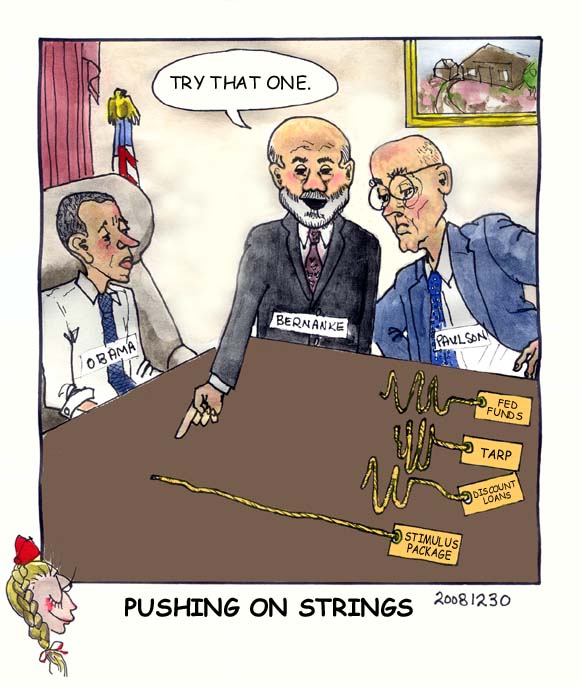
In fact, the opposite is true: Keynes's unfounded notions of pushing on a string will subject us all to its deleterious effects today, just it did our ancestors back in the 1930s.

Bailouts, debt financing, government spending, inflating the money supply to save debtors and attempt the futility of restoring failing demand--all have been tried, and all have done much more harm than good.

No, Dr. Keynes did not teach us the following "three broad lessons" in spite of what Dr. Wolf says:

Non-Lesson No. 1

"... [Keynes believed] we should not take the pretensions of financiers seriously. ... Not for him, then, was the notion of 'efficient markets.'"

This is a non sequitur if I've ever seen one. Keynes may have been cynical about bankers; but I bet he'd love to rise from the dead to confirm that he always believed in efficient markets. Where does Wolf get the connection?

Non-Lesson No. 2

"The economy cannot be analysed in the same way as an individual business. For an individual company, it makes sense to cut costs. If the world tries to do so, it will merely shrink demand. An individual may not spend all his income. But the world must do so."

Wolf talks of "the world" as if we were all parts of one entity acting in concert. In fact, each nation is acting as an individual; and each nation's government should act as an individual, i.e. should cut costs, indeed must cut costs when the money is no longer there to pay for them.

A government can only spend money it doesn't have in three ways: borrow it, confiscate it through taxes, or create it. Because we are already a debtor nation we should not do the first; the second will exacerbate the current shortage of discretionary income; and the third will eventually cause the dollar to collapse, thereby leading up to the confiscation of all dollar-holders' purchasing power--not something to do when foreigners hold a good chunk of your debt.

Of course demand is shrinking. You may not have noticed, but the bubble has burst. The demand we once had was a mirage. And you can't revive a nation's economic demand by stuffing it with borrowed or artificial money like the foie gras of some goose--or rather, you can, but it won't work because this goose is dead. You'll get nothing to show for your efforts except a bag of ruffled feathers.

And Dr. Wolf is forgetting that it is not for lack of will that we or our governments cannot "spend all our income." It is the "income" that simply isn't there, unless we attempt to fabricate it out of more monetary helium, which is how we got the bubble in the first place. (See my article, plus page 2 and 3 linked on my blog, for my view on how this happened.)

Non-Lesson No. 3

Now, this is the one that really gets my blood boiling, so I'm going to have to breathe deeply as I punch my keyboard.

"In the 1930s, two opposing ideological visions were on offer: the Austrian; and the socialist. The Austrians--Ludwig von Mises and Friedrich von Hayek--argued that a purging of the excesses of the 1920s was required. Socialists argued that socialism needed to replace failed capitalism, outright. These views were grounded in alternative secular religions [my italics]: the former in the view that individual self-seeking behaviour guaranteed a stable economic order; the latter in the idea that the identical motivation could lead only to exploitation, instability and crisis."

I don't have enough room here to analyze the error in Wolf's statements about the Austrians, but I'll say that the Austrian view of the 1920s is shared by more than one empiricist. I'll just name one: Edward C. Harwood of the American Institute for Economic Research.

To call the Austrians a "secular religion" may have a scrap of truth to it; but that doesn't mean they are wrong about their analysis of the 1920s. Dr. Wolf's criticism is more a statement about their description of their own methodology, rather than their theories; and in fact, the Austrians are quite empirical in their methodology in spite of themselves.

Even if they weren't, the Doctor mustn't throw out the baby.

More erroneous statements

Both Wolf and Keynes continue to err with the following affirmations:

- "[Keynes recognized] that the minimum state was unacceptable to a democratic society with an organised economy." Nothing could be further from the truth. Such a minimum state is unacceptable only to those who claim humans have the capability of organizing such a society's economy, which we can't, to wit our present mess.

- "Keynes would have insisted that ... [m]arkets are neither infallible nor dispensable. ... [T]hey can also go seriously awry and so must be managed with care." Keynes may indeed have so insisted; but no one has yet proven that humans can manage markets, in fact quite the contrary; the more we try to macromanage them, the more markets rebel.

- "The election of Mr. Obama surely reflects a desire for just such pragmatism." The election reflects no such thing. It reflects a slight majority's secular-religious belief in the spread-the-wealth Obama-Messiah, and/or shows an aversion to Bush and anyone like him.

- "The shorter-term challenge is to sustain aggregate demand, as Keynes would have recommended." You cannot sustain what doesn't exist. You can try to recreate it; but you will fail, just as Roosevelt did back in the 1930s. (See "pushing the string," above.) Roosevelt, with Keynes's encouragement, began the monetary inflating that is the scourge of the fiat-money 20th Century.

- "Also important will be direct central-bank finance of borrowers." This is a good way to transfer solvency problems from the private sector to the taxpayer; nothing more, nothing less.

- "A debt-for-equity swap is surely going to be necessary." Bailouts for special interests; nothing more, nothing less--and one of those special interests is politicians themselves, because it reinforces the electorate's belief in the politicians' capacity to "do something about it."

And on and on the good Doctor goes, making one Keynesian mistake after another.

Wolf finishes with a most sappy and hubristic "We must do better. We can do so, provided we approach the task in a spirit of humility and pragmatism, shorn of ideological blinkers."

Oh, gag me with a spoon. Who is the secular-religious one now?

Keynesian economists lack an understanding of simple market dynamics, and of how far the world has distanced itself from them. To blame the free market for 1929 or for our current turmoil is like blaming a train wreck on the train itself, instead of on the inebriated engineer.

Labels: , , , , , ,


Sunday, September 28, 2008

Where's a Good Economist When You Need Him?

Since 1929 and up to this moment, well-known economists have yet to come to a truly useful explanation of how and why the Great Depression happened. Modern economic researchers would all agree, I think, that all they have produced so far is a number of inconclusive conjectures.

I personally believe that a few lesser-known economists did actually get it right, with little variance among them. Among these the one whose name is most familiar to me is Edward C. Harwood of the American Institute for Economic Research. (See his book Cause and Control of the Business Cycle and the monologue-booklet Keynes vs. Harwood by Professor Jagdish Mehra, available at AIER.)

ECH

The fact that so few have taken Harwood's ideas seriously is unfortunate, because as I look through his research today I find it irreproachable. The closest he came to valid criticism was the comment that his statistical series did not prove cause and effect any more than any other coincidental movements would. The response to this is twofold:

- Okay, but in order to disprove the theory, you have to prove that this specific cause did not or could not perpetrate the effect, or that something else did (and for you methodology students, his theory is falsifiable, unlike the non-existence of green swans); and

- Harwood's pesky little theory has the annoying habit of correctly predicting all of the recessions since 1929 up to Harwood's demise in 1980, and even thereafter up to today's latest fiasco. (It did give a couple of false positives; but that's statistically acceptable, given that government actions or economic events can forestall busts temporarily.)

The economic phenomena present in today's credit crunch are strikingly similar to those of 1929; and Harwood's theory seems to fit once more. His Institute has been warning of a recession for several months now, and it looks like they're going to "get their wish," even though the marketplace has resisted up to now with less efficacious wishful thinking.

If I understand Harwood's theory correctly, the basic tenets are that two misalignments caused 1929 (and in fact equivalent ones have caused every boom/recession cycle since then):

1. After the First World War, the government purposely inflated the money supply so as to finance the war effort. Instead of allowing that supply to deflate back to gold-standard measures, they chose to allow it to continue. Excess purchasing media therefore circulated throughout the next decade, creating the boom cycle that ended with the 1929 bust.

2. Related to the above-mentioned inflationary actions of the government were the slipping banking standards of the times. Banks had begun to expand credit at an unhealthy rate, as follows:

Harwood believed in what he called "sound commercial banking," whereby banks would operate on a 20 percent or higher fractional reserve system under a federally-defined gold standard, and their functions would be divided into two distinct operations: Commercial operations, and savings & loan operations.

Commercial banks should only function as creators of credit to the extent that they had checking accounts, capital, and commercial paper (real bills) representing goods coming to market within three to four months.

Savings & loans, on the other hand, should only give as much credit (i.e. acquire investment-type assets) as they had deposits and capital (savings-type liabilities). These two quantities should remain in constant balance.

But as it happened in the 1920s, banks' accounts became unbalanced. They had begun to create credit on the basis of things other than those stated above, i.e. upon real estate, stocks and bonds, and other unsound collateral, taking on too much risk. (Sound familiar?)

This excess credit manifested itself as excessive money supply, the proverbial "too much money chasing too few goods." Harwood went to the trouble of calculating the extent of this money-supply overextension, calling the results his Harwood Index of Inflating. He used this Index to predict the coming bust, as witnessed in the 1928 and mid-1929 articles he wrote for the New York Times's weekly journal called The Annalist and other papers of the day. The crisis hit in October 1929.

He went on to use that index and his research to predict just about every single recession and inflationary episode in 20th Century monetary history, up until his death in 1980.

What a pity no one has bothered to dig up this valuable research and vet it through application of modern economic expertise--although one wonders just how much expertise there is, given the mess we're in. (As I've noted before, lots of people knew this mess was coming, most notably the BIS, or Bank for International Settlements, a collection of central bankers; but it has taken them eight years to draw up some ideas of how to impose new banking rules to lessen the dangers--six years too many.)

What a loss that we don't still have Harwood around today, bellowing warnings from the rooftop of his Institute and allowing us all to take protective measures to preserve our purchasing power in the scary months ahead.

(For more on Edward C. Harwood, see my posts starting back in the beginning of this blog in March 2005.)

Labels: , , , , ,


Thursday, August 28, 2008

First Silver, Now Gold Is Being Rationed

I noted an article about a shortage of silver at this previous post.

Today, we have this article at Bloomberg about a shortage of gold coins.

kruggerand
[Thanks to Newworldeconomics.com for the photo.]

This is getting tiresome, but I have to repeat:

You can take gold out of the standard, but you can't take the standard out of gold.

And the world knows it, even if much of the West has forgotten this axiom.

Who placed that huge order from a Swiss bank for Krugerrands? Wouldn't you like to know. Probably some Russian with lots of $100 bills to unload. Or maybe Iran. Or maybe an American! Why not.

Reminds me of the old days, back in the 1960s when my father Edward C. Harwood was investigating ways for investment advisers to suggest to Americans how to hold an interest in gold, when American law forbid direct possession. Yes, my friends, it used to be illegal to hold gold.

He found a way or two, and those investment advisers whose customers took advantage of them were able to preserve the value of their hard-earned savings.

Governments may some day again try to outlaw the holding of gold, under some pretence like "It constitutes hoarding and it's doing harm to our monetary system." The truth is that a panic that causes people to hoard gold is a sign that the monetary authorities (with the complicity of the bankers who should know better, I might add) have mismanaged the monetary system.

Unfortunately, any such immoral effort to outlaw gold would, of course, appease the envy and wrath of those voters who don't understand what their legislators have done to deprive them of their standard of living. (For a better understanding of how this works, please go back to my first posts and read forward.)

My father was a most interesting fellow. I knew this already; but I am presently archiving his papers with a view to doing some kind of book on him. (You'll find information about him in my earlier posts as well.) He was an economist and founder of the American Institute for Economic Research; but he was also one of an endangered species: A true patriot, i.e. someone who is willing to put his life and livelihood on the line for his fellow countrymen and women.

More on him as time progresses. Meantime, don't sell your gold yet. The dollar may be seeming to make a comeback; but it's only relative to other currencies. The reality is that those currencies are doing even less well than the dollar. What's left? You guessed it.

Labels: , , , , ,


Monday, April 28, 2008

It's All the Greenspan-Put-Helicopter-Ben-Fed's Fault

I love it when someone more influential than I says what I've been saying in my little blog.

Today, it's the editorial commentator at the Wall Street Journal.

He lays fault for the current commodity bubble directly at the feet of the Fed.

He blames:

1. Political pressure (i.e. Fed weakness); and

2. Intellectual mistakes (i.e. the Fed's bad economic science).

I agree. You've been reading my arguments over the past months and years along these lines.

I would add that Bernanke is personally responsible, due to his reliance upon a faulty interpretation of the 1929 Great Depression as described in his own academic work.

nakedemperor
[Thanks to Artlebedev.ru for this great illustration of the Naked Emperor.]

He is wrong and the Austrians are right about 1929, as was Edward C. Harwood.

But patience, patience my friends. We must have faith that good science will win in the end--the long-term end, I mean, which could be well after our own lifetime expires.

Labels: , , , , ,