Monday, January 11, 2021

What Is Money? The Basics Your Teenager Needs to Know


Recently someone asked me to write an explanation of "money" for a teenager. Perhaps you have a youngster who could use such an explanation, so I am publishing it here.


* * * * * * * * *

The Evolution of Money

Once upon a time, people didn’t use money as we know it today. Instead, they exchanged favors for favors, work for work, or items for items, or some other combination.

For example, in the early settlement days of this country, pioneer traders would exchange jewelry, knives, and guns for beaver skins offered by American Indians. Or a baker could exchange ten loaves of bread for a case of apples. Or a friend could help you build your house, and you could help him sow his crops.

But this immediate type of barter exchange is not always convenient, since you may not want to acquire something right this minute. Sometimes you want to buy an item in a different town. Sometimes you may want to get a haircut next week, but not today. So people came up with the notion of “money” as a way to hold on to the compensation for your work, or for the items you sold, so that you could use it later.

Way back in history, this money could take the form of a valuable sea shell, or a cow. In later times it might be a silver coin or two, or a bar of gold. These objects had what's commonly called "intrinsic value," meaning that they were appreciated not just for their value in exchanges, but also for their own beauty and/or utility.

Eventually, the idea of writing a promise of value on a piece of paper became popular, especially in market situations. Because towns evolved to the point where most people didn't necessarily know each other, intermediaries became involved. For example, if you had a lot of coins, this intermediary was someone you could trust who could hold your coins and give you his paper in exchange. Everyone knew this person, so his paper promises were considered valid.

This transaction permitted you to go about your purchases without lugging your coins around or risking them being stolen. This kind of paper money was a kind of claim ticket, a kind of promise of future purchasing power, and the intermediary was actually the first banker.

Today, at some point in your life, what and how many dollars you have will probably depend upon how much your work is valued by the person who hires you. With the paper dollars you receive (or the digital dollars that arrive in your bank account), you can buy things and services. Or if you don’t want to buy anything right away, you can save the dollars so that you will have them for later use.

Three Facets of Money

So we have now described three basic facets of money:

1. Unit of account
2. Means of exchange
3. Store of value

You can easily understand that units of money are a handy way of comparing the prices of things, and that since money is expressed in terms of numbers of currency units (dollars in our case), it can therefore be counted. (No. 1) It can also be spent (No. 2), or it can be saved and invested (No. 3).

How Much of Our Money is Real?

The question arises whether or not paper or digital dollars are a good “store of value” over time. This question would lead us into a discussion of monetary inflating, about which I wrote a few months ago. It's rather complicated, but to make a long story short, the unfortunate truth is that paper or digital money is not always what it appears to be.

Just to give you an idea of what I mean, take a look at this chart of the diminishing value of a U.S. dollar since the beginning of the last century:


I have also prepared another chart and some photos that illustrate this phenomenon here.

It is very important that you realize that what I will call real money can only be those paper and digital claims that truly represent work done and that haven't yet been exchanged for other things or services. (This is an oversimplification, but I think it gets the important message across.) Anything above and beyond that should be called credit.

It used to be that banks were in control of the amount of real paper money and credit that were created. This worked pretty well since they were closer to the actual production of things. Bankers usually knew their clients well.

Unfortunately today, the amount of paper or digital money created in the US is now handled by a government-appointed bureaucracy (the Federal Reserve, or the Fed) that has no idea how much money should be printed to represent work done. In reality, for the past 100 years or so the amount of dollars printed or digitally created is way more than it should be.

Without going into too much detail right now, you do need to understand that any creating of money beyond the total value of work done by everyone represents credit, which is very different from our current definition of money, even though most people use the same name for it. Credit is really debt, and it must be repaid in dollars from future earnings. And credit involves risk. In fact the more credit, the more risk. We could say that credit represents tomorrow's work.

So far, all the real dollars and the credit/debt dollars created by the Fed have been absorbed by our economy and that of other nations. In fact, so much credit/debt exists today above and beyond real dollars that no one really knows how much our Nation has created, nor how much we can increase our debt load. The situation is precarious.

Throughout history this has happened in a number of societies, and it does not end well. Most recently, perhaps you lived through 2009-2010 and remember the hardships some people had to endure when things turned sour. That episode was the beginning of a tremendous crisis caused indirectly by excess credit. It was rescued in extremis by the Fed, at least temporarily, until the next episode.

You can also learn about what happens when things go badly by reading some of the stories of 1929, or of the Roman empire's decline.

If you have questions please don't hesitate to comment below. It will inspire more explanations. Another article is coming soon about handling your finances.

PS: My Dad (Edward C. Harwood, founder of the American Institute for Economic Research) stopped using the word "money" because its meaning has become very slippery, even among academics. He began using the phrase “purchasing media” instead of money, but that is a bit cumbersome for a teenager, so we’ll keep using “money” for now.

Labels: , , ,


Friday, February 12, 2016

Fiat Money Versus Gold

Thanks to halloween-masks.com


No one can deny that current markets are scary, so I have opined in an article at Seeking Alpha. 


We all share the malaise as this unfolds in front of our eyes.

Labels: ,


Tuesday, December 30, 2014

The Fed's Game of Monetary Inflating and How to Put an End to It


[Thanks to Dancendancen.com for the image.]

History has shown unequivocally that you don't want to monkey with money and credit.

This is the cogent warning recently issued by Doug Noland at Prudent Bear. He is referring to the monetary shenanigans of the central banks around the world, the most egregious of which is our very own central bank, the Federal Reserve.

After more than 15 years of almost continuous and increasingly profligate money-credit creation, the Fed is now approaching the moment of truth. In the next few months it will have to put its actions where its mouth is regarding the interest rates under its control.

Up to now, Fed Chairman Janet Yellen has been very good at what we could call the Open-Market Charade. While sounding profoundly straightforward and direct, she actually has bested Alan Greenspan at the art of Fedspeak: talking in soothingly erudite phrases, all the while saying nothing in particular.

But no matter what she says now, the Fed's predicament is clear: It must soon choose between allowing the target rate to climb, which will squeeze the necks of already precarious emerging markets, or keeping the rate low and in the process risking re-devaluation of the dollar and/or blowing even more bubbles in stocks, junk bonds, global derivatives, emerging market currencies, and selected real estate.

The inflated bubbles are right in front of our noses. For example, some condos in the West Los Angeles area have now re-attained their all time highs of 2007, and bankrupt ski resort developments have pulled the shovels out of the trash heap and are at it again. And by the way, that price inflation you're looking for? It's already in the high cost of meat, sugar, poultry and eggs, which have climbed 8.3 percent this year, and in dairy that has climbed 5.6 percent. [Source] Butter has doubled since mid-2013. [Source]

The moment the Fed governors choose the former, i.e. increasing the rates, the music will stop and everyone will head for a chair. Usually in this game there is only one empty chair and hence only one loser, but this time there are far fewer chairs and far too many players. If the music stops watch carefully what will happen to countries like Argentina and Russia. Then watch what will happen to the derivatives and other more speculative markets as investors scramble for seats.

For more on the possibilities under this scenario, see this Investopedia.com article about the carry trade, also heavily involved in the derivatives market; see also this David Wessel article about a possible global financial crisis due to a rising dollar.

On the other hand, if the Fed chooses the latter route and delays rate normalization, it may succeed in holding off the moment of truth for a few more months while the music continues and stock market speculators continue their merry dance. At the same time, America's fixed-income recipients will have no choice but to reach for their handkerchiefs again to mourn a further loss of purchasing power. (Already in 2012, the SeniorsLeague.org reported that seniors have lost 34 percent of their purchasing power since 2000.)
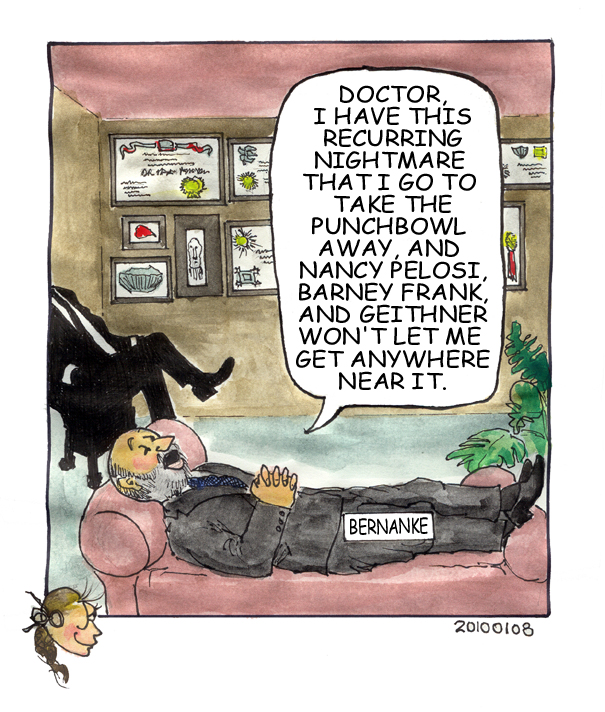
The old and the weak are always the first losers during the exaggerated business cycles caused by fiat-money monetary interference, and Oh My, what enormous and distorted cycles they have become. (See this study from the American Institute for Economic Research on the changing nature of business cycles.) Who are the winners? Debtors, and speculators most of whom are debtors. The biggest debtors of all are governments and financial institutions-who just happen to be co-appointers of their accomplice Fed governors.

What artifice makes this game possible? It is the fiat nature of global currencies. (Read Steve Forbes's latest book for more on this.) What is the solution? We must elect politicians who will free gold from its tax shackles. What shackles?
An act of Congress in 1974 and a legal decision in 1977 already permit the holding of and transacting in gold. (See the text of the 1974 law here and a discussion of the court case permitting gold clauses in contracts.) The only thing preventing gold from playing its traditional role as money is the fact that all gold transactions are taxed, whether it be through sales taxes or capital gains taxes.

Why are they taxed? Because back in the 1970's Congress classified gold as a commodity, kind of like copper or wheat. Why did Congress do this? Because the crafty politicians knew that by doing so the commodity-taxation protocol would immediately take the gold-as-money option off the table. This is what forces us all to accept unsafe fiat "money" instead of the real thing.

Without that handicap, we would not accept it unilaterally. Remove the taxation and gold would become money again. It would find its true exchange rate relative to all currencies (which today would probably be higher than its current $1,200 an ounce). Soon enough, someone would set up a system of international exchange based on gold. The metal would find itself at the center of a new worldwide system of exchange and value storage. Such a system would be much more solid and much more widely accepted than Bitcoin or other alternatives. Call it Bitgold, maybe? And by the way, reinstatement of a proper gold standard is probably not even necessary. Let the markets work out the particulars.

This is not just fanciful thinking. States such as Arizona, Texas, and Utah are discussing the use of gold as legal tender. Highly stable gold would eventually replace highly unstable fiat money, and trillions of dollars and yen and euros, currently wasted on chasing a quick profit and fulfilling the dreams of politicians (and causing worldwide recessions), would be turned back to their rightful purposes: fomenting enterprise, creating jobs, and raising standards of living across the globe. And most important, this new gold-based monetary system would deprive our central money manipulators of the world's most corrupting, devastating, unconstitutional, and destructive monopoly power.

Labels: , , , ,


Monday, December 28, 2009

Keynes's Blind Spot: Consumption is Production Shared

Bret Stephens has written a nice opinion piece in the Wall Street Journal of December 23. He cites poet Rudyard Kipling and author George Melloan who wrote The Great Money Binge: Spending Our Way to Socialism.

Melloan's work, according to Stephens, shows "in exacting detail, not only how we came to our current crisis--thank you, Barney Frank, Chris Dodd, Alan Greenspan and Tom DeLay--but where [their flawed logic] is destined to take us again."

All four of these politicians--yes, Greenspan is one of them--seem to subscribe to Keynes's theory of what some have called "demand-side economics." This theory says that consumption is the answer to an economic bust cycle, and that it's okay to create the credit to pay for it through central-bank-created funny-money.

Stephens, citing Melloan I presume, and parodying Kipling, counters Keynes's theory using the supply-siders' argument:

"'[C]onsumption must be paid for with production" ... if you don't work (i.e. produce) you die (i.e., can't consume)."

boycook
[Thanks to Allposters.com for this image.]

Stephens and Melloan have understood the evils of Keynesian spending-for-prosperity, to be sure; but they have missed an essential point, which is this:

Consumption is purely a mechanism by which producers share among each other what they have already produced.

(See this post and the subsequent two posts for a more detailed example of this process.)

You see, production and consumption are two sides of the same coin, and production always comes first. One is given life by the other. Consumption cannot exist without production. We divide our production among ourselves on a global basis through the exchange among ourselves of small or large portions of what each of us has produced; and this action is called consumption.

We have gotten a distorted picture of this process, because often we see something we want and we think we have to work to procure the money to buy it. However, in reality the production of that thing came first, and the producers of that thing took their share of the product they produced by accepting a sort of warehouse receipt we have collectively come to label "money" instead of the produced thing itself. When we go to work, we simply become part of the exchanging group, much as a poker player buys chips to participate in the game.

Keynes obviously did not agree with this idea. He wrote as though he believed money has become a tool to be manipulated by politicians and their academic agents, as though it were a vague exchange medium representing nothing more than grease facilitating the performance of our monetary machine.

Like most people, Keynes also confused money (actual warehouse receipts, representing a share of production) with credit (a promise to repay a certain amount of warehouse receipts). Credit is not the warehouse receipt itself, but rather an expectation to receive warehouse receipt(s) within a specific timeframe, based upon the lender's faith that the creditor will hand over warehouse receipts in the short-term, when he or she has actually produced something and receives warehouse receipts as payment (or sells something he or she already owns).

Problems arise when credit promises are not fulfilled. For example, banks sometimes issue credit to market participants over and above producers' capacity to sell. Our current monetary system actually encourages banks to do so to an excessive degree, for reasons that I have treated elsewhere. (See this article, Page 1, Page 2, Page 3, for example.)

It is normal that at some point in every business cycle, banks will become overconfident and begin over-expanding credit by making bad loans. As a result, producers will manufacture (and sellers will purchase, stock, and try to sell) excess production. Under a healthy banking system, slower sales cause sellers' inventories to rise. As a result, they stop ordering, producers stop producing, and things return to their original equilibrium.

However, in an imbalanced banking system, credit starts to circulate, which means that buyers keep buying, profits keep rising, and sellers keep selling at higher and higher prices (too much money chasing too few goods). Producers receive increasing orders and on that basis get even more credit from the bank. They hire more workers, creating a misallocation of labor.

Then, with profits rising inordinately, a speculator instinct wakes up inside some otherwise normal businesspeople. These market players realize that instead of working, they can make lots of easy money borrowing credit, gambling on the stock market, betting on derivatives, playing the foreign-exchange gambit, or flipping real estate, i.e. making fast profits producing nothing.

Bad credit begets bad credit in an ever-climbing spiral. The boom game has begun, misallocating huge sums of what appears to be real money (warehouse receipts), but which in fact is only bad credit.

Then one of the sectors hits a snag. Very often it starts in the financial sphere when someone over-bets his credit. He can't pay; the bank calls his loan. His creditors don't get paid. When this mini-bust occurs, it infects other sectors that depend upon the flow of easy credit collateralized by real or imaginary profits.

Much misappropriated "wealth" just disappears into thin air, which is actually where it came from; but unfortunately ordinary people also suffer as producers of speculative production go bankrupt and misallocated workers lose their jobs.

Fearful people stop consuming until the bad credit is gone and equilibrium returns. This is the normal process, and if left alone it can take several painful months to wind itself down.

But Keynes and today's central bankers think they can outsmart the process. I can hear Keynes say, "Wait a minute. The warehouses are full and people are simply not buying. The wealth seems to be there, because production has already taken place. Somehow, the 'warehouse receipts' have been stashed, or misplaced, or destroyed by the bust mechanism, and all that is needed is for the central bank to prime the pump."

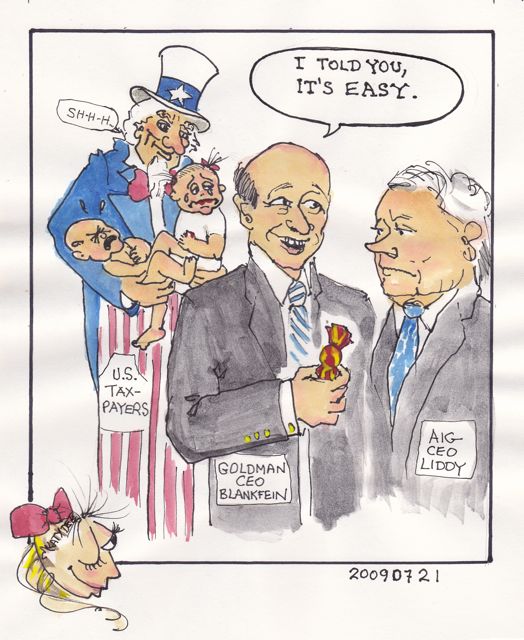
What he doesn't realize is that this Keynesian "solution" just creates more bad credit and throws it at consumers who--quite properly--just don't want to consume. This time, bad credit comes from both the Federal Reserve and the Treasury in the form of zero-interest loans, "stimuli," government purchases of private companies like AIG, and bank bail-outs, which further misallocates money distribution away from the real economy (that can't absorb it) and towards the speculators who know how to play what has now become a funny-money political game. While this is going on, the serious participants in the economy are laying low with uncertainty, wondering what the Fed, the Treasury, plus the IRS, Congress, the EPA, and all the other alphabet agencies, will do next.

Kipling, Stephens, and Melloan seem to understand this game and have tried to call the politicians' bluff. But the politicians will ignore them, because they have found they can fool most of the people most of the time, and a few they can't fool can be bought.

And this game of Pied Piper goes around and around until the people take back control of their money. And they are doing so, through the purchase of gold, gold-related instruments, and other such store-of-value investments. Hopefully, they will not let the government take that right away from them.

Labels: , , , , ,


Wednesday, June 17, 2009

Get Your Gold Right Here!

In Germany, the art of the vending machine is at the forefront of its game. See this one in Wolfsburg, where you can choose your Volkswagen:

vending
[Thanks to Jalobnik.com for the photo.]

Elsewhere, a fellow named Thomas Geissler has started a company that is installing 500 vending machines in various spots, and what do you suppose he sells?

Gold.

That's right, buyers have a choice among a 1 gram wafer for 30 euros, a 10 gram bar for 245 euros, or various gold coins.

There is a slight hitch: He has added a 30 percent mark-up to the cheapest products. Most dealers will ask only around 5 to 7 percent for bullion coins. And of course, prices are monitored and changed every few minutes.

See an article on this by Murray Wardrop at the UK Telegraph. And here's another at Reuters, and a third at Geissler's website.

Economist Edward C. Harwood introduced the notion of selling gold by the gram and potentially using it as an exchange medium back in the 1960s, and he even got his face on a one-ounce gold coin, in honor of his efforts. I don't know if he was the first; but his story is a fascinating one that I may be able to tell at some point relatively soon. I'm now working on his biography.

Meantime, I've often maintained that the gold standard can come back through various doors:

1. Official re-adoption by the politicians (but as my friend the former Columbia economics professor says, don't hold your breath);

2. Partial re-introduction, i.e. official acceptance of gold as legal tender so the public could use it as an alternative to the dollar in contracts and for repayment of debts public and private (I wouldn't hold my breath for this one either, because the politicians know how much this would limit the scope of their financial activities);

3. Demand by the public.

Now, this third avenue may just arrive in spite of a lot of skepticism. US gold coins are in short supply due to the huge demand in the US. Other countries are more aware even than we are of the importance of gold in the historical money markets. This experiment in Germany may tell us just how likely it is. If the public is willing to pay a 30 percent premium to own gold from a vending machine, then the urge to own something of value instead of fiat paper currency must be deeply ingrained indeed.

Mr. Geissler has surely thought this thing through, and has invested in some pretty heavy equipment (500 very solid machines, plus something to make the 1-ounce wafers) and security systems to see that his operation has a chance to succeed. I will be watching this one closely.

Remember my mantra:

You can take gold out of the standard, but you can't take the standard out of gold.

Labels: , , , ,


Tuesday, February 26, 2008

The Resurrection: Lawrence H. White Defends the Gold Standard

It's time to break out my mantra again:

You can take gold out of the standard, but you can't take the standard out of gold.

How many times will I say this before the world hears me? Probably many, many more, if ever.

Finally, someone in the mainstream economic community has taken up the cry to resurrect the gold standard.

LazarusResurrection
[Thanks to Allposter.com for the image of Caravaggio's Resurrection of Lazarus.]

Lawrence H. White, Adjunct Scholar at Cato, has just published this paper on gold and the gold standard.

I have written so much on this subject that I would be repeating previous posts to delve into the reasons why I support gold as a standard for modern monetary units. If you use the search feature above and look on this blog for "gold standard" or just "gold," you'll find dozens.

Please read Professor White's paper. An understanding of the principles he evokes is essential for the future economic stability of the world. And that's not an overstatement.

Will the politicians and power brokers take heed of the message? I don't think so; at least not yet. But they may be obligated to do so at some point if the public insists enough.

The history of gold is undeniable, and its future role--indeed its present role, albeit an unrecognized one--is just as undeniable. It's not because the monetary authorities have decided to uncouple gold from our currency, that gold does not retain its value as a measuring stick of their management shortcomings.

Gold is near an all-time high today. Many people in the world think as I do, that we humans need a measuring stick to manage out monetary unit. Until our leaders recognize this, expect gold to be the best store of value and to come back into favor as the currencies of the world are devalued through mismanagement.

Unfortunately, nothing in our modern age allows us to do better than the Romans or Greeks, or Medieval or Renaissance governments. Not the computers, not the modeling, not the statistics, none of it. Gold is on the level of the invisible hand. It is just there and will always be there to shine a light on our politicians' hubris.

Labels: , , , , , , ,


Tuesday, June 05, 2007

Why Isn't the US Economy Vigorous?

The answer to this question is simple: It is that the cleverer entrepreneurs have turned their sights towards speculation.

This is a phenomenon of fiat money times (i.e. times like now, when the currency is not standardized, for instance by some ratio to a weight of gold. For more information on this, read my earliest posts.)

French money 1793
[French paper "livre" from the 1790s. Thanks to www.atsnotes.com for the image.]

After all, how many adventurous whippersnappers can resist the carrot of gambling winnings now offered in hedge funds and take-over companies, over a nose-to-the-grindstone industrial or service sector job right now?

History is full of times like these. One was the 1920s. Another was the 1790s in revolutionary France.

In rereading Andrew Dickson White's classic, Fiat Money Inflation in France, I was struck by the following passage, and by the similarities between conditions today and those of France at the time:

"They knew too well, from that ruinous experience, seventy years before, in John Law's time, the difficulties and dangers of a currency not well based and controlled. They had then learned how easy it is to issue it; how difficult it is to check its overissue; how seductively it leads to the absorption of the means of the workingmen and men of small fortunes; how heavily it falls on all those living on fixed incomes, salaries or wages; how securely it creates on the ruins of the prosperity of all men of meagre means a class of debauched speculators, the most injurious class that a nation can harbor,—more injurious, indeed, than professional criminals whom the law recognizes and can throttle [emphasis added]; how it stimulates overproduction at first and leaves every industry flaccid afterward; how it breaks down thrift and develops political and social immorality. All this France had been thoroughly taught by experience. Many then living had felt the result of such an experiment—the issues of paper money under John Law, a man who to this day is acknowledged one of the most ingenious financiers the world has ever known; and there were then sitting in the National Assembly of France many who owed the poverty of their families to those issues of paper. Hardly a man in the country who had not heard those who issued it cursed as the authors of the most frightful catastrophe France had then experienced.

"It was no mere attempt at theatrical display, but a natural impulse, which led a thoughtful statesman, during the debate, to hold up a piece of that old paper money and to declare that it was stained with the blood and tears of their fathers."

(The whole work can be downloaded from the mises.org website.)

Do any of these words touch you? The difficulty of checking the "overissue" of fiat money? The "absorption" of the working man's purchasing power through inflation? The toll it takes on "fixed incomes," people like your grandmother? The trillions of dollars being made today in speculative finance?

The over-stimulation and then "flaccid" letdown in industry? The "breakdown" of savings? The "blood" of the unsuspecting victims of the recent sub-prime mortgage debauchery?

The outcome of the French experiment with fiat money was a catastrophe. There are those who will say that times have changed, that with today's electronic communication systems and current data, such a tragedy is impossible. I say watch out, because history has a nasty habit of repeating itself.

Labels: , , , ,