Tuesday, February 05, 2013

Common Sense and Caution in Today's Investing Climate

In spite of the hesitant Consumer Confidence Index, the New Year is bringing us improved animal spirits. The various stock indices are reaching record levels. Is it time to plunge back into ordinary investments, as the retail sector seems to be doing? Should we dust off the Modern Portfolio Theory and put it back into action? How about taking those old Krugerrands and gold stocks out of the closet and turning them in?

caution
[Thanks to CreativeSafetySupply.com for the image.]

Not so fast. Let's use some common sense and look around us first. I do so regularly, and I wonder: Is it possible that today's high-flying economic and financial geniuses have lost their own common sense and become overly sure of themselves?

The loss of common sense seems to be a phenomenon that occurs frequently among our Ph.D. class, including the mathematics geniuses in our universities' economics departments. The more rational-observer economic science performed by their forefathers such as Adam Smith, John Stuart Mill, Alfred Marshall, Frederich Von Hayek, Ludwig Von Mises, John Neville Keynes, Edward C. Harwood, and even Milton Friedman (incidentally, all probably good or even excellent mathematicians) has been relegated to the back of the auditorium in favor of Dynamic Stochastic General Equilibrium and the like.

Over the past century the economic science has become a clique for high-level mathematicians who enjoy toying with complicated models and computers, probably very much like those used by NASA physicists. It is now a kind of private club where only those with a certain technocrat mindset can pass muster, get published, attain tenure in the best universities, and influence public policy.

Yet the overlooking of a common-sense piece of evidence by some very smart NASA experts actually became a fatal flaw. They failed to note that a piece of lightweight foam could pierce the shell of the Columbia space shuttle, resulting in the death of seven astronauts. (See information about the event here.)

Likewise, could economic folly be causing ruinous holes in our national economy? Although the damage may turn out to be less visually dramatic than the Columbia disaster, it could be more pervasive and therefore equally as devastating, once all is said and done.

Here are some examples of possible loose "foam" in the current application of economics: Does Bernanke really know how to solve the ballooning problem of the Fed balance sheet without making waves in the general marketplace? He says he does; his researchers seem to have the computer models that suggest he does; but does he really have the wherewithal? NASA's elite probably had models that said the Columbia's wing was impenetrable. When they noted the falling foam during the take-off, they were so sure of their models that they didn't hesitate to reassure the crew that the incident was insignificant. Subsequent examination of the evidence proved them wrong.

Is Bernanke correct when he states that the Fed's intervention in the lending markets is helpful, that it does no harm, and that it is, at the very least, the lesser of two evils? Is it possible this policy is doing more damage than its alternative? Intelligent people disagree, including some on the Fed's very own Board of Governors. This policy could very well be contributing to unemployment instead of solving the problem, according to an article today in the Wall Street Journal.

On the international front, do the Japanese prime minister and his cohort at the Japanese central bank (with the encouragement of Princeton's Paul Krugman) really think they can print the yen into oblivion without endangering the Japanese economy? The optimistic prime minister and his own common-sense central banker seem to disagree.

Can the European Union bureaucrats convince themselves and the rest of the world that Greece--and now Spain, Italy, Portugal, Ireland, and even France--can continue being "independent" and still remain a part of the Union in spite of their approaching unofficial bankruptcy status?

These are a few of the questions I am asking myself as a layperson. I hope that 2013 will be the year that reveals the answer to these questions. Will it end with a bang or a whimper? No one really knows, not even the elitist quants.

But what we do know is that in uncertain times people have always turned to gold and gold-related investments, the ultimate store of value, to protect their purchasing power from the folly of their misguided governors. This is certainly one of those times.  I'm not a professional advisor, but I wouldn't let go of your bullion, your ETFs, your gold mining stocks--and your common sense--just yet.

Labels: , ,


Friday, November 30, 2012

The Dollar: Biggest Moral Hazard of Them All

Please click here to see this article.

Labels: , ,


Thursday, June 23, 2011

Bernanke Clueless?

He actually said:

"We don't have a precise read on why this slower pace of growth is persisting." These are his words--perhaps just an overabundance of academic caution, but a strange way, nonetheless, for the most important man in the world to phrase his thoughts.

Of course, if he had said, "Yes, we know exactly why this is happening", the reaction would have been, "Well then, do something about it!" Then he would have had to admit that he is powerless to do something about it, which is a very unbecoming admission for a world leader.

"Bernanke began speaking at 2:15, and stocks started falling at about 2:30...." Well, that makes sense. After all, when the Head Honcho admits outright (or pretends) that he's completely in the dark, the market is justified in getting a little skittish.

scaredylion
[Thanks to Allfancydress.com for the image.]

Then, according to this AP News article, Bernanke indulged in a little excuse fishing: "[T]he Fed blamed the worsening economic outlook in part on higher energy prices and the earthquake and tsunami in Japan, which slowed production of cars and other products."

Oh, so we have to go as far as Japan to find a culprit? Last time it was in China, with the savings glut.

Bernanke's comments seem disingenuous, as this writer suggests, especially coming as they do from one of the greatest economic intellects of our era. But just in case he's sincere, may I suggest he start looking closer to home?
Three elements possibly contributing to our current predicament come to mind:
1. The first is the phenomenon Robert Higgs describes as "Regime Uncertainty." (I did an earlier blog entry on this.) Essentially, businesses are hesitant to expand without some kind of reassurance about America's future politics. Will employers have to eliminate employees, drop health insurance, or simply join the upcoming national health system and cut profits? Will they have to pay new taxes, or consider outsourcing? Will compliance costs go up or down?

[Aside: Ignorance among academics about things happening at the ground level of business is astounding. All economics students, and come to think of it their professors too, should be required to spend one year as an apprentice in some business--any business--so that they can see how things transpire between the wheel and the road, down where the doers have to breathe the dusty air and scuttle about finding real solutions to real and, unlike in macroeconomics, solvable problems.]

2. Second is the very boom-bust process itself. As some economists have been saying, a country or set of countries cannot go on a hugely unsound leveraging binge without going through a terrible hangover afterward. The duration of the pain will correspond to the height of the crazy leveraging; and deleverage we must. The slog ahead could be long and difficult, like in Japan. (And John Mauldin [see below] calls Japan "a bug in search of a windshield.")

3. Government debt. The US is playing with fire as it blows the greatest liquidity bubble of all time on the back of the world's faith in our good credit. As the AP article states, the QE1 and 2 bond-buying programs have been "controversial. Supporters say the bond purchases have kept interest rates low and encouraged spending. Low long-term rates make it easier to buy homes and cars and for companies to expand."

The same cheerleaders argue "that those lower rates have fueled a stock rally. Since Bernanke outlined plans for the program last August, the Standard & Poor's 500 index is up 24 percent. Lower rates made stocks more attractive to investors than bonds, whose yields were still falling."

But how many asset bubbles can we blow, and how much indebtedness can the country carry, especially when we hear simultaneous chastisements from Bernanke himself about the very same debt behind the bubble? According to John Mauldin and Jonathan Tepper in Endgame, the End of the Debt Supercycle and How It Changes Everything, this explosion of debt cannot go on forever. And what cannot go on forever must therefore stop. And it won't be pretty. (This book is a very good read, by the way.)
Gold, all through this, has bode its time and held onto its glitter, which is fine with me. I don't know whether it's an accurate reflection of the over-issuance of the dollar, or of coming price inflation, or current asset bubble price inflation, or of international insecurity, or all of the above; whatever it is, it's still my best friend. And I'll go with my golden instincts over Bernanke's uncertainty (feigned or real, but certainly justified) any day.

Labels: ,


Friday, February 04, 2011

Ben Bernanke: "Let Them Eat Cake!"

Marie Antoinette
[Photo of Marie Antoinette from Wikipedia]

According to Robin Harding's article in today's Financial Times, our Federal Reserve Chairman is convinced the Fed's QE2 program has nothing to do with worldwide rising food prices. In response to a question on the subject, Bernanke says:

"I think it's entirely unfair to attribute excess demand pressures in emerging markets to US monetary policy, because emerging markets have all the tools they need to address excess demand in those countries...."

I will not harp on the fact that I don't agree with Bernanke. First of all, no one really cares what I think; and secondly, I don't have the scientific ammunition to prove him wrong, even though evidence to the contrary is clear to me.

What I can point out, however, is his twisted sense of noblesse oblige. To make the above-quoted statement, he must have made one of the following assumptions:

A. An increase in the issuance of U.S. dollars without a corresponding increase in U.S. GDP has no effect on foreign nations; or

B. An increase in the issuance of U.S. dollars without a corresponding increase in U.S. GDP may have an effect on foreign nations, but they can control that effect by tinkering with their own monetary unit, which tinkering is effective and has no deleterious effect; or

C. An increase in the issuance of U.S. dollars without a corresponding increase in U.S. GDP may have an effect on foreign nations, but who cares.

Bernanke may not have the gall to choose C, as did Nixon's Treasury Secretary, John Connally. Faced with a similar question, Connally is reported to have said: "[T]the dollar is our currency but your problem...." No, this would sound too flippant, too frank, and would not correspond to Bernanke's more academic, more convoluted style.

So let's assume Bernanke has chosen B above.

In support of this assumption, Bernanke might cite the example of China. China has simply absorbed any excess dollars by investing them in U.S. treasury bonds. (Don't look now, but China clearly has no other choice. If it stops squirreling away its excess foreign reserves, the dollar will tank even faster and take the value of the reserves with it. And by the way, if you look hard enough you'll notice that China is slowly diversifying away from U.S. dollars.)

Bernanke doesn't seem to care that other countries may not have China's leeway. He explains, "They can, for example, use monetary policy of their own. They can adjust their exchange rates, which is something they've been reluctant to do in some cases."

But ... isn't that illegal currency manipulation? In fact--isn't that what we're doing??

Oh well. I guess two wrongs make a right.

If you ask me, Ben and Marie Antoinette have something in common. It's called Hubris.

Labels: , , , ,


Wednesday, October 27, 2010

The Bernanke Putt

Helicopter Ben is now turning to golf, according to an article by Jon Hilsenrath and Jonathan Cheng in today's Wall Street Journal.

golfer

I can't decide whether that feeling in my gut was pain, wrath, or an ironic chuckle, when I read the following:

"The Federal Reserve is close to embarking on another round of monetary stimulus next week ... despite doubts about the wisdom and efficacy of the policy among economists and some of the Fed's own decision makers.... Fed Chairman Ben Bernanke's push to restart the bond-buying program--a form of monetary stumulus known as quantitative easing [QE]--has been greeted with deep skepticism among some of his colleagues.... Mr. Bernanke has used the analogy of a golfer with a new putter: Unsure how it will work, he finds [the] best strategy is to tap lightly at first and keep tapping until the golfer figures out how best to use the putter."

All this is fine and good, Dr. Bernanke, but shouldn't you have gotten your golf practice in well before now, at some prior time when the whole world wasn't watching your every twitch? Do you have any idea of the potential consequences of a misjudgment on your part? According to the WSJ, one of the fellows on your own team, Thomas Hoenig, calls the Fed's up-coming actions a "bargain with the devil."

My previous posts have referred to a slow-motion movie that we are all watching. I have mentioned that at the climax the Fed will find itself between a rock and a hard place: the choice whether to act or not to act.

This is happening right about now, and the Fed has decided to buy bonds. Yet Bernanke has just blown the Fed's reputation as a team of expert economic monetarists capable of curing the second worst economic crisis the world has ever seen, by comparing it to a novice putter trying out a new golf club. Frankly, I'm not sure which is more disquieting.

So now we're pretty sure the Fed will perform QE. Everyone is now asking, will we get inflation or not? First, I'll have to refer you to my previous posts about the definition of "inflation," to remind you that when the media refers to "inflation" they are (incorrectly) referring most often to "price increases," and not the increasing of money supply.

QE is inflating (increasing of the money supply), under the true definition of the word. Whether or not it translates into general price increases is a separate issue that depends on other factors above and beyond the simple act of increasing money supply.

It depends, for example, on the business community's reaction to the results of the November elections, and on the future Congress's subsequent successes or failures. QE might translate into higher general prices, or it might just become higher stock prices, independent of the CPI. It might translate into higher bank bonuses, independent of the CPI. It will certainly translate into a much lower dollar, quite independent of the CPI.

Some recommend TIPS as protection against "inflation" (price increases), but already the TIPS are selling at a premium, so the protection they offer is eroded. And TIPS don't protect us against the effects of a weaker dollar as buyers of our regular bonds reduce their appetite for same. What is the consequence of this? We may soon find out.

What's certain is that Bernanke doesn't seem to care: he's out playing golf.

Labels: , ,


Friday, January 08, 2010

Bernanke's Moment of Truth

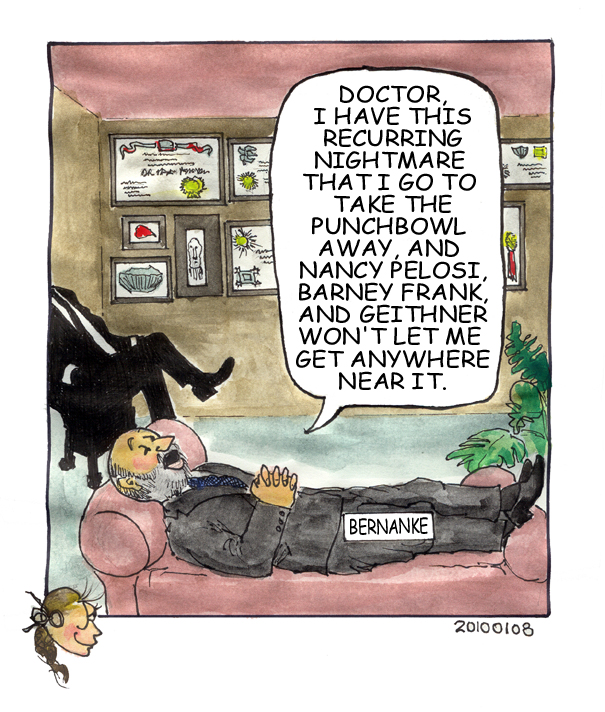
Once again, Bernanke is the object of my funny bone. The day is coming soon when his mettle will be tested.

(Click on the image for a larger version.)


Labels: , ,


Monday, January 04, 2010

But Ben, A Bubble Has No National Boundaries

Ben Bernanke is showing himself to be more of a Big-Government politician than a scientist. In his latest speech, he has tried to defend the actions of his predecessors by claiming that their easy-money monetary policy only holds five percent of the responsibility for the high real estate prices that ignited the boom-and-bust bubble that almost broke the back of the global economy.

According to his analysis, 30 percent of the responsibility goes to what he has been calling the "global savings glut." The other 65 percent, he says, belongs to the inferior standards of the US mortgage market. Therefore, his argument seems to be saying that if we cure the standards we cure the problem.

He attempts to prove his point by demonstrating through charts that other countries had even looser monetary policy than the US, and yet they did not show a worse real estate boom; therefore, he concludes, loose monetary policy does not cause bubbles.

This sounds convincing, coming as it does from the highest-placed economic academician in the land. But his logic is flawed.

There are two problems with his argument. First, you cannot isolate these particular variables as he has done. To do so is the equivalent of saying Michael Phelps eats a lot, and he is not obese, therefore a high-calorie diet does not cause obesity. (Michael Phelps is the Olympic medalist swimmer who purportedly eats around 8,000-10,000 calories a day. A scientist could probably prove that he also spends almost 8,000-10,000 calories a day in his sports activities.)

pancake
[Thanks to Allfavoriterecipe.com for the image.]

Second, although Bernanke seems to accept the wisdom that a nation's monetary looseness can create excess purchasing media that can then chase relatively fewer goods, he doesn't seem to admit that there is no economic law that restricts a purchasing media's use to its country of origin, at least not in an immediate temporal sense.

Although US dollars must ultimately come to roost back in the US, they may station themselves in any number of places for many years (to wit, China's Current Account Surplus, for example) before they find their way here; and while so stashed, they can be used as collateral for any number of ventures in the meantime, in any currency--say, for example, to buy Spanish pesetas to be invested in Spain's real estate boom.

By the same token, a loose yen, for example, can go on a bubble-blowing spending binge in the US through the carry trade (borrowing in yen to obtain dollar-denominated instruments, or even cash dollars).

Bernanke's effort is a perfect example of the econometrician's Achilles Heel: narrow-sightedness. Markets are fluid, complicated, convoluted, multifaceted mishmashes of changing signals and events. For his analysis to work it must include a variable for each relevant event, not just an isolated one or two.

I find it strange that high-powered government officials feel justified in using such flawed science to defend themselves, even if they were to claim they do it for some lofty cause like the preservation of market confidence.

Labels: , , ,


Friday, December 11, 2009

Bernanke Credibility

Bernanke is always a good target for a cartoon, especially now. So here's my latest.

(Click on the image for a larger version.)


Labels: ,


Thursday, December 18, 2008

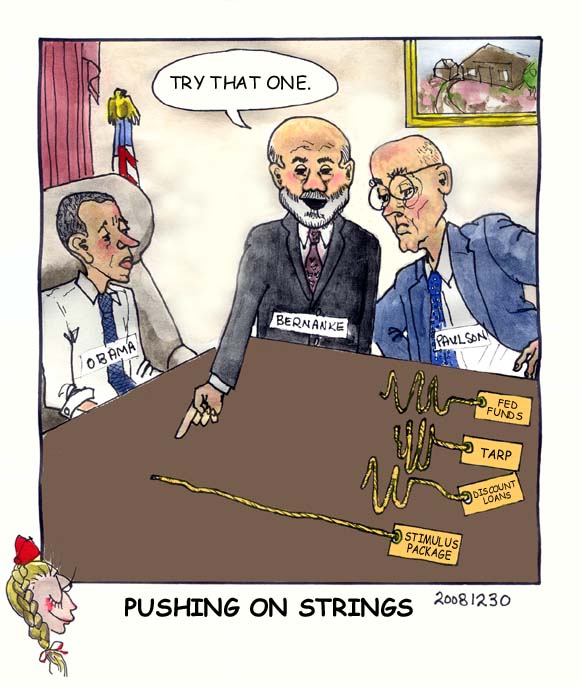
Pushing on a String: The Cartoon

Ben Bernanke, our current Fed Chairman, has spent much of his academic life studying the Great Depression only to conclude that, unlike the rest of mankind, he can push the string in spite of underlying fundamentals.

(Click on the image for a larger version.)

Labels: , , ,


Tuesday, December 16, 2008

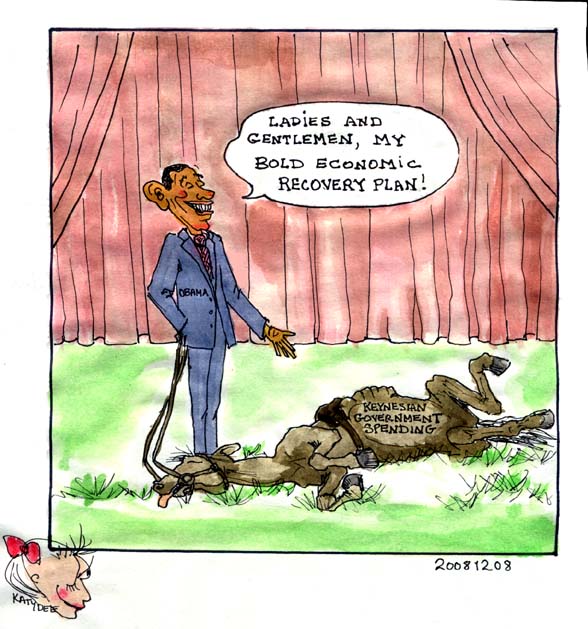
Fed Comes to Debtors' Rescue

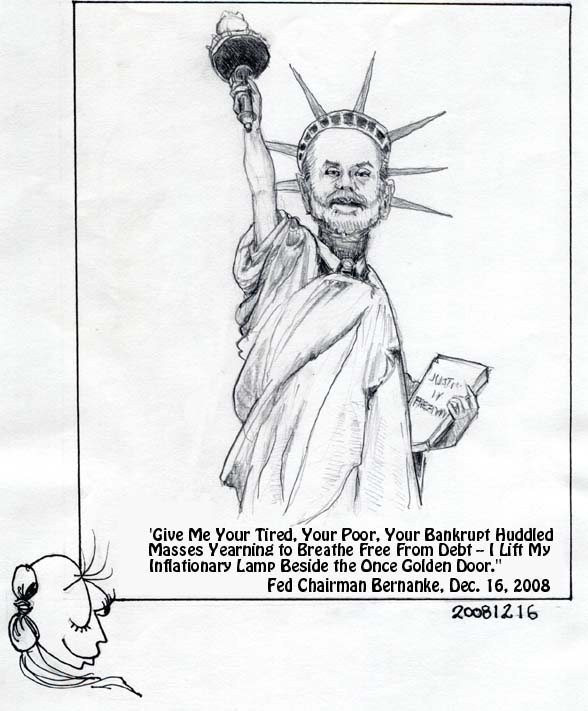
The Fed announced today that it will allow its target rate to reach zero percent.

Bernanke20081216
[Click on the image for a larger version of my latest cartoon.]

Up until now, the Fed has tried to bend its legal parameters just enough to absorb some of the bad debts of our banks and financial institutions in exchange for good credit, in order to prevent what they fear would be an economic crisis. (And for the moment, these are just fears.)

Today they announced that they will proceed forward with their intention to buy Treasuries outright, in an effort to replace the credit they think we are desperate for.

From today's statement:

"As previously announced, over the next few quarters the Federal Reserve will purchase large quantities of agency debt and mortgage-backed securities to provide support to the mortgage and housing markets, and it stands ready to expand its purchases of agency debt and mortgage-backed securities as conditions warrant. The Committee is also evaluating the potential benefits of purchasing longer-term Treasury securities."

Just as debtor nations have done in the past, the USA has once again decided to turn on the printing presses to save debtors. From my understanding of this commentary by Walker Todd of the American Institute for Economic Research, or of this one, the steps the Fed is about to take are inflationary. The Fed seems to be doing what it can to fight deflation through inflating the money supply, a counterproductive measure at best.

What the Fed should be (and probably is) afraid of is not so much deflation per se, but rather a deflationary spiral that causes fragile yet economy-essential entities to collapse. The problem is that they can't act on the deflationary spiral without stopping the deflating itself.

They will end up artificially propping up already inflated bubble-prices that are trying to right themselves through the deflating process.

Something I think we all forget is that when prices go down (i.e. deflate, in the loose sense of the term), we all get richer. When gasoline, bread, meat, lettuce and rice get cheaper, our purchasing power increases.

Inflation does the opposite. It favors debtors and makes the rest of us--and even the debtors themselves--all the poorer by decreasing our purchasing power relative to our income.

When you have an inflating of the money supply in a deflationary environment, you get the equivalent of a bubble under the surface, i.e. an unstable propping up of prices concomitant with the reduction of real wages.

Inflating may save the debtors, but it will only do so through the impoverishment of all of us.

Labels: , , , ,


Sunday, August 03, 2008

The Central Banker Credibility War

Every weekend I turn to three sources of bearish information, having been fed to the gills all week long with bullish Wall Street candy.

My three favorite permabears are:

PrudentBear.com
SirChartsAlot.com
The-Privateer.com

This week, it's this July 8 article by Gary Dorsch at SirChartsAlot.com that got my attention.

He points out that stagflation is here, just as we all expected it would be.
He also notes that today's global game is one of central bank credibility, a game that the US, the UK, and a few others are losing.

Back in the early 1980's, Paul Volcker, the then Fed Chairman, took the stagflation bear by the paws and wrestled it down to the ground in spite of the bitter deflationary medicine it required the US economy to take.

Today, "Mr. Volcker warned US Treasury chief Henry Paulson, and Fed chief Ben Bernanke against letting inflationary expectations become embedded once again." Unfortunately, neither "Strong-Dollar (Ha-Ha)" Paulson nor Helicopter Ben is listening.

Another inflation hawk, the Bank of International Settlements chief Malcolm Knight, said on June 24 that “'[t]here must be a forceful response to confront the danger that inflation expectations could rise appreciably, with all the attendant problems that would bring.... With inflation a clear and present threat, and with real policy rates in most countries low by historical standards, a global bias towards monetary tightening would seem appropriate, even though economic growth is likely to be hit harder than most observers expect....'"

He too is talking to himself.

Dorsch continues:

"So far, the Fed and US Treasury have ignored Volcker’s [and Knight's] advice, and instead, are pegging the fed funds rate at -2.25% below the inflation rate, while inflating the MZM Money supply at a +16.5% annualized rate, a prescription for hyper-inflation. [Meanwhile,] the Fed’s aggressive rate cuts have failed to stop the bleeding...."

Why are they ignoring such good advice? Well, here's one explanation: Apparently some of our Fed governors just don't get it:

"San Francisco Fed chief Janet Yellen told her audience ... 'I see inflation expectations as reasonably well anchored. There is little monetary policy can do about rising commodities prices. If rising commodity prices reflect supply and demand fundamentals, then the situation is not likely to turn around any time soon.'”

But what a big IF that is, my dear. There is a distinct possibility that people like Anna Schwartz and Milton Friedman are right, and that "inflation [rising prices] is always and everywhere a monetary phenomenon."

After all, why would food and energy prices suddenly and violently increase if they were caused only by supply and demand?

The increase in global demand for food and energy and the resultant tightening of supply are two forces that have been on the increase over more than a decade now, and that have been squarely in the sights of suppliers worldwide for at least that long. Why the sudden upward move over the last year?

The only credible answer is that the market is finally waking up to the fact that, Yes Dorothy, inflation IS, always and everywhere, a monetary phenomenon, and Yes, Dear, it's coming back with a vengeance.

Unfortunately, what our US and a few other central bankers seem to be losing is the only thing they ever had to bank on--lacking as they do any scientific foundation--and this is their credibility; and this loss is being hedged against by at least two who seem to have the guts our bankers lack: the central bankers of China and Europe.

China's bankers warned the stock market public that they intended to act no matter what; and they did.

Likewise in Europe, "on Dec 19th, 2007, Trichet was asked on German television channel N-TV if the bigger danger to the Euro zone economy was the banking crisis or inflation? 'The response is very clear. We have a mandate. The primary goal is to preserve price stability. We are alert, and everybody must know that we will do whatever is needed, to deliver price stability in the medium term, and be credible in that delivery. The single needle in our compass is price stability,' Trichet said."

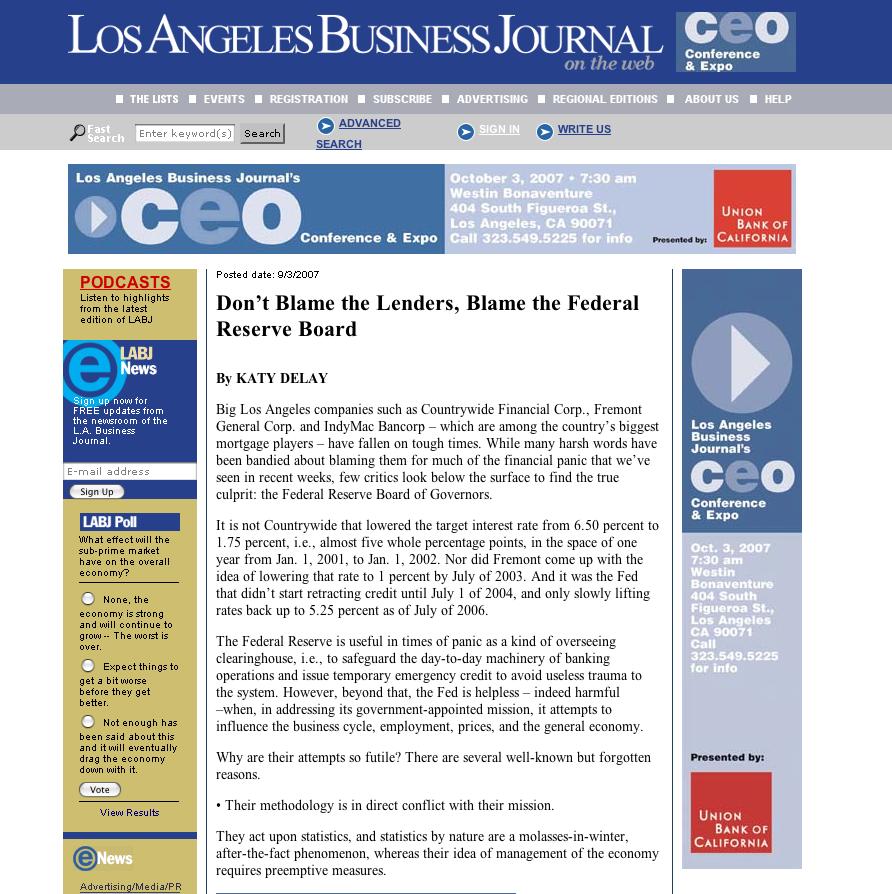
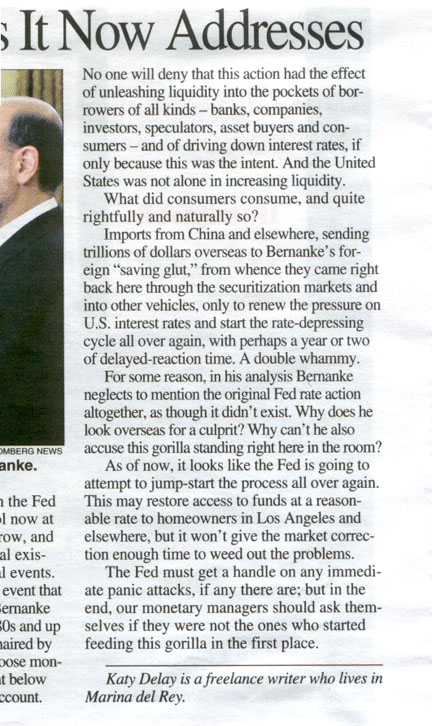
Fortunately for him, the European Central Bank mandate is straightforward price stability, unlike our dual mandate of price stability and steady employment in the US. (For further discussion on this point, see this article of mine, Page 1, Page 2, and Page 3 at the Los Angeles Business Journal.)

On the other hand, "the ECB’s anti-inflation crusade is thwarted by the other G-7 central banks [Japan, UK, US, Canada], which are afraid to raise their interest rates to combat speculators in commodities. Legions of 'yen carry' traders have migrated over from the global stock markets to the crude oil markets, since the rescue of Bear Stearns in mid-March [and since Dorsch's article was written, they seem to be moving elsewhere]. A continuation of the 'Commodity Super Cycle' to new high ground could trigger another ECB rate hike to 4.50% in the months ahead, putting enormous pressure on Bernanke to lift the fed funds rate to defend the dollar, or surrender the last ounce of the Fed’s credibility."

The question is becoming, Does Bernanke have the economic argumentation, the political mandate, and/or the plain-old cojones to begin raising rates?

We'll see Tuesday.

My bet is, they'll forgo it "this time"; and they'll jawbone about the lurking dangers of inflation just in case anyone's listening. But market ears are becoming deaf ears; and soon, without action by the Fed, inflation will take over in earnest. Then, someone in that Naked Emperors' Court will be obligated to do something.

(Until then, don't sell your gold.)

Labels: , , , , , , , ,


Tuesday, June 10, 2008

Expectations Schmexpectations (Example No. 16 of Government Intervention Run Amuck)

I get so annoyed with our central bank governors when they talk about "market expectations," as though these were something they, the governors, controlled by a mere syllable or two, when in fact they don't even know what they are.

orator
[Thanks to Dr. Leila R. Brammer at homepages.gac.edu/~lbrammer/ for the image.]

To get an idea of how truly flakey economists' understanding of inflation expectations really is, read this speech by Supreme Economist Fed Governor Bernanke himself. I applaud his candid approach to this subject; but the vacuum of scientific knowledge is scary when you think that the Fed Board controls the world economy.

Jean-Claude Trichet, the European Union central bank governor, says in his own most recent speech that "inflation expectations must be controlled."

Although Trichet has earned a reputation for putting his actions where his mouth is, Bernanke is now addressing the inflation issue mainly through jawboning, saying things like, "The Federal Open Market Committee will strongly resist an erosion of longer-term inflation expectations, as an unanchoring of those expectations would be destabilizing for growth as well as for inflation."

Okay, talk on. We'll wait for the action.

What the monetary authorities seem to want to brush under the rug is the following point:

Not only the central bankers' words but their anticipated actions have become a part of the market itself.

Here's how it works: The market participants listen to what the central bank governors say, and then they act accordingly.

Now, this doesn't mean necessarily that the market players heed the words. It may mean that they speculate on the effect of the words first, profiting from the immediate market movement; meantime, they have judged for themselves what the actual actions and outcomes of the words will be. They know well that sometimes the actions and outcomes are diametrically opposed to the words our central bankers utter.

For example, when the U.S. central bank governors instruct the market that they intend to "control inflation," the market knows that the general public might believe them and this may cause certain indices to move in the short term. However, for the long term the market players may know better and suspect that the Fed will continue to inflate at the slightest sign of economic trouble.

The words have now have become a signal to some market players that there is profit to be made in the short-term swings of public reaction to the words; but that in the long run, they can expect the opposite actions and outcome.

Speculators take action accordingly. Company management listens to the Fed governors, even using the words as an excuse to withhold pay raises for their employees. After all, they say to themselves, "[d]espite rising energy and food prices, Trichet said it was vital for workers in Western countries to moderate wage increases, which economists regard as the best way to avoid an inflationary spiral."

Okay, so employees must tighten their belt? But why then doesn't this prevent some of the more savvy market players, e.g. management of larger corporations, from skimming off the profit cream for themselves, or from using corporate funds to indulge in speculative activities a la Sears Roebuck?

In this example, it could almost sound as though management and the central bankers are in cahoots against the wage-earning public.

This may sound far-fetched; but it describes pretty much what is going on. Central bankers are asking wage earners to forego a salary increase even though this is supremely unfair given that the speculators and corporate CEOs are reaping record millions.

This means that the average Joe and Jane get stiffed on the pay raise as the cost of their food and gas is doubling. Meanwhile, higher management with their gawdy salaries--and the central bankers with their political hubris--apparently don't see the irony, or the potential dangers.

I've made a point of listing examples of government intervention gone amuck. This has got to be one of the best.

Labels: , , , ,


Thursday, June 05, 2008

Thanks, Bernanke, but I'll Take What You Do Over What You Say

Bernanke has taken up the Volcker challenge and has decided to change tactics.

He is now going to defend the dollar, if we can believe his latest declarations.

Apparently he thinks talking about it will do the trick, i.e. shape market expectations and prevent inflation from taking hold over the longer term. In other words, he's learning how to jawbone, like any self-respecting Federal Reserve Governor should.

jawbone
[Thanks to 24hourmuseum.org.uk for the picture.]

Jawboning is the Fed representatives' technique of influencing speculators and other market participants so that markets move in the direction the Fed desires.

But this will not be enough this time around.

As this excellent editorial in the Wall Street Journal points out so clearly, words alone will not do the trick at this stage in the game. The world has lived through too much political mirror-speak to believe everything our government or its representatives say.

We have seen nothing but dollar trashing over the last several years. Nothing in the Fed's actions to date confirms that the Board has any intention whatsoever of doing what is necessary to stop the decline of the dollar's exchange value and purchasing power. Quite the contrary.

There has been a loosening of the credit spigot and an assumption of moral hazard to an extent never before seen in history. The road backward is a long, exhausting haul that no political animal would undertake without extreme force.

So what do we learn from all of this jawboning? Markets learn; but Fed officials apparently don't.

Labels: , , , ,


Monday, April 28, 2008

It's All the Greenspan-Put-Helicopter-Ben-Fed's Fault

I love it when someone more influential than I says what I've been saying in my little blog.

Today, it's the editorial commentator at the Wall Street Journal.

He lays fault for the current commodity bubble directly at the feet of the Fed.

He blames:

1. Political pressure (i.e. Fed weakness); and

2. Intellectual mistakes (i.e. the Fed's bad economic science).

I agree. You've been reading my arguments over the past months and years along these lines.

I would add that Bernanke is personally responsible, due to his reliance upon a faulty interpretation of the 1929 Great Depression as described in his own academic work.

nakedemperor
[Thanks to Artlebedev.ru for this great illustration of the Naked Emperor.]

He is wrong and the Austrians are right about 1929, as was Edward C. Harwood.

But patience, patience my friends. We must have faith that good science will win in the end--the long-term end, I mean, which could be well after our own lifetime expires.

Labels: , , , , ,


Saturday, April 05, 2008

Government Intervention Amuck No. 13: Efforts to Avoid the Depression

Doug Noland continues to be one of my favorite pundits. He may not be scientific in the sense some use the term, but he looks at all the figures and draws conclusions that concord with mine.

His latest piece at Prudent Bear says it so well, I'd advise you to read it.

As a summary for those who don't have time, our government is scrummaging around in this economic mess we're in, in order to try to save us from ourselves. They will be unsuccessful in the long run, even though in the short run it may seem to work.

In other words, in my view, we are headed within an unknown time frame for either a good recession/depression, or a good run on the dollar.

Take your pick. And yes, it's our government agents' fault. (See my previous posts throughout the last four years to grasp my "analysis" of the reasons for this.)

And as a postscript, I agree with Noland that Bernanke's conclusions about the Great Depression are wrong.

wrong
[Thanks to cards4magic.com.uk for the image.]

One who got it right was Edward C. Harwood. (See this previous post and the first ones of this blog.)

Other economists with a good grasp of monetary science are those academics call "the Austrians," people like Hayek, Von Mises, Schumpeter.

Labels: , , , , ,


Sunday, December 16, 2007

Greenspan from the Sidelines - Cartoon Time

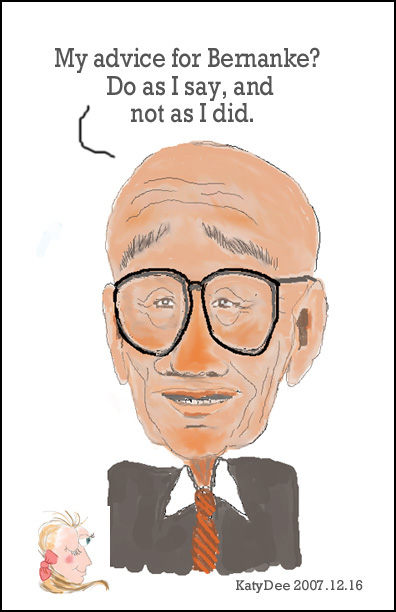
Today I felt like getting back to my cartooning. I've been reading the various interviews with Greenspan, our former Federal Reserve Chairman, and he advises his successor Ben Bernanke to avoid exacerbating inflation by lowering Fed rates too much--strange advice considering from whom it comes.


[Click on it for a larger version.]

Labels: , , , , ,


Thursday, September 06, 2007

Jackson Hole: Saving Us From Themselves

'As Nathan Mayer Rothschild was fond of saying, “I care not what puppet is placed upon the throne of England to rule the Empire on which the sun never sets. The man that controls Britain’s money supply controls the British Empire.” '

Interesting quote from this article at SeekingAlpha.com, by one of my favorite gold bugs, Gary Dorsch, blogger at sirchartsalot.com.

Gary's article points out some of the data you don't get from the dailies and makes my case look all the more scientific. (Gadflies can always use a little support.)

What I find the scariest element of our present quandary is that top economists, including 34 central bankers, are in complete opposition to each other on (1) the problem, and (2) the solution. Take a look at this article if you care to watch how our top-notch economic-scientist central bankers are scrambling for their next move.

Tenniel Mad Hatter's Teaparty
[Thanks to thebestlinks.com for the image.]

Mishkin thinks that, due to positive "[r]apid financial change, triggered by innovation and deregulation", all this wonderful lending has simply "outstripped the available information sources"; and so he wants to lower the target rate. Feldstein of the NBER [National Bureau of Economic Research, the major supplier of much of the statistics available] sees the bad writing on the wall and agrees the Fed should lower it by 1 percent. Shiller decries a classic housing bubble and seems to want something to be done. Leamer warns about the coming recession. Fisher from Israel says do something about the bubble before it explodes.

Then you have Mayer flipping off everyone's worries, saying this whole housing-boom thing was simply a sign that it's now cheaper to own a home than to rent one. (Sure.) Others say that the bubble is simply an effect of monetary policy but not the cause of any recession. (Right.)

Bernanke himself walks the tightrope between one side and the other, saying the economy can handle this and maybe we'll do something, maybe we won't.

The consensus seems to be summed up this way: We'll have to "rely on judgment more than models." Okay. But whose judgment are you gonna pick? I admit there's a consensus that now is not the time to raise rates; but whether to lower or not (and/or pump more credit into the system), they're all over the charts but seem to be leaning towards easing/pumping.

I get the heebie-jeebies when I read that a year ago "the Bernanke Fed ... heavily inflate[d] the broad US M3 money supply, after it decided to hide the figures from the general public in March 2006. Since then, the US M3 money supply has expanded at a 13% annualized clip, up from 8% when the Bernanke Fed stopped reporting the key figure." (Look at the charts if you don't believe him.)

I thought they were holding money supply steady. Why would they increase it, when they've supposedly been combatting the inflationary pressure all this time?

And then I cringe again when I read this:

"[China] has been a net seller of US T-bonds for three straight months by a record amount of $14.7 billion, the longest period of sales by China since November 2000."

This is not the time for China to bail out on our T-bonds (although I don't think they really will, given the amount they hold.)

And this is an interesting quote:

' “At some point, you have to choose between trusting the natural stability of Gold, and the honesty and intelligence of members of the government. With due respect for these gentlemen, I advise you, as long as the capitalist system lasts, to vote for Gold,” said George Bernard Shaw in 1928.'

GBS is not my paragon of economic virtue, but I like his occasional common sense and wit. I might just add that today the marketplace is more savvy and may have already factored in much of this wisdom. No one can really predict how things will play out. But we can take our chances....

And this:

'Should you place your faith in Federal Reserve notes? “Money is too important to be left to central bankers. You essentially have a group of unelected people who have enormous power to affect the economy. I’ve always been in favor of replacing the Fed with a laptop computer, to calculate the monetary base and expand it annually, through war, peace, feast and famine by a predictable 2%,” said Milton Friedman.'

He's another one whose gift of gab--indeed in his case genius of gab--got him places; but I note that he had the remarkable ability to say opposite things within the same paragraph. Here we have a committed devotee of small government saying both "power is bad" and "use the power anyway." Why not just be consistent and recommend we get rid of both the central bankers and the central bank (i.e. throw out the centralized computer, too)? Why can't we just let it all go and allow people to write contracts in gold? End of problem. (Perhaps an oversimiplification....)

Bernanke's job at the head of our monetary policy is an impossible one; but he wanted the job, so now he's got to at least pretend he can handle it. I don't envy him. The higher you fly, the harder you fall.

Labels: , , , , , , , ,


Saturday, August 18, 2007

Novak Is Leaking Again

He must be the official liaison with the public for all government and semi-government leakers.

robert novak as munchkin mayor
[Thanks to wonkette.com for the image.]

This time, he tells us in this article at Townhall.com that:

"Prior to the recent global financial crisis, the Federal Reserve Board under Chairman Ben S. Bernanke was ready to take a subtle step toward easier money in order to stave off U.S. recession fears. Ready for approval in the immediate future was a new Federal Open Market Committee (FOMC) statement taking the central bank off neutrality and putting it on a bias for an interest rate cut. But international credit scares changed all that.... [T]he central bankers do not disclose and try not to leak future plans. However, according to Capitol Hill sources, they had secretly decided to issue a statement soon changing the Fed's bias toward easing...."

Then this:

"Even the chairman's critics commend his handling of the first major crisis in 18 months on the job. They say the departed 'Maestro,' Alan Greenspan, would have acted identically -- with a single exception, in the opinion of one Fed watcher. He feels Greenspan would have leaked plans for an interest rate cut in the future to show his overriding concern about the U.S. economy."

Now, does Novak believe that Bernanke didn't actually want this leak to leak? Hmmmm....

Labels: , , , , ,